
Purbash
06/23 11:03
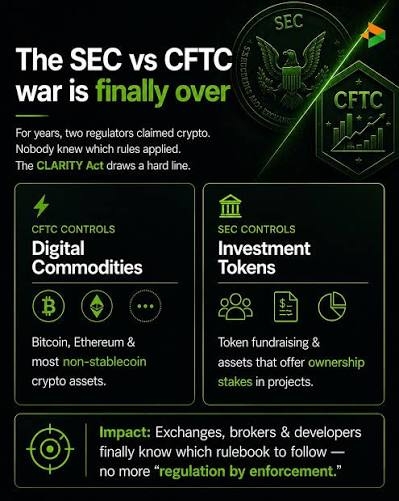
⚖️ SEC vs CFTC — Simple Crypto Explanation In the
#World Cup Predictions: 100,000 USDT Daily #HTX Invites You to Share 600K USDT in Gift Packs #BTC Prophet: 20-Day 380 Million HTX Challenge ⚖️ SEC vs CFTC — Simple Crypto Explanation
In the U.S., the two main regulators for crypto are:
SEC
CFTC
Securities and Exchange Commission
Commodity Futures Trading Commission
Regulates securities (stocks, investment contracts)
Regulates commodities (gold, oil, Bitcoin futures, etc.)
Usually stricter
Generally seen as more crypto-friendly
Focuses on investor protection
Focuses on market integrity and trading
🏛️ SEC View
If a crypto token is considered an investment contract, the SEC may classify it as a security.
Examples often discussed:
ICO-style tokens
Tokens sold to raise funds
Projects controlled by a central team
If classified as a security:
Registration requirements increase
More compliance costs
Stricter regulations
📈 CFTC View
The CFTC generally treats assets as commodities.
Examples commonly viewed as commodities:
Bitcoin
Ethereum (widely viewed as commodity-like by many market participants)
If classified as a commodity:
Easier trading environment
More flexibility for exchanges
Usually viewed positively by crypto markets
🔥 Why CLARITY Act Matters
The CLARITY Act tries to answer:
❓ Which crypto assets belong to the SEC?
❓ Which belong to the CFTC?
The crypto industry wants clearer rules because uncertainty creates legal risks for projects and exchanges.
💬 Crypto Market View
🟢 CFTC supervision = generally bullish for crypto
🟡 SEC supervision = stricter compliance and regulation
🚀 Many investors believe that if more crypto assets move under CFTC-style oversight, institutional adoption could increase.
Examples Often Discussed
Bitcoin → Commodity (CFTC-style)
Ethereum → Commodity-like in many discussions
New token launches → Often face SEC scrutiny until classification becomes clear
⚡ Bottom line: The SEC regulates securities, the CFTC regulates commodities. The biggest crypto regulation debate in the U.S. is decidi
2Partilhar
Todos os comentários0Mais recentePopular