Why Strategy CEO sees ‘monster’ demand for Morgan Stanley’s Bitcoin ETF

ambcryptoPublished on 2026-03-21Last updated on 2026-03-21

Abstract

Strategy CEO Phong Le believes the market is underestimating the potential of Morgan Stanley’s upcoming spot Bitcoin ETF (MSBT). He projects that Morgan Stanley Wealth Management, which oversees $8 trillion in assets, could see up to $160 billion in demand if it recommends a 2% Bitcoin allocation—three times the current AUM of BlackRock’s leading IBIT ETF. While Morgan Stanley has so far acted as a distributor for third-party Bitcoin ETFs, it now aims to launch its own ETF to capture both distribution and management fees. According to the firm’s head of crypto, institutional adoption is still early, with current demand largely coming from self-directed investors. However, some caution that the projected $160 billion may be optimistic, especially amid recent outflows from Bitcoin ETFs and macroeconomic uncertainty.

Is the market underestimating the potential impact of the upcoming Morgan Stanley spot Bitcoin ETF? Well, Strategy CEO Phong Le thinks so.

According to him, the wealth management segment of the investment bank could easily flip BlackRock’s IBIT.

He added,

Morgan Stanley Wealth Management oversees about $8 trillion in AUM and recommends 0–4% bitcoin allocation. A 2% allocation would represent $160 billion, ~3X the size of IBIT. $MSBT: Monster Bitcoin.

For perspective, BlacRock’s iShares Bitcoin ETF (IBIT) currently leads the segment with a cumulative net inflow of $63 billion and assets under management (AUM) of $55 billion. Hence, the $160 billion projection would be three times bigger than IBIT’s current AUM.

‘Still early?’ – Why Morgan Stanley is betting on BTC

Since the first wave of U.S. spot BTC ETFs debuted in early 2024, Morgan Stanley has mainly been a distributor, allowing advisors to recommend third-party offerings such as BlackRock’s IBIT. For this, it captures commissions for the access.

As of Q3 2025, BlackRock’s IBIT was printing nearly $191 million in management fees and was the third-highest revenue-generating product in its ETF line-up.

A few months later, Morgan Stanley applied to directly offer its BTC ETF product (MSBT). It refiled the application and could soon begin trading. This would eventually help it capture both the distribution and management fees.

As the U.S. spot BTC ETFs enter their third year, and IBIT’s dominance continues, one would wonder why Morgan Stanley is suddenly making its bold bet in the space now.

According to Amy Odelnburg, the firm’s head of crypto, the adoption was ‘still early,’ adding that current demand is mostly from self-directed investors rather than wealth-advisor-managed accounts.

Even the distribution of these ETFs, about 80% of what we see on our platform, is coming through the self-directed business.

The firm is eyeing BTC lending, trading, and even custody, and would be the first U.S. bank to directly offer a BTC ETF.

That said, Joe Takayama of Backpack cautioned that the $160 billion projected demand could still be unrealistic, as allocation could be below 2% or even close to zero. Meanwhile, the strong recovery in BTC ETFs seen in early March has reversed, with consecutive daily outflows over the past three days of trading.

Amid the ongoing macro uncertainty, a sustained risk-off mode by ETF investors could derail BTC’s recovery. At the time of writing, the asset traded at $70K.
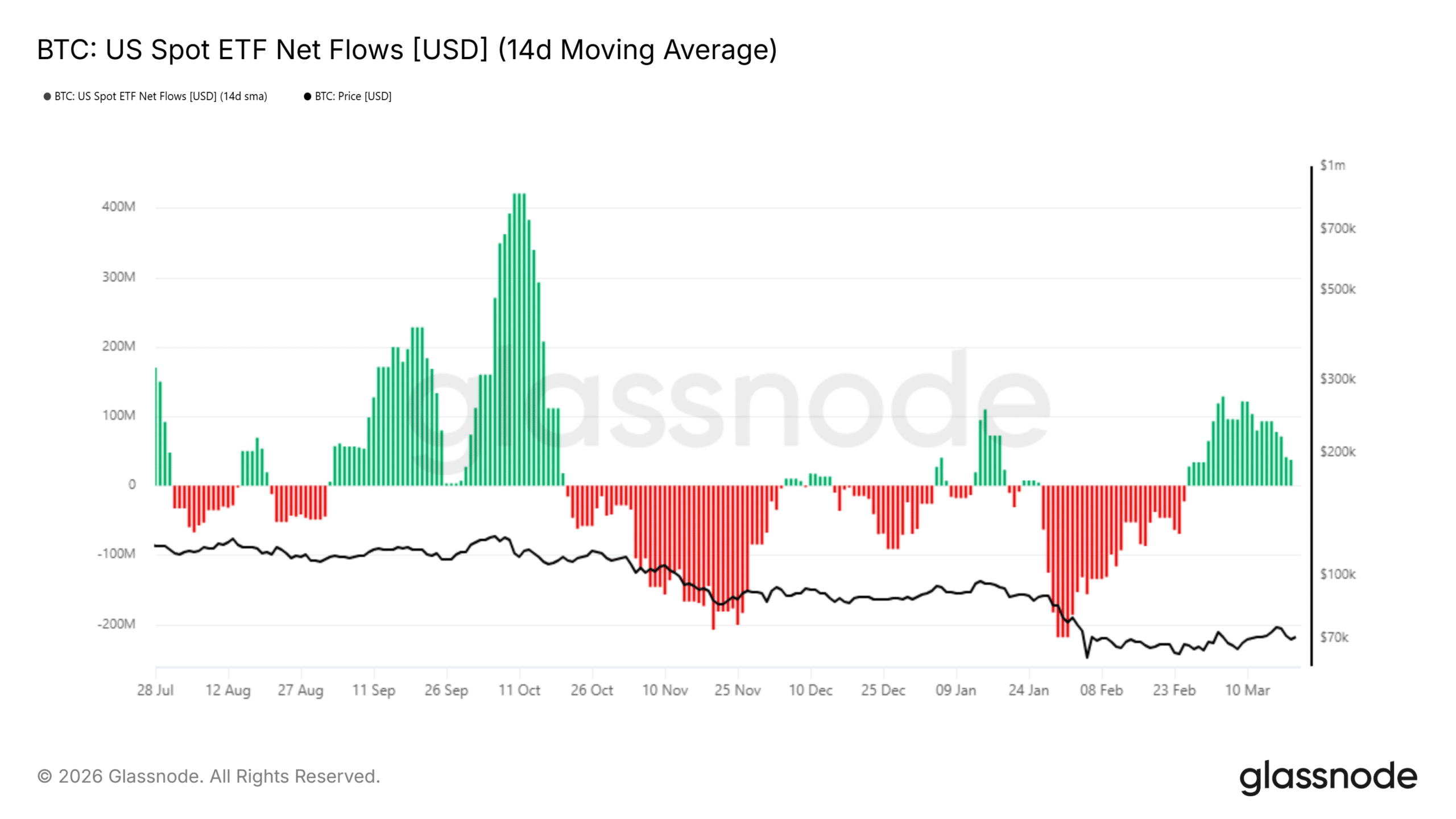
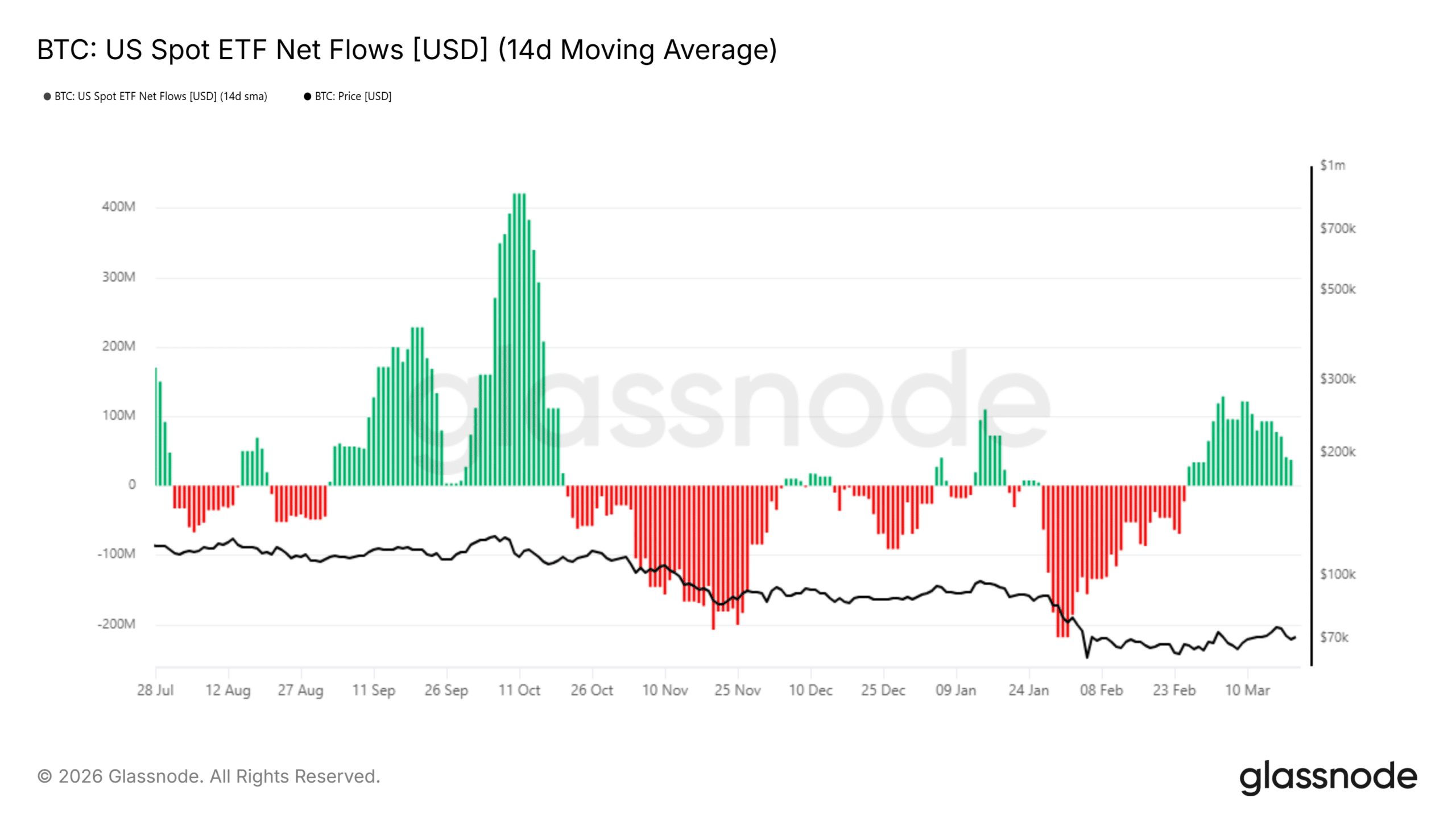
Source: Glassnode

Final Summary

  • Strategy CEO Phong Le projected that the Morgan Stanley BTC ETF could easily trigger $160 billion in demand.
  • Morgan Stanley said that institutional crypto adoption is still early, with current demand primarily driven by self-directed investors and not advisor-managed accounts.


Related Questions

QAccording to Strategy CEO Phong Le, what is the projected potential demand for Morgan Stanley's Bitcoin ETF and how does it compare to BlackRock's IBIT?

APhong Le projected that a 2% Bitcoin allocation from Morgan Stanley Wealth Management's $8 trillion AUM would represent $160 billion in demand, which is approximately three times the size of BlackRock's IBIT, which has an AUM of $55 billion.

QWhat is the primary reason Morgan Stanley is now applying to offer its own Bitcoin ETF after initially being a distributor?

AMorgan Stanley is applying to offer its own Bitcoin ETF to capture both the distribution fees and the management fees, whereas previously it only captured commissions as a distributor of third-party products like BlackRock's IBIT.

QWhat did Amy Odelnburg, Morgan Stanley's head of crypto, say about the current state of institutional crypto adoption?

AAmy Odelnburg stated that institutional crypto adoption is 'still early,' with current demand primarily coming from self-directed investors rather than wealth-advisor-managed accounts, noting that about 80% of the ETF distribution on their platform is from the self-directed business.

QWhat cautionary point did Joe Takayama of Backpack raise regarding the projected demand for Morgan Stanley's Bitcoin ETF?

AJoe Takayama cautioned that the $160 billion projected demand could be unrealistic, as the actual Bitcoin allocation by Morgan Stanley's wealth management clients could be below 2% or even close to zero.

QWhat broader services related to Bitcoin is Morgan Stanley eyeing, according to the article?

AMorgan Stanley is eyeing Bitcoin lending, trading, and custody services, and would be the first U.S. bank to directly offer a Bitcoin ETF if its application is approved.

Related Reads

How to View the Divergence Between Gold and Oil Prices?

The article analyzes the divergence between gold and oil prices following the outbreak of the U.S.-Iran war. While oil prices surged significantly, gold experienced a decline, contrary to expectations given its traditional role as a safe-haven asset during geopolitical crises. Gold serves three primary hedging functions: against geopolitical risk, inflation risk, and U.S. dollar risk. Since late 2023, gold had been in a strong bull market, rising from $1,800 to over $5,000, driven by simultaneous geopolitical tensions (e.g., Russia-Ukraine war, Middle East conflicts), inflationary pressures, and a weakening dollar due to the Fed's premature rate cuts. However, after the U.S. "decapitation" strike on Iran, gold prices fell sharply. This was attributed to two main factors: a shift of capital from gold to oil, as investors repositioned portfolios to capitalize on rising oil prices, and a liquidity crisis in U.S. financial markets that forced large-scale sell-offs of gold—a highly liquid asset—to meet redemption demands. More critically, growing pessimism about a prolonged U.S.-Iran conflict raised fears of sustained high oil prices, potential global economic disruption, and a possible reversal of Fed monetary policy (delayed cuts or even renewed hikes). This expectation of tighter policy caused gold’s dollar-related hedging function to reverse, overwhelming its geopolitical and inflation hedging roles and leading to a severe correction. Oil prices also experienced volatility. They initially spiked to nearly $120 per barrel post-strike, then fell by 30% on Trump’s hints of a quick resolution, but rebounded as market expectations corrected when the conflict persisted and the Strait of Hormuz remained threatened. The outlook for both commodities depends on the evolution of the U.S.-Iran conflict. If it becomes a prolonged war like Ukraine, gold may lack short-term value as monetary fears prevail, while oil and energy assets may benefit. A critical factor will be whether the Strait of Hormuz is reopened, which hinges on geopolitical decisions ahead.

marsbit39m ago

How to View the Divergence Between Gold and Oil Prices?

marsbit39m ago

The Stablecoin Yield Debate: How It's Stalling U.S. Crypto Regulatory Legislation?

The debate over stablecoin yields has become a central obstacle to U.S. cryptocurrency regulatory legislation, stalling the Senate’s proposed CLARITY Act. The conflict centers on whether dollar-pegged stablecoins should function solely as payment tools or also offer yield-bearing features that compete with traditional bank deposits and money market funds. Banks argue that yield offerings could drain deposits—potentially up to $500 billion by 2028—undermining their lending capacity and harming local economies. They are pushing Congress to explicitly prohibit such returns. In contrast, crypto firms contend that limited incentives could help digital dollars compete with traditional payment systems and drive mainstream adoption. A Congressional Research Service report highlighted legal ambiguities in the earlier GENIUS bill, which banned direct issuer-yield payments but left room for intermediaries to distribute benefits. This regulatory gap has intensified the legislative standoff. With political deadlines tightening ahead of elections, the window for passing the bill is narrow—likely closing by late April or early May. If Congress fails to act, regulators may impose rules independently, such as the OCC’s proposed restrictions on indirect yield mechanisms. The outcome will shape not only the future of stablecoin yields but also broader crypto market structure, including asset classification and regulatory clarity. Failure could delay legal certainty, forcing the industry to rely on organic adoption rather than legislative support.

marsbit53m ago

The Stablecoin Yield Debate: How It's Stalling U.S. Crypto Regulatory Legislation?

marsbit53m ago

Trading

Spot
Futures

Hot Articles

Discussions

Welcome to the HTX Community. Here, you can stay informed about the latest platform developments and gain access to professional market insights. Users' opinions on the price of S (S) are presented below.

活动图片