The reference exchange rate is for reference only and is not locked in. The final rate will be determined by the actual execution price.
Real-Time XLE Stats
The live price of State Street Energy Select Sector SPDR ETF (Derivatives) (XLE) is $0 USD and its current market capitalization is -- USD.
Get real-time XLE/USD updates on HTX. Stay informed with the latest data and market trends to make smart trading decisions. HTX, your trusted source for accurate cryptocurrency price information.
State Street Energy Select Sector SPDR ETF (Derivatives) Key Stats
Get the latest State Street Energy Select Sector SPDR ETF (Derivatives) price details on HTX: 24-hour high and low, all-time high (ATH), and daily price change percentage.
24h Low$0
24h High$0
All-Time High$0
Market Cap--
24h Volume (USD)--
Circulating Supply--
What is XLE?
State Street Energy Select Sector SPDR ETF (Derivatives) (XLE) is a cryptocurrency . State Street Energy Select Sector SPDR ETF (Derivatives) has a current supply of 0. The last known price of State Street Energy Select Sector SPDR ETF (Derivatives) is 64.59990344 USD and is up 0.30 over the last 24 hours. It is currently trading on 50 active market(s) with $0.00 traded over the last 24 hours.
Based on the historical performance of State Street Energy Select Sector SPDR ETF (Derivatives), our prediction tool estimates that the price of State Street Energy Select Sector SPDR ETF (Derivatives) (XLE) could reach -- by --.
Predicted XLE Price in --
Based on the historical performance of State Street Energy Select Sector SPDR ETF (Derivatives), our prediction tool estimates that the price of State Street Energy Select Sector SPDR ETF (Derivatives) (XLE) could reach -- by --.
XLE FAQs
What is the State Street Energy Select Sector SPDR ETF (Derivatives) (XLE) price today?
The current price of State Street Energy Select Sector SPDR ETF (Derivatives) (XLE) is $0 USD.
What is the State Street Energy Select Sector SPDR ETF (Derivatives) (XLE) market cap?
The current market capitalization of State Street Energy Select Sector SPDR ETF (Derivatives) (XLE) is $-- USD, calculated by multiplying its circulating supply by its current price.
What is the State Street Energy Select Sector SPDR ETF (Derivatives) (XLE) circulating supply?
The current circulating supply of State Street Energy Select Sector SPDR ETF (Derivatives) (XLE) is -- XLE.
What is the State Street Energy Select Sector SPDR ETF (Derivatives) (XLE) all-time high?
As of 11-16-2026, the all-time high of State Street Energy Select Sector SPDR ETF (Derivatives) (XLE) is $0 USD.
The article analyzes a passage from the State Council's financial work report, delivered by PBOC Governor Pan Gongsheng to the NPC Standing Committee, which states that regulation of real-world asset (RWA) tokenization will be strengthened. The author argues that the key change is not merely tighter or looser policy, but where RWA now sits in the regulatory framework: the passage appears in the section on preventing and resolving financial risks, specifically under efforts to combat illegal financial activities—placing RWA alongside virtual currency underground banking and mining crackdowns, rather than on the financial innovation or opening-up agenda. This follows the February notice (Document No. 42) that first listed RWA tokenization alongside virtual currency as a risk-disposal target under a "strictly prohibited domestically, strictly regulated offshore" approach, barring company names and business scopes from using RWA wording, banning platforms from marketing or directing traffic to such business, and prohibiting financial and payment institutions from providing account, transfer, and settlement services. The report's significance is that RWA oversight has become routine regulatory work rather than a one-off special notice. For practitioners, wrapping issuance and fundraising in "technical services" or "data on-chain" structures no longer works, since regulators assess the substance: source and destination of funds, who promises returns, and to whom promotion is directed. Offshore issuance is permitted only through the regulated filing path under Article 14 of Document No. 42, with the NDRC, CSRC, and SAFE supervising and domestic asset-holding companies filing with the CSRC; offshore structures are not a safe harbor if promotion targets domestic users and proceeds flow back through conversion channels. The article contrasts this with the digital RMB's shift from cash to deposit money, positioned under reform and opening-up, which builds an official on-chain asset track—squeezing private RWA from both sides. The author advises against panic but urges planning: business models premised on eventual reopening of domestic tokenized issuance are not viable in the visible cycle; remaining opportunities lie in not touching funds or issuance—technical services, compliance tools, custody and audit, data services, and alignment with official infrastructure.
The article covers a turbulent week in markets shaped by strong US jobs data, political shifts, and stress in the AI/tech sector. Nonfarm payrolls surged 165,000 (double expectations), pushing December rate-hike odds to ~78% and lifting the dollar. Stocks staged a fragile rebound Friday, but breadth was weak and Goldman warned CTA selling pressure (~$28B) isn't over; credit spreads remain too tight. Gold fell slightly on the day but gained 4.92% for the week, supported by China's 24th straight month of gold buying. Democrats' midterm "Blue Wave" now threatens AI infrastructure via planned data-center regulation (power-cost rules, safety reviews), with 45% of planned US data-center capacity in states Democrats won. Meanwhile, AI capex is straining balance sheets: the five big cloud firms' Q3 capex jumped 118% to $230B, free cash flow turned negative, and ROIC collapsed. Meta raised over $46B in debt/equity amid downgrades. The Philadelphia Semiconductor Index fell over 12% for a fifth weekly decline, and tech's forward P/E has halved to 17x—below the S&P 500's 18x—for the first time since 2017. Cathie Wood is buying the dip, citing AI productivity gains; Nomura sees China's AI economy as a big winner (Nasdaq Golden Dragon index up 8.3%). Nvidia faces an executive scandal, congressional scrutiny, and a missing-chip probe. Trump blamed midterm losses on the Iran war, denies responsibility, and Republicans enter a 55-day lame-duck sprint. Oil plunged ~13% on de-escalation hopes. Key upcoming events: Treasury auctions ($125B refunding), US October CPI and PPI, Fed speakers, and an Anthropic IPO roadshow with valuation cut to $1.2–1.3T.
U.S. stocks staged a sharp rebound Monday, with the S&P 500 jumping 2.35% (its biggest one-day gain in seven months), the Nasdaq up 2.74%, the Dow up 2.15%, and the Russell 2000 surging 3.15%, as all 11 sectors advanced. The rally was triggered by reports of a potential Middle East breakthrough: Saudi outlet Al Arabiya said the U.S. and Iran had restarted nuclear talks with preliminary consensus—Iran keeping uranium enrichment at up to 3.67% in exchange for reopening the Strait of Hormuz and unfreezing $6–9 billion in assets. Though Iranian officials denied the report, oil traders sold first, sending Brent down nearly 8% intraday and WTI to as low as $85.02, both multi-month lows. Falling oil eased inflation fears, pushing the dollar index down about 0.5% to 101.78 and lifting gold above $4,140/oz.
In Washington, political tensions escalated: six days after midterm losses, Trump reversed course and revived voting-fraud claims, while Democrats threatened to use the December 11 government funding deadline as leverage to end the Iran war—risking a fourth shutdown. The Senate advanced a bipartisan bill to speed data center and transmission approvals, though House Democrats and environmentalists say it lacks sufficient oversight.
AI infrastructure rebounded strongly, with the Philadelphia Semiconductor Index up 6.85% (nearly 11.4% over two days). AMD soared 13.26% on an Oppenheimer upgrade and news its fifth-gen EPYC processors will power Google Cloud's TPU 8tx. Nvidia was the sole decliner among chip stocks, falling 4.27% amid a shareholder lawsuit over undisclosed executive relationships and national security risks. Google expanded its TPU lineup, challenging Nvidia. Anthropic launched Claude Fable 5.2 and Mythos 5.2, cutting prices 20%, and plans an IPO at $70–80 per share aiming for a $1.1–1.3 trillion valuation. SpaceX rose 5.81% on plans for a $24 billion gas plant and supercomputing facility. Tesla gained 5.54% on Cybertruck discontinuation and Optimus robot plans; Meta rose 5.12% on its new lightweight Muse Ember model. Rocket Lab jumped 10.91% but fell 7% after hours on Neutron's delayed first launch. Key upcoming data: TSMC October revenue, U.S. October CPI (missing year-over-year data), and Fed speakers.
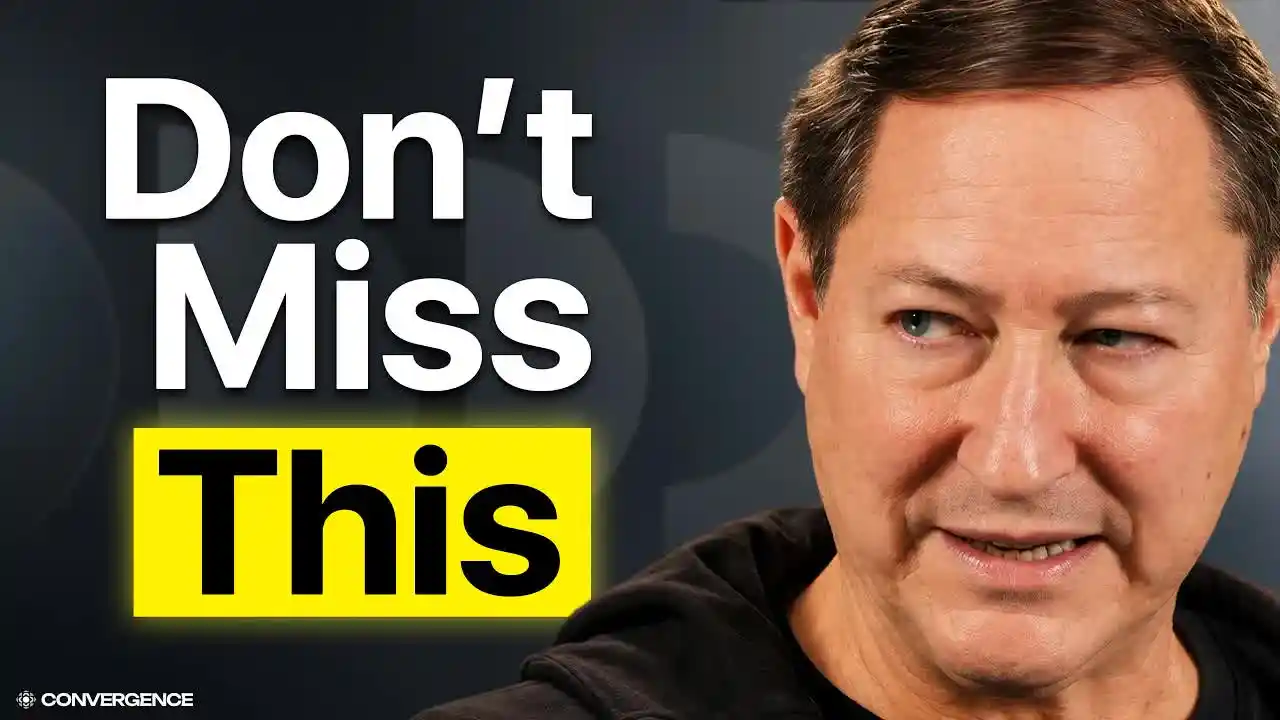
In a Convergence podcast interview, macro investor Jordi Visser argues that the current wave of capitulation among crypto believers mirrors the post-dot-com "death by a thousand cuts" period from 2003–2007—just before the iPhone era—while traditional finance billionaires quietly begin asking serious questions about tokenization and Hyperliquid. He cites Bitcoin's rare 7-sigma reversal off the 200-day moving average amid a barrage of bad news as evidence that sellers are exhausted, reiterating that "price leads narrative." Visser contends the liquidity-driven bull market is over: with Bitcoin near $2 trillion against $900 trillion in global wealth, the next leg must come from trust-based migration of dormant assets onto chains, not 5% annual liquidity growth. Using his "ghost cities" analogy from China, he argues crypto's built-out infrastructure has awaited its true residents—AI agents operating 24/7 with stablecoins—who will finally activate the machine economy. He dismisses the Fed and oil as obsolete macro variables, noting equities have shrugged off $100 oil and 5% Treasury yields, because AI-driven productivity is powerfully deflationary and rate-insensitive. Value will be taxed up the stack: Stripe, Arbitrum-based Robinhood Chain, Ethereum, and Solana capturing fees as agent-to-agent stablecoin transactions explode. Visser sees Robinhood and Hyperliquid merging old and new finance through tokenized equities and weekend price discovery, with private credit and real estate tokenization as the next frontier. Finally, he argues AI's democratization will compress mega-cap valuations while spawning millions of micro AI-native businesses, pushing growth premiums from the $70 trillion US equity market toward crypto's under-$4 trillion ecosystem.
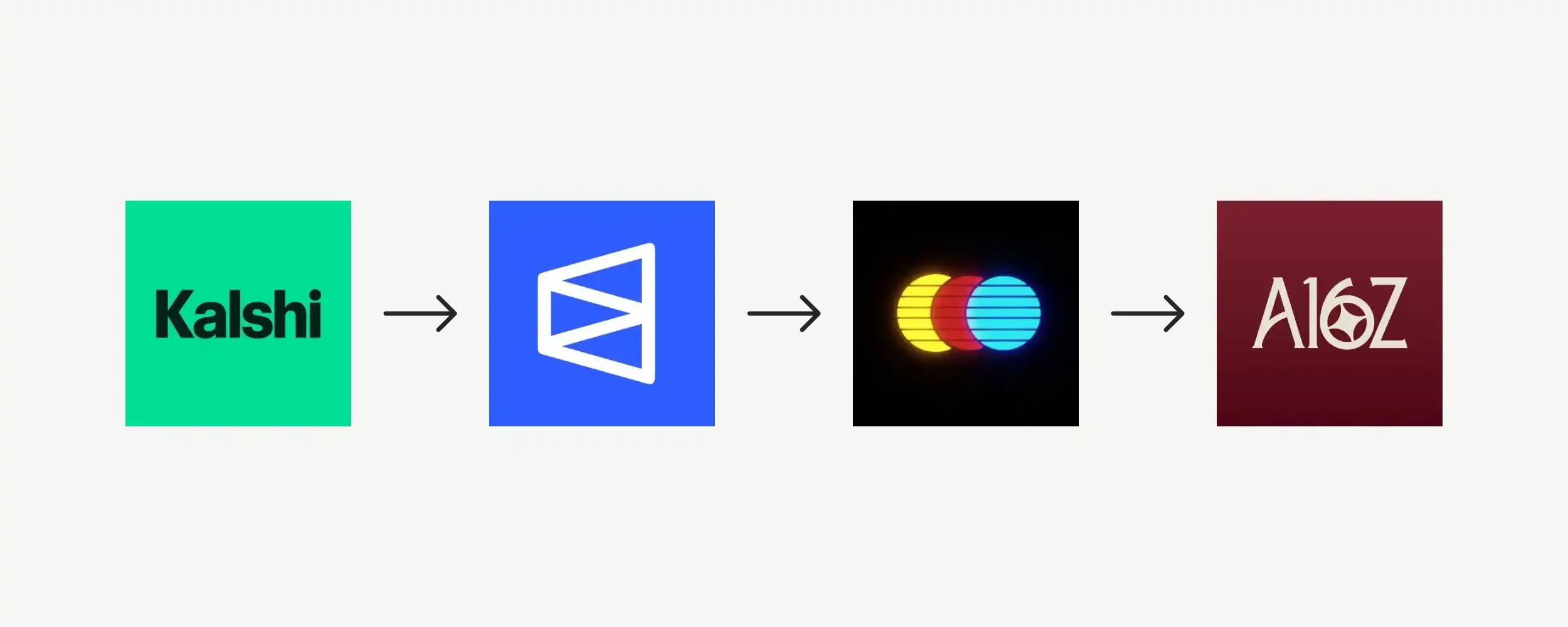
Dhruv Gupta, a University of Pennsylvania student who had interned at Morgan Stanley and Jane Street, grew disillusioned with big-company bureaucracy—exemplified by being told an LLM API key request might only be approved for a future full-time role. Over eight months, he engineered an unconventional path into Kalshi, Polymarket, MTS, and a16z.
After building a following posting engineering and quant content on TikTok, he caught Kalshi's attention via a DM, though it lacked a suitable product role. He then cold-emailed the only Penn alum at Polymarket; when the reply stalled, he spent four hours coding two rough projects that won Will's interest. That led to work on news.polymarket.com, the polygraph tools, and thespread.news, plus several articles. He also nearly launched two prediction-market startups—one with an Augur/Gnosis co-founder, another with a Wharton statistics professor—learning about fundraising, people, and niche tech.
Wanting to work in media products, he connected with a16z's Brent Liang through the New Media Fellows program. When Liang left to found MTS, Gupta joined on day three of its launch—arranging remote finals, packing, and flying to San Francisco for a month-long Airbnb in the Tenderloin. He built mts.now/situations and helped produce daily high-quality news graphics, working 12-hour days, seven days a week in the war room (he regrets leaving for a Jane Street summer internship). The team scored early hits covering the Musk v. Altman trial evidence.
With six courses left to graduate, he chose to balance school and work. He had been privately maintaining a talent list to help underclassmen land startup internships, which aligned with Erik Torenberg's vision for Cosign—a platform for surfacing doers, zealots, fighters, and obsessives. He now aims to keep improving Cosign by 10% daily.