The reference exchange rate is for reference only and is not locked in. The final rate will be determined by the actual execution price.
Real-Time XLE Stats
The live price of State Street Energy Select Sector SPDR ETF (Derivatives) (XLE) is $0.02 USD and its current market capitalization is $-- USD.
Get real-time XLE/USD updates on HTX. Stay informed with the latest data and market trends to make smart trading decisions. HTX, your trusted source for accurate cryptocurrency price information.
State Street Energy Select Sector SPDR ETF (Derivatives) Key Stats
24h Volume (USD)
$--
Price Change Today
--
Circulating Supply (XLE)
--
Sign up and trade to win rewards worth up to 1,500 USDT.Join Now
Get the latest State Street Energy Select Sector SPDR ETF (Derivatives) price details on HTX: 24-hour high and low, all-time high (ATH), and daily price change percentage.
24h Low
$0
24h High
$0
All-Time High
$0
Market Cap
$0.00
24h Volume (USD)
$--
Circulating Supply
--
What is XLE?
State Street Energy Select Sector SPDR ETF (Derivatives) (XLE) is a cryptocurrency . State Street Energy Select Sector SPDR ETF (Derivatives) has a current supply of 0. The last known price of State Street Energy Select Sector SPDR ETF (Derivatives) is 65.28235266 USD and is up 0.22 over the last 24 hours. It is currently trading on 49 active market(s) with $0.00 traded over the last 24 hours.
Based on the historical performance of State Street Energy Select Sector SPDR ETF (Derivatives), our prediction tool estimates that the price of State Street Energy Select Sector SPDR ETF (Derivatives) (XLE) could reach -- by --.
Predicted XLE Price in --
Our most recent forecast indicates the price of State Street Energy Select Sector SPDR ETF (Derivatives) (XLE) will increase to -- by --, with a price change of --% and a cumulative ROI of approximately --%.
Buy your first XLE on HTXSign Up
XLE FAQs
What is the State Street Energy Select Sector SPDR ETF (Derivatives) (XLE) price today?
The current price of State Street Energy Select Sector SPDR ETF (Derivatives) (XLE) is $0.02 USD.
What is the State Street Energy Select Sector SPDR ETF (Derivatives) (XLE) market cap?
The current market capitalization of State Street Energy Select Sector SPDR ETF (Derivatives) (XLE) is $0.00 USD, calculated by multiplying its circulating supply by its current price.
What is the State Street Energy Select Sector SPDR ETF (Derivatives) (XLE) circulating supply?
The current circulating supply of State Street Energy Select Sector SPDR ETF (Derivatives) (XLE) is -- XLE.
What is the State Street Energy Select Sector SPDR ETF (Derivatives) (XLE) all-time high?
As of 2026-10-11, the all-time high of State Street Energy Select Sector SPDR ETF (Derivatives) (XLE) is $0 USD.
Pimco, the world's largest bond fund, warns there is a risk of the US 10-year Treasury yield breaking above 6%, a level not seen in 26 years. Chief Investment Officer Dan Ivascyn states that a significant rise from the current 5.29% is achievable, driven partly by technical selling pressure as leveraged investors like hedge funds face losses and are forced to liquidate positions. He cautions that yields reaching 5.5% or higher could trigger significant declines in risk assets like stocks and credit.
This surge is already impacting the real economy, with the average 30-year US mortgage rate hitting 7.4%, the highest since 2023. The market risks a negative cycle where rising yields force more participants to sell, further pushing yields up. Factors behind the climb include inflation concerns, corporate borrowing for AI, and strong US growth expectations.
While high yields pressure risk assets and expose vulnerabilities in areas like commercial real estate, Ivascyn notes a self-correcting mechanism: attractive yields will eventually draw investors back to Treasuries, capping further rises. He also sees better opportunities in non-US bond markets, such as Australia, the UK, Canada, and Germany, which offer attractive yields and stronger fiscal starting points.
The XRP Ledger (XRPL) has activated a major new update, PermissionDelegationV1_1, targeting Wall Street institutions like banks, stablecoin issuers, and tokenized fund managers. This system allows corporate users to delegate specific account permissions—such as customer verification, payment processing, or account freezing—to other accounts without compromising the security of their master account's private keys. Organizations can delegate up to ten distinct permissions via a single account, and the master account owner can revoke these delegated rights at any time. The upgrade aims to provide a more secure and flexible framework for institutional account management on the XRPL.
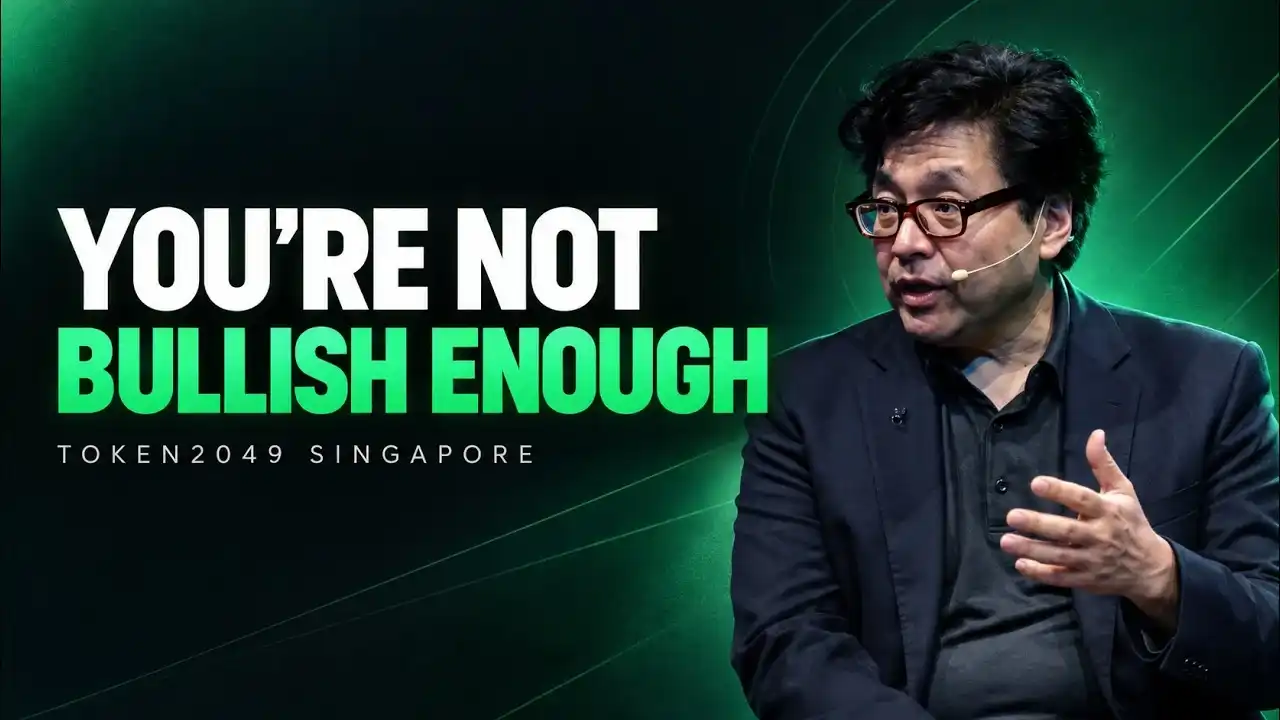
**Podcast Summary | Tom Lee: Ethereum Could Hit $50K This Cycle, Tokenization is Wall Street’s Disruptive Force**
In a discussion at TOKEN2049, Fundstrat co-founder and BitMine Chairman Tom Lee shared his outlook on crypto markets, AI, and the future of finance.
Lee asserts the crypto bear market is over and a new bull cycle has begun, driven significantly by institutional adoption and real innovation, unlike previous retail-driven cycles like ICOs or NFTs. He highlights Asia as a key region for blockchain and tokenization progress.
A central theme is the vast potential of asset tokenization. While on-chain assets currently total $3-4 trillion, the traditional capital pool is around $200 trillion, with ~$7 trillion in new liquid assets annually. Lee sees this as a massive opportunity to bring wealth on-chain, particularly from illiquid private markets.
On AI, Lee argues the current phase is not a bubble but resembles 1997 in the internet era. He notes comparable infrastructure spending (~$30 trillion for AI vs. ~$35 trillion for internet/mobile) and suggests a potential AI bubble peak may not arrive until around 2033.
Lee is exceptionally bullish on Ethereum, which BitMine's balance sheet is heavily invested in. He calls ETH "severely undervalued," predicting it could reach $2,500 to $5,000 by year-end (breaking its all-time high) and potentially $25,000 to $50,000 in this cycle, citing its role as a neutral settlement layer and robust developer community.
Tokenization, Lee explains, will reshape finance by unbundling assets (e.g., trading fragments of Alphabet, Starlink, or Tesla FSD) and enhancing liquidity. Asset management will lead adoption, while traditional banking functions reliant on capital intermediation face disruption. He warns that major financial institutions without a crypto strategy risk becoming obsolete, akin to NCR or MCI in past tech shifts.
Finally, Lee notes crypto's potential to broaden financial inclusion, pointing out that 46% of Americans are underbanked. In an increasingly digital economy driven by agents and robots, finance could become the largest sector, with crypto playing a foundational role.
Lithuania's State Tax Inspectorate has issued updated procedures clarifying reporting requirements for crypto-asset service providers regarding their users. This move aligns national tax rules with the EU's DAC8 directive and the OECD's Crypto-Asset Reporting Framework (CARF) ahead of stricter EU transparency rules. Under the new order (VA-63), supervised crypto service providers and domestic operators must enhance their customer due diligence protocols. They are now required to collect detailed user identification data, transaction records, and tax residency information.
TypeSafe AI, a San Francisco startup, has raised approximately $870 million at a staggering $7.5 billion valuation in a round led by Andreessen Horowitz (a16z), with participation from Sequoia Capital, DCVC, and angel investors. The funding, one of Silicon Valley's most notable recent deals, followed the explosive launch of its core product, Jev, just weeks prior in mid-September, which rapidly gained over a million users.
Jev represents a fundamental departure from mainstream large language models (LLMs) like those from OpenAI and Anthropic. Built on a Transformer architecture, Jev does not generate text. Instead, it outputs calibrated probability values or "decisions," enabling it to be directly embedded into software systems for automation tasks. This approach results in faster execution, significantly lower token consumption, and reduced costs compared to traditional LLMs. The company claims Jev already processes trillions of tokens daily, is profitable, and is used by about one-third of Fortune 500 companies.
Founded in 2024 by ex-OpenAI researcher Diogo Almeida and others from Meta and Google, TypeSafe employs just over 20 people. The new capital will fund scaling, hiring, and compute resources. a16z's investment aligns with its focus on AI developer tools, drawing parallels to its successful bet on Cursor. The move underscores a market shift towards high-reliability, cost-effective AI infrastructure for automation as industry cost pressures intensify.
marsbit19小时前
Related Questions
Welcome to the Crypto FAQ. Users' questions and answers on State Street Energy Select Sector SPDR ETF (Derivatives) (XLE) are presented below.