Technical Wave Patterns Turn Bullish for Ethereum as Price Reaction Intensifies Before Fed Decision

bitcoinistPublished on 2025-12-11Last updated on 2025-12-11

Abstract

Ethereum (ETH) is showing bullish technical signals, breaking above key resistance near $3,300 as market sentiment strengthens ahead of the Federal Reserve's expected 25-basis-point rate cut. The ETH/BTC ratio has improved, and spot Ethereum ETFs saw significant inflows. Institutional interest is growing, highlighted by BlackRock's filing for an Ethereum Staking Trust ETF. Supply is tightening as exchange reserves hit multi-year lows. Technical analysis suggests a potential move toward $3,600, with some analysts targeting $4,200–$4,300 if the bullish trend continues. The Fed's decision remains a critical factor for momentum.

Ethereum (ETH) is under a pivotal week as traders weigh a mix of macroeconomic expectations, institutional developments, and strengthening technical signals.

Related Reading: Midnight Goes Live As Cardano Founder Targets A $10 Billion Ecosystem

With the Federal Reserve set to deliver its next rate decision, market participants are watching how Ethereum’s recent momentum interacts with a broader risk-on environment.

The second largest cap cryptocurrency has already staged a notable rebound, breaking key resistance levels and drawing renewed interest from both retail and institutional investors.
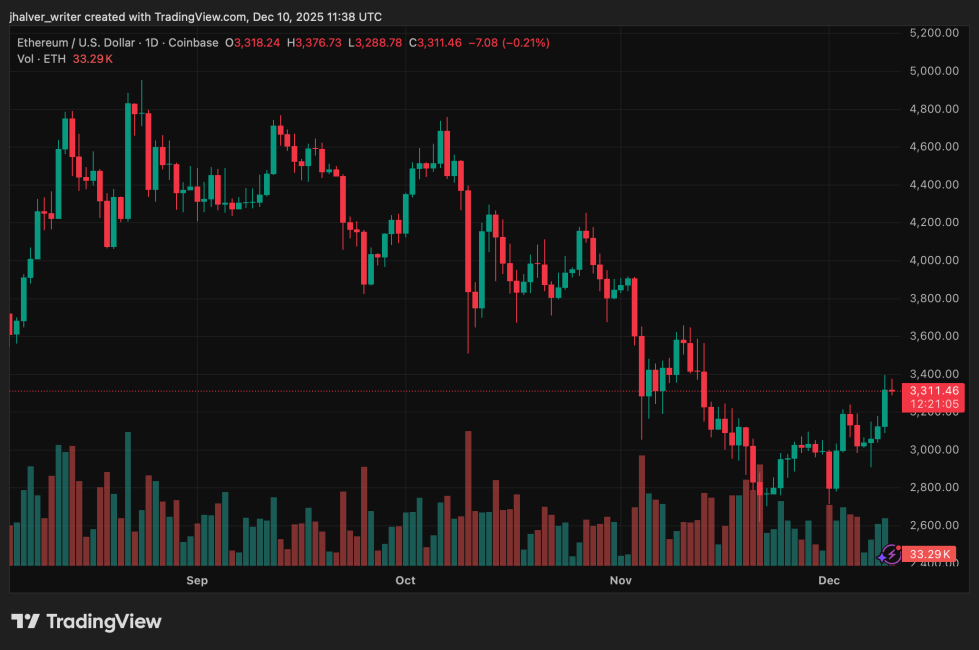
ETH's price sees some gains on low timeframes as recorded on the daily chart. Source: ETHUSD on Tradingview

Fed Expectations Drive Ethereum Position Repricing

Ethereum surged past $3,300 and briefly approached $3,400 after recording a 6% jump over the past 24 hours.

The rally comes as traders price in a high probability, close to 90%, that the Federal Reserve will announce a 25-basis-point rate cut. Lower interest rates tend to improve liquidity conditions, a factor that has historically supported digital assets.

Bitcoin’s recovery above $94,000 added further confidence to the market, though Ethereum outperformed on a relative basis. The ETH/BTC ratio reached its strongest point since late October, indicating a shift of capital from Bitcoin to Ethereum.

Spot Ethereum ETFs also saw $177.7 million in inflows on December 9, surpassing Bitcoin’s inflows on the same day.

Institutional Moves Add to Bullish Sentiment

One major catalyst behind this shift has been BlackRock’s filing for the iShares Ethereum Staking Trust ETF. The fund would offer exposure not only to ETH’s price but also to staking rewards, expanding access to yield-bearing strategies.

Analysts note that such products could increase liquidity inflows into Ethereum, especially as institutional portfolios diversify beyond Bitcoin. This filing arrives at a time when the amount of ETH held on centralized exchanges has fallen to its lowest level since 2015, roughly 8.7% of the total supply.

Large buyers, including Bitmine Immersion, have accumulated billions of dollars’ worth of ETH in recent months. Combined, these developments indicate a tightening of supply conditions.

Technical Breakouts Reinforce the Trend

Chart analysts highlight that Ethereum has broken above a downward trendline that previously capped rallies for nearly two months.

Momentum indicators, including MACD and RSI, show increasing buyer strength despite approaching overbought territory. Ethereum’s break above the $3,300 zone has shifted focus toward the next resistance level at $3,500, with wave-pattern analysis suggesting potential upside toward $3,600.

Related Reading: Bitwise Rolls Out New ETF For Broad Crypto Exposure, Including BTC, XRP, And ADA

Analysts such as Captain Faibik argue that a confirmed breakout could support a rally of up to 30%, targeting the $4,200–$4,300 region if bullish conditions persist. However, the Fed’s upcoming decision remains a key variable in determining whether momentum continues or cools.

Cover image from ChatGPT, ETHUSD chart from Tradingview

Related Reads

Why Can HashKey Become Hong Kong's 'First Crypto Stock'?

HashKey, a licensed Virtual Asset Trading Platform (VATP) in Hong Kong, has passed the listing hearing of the Hong Kong Stock Exchange (HKEX) and is poised to become the city’s first listed crypto-native company. Its Post-Hearing Information Pack (PHIP) reveals key aspects of its business, compliance, and governance. A major strength lies in its global multi-jurisdictional regulatory compliance, with licenses in financial hubs including Hong Kong, Singapore, Japan, Bermuda, the UAE, and Ireland. This allows it to operate across borders while adhering to local regulations. The platform emphasizes strong technical and internal controls: 96.9% of user assets are stored in cold wallets, customer funds are segregated, and multi-signature approval processes are implemented. It has also developed HashKey Chain, a compliant Ethereum Layer-2 network designed for institutional use, particularly in tokenized securities, which embeds regulatory requirements at the protocol level. HashKey Holdings is incorporated in Cayman Islands and has established a corporate governance structure aligned with HKEX standards, including a board with independent directors and a fully independent audit committee. Its potential listing is seen as a significant milestone, demonstrating that Web3 businesses can operate within regulatory frameworks. It also reflects Hong Kong’s supportive stance toward virtual asset innovation. However, ongoing compliance across multiple regions entails high and continuous operational and legal costs.

marsbit51m ago

Why Can HashKey Become Hong Kong's 'First Crypto Stock'?

marsbit51m ago

The Crisis Behind Silver's Surge: When the Paper System Begins to Fail

Silver has emerged as the star performer in the precious metals market, with its price surging nearly 110% year-to-date, far outpacing gold's 60% gain. This dramatic rise, driven by seemingly rational factors like Fed rate cut expectations and strong industrial demand from solar, EVs, and AI, masks a deeper and more dangerous reality. The core of the crisis lies in the market's structure. Unlike gold, which is backed by central bank purchases, silver is an "island asset" with almost no official reserves and a much smaller, less liquid market. Its daily trading volume is a fraction of gold's. The rally is increasingly fueled by a futures market squeeze, where paper contracts (derivatives, ETFs) vastly outweigh physical metal. This has created a dangerous inversion where futures prices trade at a persistent premium to spot—a sign of potential market manipulation or a short squeeze. A major red flag is the surge in physical silver withdrawals from key exchanges like COMEX, LBMA, and Shanghai. Investors are increasingly demanding physical delivery, distrusting the "paper silver" system. This has led to plunging exchange inventories, exposing the system's fragility: a small physical base supports a massive pyramid of paper claims. Suspicions of market manipulation are heightened by the dominant role of JPMorgan, which holds nearly half of COMEX silver inventory and is the custodian for a major silver ETF. While no wrongdoing is proven, its immense influence over both physical supply and paper markets places it at the center of the volatility. Ultimately, the silver surge signals a broader crisis of confidence in financialized paper assets. A global shift is underway from financial instruments to physical possession, a movement driven by de-dollarization and a quest for certainty. The rules of the game are changing: when the music stops, only those holding real metal will have a seat.

marsbit1h ago

The Crisis Behind Silver's Surge: When the Paper System Begins to Fail

marsbit1h ago

Trading

Spot
Futures
活动图片