Altcoin ETF Market Reshuffle: XRP in Focus, Why Are LTC and DOGE Being Abandoned by the Market?

金色财经Published on 2025-12-10Last updated on 2025-12-10

Abstract

The first batch of four altcoin ETFs (Litecoin, XRP, Solana, Dogecoin) launched in the U.S. in November 2025, revealing a sharply divided market. XRP emerged as the clear winner, with over $600 million in net inflows and price appreciation, attributed to its clear regulatory status, utility in cross-border payments, and competitive fees. Solana also attracted over $600 million in inflows, but its price fell nearly 30%, showing that ETF demand can be overshadowed by broader market sentiment, though its staking yield remained a draw. Litecoin and Dogecoin were largely ignored, with combined inflows under $8 million due to lack of new narratives, high fees, and limited functionality. The divergence highlights two distinct investor groups: traditional institutions withdrew over $40 billion from Bitcoin and Ethereum ETFs amid market volatility, while crypto-native investors viewed the dip as an opportunity to enter new altcoin ETFs. This debut underscores that ETF approval alone isn’t a guarantee of success; long-term viability depends on real-world utility, regulatory clarity, and ecosystem strength. The altcoin ETF era marks a shift from speculative hype toward institutional value assessment, with only assets possessing strong fundamentals likely to thrive in an increasingly crowded market.

In November 2025, the first four altcoin ETFs (Litecoin, XRP, Solana, Dogecoin) were approved for listing in the U.S. Against the backdrop of massive losses in Bitcoin and Ethereum ETFs during the same period, their performance was starkly different, revealing a new era of market divergence.

Key Highlights: A Tale of Two Extremes in the Debut Performance

XRP

The clear winner, with net inflows exceeding $600 million, it was the only asset whose price increased. Its success stems from a clear regulatory status, practical value as a cross-border payment infrastructure, and competitive fee structures.

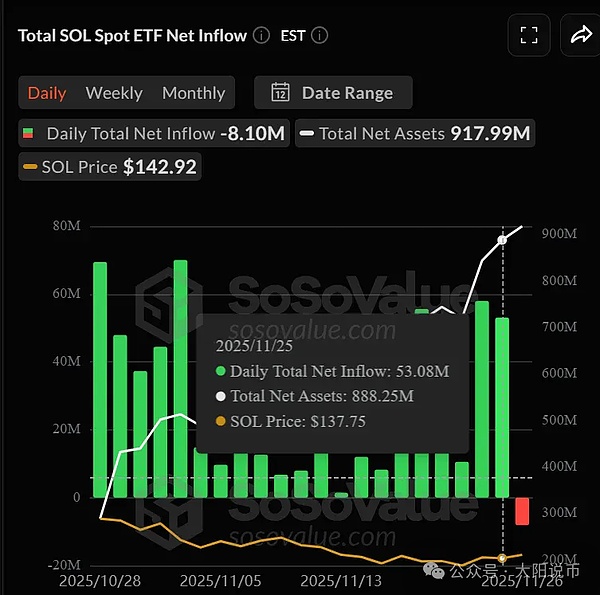
Solana

The awkward runner-up, also attracting over $600 million in inflows, yet its price plummeted nearly 30%. This exposed the limited effect of ETF inflows in the face of systemic market panic, though its offered staking rewards remain a unique attraction.
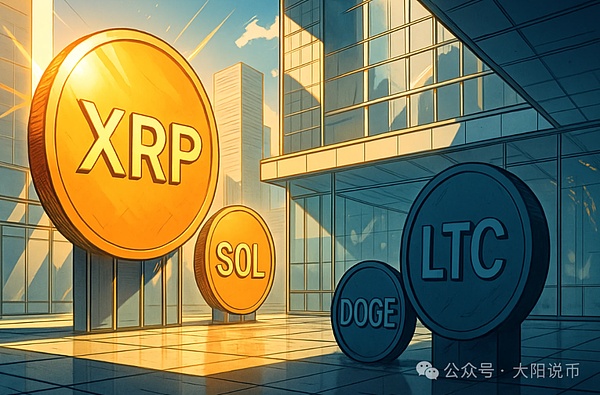
Litecoin and Dogecoin

Forgotten by the market, with combined inflows of less than $8 million. A lack of new narratives, high fees, and insufficient functionality made them unattractive to institutional investors.

Underlying Logic: Investors in Two Parallel Worlds

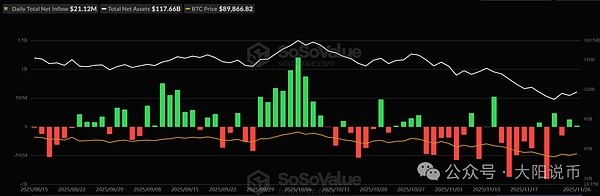
The most contradictory market phenomenon in November was this: Bitcoin and Ethereum ETFs saw net outflows of over $40 billion, while altcoin ETFs saw net inflows of $13 billion. This wasn't a rotation of funds but reflected a fundamental difference between investors in the "traditional finance world" and the "crypto-native world":
Traditional Institutions Are Retreating

Triggered by risk controls during the market flash crash, they took massive profits by exiting BTC/ETH ETFs.

Crypto-Native Institutions Are Entering

They viewed the market adjustment as an opportunity to allocate to new instruments (altcoin ETFs), executing their established plans.

Future Implications: ETFs Are Not a Panacea, But a "Litmus Test"

This debut shows that the "new product effect" of ETFs has a time limit. Once the initial hype subsides, the asset's inherent practical value, regulatory clarity, and ecosystem fundamentals will become the decisive factors attracting capital.

By 2026, hundreds of crypto ETFs could emerge in the U.S. market. However, it's foreseeable that only a few assets with real value and strong narratives will stand out, while a large number of uncompetitive products will face elimination. The launch of altcoin ETFs marks crypto's transition from speculative narratives into a new phase where institutions use real capital to screen for value.

Related Questions

QWhich cryptocurrency ETF was the clear winner in terms of net inflows and price performance upon their US debut in November 2025, and why?

AThe XRP ETF was the clear winner, attracting over $600 million in net inflows and being the only one to experience a price increase. Its success is attributed to its clear regulatory status, utility as a cross-border payment infrastructure, and competitive fee structure.

QDespite significant inflows, why did the Solana ETF's price drop nearly 30% after its launch?

AThe Solana ETF's price dropped nearly 30% despite over $600 million in inflows because the ETF inflows were not enough to counteract a broader, systemic market panic. However, its ability to offer staking rewards remained a unique attraction for investors.

QWhat was the combined net inflow for the Litecoin and Dogecoin ETFs, and what were the primary reasons for their poor performance?

AThe combined net inflow for the Litecoin and Dogecoin ETFs was less than $8 million. They performed poorly due to a lack of new compelling narratives, high management fees, and insufficient perceived utility, making them unattractive to institutional investors.

QWhat does the simultaneous massive outflow from Bitcoin/ETH ETFs and inflow into altcoin ETFs in November 2025 reveal about different investor groups?

AThis divergence reveals a fundamental difference between 'Traditional Finance (TradFi) World' and 'Crypto-Native World' investors. TradFi institutions were retreating, taking profits and triggered by risk controls during a market crash, while crypto-native institutions saw the market adjustment as an opportunity to deploy capital into new altcoin ETF products according to their plans.

QAccording to the article, what will be the decisive factors for an asset's success in the future crypto ETF landscape beyond the initial 'new product effect'?

ABeyond the initial hype, the decisive factors for success will be an asset's practical utility, regulatory clarity, and fundamental strength of its ecosystem. The ETF acts as a 'litmus test,' and only assets with real value and powerful narratives will thrive in the long term.

Related Reads

Farcaster Is Not a Pivot, It's Evolution: The True Ambition from Social to Wallet

Recently, Farcaster co-founder Dan Romero announced a shift in the project’s focus from "social-first" to "wallet-first," sparking widespread discussion. While some interpreted this as Farcaster abandoning social features or even signaling the failure of Web3 social networks, the move is better understood as a strategic evolution rather than a pivot. Farcaster’s integration of a built-in wallet is not a replacement for social functionality but an upgrade to improve user experience. It enables seamless on-chain interactions, especially as Frames evolve into more powerful Mini Apps. This enhancement allows users to mint NFTs, execute trades, and engage with decentralized applications without leaving the app—reducing friction and supporting richer crypto-native experiences. The shift reflects a broader trend: social apps are integrating wallets, and wallet apps are adding social features. This convergence is becoming the natural direction for consumer crypto applications. By combining social graphs with built-in wallets and Mini Apps, Farcaster enables closed-loop scenarios for asset creation, discovery, trading, and community interaction—all within a unified experience. Other platforms like Telegram, Zapper, Base App, and Binance are also exploring similar integrations, highlighting the growing importance of blending social context with financial activity. Farcaster’s open and composable social protocol allows developers to build diverse clients and applications, further expanding its ecosystem. In summary, Farcaster is not moving away from social—it is enhancing it. The integration of wallet functionality aims to drive growth, improve utility, and solidify its unique value proposition in the crypto space.

marsbit1h ago

Farcaster Is Not a Pivot, It's Evolution: The True Ambition from Social to Wallet

marsbit1h ago

Trading

Spot
Futures
活动图片