Author: Ben Weiss
Compiled by: Deep Tide TechFlow
Deep Tide Guide: Fortune reporters obtained previously undisclosed financial disclosure documents of crypto VCs from the SEC. The data shows that the assets under management (AUM) of leading institutions such as Paradigm, Pantera, a16z crypto, and Multicoin have shrunk across the board in 2025. However, the shrinkage is not all bad news—a16z crypto returned money to LPs at the market peak, with the first fund's DPI reaching 5.4x. The only one that grew against the trend was Haun Ventures, which hit the stablecoin track by betting on BVNK's acquisition by Mastercard.
Top crypto VC players failed to escape the market crash of 2025.
Fortune reporter Ben Weiss obtained a batch of previously undisclosed investment advisor financial disclosure documents from the U.S. Securities and Exchange Commission (SEC). The data is straightforward: the AUM of top institutions like Paradigm and Pantera Capital collectively shrunk in 2025.
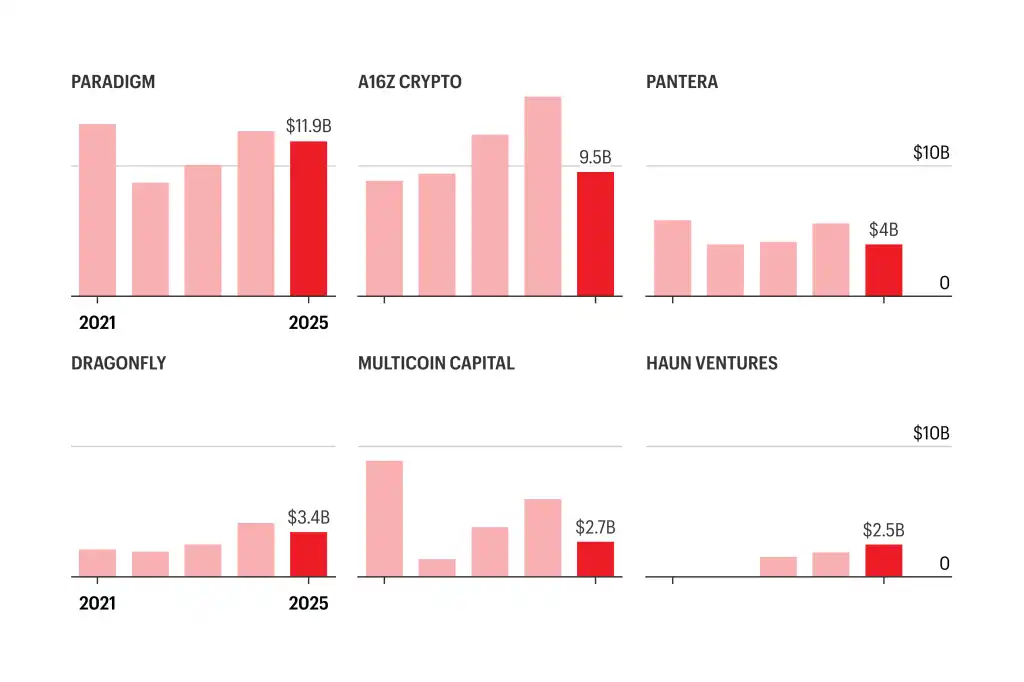
Caption: Changes in AUM of top crypto VCs from 2021 to 2025
Chart by: Ben Weiss / Fortune
But before listing the numbers, there's a premise to clarify: AUM is not a good indicator of VC success or failure. It does not reflect new rounds of financing, LP exit distributions, or capital calls. Crypto asset prices themselves are highly volatile—a tweet from a moody man can send prices on a roller coaster (Elon Musk, Donald Trump, Changpeng Zhao, take your pick). Veteran crypto VCs have experienced asset surges during the 2021 NFT frenzy and subsequent portfolio plunges during the "crypto winter."
Original author Ben Weiss also emphasized: Truly top investors ultimately return money to LPs. Short-term AUM changes do not equal performance quality.
With that premise clear, let's look at the specific data.
a16z crypto: AUM shrunk nearly 40%, but money returned to LPs
The combined AUM of a16z crypto's four crypto funds plummeted nearly 40% from 2024, dropping to $9.5 billion. During the same period, the parent company Andreessen Horowitz's assets under management swelled to over $100 billion.
Part of the reason for the shrinkage is that the institution began distributing returns from the first three funds back to LPs. According to informed sources, a16z crypto intentionally chose to make distributions at the 2025 crypto market peak.
How effective was it? According to Newcomer data, a16z's first crypto fund achieved a net DPI (Distributed to Paid-In capital ratio) of 5.4x. Compared to other VC funds raised in the same period in 2018 on the Carta platform, this return rate is quite impressive.
In other words, the AUM shrinkage for a16z crypto is more a result of "making money and returning it to LPs" rather than "plummeting holdings."
Multicoin: AUM halved to $2.7 billion
Multicoin Capital's fate is deeply tied to the crypto market. During the 2021 crypto frenzy, its AUM nearly tripled in a year, approaching $9 billion. After FTX collapsed, it plummeted directly, then gradually rebounded over the next two years.
But the 2025 downturn hit it again. From 2024 to 2025, Multicoin's AUM shrunk by more than half, falling to approximately $2.7 billion. Since BTC began its dive in October 2025, crypto assets have retreated across the board, and Multicoin's structure—which operates both hedge funds and VC funds—was hit hardest.
Additional context: Multicoin co-founder Kyle Samani left the company in February this year, turning to invest in other areas of technology.
Pantera: Five portfolio companies IPO, capital returned to LPs
Pantera Capital's AUM also shrunk, but similar to a16z, part of the reason is active distributions to LPs.
According to informed sources, Pantera had five portfolio companies go public in 2025, including Circle and BitGo. These exits brought significant cash returns.
Haun Ventures: The only one growing against the trend, AUM up over 30%
Amid the widespread shrinkage, Haun Ventures is the only exception.
The institution, founded by former a16z crypto partner Katie Haun, saw its AUM increase by over 30% year-on-year, approaching $2.5 billion. This is partly due to betting on the right track—its investment in stablecoin company BVNK was acquired by Mastercard for up to $1.8 billion. Additionally, Haun Ventures itself raised a new $1 billion fund in 2025.
New fundraising rounds have begun
Although AUM has shrunk, top institutions have not stopped:
Paradigm is raising a new fund of up to $1.5 billion. a16z crypto is raising up to $2 billion. Dragonfly just closed its $650 million fourth fund. Post-publication correction by Fortune: A Dragonfly spokesperson actually responded, confirming the data is "accurate" and stating, "We are actively deploying capital."
Spokespersons for Paradigm, Pantera, a16z crypto, Multicoin, and Haun Ventures all declined to comment.
The cyclical fate of crypto VCs
The original article ends here, but a few background points are worth adding.
Crypto VCs are fundamentally different from traditional tech VCs. Traditional VCs invest in equity, exiting through IPOs or M&A. Many crypto startups have their own tokens, and VCs' holdings are directly exposed to token price fluctuations.
Multicoin is the most extreme case: According to a previous Fortune report, its assets increased by 20,287% from 2017 to 2021, then retreated 90% in 2022. This magnitude is unimaginable in the traditional VC field.
According to Pantera Capital's outlook report earlier this year, the total crypto market cap excluding BTC (also excluding ETH and stablecoins) fell about 44% from the end of 2024 highs. But according to historical patterns, bear markets are also windows for bottom-fishing. The intensive fundraising efforts by several leading institutions at this moment are betting on the next cycle.
According to a previous Fortune exclusive report, a16z crypto's fifth fund is planned to complete fundraising in the first half of 2026, led by Chris Dixon, and will continue to fully bet on the blockchain direction. Paradigm's new fund, according to The Wall Street Journal, will expand into AI and robotics technology. The strategic divergence is clear: a16z continues all-in on crypto, while Paradigm chooses cross-sector hedging.