Will Japan's Interest Rate Hike Trigger a Global Liquidity Shock?

marsbitPublished on 2025-12-18Last updated on 2025-12-18

Abstract

As the Bank of Japan's December 19 monetary policy meeting approaches, market concerns are rising over a potential hawkish interest rate hike. A report by Western Securities on December 16 analyzes whether this move could end the era of cheap yen and trigger a global liquidity crisis. Key drivers for a rate hike include Japan’s sustained inflation above the 2% target, low unemployment supporting wage growth, and expansionary fiscal policy. These factors may push the BOJ toward tightening, raising fears of unwinding large-scale carry trades and causing global financial stress. However, the report suggests the most dangerous phase of liquidity shock may have already passed. Previous rate hikes in July and January had diminishing market impact, speculative short positions in yen have largely been closed, and the macro environment—including a resilient U.S. economy and Fed easing—reduces urgency for rapid unwinding. The Fed’s expanded balance sheet also acts as a buffer. Despite theoretical stability, global markets remain fragile after a six-year bull run, with elevated valuations and AI-related泡沫 concerns. A BOJ hike could act as a catalyst for a liquidity shock, though any sharp sell-off may prompt stronger Fed easing, leading to a quick recovery. Investors are advised to monitor the situation closely. If U.S. markets experience repeated “stock-bond-currency triple sell-offs,” it may signal a liquidity crisis. Over the medium term, global monetary easing is expected to con...

Original Author: Long Yue

Original Source: Wall Street News

As the Bank of Japan's monetary policy meeting on December 19 approaches, market concerns about a potential hawkish interest rate hike are intensifying. Could this move mark the end of the era of cheap yen and trigger a global liquidity crisis? A recent strategy report released by Western Securities on December 16 provides an in-depth analysis.

High Inflation Makes Hawkish Rate Hike by Japan Inevitable

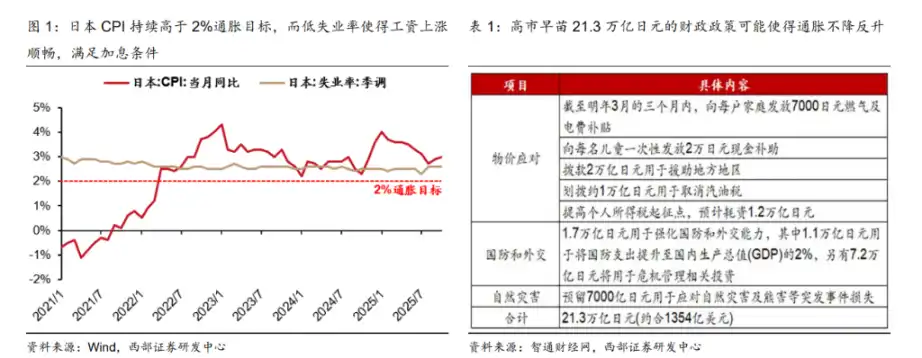
The report points out that multiple factors are behind the BOJ's potential rate hike. Firstly, Japan's CPI has consistently remained above the official 2% inflation target. Secondly, the unemployment rate has long stayed below 3%, creating favorable conditions for nominal wage growth. Market expectations for significant wage increases in next year's "Shunto" (spring labor negotiations) are high, which will further increase inflationary pressures. Finally, the 21.3 trillion yen fiscal policy introduced by Takayuki Kobayashi could also exacerbate inflation.

These factors collectively force the Bank of Japan to adopt a more hawkish stance. The market worries that once the rate hike is implemented, it could lead to the concentrated unwinding of the massive "carry trade" positions accumulated during Japan's YCC (Yield Curve Control) era, thereby causing a liquidity shock to global financial markets.

Theoretical Analysis: Why the Most Dangerous Phase of Liquidity Shock Might Be Over

Despite market anxieties, the report analyzes that, theoretically, the current impact of a Japanese rate hike on global liquidity is limited.

The report lists four reasons:

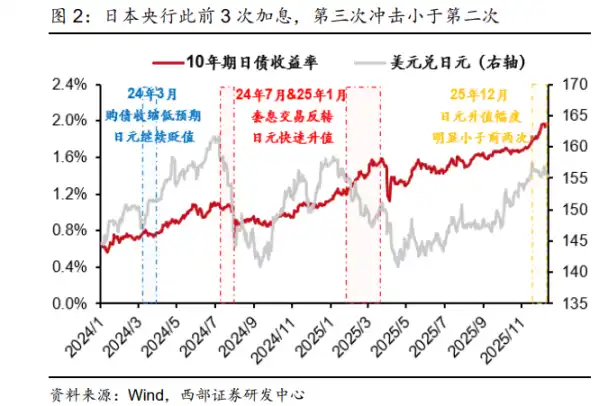
Risk Partially Released: The Bank of Japan has already implemented 3 rate hikes since March last year. Among these, the hike in July last year, coupled with the exit from YCC, did cause a significant liquidity shock, but the impact from the January hike this year has noticeably weakened, indicating increasing market adaptation.

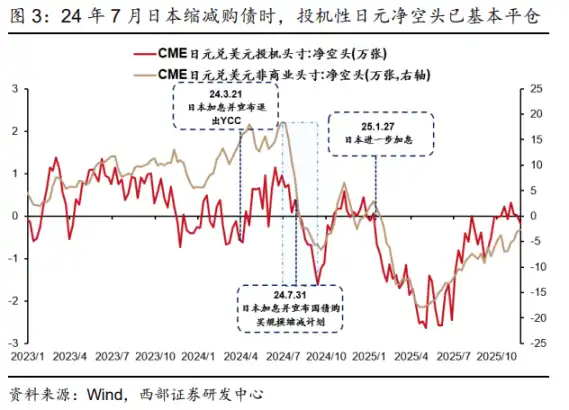
Speculative Positions Already Exited: Data from the futures market shows that most speculative yen short positions were unwound in July last year. This means the most active "carry trades" most likely to cause chain reactions have receded, and the most dangerous phase of the liquidity shock has passed.

Different Macro Environment: The current U.S. is not experiencing a "recession trade" similar to July last year, dollar depreciation pressure is not significant, and the yen itself remains weak due to geopolitical and debt issues. This weakens expectations for yen appreciation, thereby reducing the urgency to unwind "carry trades".

The Fed's "Safety Cushion": The report specifically mentions that the Federal Reserve has begun to pay attention to potential liquidity risks and has initiated balance sheet expansion (quasi-QE) policies, which can effectively stabilize market liquidity expectations and provide a buffer for the global financial system.
Actual Risk: A "Catalyst" in a Fragile Market

The report emphasizes that theoretical safety does not mean one can rest easy. The current fragility of global markets is the real root cause of the potential shock triggered by a Japanese rate hike. The report describes it as a "catalyst".

The report analyzes that the reason the July rate hike last year had such a large impact was the resonance of two major factors: "massive unwinding of active carry trades" and the "U.S. recession trade". Currently, the former condition has weakened. However, new risks are emerging: Global stock markets, represented by U.S. stocks, have experienced a 6-year "big water bull" market (prolonged bull market fueled by liquidity), accumulating substantial profits and inherent fragility. Simultaneously, concerns about an "AI bubble" are resurfacing in the U.S. market, leading to strong risk-off sentiment among investors.

In this context, the certainty of a Japanese rate hike could likely become a trigger, sparking panic selling and inducing a global liquidity shock. However, the report also offers a relatively optimistic judgment: such a liquidity shock would most likely force the Federal Reserve to introduce stronger easing policies (QE), so global stock markets, after a brief sharp decline, are very likely to recover quickly.

Watch and Wait, Monitor the Signal of "Stocks, Bonds, Forex Triple Kill"

Faced with this complex situation, the report advises investors to "watch and wait".

The report believes that since the Bank of Japan's decision is basically an "open secret," but capital flows are unpredictable, the best strategy is to observe.

Scenario One: If capital does not exhibit panic flight, the actual impact of the Japanese rate hike will be very limited, and investors need not take action.

Scenario Two: If capital panic does trigger a global liquidity shock, investors need to closely monitor a key signal—whether the U.S. market experiences 2-3 consecutive instances of a "stocks, bonds, forex triple kill" (simultaneous decline in stock, bond, and foreign exchange markets). The report points out that if a situation similar to early April this year repeats, it indicates a significantly increased probability of a liquidity shock.
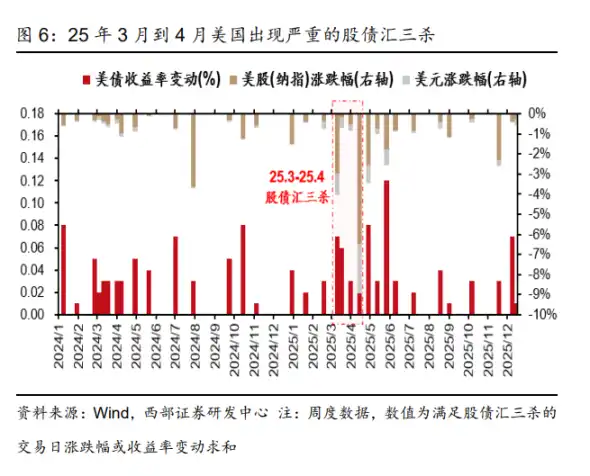
Finally, the report believes that even if a Japanese rate hike causes short-term turbulence, it will not change the broader long-term trend of global monetary easing. In this context, it continues to be bullish on the strategic allocation value of gold. Meanwhile, as China's export surplus expands and the Federal Reserve restarts interest rate cuts, the RMB exchange rate is expected to return to a medium-to-long-term appreciation trend, accelerating cross-border capital inflows, which is positive for Chinese assets. The report is optimistic about AH shares experiencing a "Davis Double Click" of earnings and valuation. For U.S. stocks and bonds, the report holds a震荡 (volatile/oscillating) view.


Related Questions

QWhat are the main factors driving the Bank of Japan's potential hawkish interest rate hike?

AThe main factors include Japan's CPI consistently exceeding the 2% inflation target, a low unemployment rate below 3% that supports nominal wage growth, high expectations for wage increases in the upcoming 'Shunto' spring wage negotiations, and the inflationary pressure from the 21.3 trillion yen fiscal policy introduced by Takayuki Kobayashi.

QWhy does the report suggest that the most dangerous phase of a global liquidity shock from a BOJ hike may have already passed?

AThe report cites four reasons: risks have been partially released through three previous rate hikes since last March, speculative short positions in the yen were largely closed last July, the current environment lacks a 'recession trade' in the US and the one seen in July last year, and the Federal Reserve has begun expanding its balance sheet to provide a liquidity buffer.

QWhat role could a BOJ rate hike play in the current fragile global market, according to the report?

AThe report suggests that a BOJ rate hike could act as a 'catalyst', triggering a panic-driven capital flight and potentially inducing a global liquidity shock, given the existing fragility in markets like the US stock market after a 6-year bull run and rising concerns about an 'AI bubble'.

QWhat key signal should investors watch for to gauge the probability of a liquidity shock?

AInvestors should watch for a key signal of 2-3 consecutive occurrences of 'stock, bond, and currency markets falling together' (a 'triple kill') in the US market, similar to the situation in early April, which would indicate a significantly increased probability of a liquidity shock.

QWhat is the report's medium to long-term outlook for global monetary policy and its implications for assets?

AThe report believes that a BOJ hike will not change the medium to long-term trend of global monetary easing. It remains bullish on the strategic allocation value of gold, expects the RMB exchange rate to appreciate due to China's export surplus expansion and Fed rate cuts, and is optimistic about a 'Davis double play' for AH shares. It holds a震荡 (volatile/oscillating) view on US stocks and bonds.

Related Reads

Bankless Co-founder: Why I Sold All My ETH

Author David Hoffman, founder of Bankless, explains his decision to sell all his ETH, despite being a prominent figure in the Ethereum ecosystem. He clarifies that his move is not a bearish take on Ethereum itself, which he remains highly optimistic about as a network. His core argument is that the "ETH is money" thesis, which he helped popularize, has largely played out. Hoffman argues that ETH has achieved the market valuation it deserves based on Ethereum's current success and competitive position. He details several reasons for this view. First, the path for ETH to become global money required nearly flawless execution and sustained dominance across Ethereum's entire technical and social stack—a coordination challenge he now believes had a narrower window for success than anticipated. Second, market data shows a strong correlation between L1 chain activity/fees and the price of its native asset; Ethereum's fee dominance has been challenged by competitors like Solana. Third, the "strong version" of crypto (decentralized, native crypto economies) that ETH's monetary thesis relied upon has struggled to maintain a positive mainstream narrative and stable adoption beyond a brief period. Finally, Ethereum's architecture as a "giver"—providing secure block space and tokenization capabilities at cost to L2s and applications—means it doesn't capture premium value directly. Its rollup-centric roadmap further directs most profits to L2s and applications ("fat app theory"). In conclusion, Hoffman believes the opportunity for ETH to be revalued significantly upward as money has diminished. He sold not because ETH will fail, but because its monetary thesis has matured, and he seeks to allocate capital to other opportunities he finds more compelling.

链捕手1h ago

Bankless Co-founder: Why I Sold All My ETH

链捕手1h ago

From Issuer to Infrastructure Owner: Circle's Arc Strategy and the Fatal Gap in the GENIUS Act

Circle raised $222 million for its proprietary Layer-1 blockchain, Arc, positioning itself not just as a stablecoin issuer but as the owner of the settlement infrastructure USDC relies on. This move, backed by investors like BlackRock and Apollo, highlights a significant structural conflict unaddressed by the GENIUS Act of 2025. While the act focuses on stablecoin reserves and issuer oversight, it remains silent on the market structure implications of an issuer controlling the underlying network—a scenario akin to a currency issuer also owning the payment rails. Traditionally, financial regulations separate issuers from settlement infrastructure to ensure neutrality. With Arc, Circle gains control over transaction ordering, fees, and network rules, potentially favoring USDC over competitors. The article argues that this creates a permanent structural temptation, even if no abuse occurs. The solution lies in applying established market infrastructure principles: mandating neutral transaction ordering, transparent fee schedules, and governance separated from Circle’s commercial interests. The current pre-mainnet phase offers a critical window for regulators to establish these rules before Arc becomes entrenched. Once operational, enforcing changes would be costly and disruptive. The core question remains: should a regulated stablecoin issuer be allowed to own the settlement network its competitors must use? The GENIUS Act doesn’t answer this, but Circle’s Arc strategy makes it urgent.

marsbit1h ago

From Issuer to Infrastructure Owner: Circle's Arc Strategy and the Fatal Gap in the GENIUS Act

marsbit1h ago

What Are the Key Variables Determining the AI Bull Market?

Title: What Determines the AI Bull Market? Key Variables Revealed Despite rising oil prices above $100/barrel, persistent inflation, and fragile Fed rate cut expectations—a traditionally hostile environment for high-valuation tech stocks—the AI sector continues to drive the market to new highs. According to analysts, the current AI boom is in a phase of "rational fervor": while bubbles exist, they are not yet out of control. The crucial shift is the emergence of Agentic AI, which is evolving from an assisting tool (Copilot) to an autonomous execution tool (Autopilot), creating a clearer commercial path from investment to revenue. This shift accelerates Token consumption and inference computing demand while boosting revenue forecasts for leading firms. The market is now rewarding capital expenditure as it transforms from a burden into a competitive moat, supporting hardware chains like GPUs, optical modules, and storage. However, valuations have already priced in growth expectations for 2027-2028. The forward P/E ratio for the "Magnificent Seven" tech giants is about 35x, compared to 25x for the rest of the S&P 500. This premium implies AI adoption must occur 5 to 8 times faster than past technological revolutions—a scenario with little room for error. The sustainability of the AI bull market hinges on three key variables: 1. **Short-term liquidity shocks**: Risks include sustained high oil prices, resurgent inflation, rising interest rates, and potential unwinding of the yen carry trade. The critical question is whether the upward revision speed of Annual Recurring Revenue (ARR) can outpace the rise in interest rates. 2. **Mid-term industry realization**: Can the actual pace of AI adoption and commercialization match the current lofty valuations? Historically, general-purpose technology revolutions follow a non-linear path with periods of acceleration and deceleration. 3. **Long-term structural constraints**: These include energy and power grid limitations, employment displacement and consumer purchasing power, social acceptance and potential backlash, and potential hardware technology breakthroughs that could disrupt current supply chains. While the long-term prospects for AI remain optimistic with potential for significant productivity gains, the stock market's pricing depends not just on the vision but on the actual speed of realization amid these growing constraints. The direction is clear, but the pace of execution will determine whether the bubble remains controlled or spirals out of control.

marsbit1h ago

What Are the Key Variables Determining the AI Bull Market?

marsbit1h ago

Trading

Spot
Futures

Hot Articles

Discussions

Welcome to the HTX Community. Here, you can stay informed about the latest platform developments and gain access to professional market insights. Users' opinions on the price of S (S) are presented below.

活动图片