Uzbekistan begins government bond-backed stablecoin payment pilot

cointelegraphPublished on 2026-09-08Last updated on 2026-09-08

Abstract

Uzbekistan has launched a pilot program to test a national stablecoin called HUMO, which is pegged 1:1 to the Uzbek som and backed by government securities. The project, approved under a framework established in November 2025, is overseen by the National Agency for Prospective Projects (NAPP) and the central bank. It will examine the issuance, circulation, and redemption of the token over an initial 12-month trial, with a total duration not exceeding three years. More than 20 merchants are ready to accept HUMO for payments. The pilot will involve integrating bank payment systems and blockchain infrastructure, with licensed crypto exchange Asterium as a partner. Regulators will evaluate the project's collateral safeguards, cybersecurity, consumer protection, anti-money laundering controls, and potential risks to financial stability.

Uzbekistan has launched a pilot to test payments with a som-pegged stablecoin backed by government securities.

On Monday, the National Agency for Prospective Projects (NAPP) said it had registered Humo Digital as a participant in a special regime jointly overseen with the central bank. The pilot will test the issuance, circulation and redemption of HUMO, with each token pegged to one Uzbek som.

NAPP said more than 20 merchants are prepared to test HUMO payments for goods and services.

The project will also integrate participating banks’ payment-processing and blockchain infrastructure. Asterium, a licensed crypto exchange, will serve as a project partner.

According to the Central Bank of Uzbekistan, the initial trial will run for 12 months, with the project’s total duration capped at three years. Regulators will assess the adequacy and safeguarding of the token’s collateral, cybersecurity, consumer safeguards, anti-money laundering controls and risks to financial and price stability.

The pilot follows a framework approved in November 2025. At the time, Uzbekistan said it was planning to permit stablecoin payment trials under a sandbox, alongside provisions for tokenized shares and bonds.

Related: Kyrgyzstan introduces state crypto reserve concept in new bill

Related Questions

QWhat is the backing asset for the new Uzbek stablecoin HUMO?

AThe HUMO stablecoin is backed by government securities.

QWhich two regulatory bodies are jointly overseeing the pilot program for HUMO?

AThe National Agency for Prospective Projects (NAPP) and the Central Bank of Uzbekistan are jointly overseeing the pilot.

QHow long is the initial trial phase of the HUMO stablecoin project scheduled to last?

AThe initial trial phase is scheduled to run for 12 months.

QWhat is the designated role of the licensed crypto exchange Asterium in the pilot project?

AAsterium will serve as a project partner in the pilot.

QIn what context did Uzbekistan first announce its plan to permit stablecoin payment trials?

AUzbekistan first announced the plan to permit stablecoin payment trials in a framework approved in November 2025, which included provisions for a regulatory sandbox and tokenized shares and bonds.

Related Reads

Changing Gas Metering Could Break Smart Contracts? Ethereum Urgently Halts Hoodi Fork to Investigate Eight Major Security Risks

Ethereum core developers have paused the Hoodi testnet upgrade after security auditors found that two upcoming Gas improvement proposals could invalidate long-standing assumptions underpinning many deployed smart contracts. The proposals, EIP-8037 and EIP-8038, part of the Glamsterdam upgrade, aim to reprice state storage by decoupling state creation from state access and setting dynamic weights for certain opcodes, in order to curb unchecked growth of Ethereum's state data. However, this overhaul disrupts static Gas constants that developers have relied on as fixed system parameters. ChainSecurity identified eight invariant risks. Many contracts and off-chain infrastructure depend on hardcoded Gas limits, for example to prevent reentrancy or bound execution scope; higher costs could cause cross-contract calls to run out of Gas and revert. Other risks lie in error-handling logic that relies on precise prediction of inner execution costs, and in proxy contracts that forward Gas based on fixed ratios, potentially distorting execution paths or locking funds in incomplete state-machine branches. To avoid systemic compatibility failures and cascading disruptions across multisig wallets, bridges, and lending protocols, developers agreed at an ACD meeting not to hard-fork Hoodi until the affected contracts are fully mapped and compatibility guidance is issued. Because much logic lives off-chain in proprietary routing, settlement scripts, and liquidation bots, the Ethereum Foundation acknowledged it cannot audit the entire ecosystem alone. It has published a public repository detailing the eight affected invariants, sample problem code, and prompt templates for audit and scanning tools, so teams can check their own logic. Findings will be reviewed at next week's ACD meeting, when Hoodi activation conditions will be reassessed.

marsbit1h ago

Changing Gas Metering Could Break Smart Contracts? Ethereum Urgently Halts Hoodi Fork to Investigate Eight Major Security Risks

marsbit1h ago

What Exactly Drives the Value of Layer 1?

This analysis by Marc Arjoon, CFA, examines what actually drives Layer 1 valuation through time-series regression on major L1 assets. Short-term, all L1 price movements remain dominated by Bitcoin beta. Over longer horizons, Ethereum's market cap has fully decoupled from its own protocol revenue—a deliberate policy outcome of Dencun and higher gas limits rather than a demand collapse—with its 2025 rally driven instead by spot ETF and corporate treasury demand. Solana, by contrast, shows revenue and market cap moving in tandem, both rising ~15x since January 2023 and peaking the same week. Active addresses and DEX volumes show weak weekly correlations and large divergences despite long-cycle drift. Testing Metcalfe's Law, the fitted elasticity of market cap to active addresses is only 0.56 for Ethereum and 0.62 for Solana and BNB—closer to the square root of addresses than the square. None of six valuation multiples reliably mean-reverts; Mcap/REV is the only one that predicts positive 13-week returns from low valuation quantiles on Ethereum and TRON. No L1 has Bitcoin's deep holder base: only 4% of Solana and 10% of Ethereum supply has been dormant over three years versus 42% for Bitcoin. Ethereum's pricing anchors to peer capital share—59% of L1 market cap, 70% of DeFi TVL, 75% of tokenized RWA—rather than on-chain activity, where it holds just 5% of active addresses. Across chains, market cap rank correlates strongly with TVL (Spearman 0.87) and stablecoin supply (0.63) but weakly with transactions (0.17). The core conclusion: L1s are valued less as fee-generating businesses and more as monetary assets competing for capital settlement and liquidity share.

marsbit1h ago

What Exactly Drives the Value of Layer 1?

marsbit1h ago

From 85% to 9%: The Dramatic Shift in Korean Exchange Listing Logic—Tokens Are Safer, but Is the Business Harder?

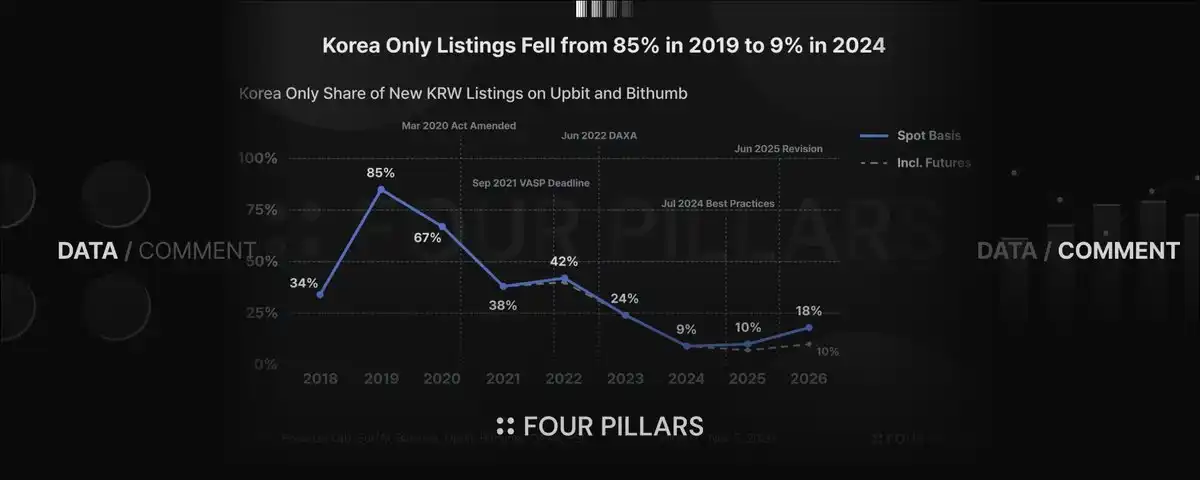
South Korea’s KRW crypto exchanges have fundamentally changed their listing logic. According to Bonanza Lab data across Upbit, Bithumb, Coinone, Korbit, and Gopax, the share of Korea-only token listings fell from 85% in 2019 to 9% in 2024, with a slight rebound to 18% in 2026 that drops back to about 10% when excluding assets first traded on overseas futures markets. The shift began with the 2021 Specific Financial Information Act, which required real-name bank accounts and traditional-finance-level AML compliance, and was reinforced by DAXA’s unified listing review guidelines effective July 2024, under which assets with two or more years of trading history on compliant overseas exchanges can automatically satisfy baseline disclosure and whitepaper requirements. Despite the collapse in local-first listings, total listings have grown: Upbit and Bithumb added 43 KRW-market tokens in 2022, 116 in 2023, 125 in 2024, and 238 in 2025. Listing timing remains cyclical—in the 2025 bitcoin high, 111 assets (47%) were brought to Korea within 30 days of overseas listing, while in 2026 mature assets with over a year of overseas trading became the mainstay (52 assets, 31%), including older tokens such as CRV and RSR. The consequences are clear. The share of assets hit by investment warnings or delisting within two years fell from 24% for the 2020 cohort to 10% for 2024. Among 2020–2024 listings, 44 of 148 Korea-only tokens (30%) faced warnings or delisting within two years, versus only 26 of 279 overseas-first tokens (9%). Overseas seasoning also reduces post-listing drawdowns: assets listed in Korea within 30 days of overseas launch saw a median 30-day price decline of 39%, compared with just 7% for assets with over a year of overseas trading history. The trade-off is revenue. Heavily traded overseas assets generate limited first-day speculative volume, and since Korean exchanges rely overwhelmingly on spot trading fees, weaker listing-day surges can hurt earnings. A renewed bull market could temporarily revive listings of newly launched overseas assets, but exchanges cannot build a durable, cycle-resistant business on listing structure alone. Their core challenge is to create new trading demand and diversify revenue beyond listing-driven fees.

marsbit1h ago

From 85% to 9%: The Dramatic Shift in Korean Exchange Listing Logic—Tokens Are Safer, but Is the Business Harder?

marsbit1h ago

Trading

Spot
活动图片