US Nonfarm Payrolls Unexpectedly Strong, Probability of September Rate Hike Rises to About 60%, Market Eyes Next Week's CPI

marsbitPublished on 2026-09-05Last updated on 2026-09-05

Abstract

U.S. August non-farm payrolls came in significantly stronger than expected, adding 162k jobs—nearly triple economists' forecasts. This robust employment data signals ongoing economic resilience and has sharply increased market expectations for a Federal Reserve rate hike at the September meeting, with fed funds futures now pricing in roughly a 60% probability of an increase. The data prompted immediate market adjustments: U.S. equities closed lower on Friday, and Treasury yields climbed, with the policy-sensitive 2-year yield rising to its highest level since January 2025. However, broader market impact remained contained for now, as major stock indexes still posted weekly gains and credit spreads stayed relatively low. Analysts note that despite higher rates, financial conditions remain accommodative, corporate earnings are strong, and the AI investment boom—evident in job gains in sectors like construction and manufacturing—is providing economic support. While the non-farm payrolls report tilts the policy debate toward a more hawkish stance, it does not conclusively determine the Fed's next move. Market focus is now firmly shifting to the upcoming Consumer Price Index (CPI) report. Analysts warn that if inflation data remains elevated and further pushes up rate expectations, it could force investors to more aggressively reduce risk exposure, potentially increasing market volatility. The CPI release, alongside political considerations around the midterm elections, is seen ...

Author: Wall Street News

The US August nonfarm payrolls data significantly exceeded expectations, further widening market divergence over the Fed's September policy path. The strong job growth indicates the US economy remains resilient and has led markets to reassess their expectations for further Fed rate hikes. US stocks fell on Friday, Treasury yields broadly rose, and gold came under pressure.

Data released by the US Labor Department on Friday showed that nonfarm payrolls increased by 162,000 in August, about three times the economists' forecast. The stronger-than-expected employment performance suggests the labor market has not deteriorated as significantly as markets had previously feared, further complicating the Fed's policy balancing act between employment and inflation.

Federal funds futures markets indicate that the probability of a Fed rate hike at the September 16th meeting has risen to about 60%. Previously, Fed Governor Waller signaled a preference to hold rates steady, leading to some retrenchment in market bets for a September hike.

Market reactions subsequently tilted hawkish. The three major US stock indices closed lower across the board on Friday, and US Treasury yields broadly moved higher. However, on a weekly basis, the S&P 500 and Nasdaq 100 indices still posted gains, indicating the market adjustment triggered by this employment data remains relatively limited so far.

US Treasury Yields Rise Across the Curve, Risk Assets Show No Significant Pressure Yet

Following the employment data release, US Treasuries were sold off, with yields rising broadly across maturities.

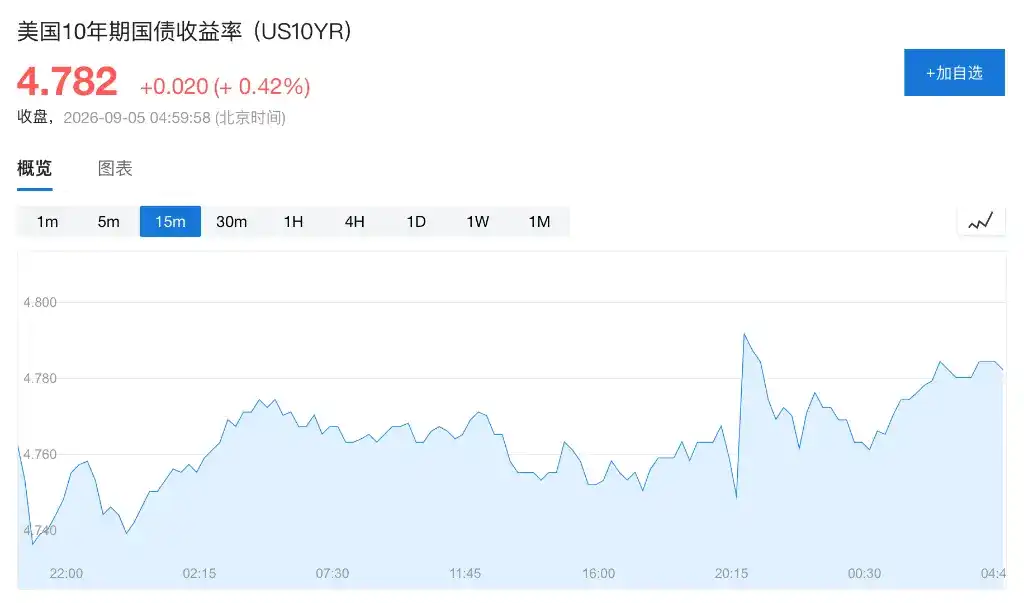
Among them, the most policy-sensitive 2-year Treasury yield rose 3.4 basis points to 4.3703%, hitting an intraday high of 4.416%, the highest since January 2025; the 10-year Treasury yield rose 2.2 basis points to 4.782%; the 30-year Treasury yield edged up 0.3 basis points to 5.246%.

However, the transmission of this bond market volatility to other risk assets remains limited. Credit spreads remain at low levels, and the cost of downside protection for risk assets is also relatively modest. JPMorgan notes that US Treasury market liquidity has deteriorated noticeably, but similar pressures have not yet appeared in stock index futures or corporate bond ETFs.

Collin Martin, Head of Fixed Income Research and Strategy at Charles Schwab, said current financial conditions remain accommodative, and credit spreads are still at exceptionally tight levels. Meanwhile, corporate earnings are growing over 20% year-over-year, and current corporate financing costs do not yet appear to pose a significant strain on businesses.

This means that, despite the employment data pushing up rate expectations, the impact of high interest rates on corporate financing and risk assets has not yet fully materialized.
AI Investment Boom Provides Support, Employment Structure Shows Divergence

The current resilience of the US economy is also linked to the ongoing boom in AI infrastructure investment.

Brad Conger, Chief Investment Officer at Hirtle & Co., stated that the contours of 'AI substitution effects' are already faintly visible in the August employment data: combined, the finance and information sectors lost 34,000 jobs, while employment in construction, manufacturing, and utilities—sectors related to data center construction, equipment supply, and power infrastructure—was notably stronger.

Economists at BNP Paribas noted in a client report that this employment report shows the US economy remains in a cyclical expansion phase, supported significantly by accommodative policies and the AI infrastructure construction boom. With labor supply constrained, the unemployment rate could continue to fall, and wages face upward pressure.

At the same time, high financing costs have not yet significantly suppressed credit expansion. JPMorgan found that, although borrowing costs have risen, US loan volumes and money creation have not contracted in sync; bank lending is still growing, and net issuance of US investment-grade corporate bonds also increased in August.

Therefore, the current US economic situation does not represent a typical 'high-interest-rates-suppress-demand' scenario. While corporate financing costs have increased, credit activity and investment demand continue to show some growth, which is also one reason why risk assets have not seen more severe adjustments in response to the hawkish-leaning employment data.

Rate Hike Expectations Intensify, CPI to Become Next Key Validation

While the nonfarm payrolls data is clearly hawkish-leaning, it is not enough to completely determine the Fed's next policy step. The market will now shift more focus towards inflation data.

Dan Suzuki, Global Investment Strategist at iCapital, warned that if interest rates rise significantly further, it could force investors to more aggressively cut risk exposure and further deteriorate market sentiment.

Sarah Hunt, Chief Market Strategist at Alpine Saxon Woods, said that compared to a weaker employment report, this data provides significantly less policy basis for the dovish camp.

Marvin Loh, Senior Macro Strategist at State Street, pointed out that Friday's employment report again shows the US economy is performing well even without structural conditions to lower unemployment. He believes the market is signaling to the Fed that it 'should hike rates' and still expects the Fed to raise rates within the year.

Greg Boutle, Head of US Equity & Derivatives Strategy at BNP Paribas, stated that with the earnings season largely over, macroeconomic data will be important variables influencing the market in the coming weeks. He believes it's appropriate to adopt a more cautious stance on stocks now, but it's not yet time for a definitive bearish view.

In his view, while Friday's nonfarm payrolls data leaned slightly hawkish, it has not fully clarified the Fed's next policy direction. The most critical variables ahead are the CPI data to be released next week, and whether the Fed will choose to hike rates before the US midterm elections.


Related Questions

QWhat was the key takeaway from the August US non-farm payroll report regarding the Federal Reserve's next move?

AThe much stronger-than-expected August non-farm payroll data significantly increased market expectations for a Federal Reserve rate hike in September, with the probability rising to about 60% according to federal funds futures.

QHow did the financial markets react immediately to the strong non-farm payroll data?

AFinancial markets reacted with a hawkish tilt. US stock indices fell, and US Treasury yields rose across the board, with the policy-sensitive 2-year yield hitting its highest level since January 2025. However, the broader market adjustment was seen as limited.

QAccording to the article, what is one reason the strong employment data hasn't triggered a more severe sell-off in risk assets yet?

AOne key reason is that, despite higher interest rate expectations, the actual impact of high rates has not fully materialized. Financial conditions remain relatively loose, credit spreads are narrow, corporate profits are strong, and AI infrastructure investment is providing economic support.

QWhat structural shift in employment was hinted at in the August jobs report, according to Hirtle & Co.'s CIO?

AThe report hinted at an 'AI substitution effect,' where sectors like financial activities and information lost jobs, while industries related to AI infrastructure—such as construction, manufacturing, and utilities tied to data center building and power supply—saw stronger employment gains.

QWhat is the next critical piece of data that markets will focus on to gauge the Fed's policy path after this jobs report?

AMarkets will now shift their primary focus to the upcoming Consumer Price Index (CPI) inflation data, as it will be a crucial factor in determining whether the Federal Reserve will proceed with a rate hike at its next meeting.

Related Reads

The Crypto Revenue Narrative Is Just Beginning: How Token Buybacks Are Reshaping Valuation Logic?

Despite a challenging 2026 crypto market, on-chain protocols have generated $11.68 billion in real revenue year-to-date, with full-year projections near $13.9 billion—signaling a shift from narrative-driven speculation toward fundamentals-based investing. As institutional capital prioritizes traditional business metrics, protocols that convert commercial success into tokenholder value are outperforming. Token buybacks have become the key mechanism for linking revenue to token value, since most tokens confer no legal claim on profits. While 2025's buyback wave saw mixed results, 2026 data shows tokens with active buybacks averaged +62.2% YTD returns versus -31.6% for those without—a 93.8 percentage point gap—even as total crypto market cap fell ~19%. Buybacks also outperformed direct revenue-sharing models. Success depends on four criteria: funding from real revenue, proven product-market fit, transparent execution, and sustainable capital allocation—plus market conditions, token supply growth, and flexible versus programmatic execution. Notable cases include Hyperliquid ($505M+ in buybacks), World Liberty Financial (linking USD1 stablecoin reserve income to WLFI buybacks), Venice (privacy AI with $100M+ annualized revenue and record burns), Bittensor subnets (14 of 24 revenue-generating subnets回购 Alpha tokens), and Robinhood Chain's LONG 500 mechanism tying buybacks to tokenized stocks. The author argues the revenue narrative is still early: when a full bull market returns, rising adoption and revenue will expand buyback demand, amplifying upside potential.

marsbit1m ago

The Crypto Revenue Narrative Is Just Beginning: How Token Buybacks Are Reshaping Valuation Logic?

marsbit1m ago

Nvidia's New Chief Kress: Once Cut a $250 Billion Guarantee in Half, Now Applying the Brakes to AI Financing

Nvidia’s founder Jensen Huang has stepped down amid a scandal, ending an era in which the company acted as the “central bank of AI” by building a circular financing network worth over $500 billion through equity investments, credit guarantees, and lease backstops. His successor is CFO Colette Kress, whom Huang had derided as a “frightened deer” and a “reporting CFO.” Kress had already been quietly applying the brakes: she cut Nvidia’s backstop commitment for OpenAI’s Ohio data center from $2,500 billion to about $1,050 billion, questioned how guarantees were priced and how returns were calculated, and pushed for board and executive review of new revenue-sharing credit deals. Nvidia’s contingent liabilities and commitments reached $530.5 billion as of its July 26 10-Q, excluding newer deals and a planned $500 billion AI compute financing platform in which Nvidia would backstop up to $125 billion. That platform, announced in August with six major asset managers, has yet to close a single transaction, partly because Nvidia’s 25% residual-value support is far below rivals’ guarantees, such as Broadcom’s roughly 86% backstop on a $35 billion Anthropic debt deal. Analysts expect existing binding commitments, including $5 billion for Safe Superintelligence and about $2.5 billion for Thinking Machines Lab, to be honored, but say future large multi-party ecosystem investments will be harder without Huang’s vision, relationships, and convening power. Deals still in negotiation—including a potential $10 billion investment in Anthropic’s IPO, over $5 billion in credit support for Nscale, at least $2 billion in private financing for Firmus, and a possible $1 billion follow-on for Figure AI—face greater uncertainty. Goldman Sachs, UBS, and others warn that a pause in Nvidia’s financing could withdraw $50 billion or more per quarter from the AI ecosystem, potentially triggering a broader repricing of AI risk. Kress will host Nvidia’s third-quarter earnings call on November 17, where analysts will press her on the $500 billion in commitments and whether Nvidia will continue to act as the “AI central bank.”

marsbit1m ago

Nvidia's New Chief Kress: Once Cut a $250 Billion Guarantee in Half, Now Applying the Brakes to AI Financing

marsbit1m ago

Microsoft 365 outage hits Outlook email and Teams calendars worldwide

A global Microsoft 365 outage continued into Friday, disrupting Outlook email and some Teams features. Microsoft said in a 7:25 am UTC update that a patch had improved stability on some servers and that it was working to deploy the fix more widely, but gave no timetable for restoration. The outage began Thursday, leaving some users unable to access their Exchange Online mailboxes. Microsoft said a process handling secure connections became overloaded, causing affected servers to stop processing requests. The company attempted to restore services by restarting infrastructure, redirecting network traffic and expanding server capacity, and said there was no indication of a security breach. The outage also affected features in Microsoft Copilot and Defender for Office 365. In Teams, users had trouble scheduling meetings and sending invitations, though Microsoft said most Teams calls and chats continued to work. Businesses and government agencies worldwide use Microsoft 365 for email and scheduling; Microsoft reported more than 450 million paid commercial seats for the suite in an October filing. Exchange Online hosts the mailboxes and calendars those organizations use, and outside apps, including AI assistants, rely on the same service to retrieve that data when users connect their work accounts. OpenAI reported errors in ChatGPT's Microsoft 365 connector, and Anthropic said the outage caused most email, calendar and search requests through Claude's Microsoft 365 connector to fail. The US Court of Appeals for the Tenth Circuit said its clerk's office could neither send nor receive email for much of Thursday. Japan's Finance Ministry said it was unable to receive email on Friday, and Singapore's Government Technology Agency told CNA that government email was among systems affected.

cointelegraph12m ago

Microsoft 365 outage hits Outlook email and Teams calendars worldwide

cointelegraph12m ago

Trading

Spot
活动图片