US Crypto Policy Debate Intensifies as CLARITY Act Support Fractures

bitcoinistPublished on 2026-01-16Last updated on 2026-01-16

Abstract

Washington's efforts to regulate the crypto market face new uncertainty as the CLARITY Act, a key legislative proposal, encounters significant setbacks. Coinbase withdrew its support, citing concerns over restrictions on tokenized equities, crypto rewards, and expanded government data access. This prompted a pause in the Senate Banking Committee's progress on the bill, though the White House reaffirmed its backing. The debate centers on whether the SEC or CFTC should have primary oversight, with exchanges favoring the CFTC's commodity-based approach. Industry leaders are divided, with some supporting the bill as a necessary step forward despite its flaws, while others warn it could stifle innovation. Stablecoin regulation and consumer protection remain contentious issues.

Washington’s long-running effort to bring regulatory clarity to the U.S. crypto market has entered a more uncertain phase. The Digital Asset Market Clarity Act, known as the CLARITY Act, was expected to move closer to a Senate vote this week.

Instead, a sudden withdrawal of support from Coinbase and a last-minute pause by Senate leadership have exposed deep divisions within the industry and among lawmakers. While the White House insists the bill is still on track, the debate over how digital assets should be regulated is becoming more fragmented.
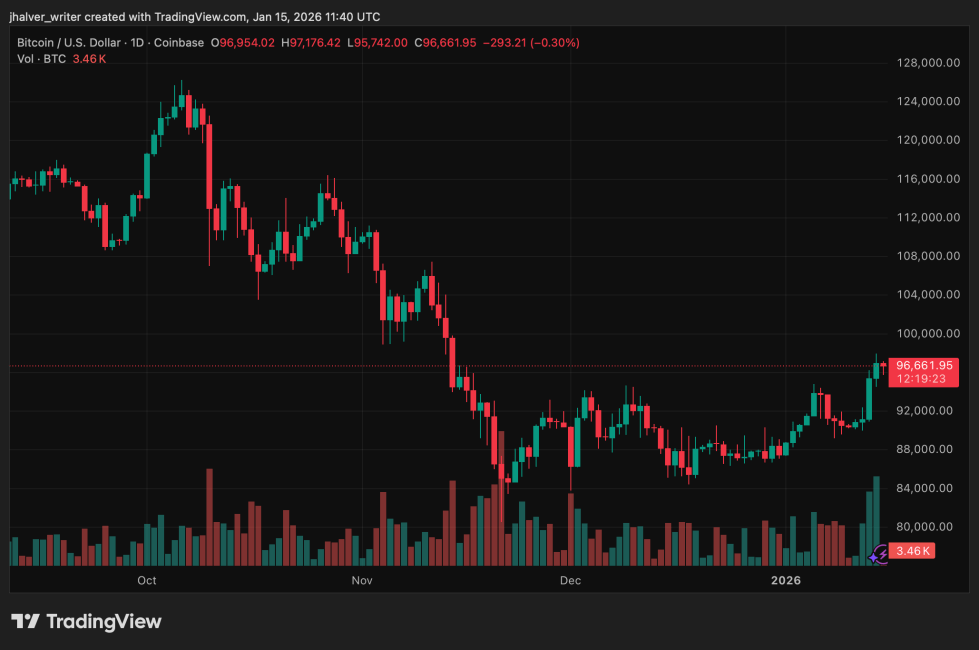
BTC's price records some gains on the daily chart. Source: BTCUSD on Tradingview

Coinbase Withdrawal Triggers Legislative Pause

The immediate turning point came when Coinbase CEO Brian Armstrong announced that the company could no longer support the current draft of the CLARITY Act.

Armstrong argued that the bill would be worse than the existing regulatory uncertainty, citing concerns over limits on tokenized equities, restrictions on crypto rewards, and expanded government access to financial data.

Shortly after, Senate Banking Committee Chair Tim Scott introduced a brief pause in the bill’s progress, cancelling a scheduled markup.

Scott described the delay as procedural rather than political, stating that negotiations were ongoing and bipartisan talks continued. A new markup date has been set for January 27, once updated bill language is released.

Despite the setback, White House AI and crypto czar David Sacks reiterated that the administration still backs the legislation. He said the pause should be used to resolve remaining issues and push forward a framework that allows innovation while strengthening oversight.

Industry Split Over SEC and CFTC Roles

At the core of the dispute is the division of regulatory authority between the Securities and Exchange Commission (SEC) and the Commodity Futures Trading Commission (CFTC) as outlined in the CLARITY Act.

Crypto exchanges generally favor the CFTC’s approach, which treats many digital assets as commodities. The SEC, by contrast, applies securities laws that impose stricter compliance requirements.

Critics argue the bill shifts too much power to the SEC, particularly over tokenized equities and certain crypto products. Coinbase has warned that the proposed rules could effectively block the development of on-chain stock trading and limit user reward programs.

Other industry leaders, including executives from Ripple, a16z, and Kraken, have taken a more cautious stance. While acknowledging flaws in the draft, they argue that passing some form of market structure legislation is better than leaving the sector in regulatory limbo.

Banks, Stablecoins, and the Broader Stakes

Another contentious issue is stablecoin regulation. The CLARITY Act would make it difficult for crypto platforms to offer yield or interest-like rewards on stablecoin holdings. Banks support these restrictions, saying they protect financial stability.

Lawmakers also point to past failures, such as the FTX collapse, as evidence that clearer rules are needed to protect consumers and national security. However, frustration is growing behind the scenes.

Senate sources indicate that some committee members were dissatisfied with Coinbase’s timing, perceiving the withdrawal as disruptive to months of negotiations.

Cover image from ChatGPT, BTCUSD chart from Tradingview

Related Questions

QWhat was the immediate trigger that caused a pause in the progress of the CLARITY Act?

AThe immediate trigger was Coinbase CEO Brian Armstrong's announcement that the company could no longer support the current draft of the bill.

QAccording to Coinbase, what are some specific concerns they have with the proposed CLARITY Act?

ACoinbase cited concerns over limits on tokenized equities, restrictions on crypto rewards, and expanded government access to financial data.

QWhich two U.S. regulatory agencies are at the core of the dispute over the CLARITY Act?

AThe Securities and Exchange Commission (SEC) and the Commodity Futures Trading Commission (CFTC) are at the core of the dispute.

QWhat is the new date set for the markup of the CLARITY Act after the pause?

AA new markup date has been set for January 27, once updated bill language is released.

QBesides Coinbase, which other industry leaders were mentioned as taking a more cautious stance on the bill?

AExecutives from Ripple, a16z, and Kraken were mentioned as taking a more cautious stance, arguing that passing some form of legislation is better than regulatory limbo.

Related Reads

TechFlow Intelligence Bureau: KelpDAO Attack Causes Nearly $300 Million Loss, Triggers Aave Withdrawal Wave, RAVE Crashes 95% in a Single Day

China's AI firm DeepSeek is seeking external funding for the first time, with a valuation exceeding $10 billion, signaling intensifying competition and high R&D costs in the domestic large model sector. Meanwhile, OpenAI CEO Sam Altman faces scrutiny over potential conflicts of interest between his personal investments and OpenAI’s business ahead of a possible IPO. In Web3, KelpDAO suffered a $294 million attack due to forged cross-chain messages on LayerZero, leading to massive withdrawals from Aave and a resulting 18% drop in AAVE tokens. Separately, RAVE cryptocurrency collapsed by 95% in a single day amid suspected insider manipulation. Geopolitically, Iran is now demanding Bitcoin payments for transit through the Strait of Hormuz, reflecting both internal governmental discord and the growing adoption of crypto in tense regions. In semiconductors, Nvidia CEO Jensen Huang showed rare public frustration over questions regarding chip sales to China, while the industry faces renewed price hikes. Tesla continues expanding its Robotaxi service, and a Chinese humanoid robot outperformed humans in a half-marathon, marking a milestone in robotics. Despite Middle East tensions and market uncertainties, U.S. stocks continue to rise, prompting discussions about market optimism versus risk blindness. Overall, today’s developments highlight systemic vulnerabilities—in tech, finance, and geopolitics—while also showcasing innovation in crises.

marsbit5h ago

TechFlow Intelligence Bureau: KelpDAO Attack Causes Nearly $300 Million Loss, Triggers Aave Withdrawal Wave, RAVE Crashes 95% in a Single Day

marsbit5h ago

Trading

Spot
Futures
活动图片