Trump's Perplexing Fed Threat Might Be a Gift to Warsh

marsbitPublished on 2026-09-08Last updated on 2026-09-08

Abstract

Former President Donald Trump's puzzling call for Federal Reserve interest rate cuts and threats to halt trade with countries running U.S. deficits has drawn market confusion rather than movement. Reuters columnist Mike Dolan argues this rhetoric, lacking logical coherence, paradoxically presents new Fed Chair Kevin Warsh with an opportunity. By pushing for a rate hike at the upcoming September meeting, Warsh could credibly distance the central bank from White House pressure, reaffirm its commitment to the inflation target, and bolster his own credibility. With strong August jobs data, growth accelerating, and core inflation persistently above 2%, few economists see a case for cuts. A 25-basis-point hike, Dolan suggests, would be a strong public relations move to end speculation that Warsh is a White House "puppet" and could even help lower long-term borrowing rates by reinforcing the Fed's anti-inflation resolve. The article notes Trump's history of turning on his Fed appointees, implying Warsh faces a critical choice that may ultimately anger his patron.

Author: Mike Dolan

Compiled by: TechFlow

Deep Tide Digest: Last Friday, positive U.S. August employment data emerged, yet Trump suddenly pivoted to criticize the Federal Reserve, demanding "interest rate cuts, or else stop trading with countries with deficits." Reuters columnist Mike Dolan points out that this statement is logically incoherent and barely elicited a market reaction. However, it precisely presents an opportunity for Fed Chair Kevin Warsh, who took office this past May, to push for a rate hike this month. This move would reaffirm the Fed's commitment to its inflation target and demonstrate that he is not the White House's "puppet," thereby creating distance from the President and building his own credibility.

Trump's inexplicable linking of U.S. interest rate policy with trade relations with America's largest trading partners has generated more confusion than market volatility. But the President's outlandish statement has instead given Federal Reserve Chair Kevin Warsh an opportunity: to drive a Fed rate hike this month, convincingly creating distance from the White House and boosting his own credibility.

Last Friday should have been a reasonably good day economically for the President. After all, U.S. August job growth came in three times higher than expected, and a significant portion of the summer's weak job figures were revised upward. Diesel prices did hit a record high earlier that day, potentially adding upward pressure on inflation. However, the modest wage growth in the jobs report could also be interpreted as another reason for the Fed to stand pat ahead of this Friday's inflation data, coming just days before the Fed's next meeting.

Trump needed some good economic news. With only two months until the midterm Congressional elections, his overall approval rating remains at the low point of his two terms, and 71% of Americans (including four in ten Republicans) disapprove of his handling of the cost of living.

Yet, instead of focusing on the positive August jobs data, Trump quickly and somewhat inexplicably pivoted to attack the Fed, telling the central bank what it should do and threatening what he would do if it didn't comply.

"High interest rates put the U.S. at a very unfair disadvantage, I won't allow it!" Trump wrote on his Truth Social platform, while praising Warsh as "great." "We should have the lowest interest rates in the world... No rate cut, I'll stop trading with those countries where we have a deficit," Trump added.

The main problem with this argument is that it simply doesn't make sense. Even commentators typically supportive of the President either gave up trying to parse it or ignored it outright. Given the market's concerns over the past 18 months about the President's persistent political pressure on the central bank—including his willingness to force its hand through political appointments—this apparent disregard is noteworthy.

Trump has repeatedly called for significant rate cuts during his second term and has threatened multiple times to fire Warsh's predecessor, Jerome Powell, for not complying. He has also frequently questioned why America's economic strength shouldn't also grant it the world's lowest interest rates, even though most economists would struggle with the notion that a high-growth economy should have lower borrowing costs—considering the inflationary impact of overheating, the opposite is typically true.

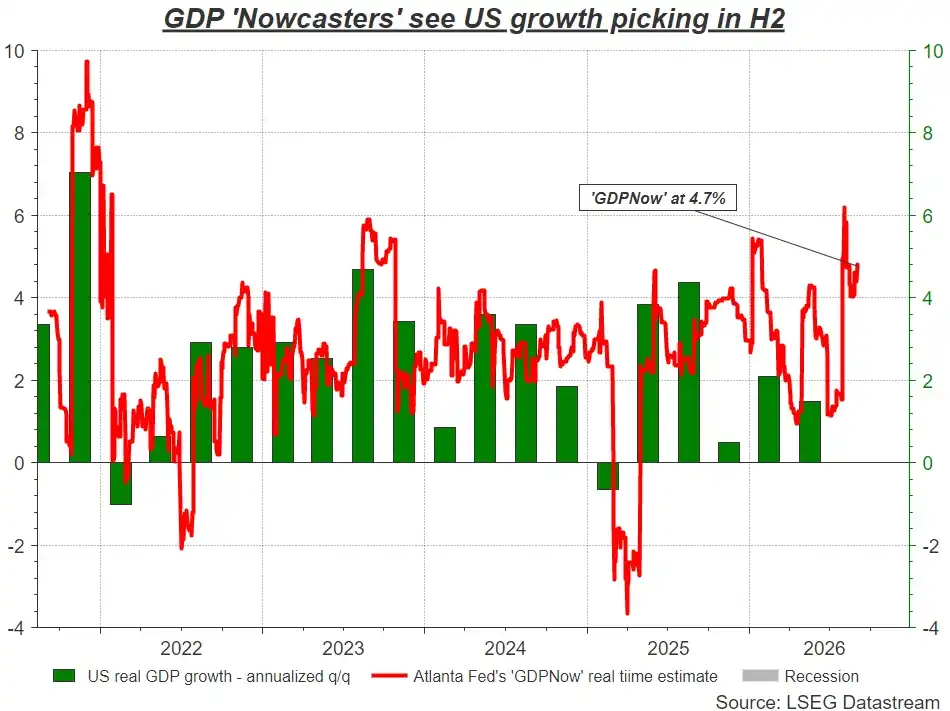
More importantly, with core inflation running above the Fed's 2% target for 65 consecutive months, growth accelerating, financial conditions loose, and full employment effectively achieved, almost no one believes the Fed should be cutting rates now—not even those who think a September hike (currently priced by futures markets at over a 50% probability) might be slightly premature.
Even if one agreed with the call for rate cuts now, despite the cost-of-living issues, linking the Fed's hesitation to a threat to "stop trading with foreign countries" has left most commentators and investors questioning the President's grasp of basic economics.

"Clueless" or "Puppet"?

Perhaps Friday's post was just a hasty attempt to re-energize his latest offensive in the trade tariff war. But even then, deliberately weakening foreign economies by cutting off imports via tariffs or executive order could prompt those countries to cut rates while also potentially raising import prices at home. That wouldn't give the U.S. the world's lowest interest rates.

The market's lack of reaction to Trump's latest Fed comments might indicate investors are growing more skeptical and cautious about the President's increasingly outlandish posts. For example, Trump recently claimed to have "blown to pieces" Iran's Kharg Island oil hub, which turned out to be completely false.

So where does this leave Kevin Warsh? The Trump-appointed chair has struggled to establish his own credibility since taking office in May, with concerns about White House political pressure constantly looming over him.

However, Warsh seemed to lean noticeably hawkish in his recent keynote speech at Jackson Hole.

A rate hike now would not only highlight the Fed's commitment to its inflation target (regardless of how little consumer price inflation trends fluctuate this week) but also affirm Warsh's control over the central bank and help him create distance from the President.

"A 25bp hike is good PR. It ends the credibility narrative and months of speculation over whether Warsh is a puppet," wrote TS Lombard economist Dario Perkins. He noted that in the last 50 years, only Janet Yellen didn't raise rates within two months of becoming Fed chair.
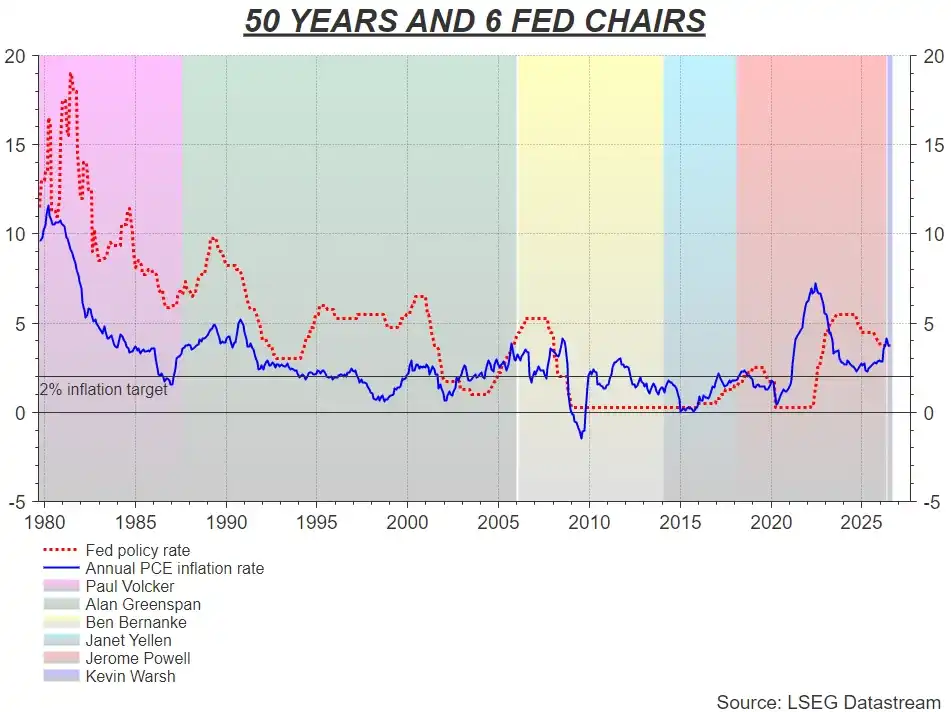
The perceived cost of the Fed and its current head being seen as cowed by a White House whose views are "hard to explain" outweighs any negative impact from a quarter-point hike. In fact, hiking now might even help lower long-term bond borrowing rates by reaffirming the Fed's inflation-fighting credibility, taking some pressure off Treasury Secretary Scott Bessent; and long-term rates arguably have a bigger impact on the economy than the policy rate.

"Warsh only gets credibility when Trump starts calling him an idiot!" Perkins added.

For now, Warsh still seems "great" in the President's eyes. But it took Trump only a year to go from praising Powell as "brilliant" to labeling him "clueless" as rates kept rising. Warsh faces significant choices, even if they risk angering the person who appointed him.

(These views are those of the author, Mike Dolan, a Reuters columnist.)

Related Questions

QWhat is the main point made by the author regarding President Trump's recent criticism of the Federal Reserve?

AThe author argues that President Trump's illogical criticism of the Federal Reserve and his demand for rate cuts paradoxically provides an opportunity for Fed Chairman Kevin Warsh to raise rates, which would help him establish credibility and distance himself from the White House.

QAccording to the article, why is President Trump's argument for lower interest rates considered illogical?

ATrump's argument is considered illogical because it suggests a high-growth economy like the U.S. should have the world's lowest interest rates, while most economists believe the opposite is typically true due to inflationary pressures from an overheating economy. Furthermore, his threat to stop trade with countries running a deficit with the U.S. has no logical connection to Fed rate policy.

QWhat opportunity does Trump's critique create for Fed Chairman Kevin Warsh, according to the analysis?

ATrump's critique creates an opportunity for Warsh to lead the Fed in raising interest rates. This move could demonstrate the Fed's commitment to its inflation target, confirm Warsh's control over the central bank, and help him build personal credibility by distancing himself from political pressure from the White House.

QHow did the market react to President Trump's latest comments on the Federal Reserve, and what does this reaction suggest?

AThe market showed little reaction to Trump's latest comments. This lack of reaction suggests investors are becoming increasingly skeptical and cautious towards the president's more outlandish posts, as seen with his earlier false claim about bombing an Iranian oil hub.

QWhat is the significance of a potential rate hike for Fed Chairman Kevin Warsh's reputation, as highlighted in the article?

AA potential rate hike is significant for Warsh's reputation because it would serve as a strong public relations move. It could end the narrative questioning his credibility and speculation that he is a 'puppet' of the White House, ultimately helping him establish his independence and authority as Fed Chair.

Related Reads

Has the Time Come to Buy the Dip on Nvidia?

Nvidia announced on November 12 that Jensen Huang resigned as President, CEO, and Director, effective immediately. Shares fell as much as 14% intraday to $148.8, down nearly 40% from October highs, with over $600 billion in market value briefly erased. The founder's departure triggered the selloff, but the market is repricing the entire company rather than reacting to a single risk. Nvidia now trades at roughly 12x forward PE, its lowest in 15 years and below the S&P 500's ~18x, despite strong fundamentals: FY2026 revenue of $215.9 billion (+65%), data center revenue of $62.3 billion in a single quarter, ~75% gross margins, and Q2 FY2027 revenue of $96.2 billion with $21.3 billion free cash flow. Most investment banks cut targets but maintained Buy/Overweight ratings (Barclays $210, Goldman $220, Citi $225, RBC $230), implying ~20% upside, while Truist downgraded to Hold at $174. The consensus: the business is intact, but its valuation multiple needed resetting. Supporting demand, Huang forecast at GTC 2026 that Blackwell and Rubin AI chip demand would reach at least $1 trillion by 2027, double the prior 2026 estimate. However, risks remain beyond CEO succession. CUDA's lock-in effect is eroding on the inference side—Anthropic disclosed that its Claude Mythos Preview autonomously ported core GPU kernels to AMD flagship GPUs in three days with minimal human intervention, prompting investor Marcelo P. Lima's widely cited claim that "Nvidia's CUDA moat no longer exists." Supply bottlenecks lie in HBM and packaging, not wafers: TSMC can cut over 400 million GPU dies annually, but Nvidia ships only ~10 million GPUs yearly, constrained by HBM capacity (~3.75EB globally, ~70% allocated to Nvidia, ~260GB per GPU) and tight packaging, with HBM4 adjustments possibly delaying Rubin. Huang also leaves behind highly personalized assets—strategic technology judgment, supply chain negotiation with TSMC and SK Hynix, and direct channels to customers and governments—that interim CEO Colette Kress, the long-time CFO, may not fully replace. In short, the business remains, but the "faith premium" is being systematically stripped away. At 12x forward PE, much pessimism is priced in, offering a favorable risk-reward window if AI capex holds and demand materializes. Yet cheapness alone isn't sufficient: CUDA's erosion is slow but irreversible, HBM and packaging limit revenue upside, and succession uncertainty means the founder premium may not be fully removed. As Bernstein noted, "if you see two ants in the kitchen, there are more than two," warning that chains from scandal to governance vacuum to government probes could trigger further selloffs. Until the dust settles, what a Jensen-less Nvidia is worth remains an open question.

marsbit12m ago

Has the Time Come to Buy the Dip on Nvidia?

marsbit12m ago

AI Bull Market Trap? The Big Short Seller Strikes Again

Recent signals from Goldman Sachs, the Federal Reserve, and prominent short-seller Michael Burry are converging on concerns about the AI trade. Goldman warns that AI capital expenditure growth will likely peak in early 2027, with the boost to S&P 500 earnings falling from a 12-point peak in 2026 to a 5-point drag by 2028, shifting the market from a one-way rally to two-way volatility. The Fed has flagged AI as a potential threat to asset valuations and financial stability. Burry has doubled his Nasdaq 100 put options and rebuilt short positions in a semiconductor ETF, calling this a "bull market trap" analogous to the 2000 dot-com bubble, with Nvidia's influence a key worry. Four pressures weigh on the AI narrative: peaking capex growth, high interest rates that hit long-duration AI assets and leveraged GPU cloud providers like CoreWeave and Nebius, circular financing risks among interconnected tech firms, and tighter regulation under Democrats affecting data center energy, land, and permitting. Nvidia-related turmoil has shaken the pricing anchor for the entire supply chain. However, a valuation bubble bursting does not mean the AI industry is declining. Goldman notes US cloud giants trade at just 19.7x forward P/E, below their 20-year historical range and even below defensive staples, suggesting much pessimism is already priced in. Opportunities are shifting from upstream hardware "shovel sellers" toward fairly valued cloud giants with improving free cash flow, AI application companies delivering real ROI, and deeply discounted cyclical names like Korean memory. Conversely, GPU cloud providers dependent on Nvidia orders and cash-burning startups without products are most vulnerable. Investors should diversify, hedge, and focus on assets that convert spending into stable returns.

marsbit17m ago

AI Bull Market Trap? The Big Short Seller Strikes Again

marsbit17m ago

Just Offered 3.3 Million Yuan Salaries to Poach Talent, OpenAI Suddenly Dissolves Robotics Team—Is the Industry About to Change!

OpenAI has disbanded its standalone robotics research team, confirmed shortly after booking booth 208 at the CoRL robotics conference in Austin went empty on November 13. The move surprised many, given that just months earlier OpenAI was aggressively hiring robotics talent—some roles paying up to $500,000 base salary—and had expanded its San Francisco data-collection lab to about 100 workers across three shifts, with a second lab planned in Richmond, California. Researchers from the robotics team are now folded into Chief Research Officer Mark Chen's core research division, while robotics applications and hardware staff move to President Greg Brockman's Applied division. OpenAI says robotics remains part of its long-term vision and the reshuffle is meant to accelerate progress. This is not OpenAI's first robotics retreat: it ended its first independent robotics effort in 2020 to focus on large language models, which produced ChatGPT, and only rebuilt a team in 2024. OpenAI explains the latest pivot technically—researchers initially believed video-generation models like Sora could teach robots physics, but general models such as GPT-6 Astra proved capable of directly controlling robots, so robotics work is being merged into the general foundation-model team. The broader industry context supports this shift. Unitree's Wang Xingxing said his biggest mistake over the past decade was not trusting AI enough, noting GPT-6 integration exceeded expectations and that humanoid intelligence's tipping point may arrive within one to two years. Anthropic's Claude Fable 5.2 scored 64.9% on the RoboDojo Sim benchmark versus 29.8% for GPT-6 Astra, and Nvidia's Astranomy study showed GPT-6 Astra controlling simulated robots with 74.8% success using an agentic approach, beating the prior specialized-model best of 51.0%. Yet challenges remain: general models are costly and slow—GPT-6 Astra averaged 18.56 seconds per inference and about 30.9 million tokens (roughly $36.40 in API fees) per successful task—problematic for real factories where conveyor belts don't pause. Google DeepMind, Nvidia, Unitree and AgiBot continue training specialized robotics models; Google's Apollo 2 achieved 96% success sorting parts in Mercedes factories using paired reasoning and action models, while Nvidia's GR00T 2 reached 95% success after brief fine-tuning. Analysts suggest OpenAI now treats robotics as a downstream application of general intelligence, leveraging core model advances while using its data-collection and hardware capabilities to validate models on real robots.

marsbit17m ago

Just Offered 3.3 Million Yuan Salaries to Poach Talent, OpenAI Suddenly Dissolves Robotics Team—Is the Industry About to Change!

marsbit17m ago

"Strictest Ever" Wet-Lab Prediction Benchmark Released: Maxed-Out Reasoning and 5x Compute Still Won't Cut It

UniPat AI has launched Science Prediction Universe (SPU), a new benchmark that evaluates whether AI models can predict the outcomes of real wet-lab experiments before they are conducted. The benchmark covers 116 tasks and 4,207 wet-lab experiments across chemistry, materials science, biology, and medicine, drawing on recent papers and unpublished collaborations with institutions such as Stanford, Cornell, and Harvard. Models are given eight hours, an H20 GPU, internet access, and scientific software, and must submit a ranked prediction of experimental results, which is then scored against hidden ground-truth data using the Spearman correlation coefficient. To prevent memorization, evaluation runs in isolated, offline containers and screens outputs for paper identifiers. Results show that even leading models like Opus 5.5 and GPT-6 Astra remain far from reliable prediction: the best average score was 0.486, and only about half of tasks exceeded the random baseline. The study also found that increasing reasoning effort fivefold barely improved accuracy, since models often settled on an answer early and spent the rest of the time on minor adjustments. Likewise, more tool use and GPU calls did not reliably help. Performance varied sharply by measurement target, and API costs ranged 300-fold across configurations. SPU aims to give researchers and model developers a unified way to measure and improve AI's scientific judgment before investing in costly experiments.

marsbit4h ago

"Strictest Ever" Wet-Lab Prediction Benchmark Released: Maxed-Out Reasoning and 5x Compute Still Won't Cut It

marsbit4h ago

Trading

Spot
活动图片