Tidal Investment: We Remain Bullish on the AI Industry Chain, But the Reasons Have Changed

marsbitPublished on 2026-06-25Last updated on 2026-06-25

Abstract

Tidal Investment remains optimistic about the AI industry chain, but the rationale has shifted. The market narrative has changed. While recent large-scale IPOs (e.g., SpaceX) and major fundraising plans by tech giants like Alphabet and Meta have caused some nervousness, this isn't a sign of an AI peak. The focus has moved from the initial question of AI's viability to the sustainability of massive investment cycles. The key players—primarily the major cloud providers—are not slowing down; their capital expenditure (Capex) guidance for 2026 has been increased across the board (e.g., Alphabet to $180B, Amazon to $200B). This investment cycle is proving resilient and difficult to stop. Unlike traditional hardware cycles, current AI Capex is distributed across multiple physical layers—computing, memory, networking, and critically, power infrastructure. Bottlenecks are shifting from chips to elements like electricity, transformers, and cooling systems, which have much longer lead times and cannot be easily pre-built like fiber optics during the dot-com bubble. Supply chain data (e.g., Eaton's 240% YoY data center orders) confirms this broad-based, project-driven expansion. Market concerns are acknowledged but viewed differently. First, while Capex growth currently outpaces revenue growth, raising ROI questions, this mirrors the early scaling phase of cloud computing itself. A change in view would require concrete signals like downward Capex revisions or missed AI product target...

Author: Tidal Investment

I. The Market Has Switched Scripts

Recently, the market has been both excited and a bit nervous. SpaceX completed a massive $750 billion IPO, and OpenAI and Anthropic are also rumored to be preparing for listings. At the same time, Alphabet is planning an $800 billion equity financing round, and Meta is also arranging new funding.

Honestly, seeing so many giant companies asking the market for money simultaneously can unsettle almost anyone. But interpreting this wave as the peak of AI is too simplistic; it's more like the AI drama has flipped to the next scene.

Over the past two years, the market bought into demand explosion and industry imagination, wondering if AI was viable. By 2026, the question became: How long can this massive investment intensity be sustained?

Wu Shaokang, founder of Tidal Investment, says: "The market always sees the fast-moving variables, but what determines the direction of a cycle are often the slow-moving variables."

Standing in mid-2026, we remain bullish on the AI industry chain. But today's optimism can't be sustained by imagination alone. Talking about AI two years ago, you could talk about models, AGI. But talking about the same things today may not satisfy the market.

II. Money Is Flowing In, And It's Becoming More Aggressive

How do you judge if a cycle has run its course? See if those spending are still spending. Flipping through the books of the five major cloud providers, the answer is quite clear.

  • Alphabet: 2025 Capex $90 billion, 2026 guidance raised to $180 billion.

  • Amazon: 2025 Capex $130 billion, 2026 guidance raised to $200 billion.

  • The other three are also moving in the same direction: Meta 2026 guidance raised to $140 billion, Microsoft to $190 billion, Oracle FY26 already close to $60 billion.
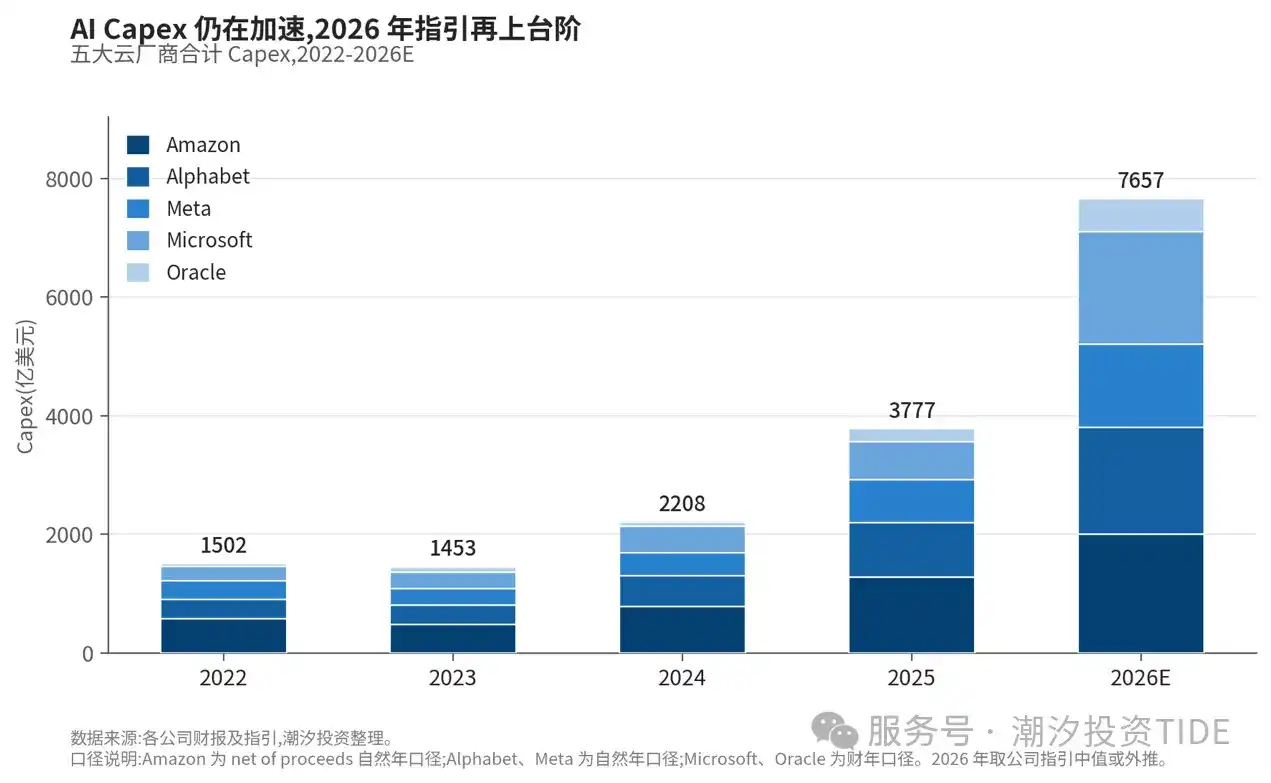
Laying out these numbers is a bit daunting. In the past, the greatest strength of these internet giants was considered their strong cash flow and ample reserves. But now, even they are proactively reaching out to the market for more funding in the face of AI. Besides that $80 billion equity financing, Alphabet also issued a significant amount of debt over the past year. AI infrastructure has become so large that even companies with the best cash flow need to restructure their capital.

Money is still flowing in, no doubt about that. The question is, how long can this spending continue?

III. Why This Investment Cycle Won't Stop

What are people most afraid of? Capex peaking, and this cycle running its course in two or three years like past tech hardware cycles, followed by a long digestion period. Servers, phones, PCs—many hardware cycles play out like this: demand picks up, then capacity expands, inventory piles up. Once downstream slows, the entire chain faces valuation compression.

This concern is valid in past cycles. But this AI Capex cycle might not be so simple.

First, the money is being thrown at too many places. Cloud providers' money is all labeled Capex, but when broken down, they're completely different: compute, memory, networking, power—each layer has its own expansion rhythm and bottlenecks. And with engineering, once it starts, stopping halfway is often more costly than pushing through.

More crucially, bottlenecks are shifting from chips down to more physical constraints. Chip shortages can be addressed by expanding production, but expanding production for power, transformers, high-power density cabinets isn't as fast. Just getting grid access can often mean waiting in line for years.

And Capex is no longer just about GPUs. Clear signals from the supply chain show this: Eaton, which makes power distribution equipment, saw a 240% year-over-year increase in data center orders in Q1 2026.
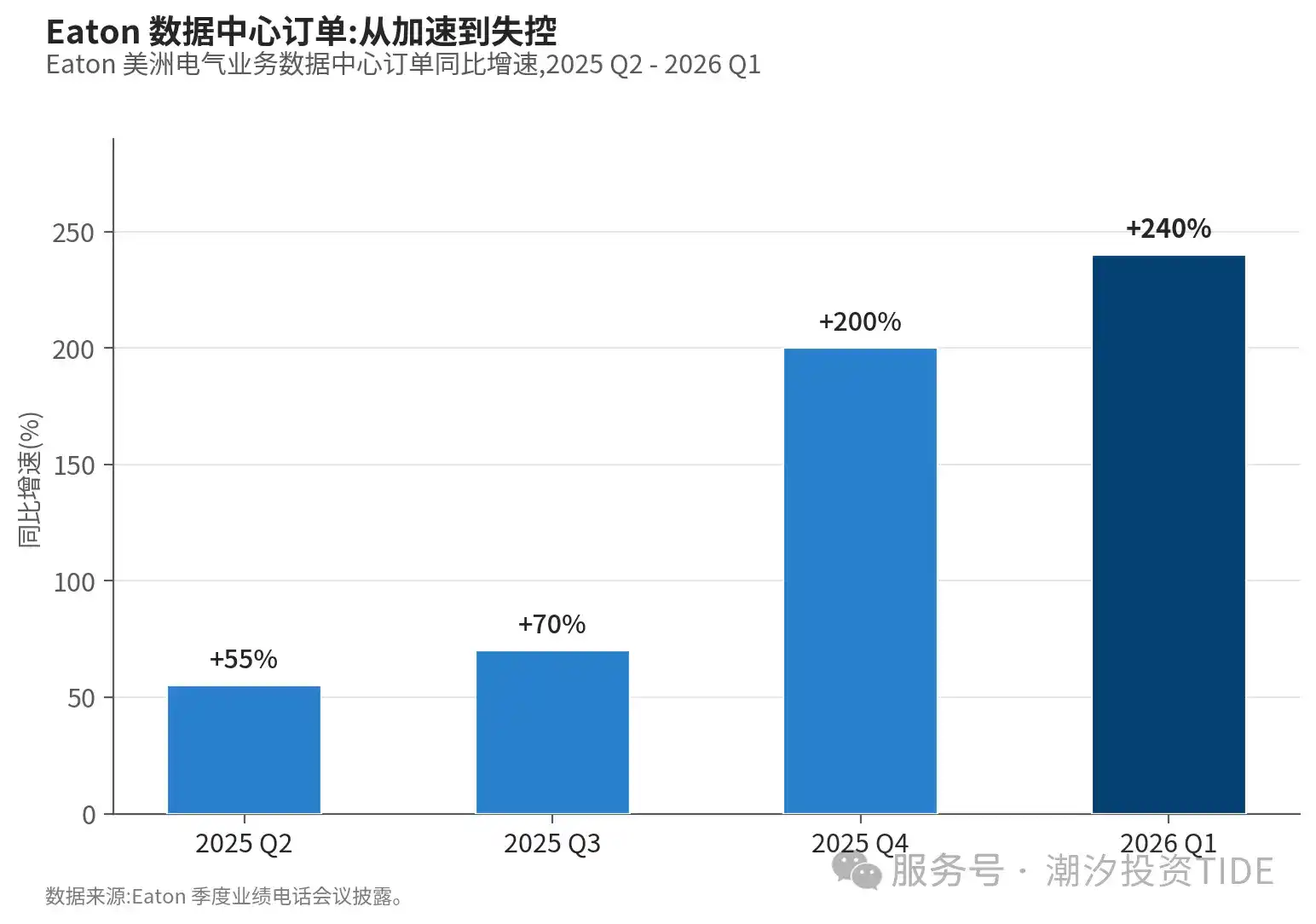
Orders for transformers, UPS, liquid cooling, thermal management, cabinet integration—these only surge in large volume when cloud providers decide to build campuses. The simultaneous explosion of these orders indicates solid construction progress underpinning this Capex cycle.

Looking at these factors together, you realize this investment cycle won't stop easily.

IV. What the Market is Actually Worried About

Bullish as we are, the market has two concerns right now we can't ignore.

Concern 1: Capex Growth Outpacing Revenue Growth - Can ROI Be Realized?

For the five major cloud providers in 2025, Capex growth rates all outpaced revenue growth. Alphabet's depreciation rose from $15.3 billion in 2024 to $21.1 billion in 2025, a 38% increase in a year, hitting the income statement hard. Amazon spelled it out in its earnings report: FCF decline was due to AI investment driving up PPE.
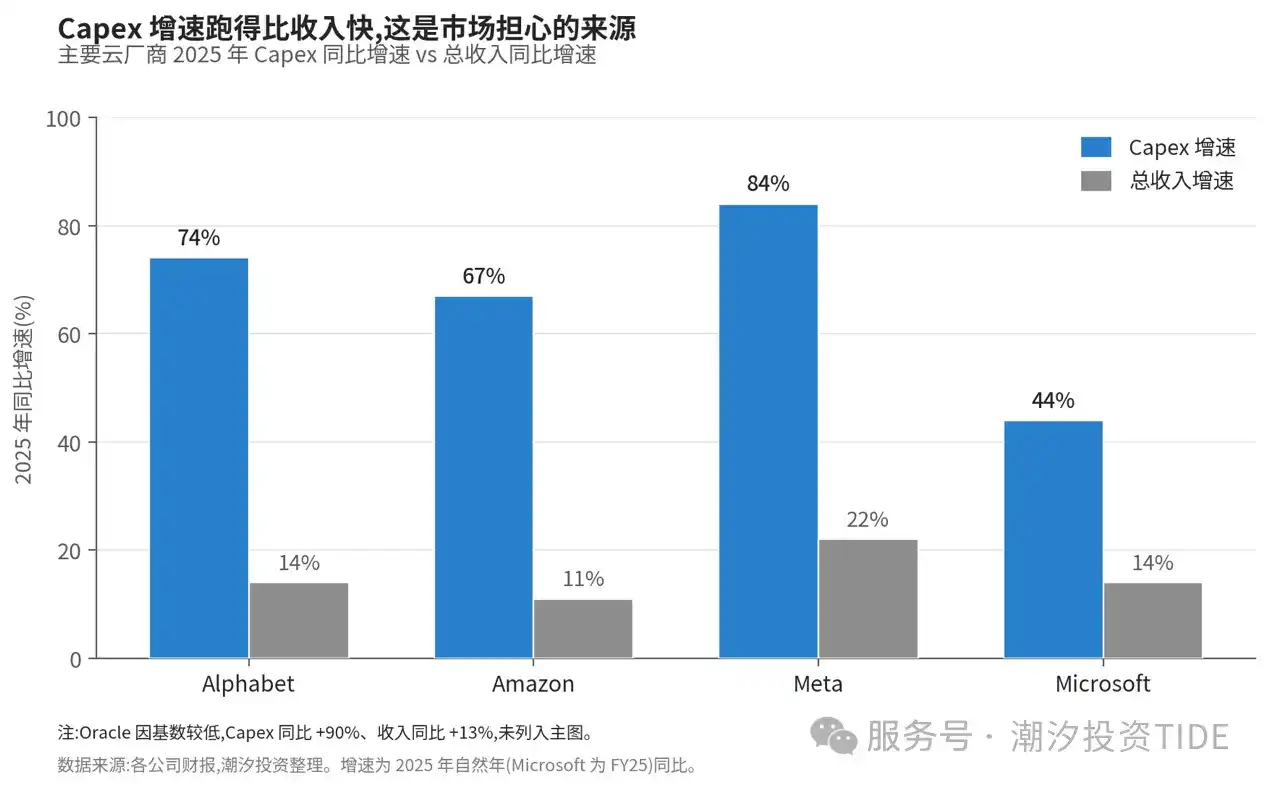
A popular saying in the market is that when Capex growth exceeds revenue growth, it signals peaking ROI. This isn't wrong, but applying it to the cloud computing business is somewhat simplistic. AWS, Azure, GCP all went through phases in the early 2010s where Capex far outstripped revenue, eventually recouping the money through scale-based monetization. The difference with this AI Capex cycle is the higher capital intensity; payback depends on whether future AI workloads can be monetized.

Of course, we're not bullish with our eyes closed. To change our view, we'd need to see at least a few things happen: cloud providers start lowering Capex guidance, orders get canceled or postponed, or AI product revenue and usage fall below expectations. As of mid-2026, none of these have happened yet.

ROI risks certainly exist, but current facts lean more towards the bullish side. Wait until the data actually starts to decline before changing judgment; we're not at that point today.

Concern 2: Is This Another 2000?

How did the 2000 bubble actually burst? Back then, demand was also growing, with more people going online and traffic increasing year by year. The problem was on the supply side.

A popular saying then was that internet traffic doubled every 100 days. Telecom companies believed this curve and laid fiber furiously along railways and roads. There was a cost advantage with fiber: dig a trench once, and laying more cables didn't cost much more, so they simply filled it with capacity for over a decade. Dozens of companies dug their own trenches simultaneously, resulting in supply far exceeding demand. Consequently, the price of buried fiber crashed. By the time traffic grew to fill it, a decade had passed, and those original companies couldn't survive that long.

Of course, there are bubble elements in this cycle too. No major cycle is clean; there are always companies riding the AI wave and some investments that will seem excessive in hindsight.

But on the supply side this time, it's the opposite, because what AI needs isn't as simple as laying a pipe. Transformers are customized heavy equipment, constrained by silicon steel and lengthy approval processes. Grid access also can't be parallelized like digging trenches; you must queue behind the public grid, often for years. More importantly, electricity can't be pre-laid like fiber; you can't lay down electricity for the next decade and just wait for it.

So the 2000-style collapse is difficult to replicate this time.

V. The AI Show Isn't Over

Just recently, SpaceX plummeted from its highs, even falling below its IPO closing price, making the market nervous again. Seeing so many giants asking the market for money simultaneously easily makes one nervous, wondering if AI has peaked.

But we don't see it that way.

The reason giants are raising large funds now is that the show must go on, and the hurdles ahead are growing. Look at those five cloud providers—none have lowered their 2026 Capex guidance; all have raised it. Looking further ahead, transformers take four years to deliver, data centers wait years for grid access. These hurdles probably can't be easily overcome by just spending more money.

So a massive wave of fundraising, while daunting, is essentially just an intermission.

Don't rush to call the peak. The AI show isn't over yet; it's just switched to a different script.


Trending Cryptos

Related Questions

QWhat is the main argument of the article regarding the future of AI investment?

AThe main argument is that the investment cycle in the AI industry is far from over. While market sentiment has shifted from pure imagination to concerns about capital intensity, the massive capital expenditures (Capex) from major cloud providers are increasing and are unlikely to stop soon due to deep-seated physical supply chain bottlenecks like electricity, transformers, and grid access, which cannot be easily overbuilt like fiber optics in the 2000s dot-com bubble.

QWhy does the article claim the current AI investment cycle is different from typical hardware cycles like smartphones or PCs?

AThe article argues that the current AI Capex cycle is more complex and durable than typical hardware cycles. The investment is spread across multiple physical infrastructure layers (compute, memory, networking, power, cooling). More critically, key bottlenecks have shifted from chips to physical constraints like power supply and grid interconnection, which have much longer lead times and cannot be easily or quickly scaled up, making the cycle less prone to a rapid, synchronized bust.

QWhat are the two main market concerns addressed in the article, and what are the counter-arguments?

A1. Concern: Capex growth is outpacing revenue growth, raising ROI worries. Counter-argument: Cloud business models historically have involved early high Capex for eventual scale monetization. The current cycle relies on future AI workload monetization. No negative signals like Capex guidance cuts or order cancellations have occurred yet. 2. Concern: The situation resembles the 2000 dot-com bubble. Counter-argument: The 2000 bubble burst due to massive overcapacity in easily deployable fiber optics. In contrast, current AI infrastructure (e.g., custom transformers, grid access) faces severe supply constraints and long lead times, preventing similar overbuilding.

QWhat evidence does the article provide to support the claim that AI-related capital expenditures (Capex) are still accelerating?

AThe article cites the 2026 Capex guidance increases from the five major cloud providers: Alphabet (up to $180B from $90B in 2025), Amazon (up to $200B from $130B), Meta (up to $140B), Microsoft (up to $190B), and Oracle (approaching $60B for FY26). It also mentions surging orders for power distribution equipment, like Eaton's 240% year-over-year increase in data center orders for Q1 2026, indicating deep, project-based investment beyond just GPU purchases.

QAccording to the article, what would be the signals that might change the author's positive view on the AI investment cycle?

AThe author states that to change their positive view, they would need to see concrete evidence such as: major cloud providers starting to lower their Capex guidance, significant order cancellations or postponements in the supply chain, or AI product revenues and usage metrics consistently falling short of expectations. As of mid-2026, none of these negative signals have materialized.

Related Reads

Standard Chartered Bank’s 50-Fold Fantasy: Predicting AAVE to Reach $3,500

Standard Chartered Bank has issued an optimistic research report predicting that the AAVE token could surge 50-fold to $3,500 by 2030. This forecast is based on the projection that the total value locked (TVL) in DeFi will grow 37x to approximately $2.7 trillion, driven by stablecoin expansion and the tokenization of real-world assets (RWA). The bank's model links Aave's potential valuation directly to its protocol revenue, which is primarily driven by net interest margins. The report highlights Aave's current dominant position, noting it captures over 80% of the net earnings ("protocol retained earnings") in the lending sector while holding only about half of its TVL. It also points to the recent launch of the Aave V4 architecture and a healthy revenue stream of $142 million in 2025 as positive fundamentals. Grayscale's separate analysis, applying traditional valuation metrics like DCF, concluded AAVE is currently undervalued. However, the article notes significant challenges. Aave's peer-to-pool lending model suffers from inherent capital inefficiency, with an estimated $52 million annual "deadweight loss" due to idle funds needed for liquidity buffers. This structural flaw was exposed during the April KelpDAO exploit, which locked a WETH pool at 100% utilization for days. Emerging protocols like Morpho, with more efficient point-to-point models, are cited as growing competitive threats. In summary, while institutional forecasts paint a macro picture of massive growth fueled by RWA adoption, Aave's path forward hinges on addressing its core structural limitations and competitive pressures within the evolving DeFi lending landscape.

链捕手35m ago

Standard Chartered Bank’s 50-Fold Fantasy: Predicting AAVE to Reach $3,500

链捕手35m ago

Tidal Investment: We Remain Bullish on the AI Industry Chain, But for Different Reasons Now

Tidal Investments remains optimistic about the AI industry chain, but the rationale has shifted. The market is concerned about massive concurrent fundraising by tech giants like SpaceX, OpenAI, Alphabet, and Meta, fearing an AI peak. However, the authors argue this signals the next act of AI development, not its end. Capital expenditure (Capex) from major cloud providers (Alphabet, Amazon, Meta, Microsoft, Oracle) continues to surge aggressively into 2026. This investment cycle is more resilient than past hardware cycles due to its scale and complexity. Bottlenecks have shifted from chips to critical physical infrastructure like power grids, transformers, cooling, and data center construction—areas with long lead times and limited capacity for rapid expansion. Supply chain data (e.g., Eaton's orders) confirms substantial, tangible progress. Key market concerns are addressed: 1. **ROI vs. Capex Growth**: While Capex growth outpaces revenue, the authors note cloud giants have historically overcome similar phases through scale. The cycle will only be in danger if Capex guidance is cut, orders are canceled, or AI product demand falters—none of which are currently observed. 2. **Comparison to the 2000 Dot-com Bubble**: Unlike the telecom bubble, where cheap, oversupplied fiber crashed prices, AI infrastructure (especially power) is constrained, customized, and subject to lengthy approvals, making a similar supply glut and crash unlikely. In conclusion, the wave of fundraising reflects the immense, ongoing capital needs for AI's next phase, constrained by slow-moving physical bottlenecks. The AI cycle is not over; the script has simply changed.

链捕手1h ago

Tidal Investment: We Remain Bullish on the AI Industry Chain, But for Different Reasons Now

链捕手1h ago

Grayscale: These 15 Profitable Crypto Protocols Are Severely Undervalued

Grayscale Research identifies 15 top-revenue crypto protocols trading at significant valuation discounts, with many at single-digit or even 1x revenue multiples. Protocols like Pump.fun, PancakeSwap, and Meteora have market capitalizations roughly equal to their annual revenue. The report argues these financially-focused protocols (DEXs, lending, staking) are fundamentally undervalued and could benefit from the potential passage of the CLARITY Act, expected as soon as next month. This legislation aims to clarify digital asset regulation, potentially reducing institutional barriers and driving on-chain activity. The analysis breaks down the protocols into three groups: the "1x Club" (market cap ≈ revenue), mid-tier protocols with 3-9x multiples (e.g., Aave, Lido, Jupiter), and high-multiple protocols like Hyperliquid (15x) and Uniswap (37x), where valuation reflects future potential rather than current cash flows. Grayscale applies a traditional DCF model to Aave, suggesting a one-year price target of ~$175, representing ~130% upside from current levels. The report notes a risk-off macro environment since the Iran conflict has further compressed valuations, creating a potential entry window. The conclusion highlights that while the valuation data presents an intriguing opportunity, the investment thesis is contingent on the CLARITY Act's passage and subsequent institutional capital flows. Investors are cautioned to consider Grayscale's inherent conflict of interest as a crypto asset manager with products tied to these assets.

marsbit2h ago

Grayscale: These 15 Profitable Crypto Protocols Are Severely Undervalued

marsbit2h ago

Sam Altman's Personal Alchemy of Wealth: Investing in 400 Companies, Over 10 Deeply Tied to OpenAI

The article investigates Sam Altman's personal wealth strategy, centered around his investments in approximately 400 companies while serving as OpenAI's CEO. Despite not holding direct equity in OpenAI, Altman has built a vast portfolio, with at least 10 of his investments having commercial ties or ongoing negotiations with OpenAI. This creates a complex network of potential conflicts of interest, drawing scrutiny from U.S. congressional committees and state attorneys general. Key investments highlighted include the anti-aging startup Retro Biosciences (valued at $258 million for his stake as of late last year) and the chipmaker Cerebras, whose value soared following an OpenAI procurement deal. His most significant financial gain is linked to the nuclear fusion company Helion, where a recent funding round reportedly increased his stake's value to at least $4.1 billion. The article details a decade-long relationship between Altman, Helion, and OpenAI, including a controversial non-binding power purchase agreement and Altman's efforts to secure investments from OpenAI and its backer SoftBank for Helion. Other points include internal investigations at Tools for Humanity (developer of Worldcoin) and OpenAI's massive contracts with tech giants like Nvidia. According to Forbes, Altman's net worth is around $3.4 billion, ranking him 1251st globally—a rise of over 1400 places since 2024. OpenAI's board states that Altman's external dealings are transparent and potential conflicts are carefully managed.

Odaily星球日报2h ago

Sam Altman's Personal Alchemy of Wealth: Investing in 400 Companies, Over 10 Deeply Tied to OpenAI

Odaily星球日报2h ago

Trading

Spot
Futures

Hot Articles

Discussions

Welcome to the HTX Community. Here, you can stay informed about the latest platform developments and gain access to professional market insights. Users' opinions on the price of AI (AI) are presented below.

活动图片