The Shadow Banking Battle of Stablecoins: Tether Enters Private Credit with a $3 Billion War Chest

marsbitPublished on 2026-09-10Last updated on 2026-09-10

Abstract

Titled "The 'Shadow Banking' Battle of Stablecoins: Tether Enters Private Credit with a $3 Billion Giant Fund," this article details Tether's strategic expansion beyond crypto. Having built immense profits from issuing USDT and investing reserves in U.S. Treasuries, Tether is now targeting the private credit market. Through a new partnership with London-based asset manager Fasanara Capital, it has launched "StableFund," a perpetual fund aiming for up to $3 billion to provide credit to SMEs and consumer lenders across 60+ countries. The move represents a shift from earning risk-free spreads to seeking higher yields in private credit, a sector with a massive global funding gap. Crucially, Tether leverages USDT as a settlement rail, offering borrowers instant, low-cost digital dollar loans instead of slow traditional wire transfers. Fasanara handles underwriting and risk management for these short-duration, asset-backed loans, while Tether provides the capital and infrastructure. This venture positions USDT as a tool for real-world economic activity, not just crypto trading. However, it also ventures Tether deeper into the regulated realm of credit risk. While StableFund is structured as an off-balance-sheet entity to isolate potential losses from Tether's core reserves, the company already holds over $13.45 billion in secured loans on its balance sheet. The article raises concerns that Tether is effectively becoming a large, unregulated "shadow bank," operating without tradit...

Author: Deep Tide TechFlow

After becoming the world's most profitable and cash-rich "atypical financial institution" by issuing USDT, Tether has finally taken the most critical step from the virtual to the real economy.

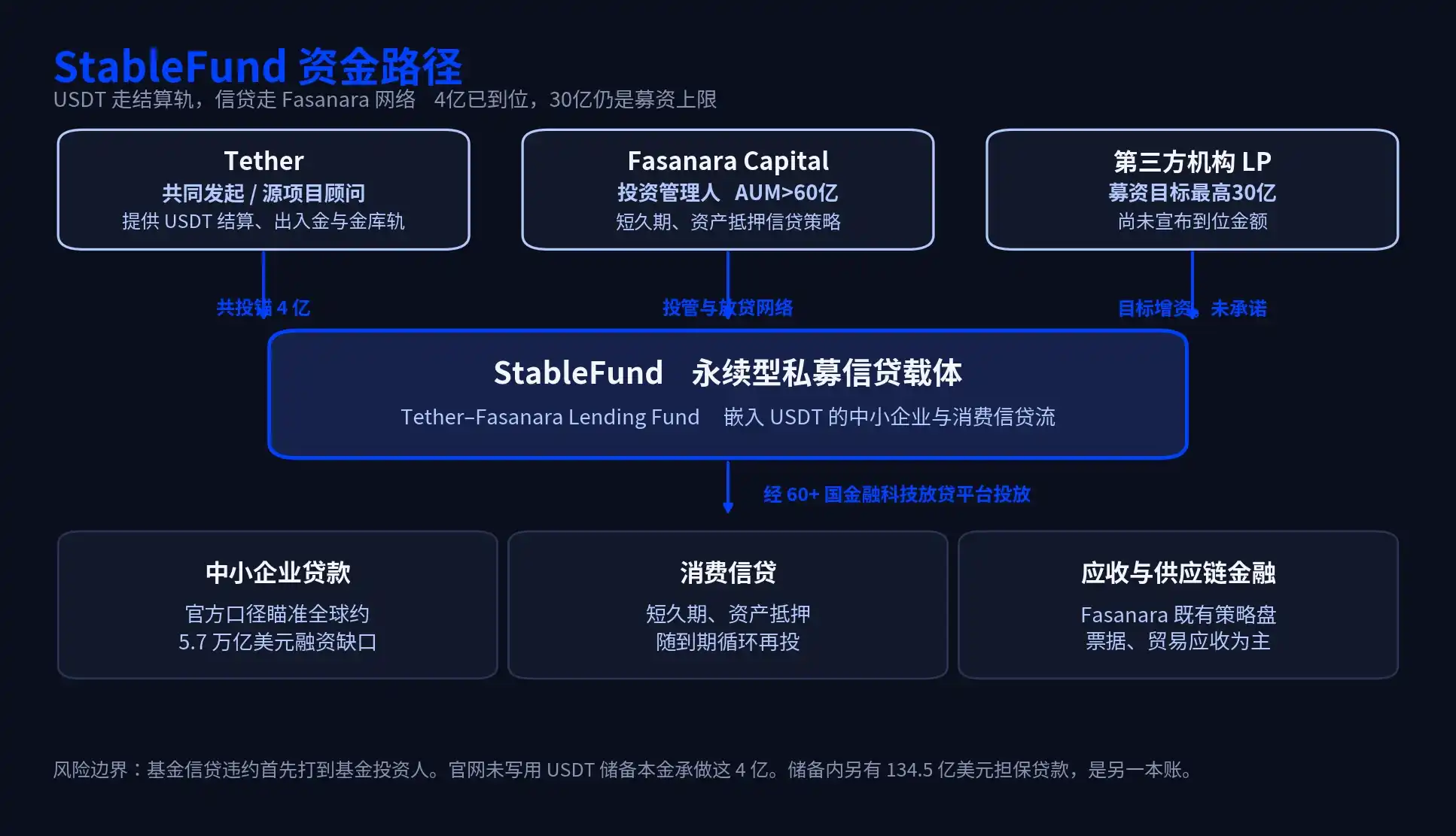
On September 9, Tether, in collaboration with London-based alternative asset manager Fasanara Capital, launched the StableFund, an evergreen private credit fund with a target size of up to $3 billion. The two parties contributed an initial $400 million in co-investment capital as the anchor, officially opening fundraising to external institutions.

This time, Tether is no longer targeting liquidity on crypto exchanges, but rather lending to physical small and medium-sized enterprises (SMEs) and consumer credit distributed across over 60 countries. While Silicon Valley is still debating the real-world use cases of cryptocurrencies, Tether, flush with massive US Treasury interest income, has quietly transformed into the most ambitious "on-chain shadow bank" in traditional finance.

Capital Flywheel: From Risk-Free Spread to a "Poacher" on Wall Street

Over the past two years, Tether's business logic has been remarkably simple: on one hand, meeting the demand for interest-free stablecoin issuance, and on the other, pouring its hundreds of billions in reserves into risk-free US Treasury assets.

This "money-printing machine" model, profiting from the interest spread, allowed Tether to easily record approximately $1.5 billion in operating profit in Q2 of this year.

However, as the global macroeconomic cycle of interest rate cuts approaches, the golden window for enjoying risk-free spreads is narrowing. Tether's enormous profit reserves must find the next reservoir capable of absorbing massive capital and offering higher potential returns.

Private Credit became the best landing point.

Against the backdrop of traditional Western banks contracting their balance sheets and a global SME financing gap reaching $5.7 trillion, Wall Street giants like Blackstone and Apollo have long deployed significant resources here. But unlike traditional Wall Street institutions, Tether wields a weapon for a dimensional strike: it not only provides capital but also the "road."

In this $3 billion venture, the funding pipeline has been completely restructured. Borrowers no longer receive wire transfer dollars that require multiple correspondent banks, take days to clear, and incur high fees. Instead, they receive USDT, settling in seconds.

Using USDT to Bypass the Traditional Banking Lending Track

Within this new vehicle named StableFund, the roles of Tether and Fasanara are clearly delineated, following a typical "storefront-backend" model.

London-based Fasanara plays the role of the "underwriter" and "risk controller." This specialized asset manager, overseeing over $6 billion in assets, has already established a lending network on fintech platforms across more than 60 countries. They are responsible for precisely channeling funds into short-duration, asset-backed SME and consumer credit strategies.

Tether, meanwhile, plays the most central role: the source of capital and the settlement rail. Tether CEO Paolo Ardoino maintains a sober and restrained view on this: Tether will not engage in direct debt collection but will provide the stablecoin infrastructure that enables cross-border lending to function.

At this point, the narrative of USDT undergoes a fundamental shift. It is no longer merely a "trading pair" used by crypto players to hedge volatility but has become a lending pipeline directly inserted into the real economies of emerging markets. Tether is transforming the liquidity once confined to crypto casinos into a dollar alternative that improves the financing efficiency of global physical businesses.
On-Balance-Sheet and Off-Balance-Sheet Gameplay: The Deep Waters of Shadow Banking Risk Control

Venturing into real-economy credit means Tether has officially stepped into the minefield of risk control that traditional banks fear most:

If borrowers can't repay, who bears the loss first?

According to the current structure, the newly established StableFund is an off-balance-sheet fund. Theoretically, its credit default losses will be contained within the fund's net asset value and its Limited Partners (LPs), thus isolated from the 1:1 redemption reserves backing USDT.

But scrutiny from the outside world never ceases. Because on Tether's own balance sheet, credit business is already a behemoth. As of Q2 this year, Tether's reserve assets still contain a staggering $13.45 billion in Secured Loans. In comparison, the initial $400 million anchor capital for the new fund is just a drop in the bucket for testing the waters.

What truly gives Wall Street and regulators pause is this: when a stablecoin giant lacking extreme transparency in audits holds tens of billions in on-balance-sheet secured loans while also starting to lend to micro, small, and medium-sized entities off-balance-sheet through fintech platforms in 60 countries, it has, in effect, become a super shadow bank that circumvents all capital adequacy constraints.

Before this $3 billion target is fully raised, StableFund is merely a reconnaissance mission. But once Tether, leveraging its extremely low cost of capital and the settlement advantages of USDT, truly carves out a niche in the global private credit market, any widespread cross-border collection failures or collateral depreciation could escalate into a stress test for the entire crypto liquidity foundation.

When that time comes, this "unlicensed global central bank" operating outside of regulation will undoubtedly face the harshest scrutiny from Washington.


Related Questions

QWhat is the key strategic move announced by Tether, and who is their partner?

ATether has announced a key strategic move into the private credit sector by launching the StableFund, a perpetual private credit fund with a target size of up to $3 billion. Their partner in this venture is the London-based alternative asset management firm, Fasanara Capital.

QHow does the StableFund plan to use USDT differently from its traditional role in crypto exchanges?

AThe StableFund plans to use USDT not just as a trading pair for speculation but as a core settlement rail for lending. It will provide borrowers in over 60 countries with near-instant, USDT-denominated loans for small and medium-sized enterprises and consumer credit, aiming to improve cross-border lending efficiency.

QWhat are the primary roles of Tether and Fasanara Capital within the StableFund partnership?

AWithin the StableFund partnership, Fasanara Capital acts as the 'underwriter' and 'risk controller,' leveraging its global fintech lending network to source and manage credit strategies. Tether serves as the 'capital source and settlement rail,' providing the foundational USDT liquidity and infrastructure for the lending operations.

QWhat major risk does the article highlight regarding Tether's expansion into private credit?

AThe article highlights the significant risk of Tether effectively operating as a 'super shadow bank' outside traditional banking regulations. Its entry into private credit, both on and off its balance sheet, exposes it to the complexities of global credit risk, loan defaults, and collateral depreciation, which could pressure the stability of the broader crypto liquidity system it underpins.

QWhat financial pressure is prompting Tether to seek new investment avenues like private credit?

ATether is seeking new investment avenues like private credit because the 'golden window' for earning easy profits from the interest rate spread between its non-interest-bearing stablecoin liabilities and risk-free U.S. Treasury assets is narrowing. With a global macro interest rate cutting cycle approaching, Tether needs to deploy its massive profit reserves into higher-yielding, capital-intensive assets.

Related Reads

Coinbase and PNC Bank Launch USDC Collection: Can Stablecoins Become the New Gateway for Enterprise Payments?

Coinbase and PNC Bank have expanded their partnership to launch a USDC collection service for enterprise and institutional clients. Eligible customers can receive USDC via the Ethereum network, which is then converted 1:1 into USD and deposited into their designated PNC bank account. The service uses Coinbase's Payment APIs integrated with PNC's existing treasury management systems, embedding the stablecoin collection process within the traditional banking framework. The collaboration highlights a complementary relationship between stablecoins and banks rather than pure competition. Banks provide client relationships, compliance, and deposit accounts, while blockchain offers round-the-clock value transfer. Coinbase supplies the stablecoin infrastructure and payment APIs, while PNC handles account and traditional financial services. For businesses, the appeal is gaining a new payment channel without overhauling their existing financial systems or managing wallets and private keys themselves. The partnership builds on earlier collaboration announced in July 2025, when the two firms began integrating crypto trading capabilities into PNC's services, followed by Bitcoin spot trading for eligible private banking clients in December. The USDC service extends the focus from wealth management into enterprise payments and treasury management. Coinbase has pursued similar integrations with Citigroup and payment technology firm Moov, signaling a strategic shift from a trading platform toward payment infrastructure. However, questions remain about fees, settlement times, compliance requirements, and actual adoption scale. The service is still in a pilot phase with limited eligibility, and full fee structures and processing times have not been disclosed. The key question is whether enterprises will adopt stablecoin collection in daily operations and whether the funds can be reliably converted, deposited, and used without adding excessive operational cost. The real competitive frontier may be integrating digital dollars into everyday corporate cash flows rather than simply accumulating on-chain assets.

marsbit16m ago

Coinbase and PNC Bank Launch USDC Collection: Can Stablecoins Become the New Gateway for Enterprise Payments?

marsbit16m ago

Crypto Stocks Weekly丨Strategy Adds 1,036 BTC but Holdings Fall Below Cost Basis; Bitmine Holds 4.97% of ETH Supply (November 10)

The article begins by noting that Democrats swept both chambers of Congress, ushering in a divided-government phase, after which markets shifted focus to AI regulation and capex payback cycles, with Anthropic's IPO seen as a bellwether for AI stocks. US equities fell sharply (Nasdaq -5.52% and Philadelphia Semiconductor Index -12.24% on Nov 5) before a Monday rebound driven by falling oil prices and oversold buying—characterized as a repair, not a new high. Macro data showed October nonfarm payrolls +165k and unemployment at 4.1%, keeping 10-year Treasury yields near 4.86% and rate-hike expectations alive. Citi cut US equities and global tech to neutral while upgrading Europe ex-UK, citing unstable AI sentiment; Goldman noted AI stocks are ~40% of the S&P 500 versus ~15% of STOXX 600. Crypto diverged from the equity rebound: US spot Bitcoin ETFs saw $1.282B in weekly net outflows (BlackRock's IBIT -$12.09B... actually $1.209B), Ethereum ETFs -$365M for a sixth straight weekly outflow, with continued outflows on Nov 9. NYSE-affiliated tokenized securities platform chose Avalanche for settlement infrastructure. Corporate treasury updates: Strategy bought 1,036 BTC at ~$79,012 (total 850,364 BTC, average cost ~$75,456, now above spot), funded partly by ATM share sales, with most proceeds used to repurchase STRC preferred shares. Strive added 29 BTC (total 43,153). Listed companies now hold over 6% of Bitcoin's supply (1.2664M BTC across 199 firms). Bitmine added 9,587 ETH, holding 6,070,092 ETH (~4.97% of supply, ~99% of its 5% goal). DeFi Development Corp's SOL rose to 2,609,829. Hyperliquid Strategies raised $911M in Q3, bought ~9.1M HYPE (holdings up to 38.5M, ~16% of circulating supply), and repurchased ~2.7M PURR shares.

marsbit36m ago

Crypto Stocks Weekly丨Strategy Adds 1,036 BTC but Holdings Fall Below Cost Basis; Bitmine Holds 4.97% of ETH Supply (November 10)

marsbit36m ago

Trading

Spot
活动图片