The Naked Fall of a Crypto OG: Harry Yeh's Wealth, Gambles, and the Final Dawn

marsbitPublished on 2026-08-10Last updated on 2026-08-10

Abstract

The mysterious death of cryptocurrency investor Harry "Chun Tak" Yeh, founder of Quantum Fintech Group, is under investigation in Asunción, Paraguay. On August 7, 2026, his fully nude body was found covered by a black plastic bag after a fall from the 30th floor of a luxury apartment. His apartment was found open and ransacked, with no one inside. Authorities are considering accident, suicide, or homicide—including a potential "wrench attack" targeting crypto holders for their assets. Yeh's career epitomized the crypto boom. Starting with a $500 Bitcoin investment in 2013, he built funds claiming over $24 billion in assets under management. His peak came during the 2021 DeFi surge on the Fantom blockchain, where he reportedly grew the Tomb Finance project's value from $2.5 million to $1.6 billion in four months. He was a frequent speaker at industry events and moved in circles from Miami to Dubai. The circumstances of his death in Paraguay, far from his usual bases in Abu Dhabi and Miami, raise urgent questions about the physical security risks faced by visible crypto figures, as violent crimes targeting holders for private keys are reportedly rising. The case underscores the extreme volatility and dangers—both financial and physical—in the cryptocurrency world. Final conclusions await the official autopsy and investigation results.

By: Lin Zhengying

At 4:30 AM on August 7, 2026, the 911 call center in Asuncion, the capital of Paraguay, received a call: a body was lying outside the upscale apartment building Jade Park in the Trinidad district.

The scene that met the police was bizarre: the deceased was completely naked, covered with a black plastic bag, having apparently fallen from roughly the 100-meter-high 30th floor. The victim was quickly preliminarily identified as Harry Chun Tak Yeh, Chinese name Ye Junde, founder and managing partner of the cryptocurrency fund Quantum Fintech Group, a self-proclaimed Chinese-Canadian crypto investor managing over $2.4 billion in assets.
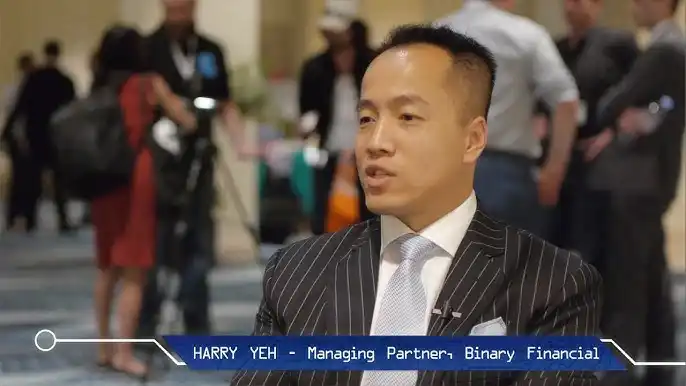
Investigators went up to the 30th floor and found the door to his apartment wide open, the interior ransacked, but completely empty.

He owned another apartment on the 27th floor of the same building, occupied by his 29-year-old Brazilian girlfriend, Isadora de Proenca Braganholo Carvalho. Questioned by prosecutors, she claimed to know nothing; the police have not publicly charged her with any wrongdoing.

After leading the investigation, prosecutor María del Carmen Palazón stated that accident, suicide, and homicide are all being considered as possibilities, pending the results of the autopsy.

$500 Entry

Harry Yeh's rise to wealth followed the most classic script in the crypto world.

Born in Hong Kong, he immigrated to Canada with his family as a child. He earned a bachelor's in Electrical Engineering from UC Berkeley and later an MBA from Stanford Graduate School of Business—at least, that's the resume he presented publicly.

Before entering the crypto space, he followed the standard Silicon Valley elite path: an engineer by background, he served as CTO and co-founder for several startups, ran a tech consulting firm, and worked with institutions generating revenues from $5 million to $200 million.

In 2013, when Bitcoin was hovering around $60, Yeh used $500 to buy his first BTC. That same year, he started his first fund with $250,000, founding the venture capital firm Binary Financial, which after several name changes became Quantum Fintech Group.

It was a pioneering era. Engaging in crypto OTC trading and managing hedge funds for high-net-worth clients, Yeh rode the entire curve of Bitcoin from $60 to tens of thousands of dollars. By 2023, he and his team claimed to manage a hedge fund and private investment network exceeding $2.4 billion in assets.

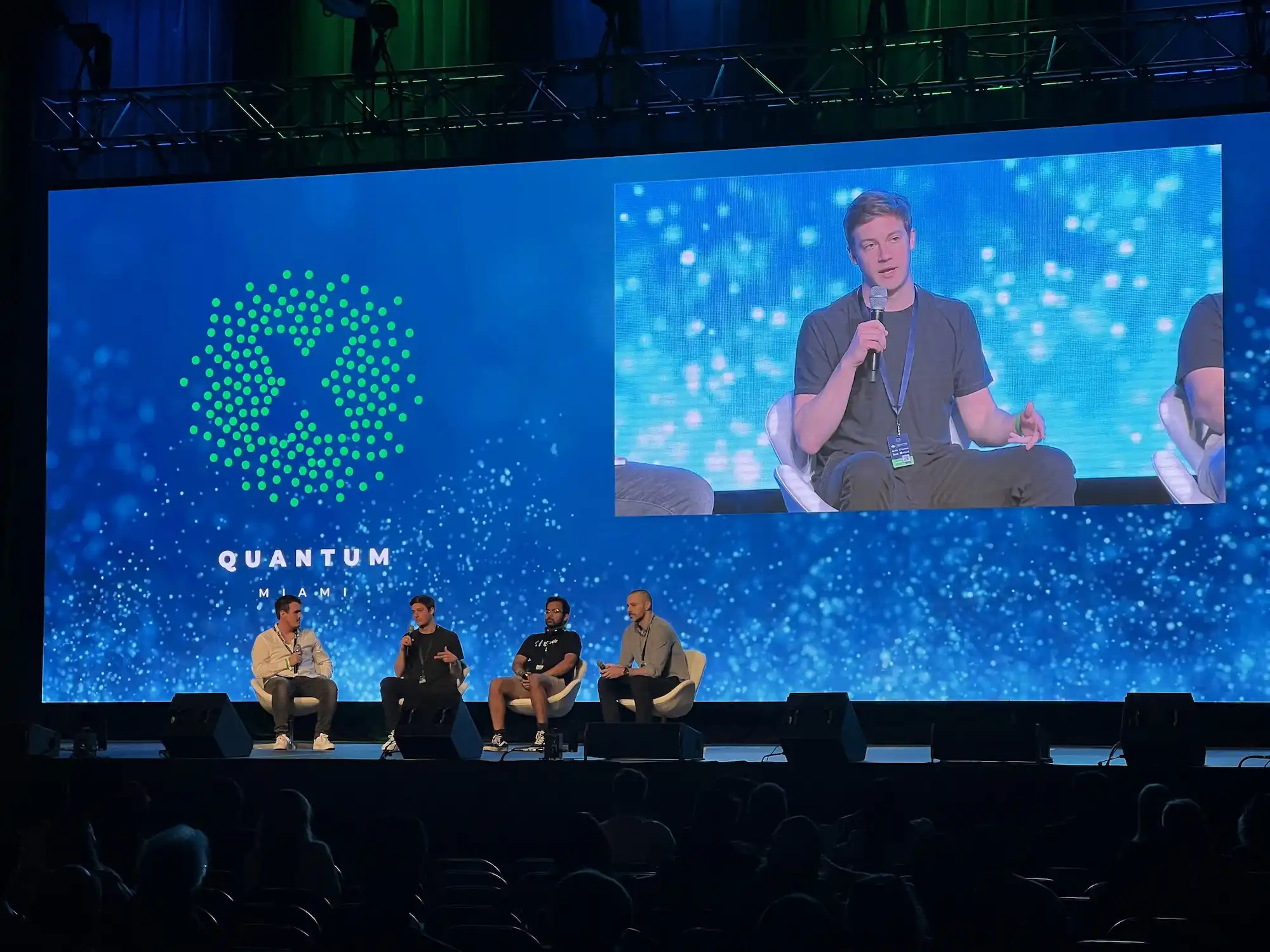
He began appearing frequently in the industry spotlight: discussing Bitcoin forks and ICOs on CNBC as early as 2017, appearing on Bloomberg's crypto show in 2022 calling Bitcoin "digital gold," and sharing stages with figures like Mark Cuban and Tether co-founder Craig Sellars. He also took over the production teams for The North American Bitcoin Conference (TNABC) and the Fantom Developer Conference, launching his own Quantum Miami conference, where the Mayor of Miami personally showed support.
Pinnacle Moment: Four Months, $2.5M to $1.6B

The most legendary "investment" of Yeh's career happened within the Fantom ecosystem.

Fantom was one of the hottest blockchains during the "DeFi Summer" of 2021, built by the so-called "DeFi Godfather," Andre Cronje. In September 2021, the algorithmic stablecoin project Tomb Finance on Fantom faced a crisis of trust due to a vulnerability event called "Gatekeeper" and was on the verge of collapse. Yeh stepped in to lead the team in his capacity as a member of the Fantom Foundation.

The next four months were a magical time for Tomb Finance: its Total Value Locked (TVL) skyrocketed from $2.5 million to a peak of $1.6 billion, an increase of nearly 80 times within two months, making it the most dazzling project in the Fantom ecosystem.

This victory cemented Yeh's status within the Fantom circle.

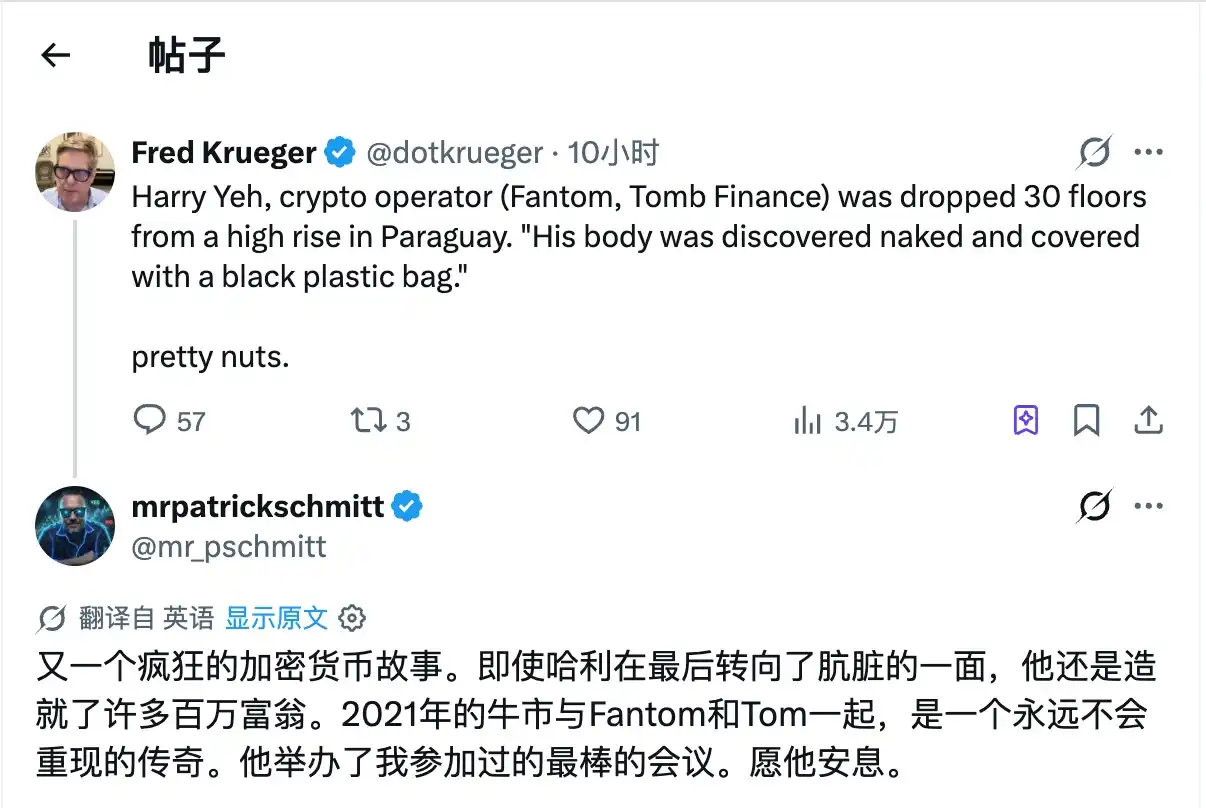
Someone on X reminisced: "Even though Harry turned to the dark side towards the end, he still created many millionaires. The 2021 bull run on Fantom and Tomb was a legendary time that will never be repeated. He hosted the best conference I ever attended. May he rest in peace."
His team subsequently incubated the LIF3 ecosystem, a blockchain focused on DeFi, and L3 Reserve, which issued the L3USD stablecoin asset. His personal website listed an investment portfolio densely centered around the Fantom ecosystem.

As recently as November 2024, he was still promoting LIF3: partnering with Web3 phone company Jambo to pre-install the Lif3 app on the $99 JamboPhone, claiming to bring crypto payments to users in over 120 countries.

At that time, his primary residence was Abu Dhabi, and he appeared on Dubai Crypto Oasis's "2024 Visionaries" list.

Why Die in Paraguay?

This is the most unsettling part of the entire story.

Why was a crypto magnate primarily residing in Abu Dhabi, with a professional footprint spanning Miami and Dubai, found in an apartment building in Asuncion, and why did he fall from a height completely naked?

Several details from the scene (open door, ransacked interior, naked victim) quickly led crypto community discussions to focus on one term: wrench attack.

This concept comes from an old saying in security circles: the strongest encryption can't withstand a $5 wrench. Attackers don't target code; they target the physical person, using violence or the threat of violence to force crypto holders to surrender wallet access, transfer funds, or private keys.

Just one day before Yeh's death, on August 6, blockchain analysis firm Chainalysis released a report: in the first half of 2026, 46 confirmed wrench attacks targeting crypto holders globally resulted in over $30 million stolen. At this rate, the year would break the 2025 record of $58 million.

Including attempted transfers and ransom amounts, the exposure so far this year is close to $107 million, with home invasions accounting for 37% of all wrench attacks, a new high for the year.

A crypto billionaire who publicly claimed to manage $2.4 billion, frequently appearing at conferences and on television, would be the ideal target for wrench attackers.

Of course, the possibilities of suicide and accident have not been ruled out.

The wealth rollercoaster of the crypto industry is enough to break anyone. Algorithmic stablecoin projects like Tomb Finance largely collapsed after the 2022 bear market, and the Fantom ecosystem also experienced its darkest moments with Andre Cronje's departure and evaporated TVL. How much of Yeh's self-proclaimed "$2.4 billion" in assets could withstand the bear market and proper auditing is unknown to the outside world.

A naked fall and a messy room could also point to a chaotic and lonely final night.

Currently, Paraguayan prosecutors have not released any evidence linking any party to the fall. The autopsy results will be key to unraveling the mystery.

Harry Yeh's life is a microcosm of the crypto industry's golden age: an engineer entering the field, placing a $500 bet, catching Bitcoin's steepest decade-long rise, creating a $1.6 billion myth in four months during the DeFi frenzy, hosting conferences, appearing on Bloomberg, and toasting with mayors.

But the safety lessons this industry teaches are all about asset security: cold wallets, multi-signature, hardware devices. As code becomes harder for hackers to crack, crime has shifted to the physical. In recent years, more and more crypto moguls have been targeted where they live long-term due to flaunting wealth.

In 2013, Bitcoin at $60 gave Harry Yeh everything; at 4:30 AM on August 7, 2026, the 100-meter height in Asuncion took it all back.

He once said in an interview: "The best investors know that great fortunes are born in bear markets." Only this time, he wouldn't live to see the next bull run.

(The factual information in this article is based on public reports; the individual's stated asset scale is according to their own claims. The case is still under investigation, and final conclusions are subject to autopsy and investigation results from Paraguayan judicial authorities.)

Trending Cryptos

Related Questions

QWho was Harry Chun Tak Yeh, and what was his role in the cryptocurrency world?

AHarry Chun Tak Yeh, also known by his Chinese name Ye Junde, was a Chinese-Canadian cryptocurrency investor and the founder/managing partner of the crypto fund Quantum Fintech Group. He was a prominent figure in the crypto space, claiming to manage over $2.4 billion in assets, and was known for his involvement with projects on the Fantom blockchain, most notably leading Tomb Finance to significant growth.

QAccording to the article, what were the key events and possible theories surrounding Yeh's death?

AYeh was found dead, fully nude and covered with a black plastic bag, after an apparent fall from the 30th floor of his apartment building in Asunción, Paraguay, on August 7, 2026. His apartment door was open and the interior was in disarray. The prosecutor listed accident, suicide, and homicide as three possibilities under investigation. The crypto community speculated about a 'wrench attack'—a physical attack to steal crypto assets—due to his public wealth and the scene's details.

QWhat is a 'wrench attack' in the context of cryptocurrency, and why is it relevant to this case?

AA 'wrench attack' is a physical security threat where attackers use violence or the threat of violence (symbolized by a wrench) to force a cryptocurrency holder to give up access to their wallets, transfer funds, or reveal private keys. It's relevant because Yeh was a publicly known crypto millionaire, making him a potential target for such crimes, and the disarray in his apartment suggested a possible struggle or robbery.

QDescribe Yeh's most notable career achievement mentioned in the article.

AYeh's most notable career achievement was his role in the dramatic turnaround of the Fantom-based algorithmic stablecoin project Tomb Finance in late 2021. After a crisis, he took over the team, and within four months, the project's Total Value Locked (TVL) skyrocketed from $2.5 million to a peak of $1.6 billion, cementing his reputation within the Fantom ecosystem.

QWhat broader trend in cryptocurrency-related crime does the article mention in relation to Yeh's death?

AThe article cites a Chainalysis report from August 6, 2026, indicating a rising trend in 'wrench attacks' or physical attacks against cryptocurrency holders. It noted that 2026 was on track to break records for such crimes, with home invasions accounting for 37% of these attacks. This highlights a shift where criminals, finding digital security harder to breach, are increasingly targeting the physical holders of valuable crypto assets.

Related Reads

The CEO of Silicon Valley's Trillion-Dollar AI Empire is Actually a Two-Faced 'Doomsday Prophet'

Dario Amodei, CEO of the trillion-dollar AI company Anthropic, is portrayed as a paradoxical "doomsday prophet." He has spent a decade warning that AI poses an existential threat to humanity, exhibiting extreme caution such as air-gapping computers and personally delivering printed memos. He famously rejected a "charm offensive" PR campaign, instead authorizing ads depicting tombstones to highlight AI's dangers. Yet, simultaneously, he is aggressively accelerating AI development, believing the "singularity" is inevitable. He sees building the most powerful AI as the only way to control and steer it away from catastrophe, a philosophy described as "stepping on the gas while looking for the brake." His leadership is more that of a religious visionary than a conventional CEO, focusing on grand visions of AI and societal impact while delegating daily operations. This has fostered a cult-like, mission-driven culture at Anthropic. Despite Anthropic's staggering commercial success—a valuation nearing a trillion dollars with explosive revenue growth—investors are unnerved. They fear Amodei is fundamentally indifferent to money, preferring to discuss AI extinction risks over business metrics. The central tension lies in whether this "doomsday prophet" can maintain his safety-first creed while managing a capital-fueled juggernaut, a high-stakes gamble where humanity itself is the ultimate stakeholder.

marsbit2m ago

The CEO of Silicon Valley's Trillion-Dollar AI Empire is Actually a Two-Faced 'Doomsday Prophet'

marsbit2m ago

New Job in the Robotics Industry: A 'Bone Doctor' Earning 6,000 Yuan Monthly, Specializing in Treating Broken Limbs

A new job has emerged in the robotics sector: the "orthopedic surgeon" for robots, earning around 6,000 RMB per month by specializing in repairing robots and robotic dogs. As the number of robots explodes, with IDC projecting 18,000 humanoid robots shipped globally in 2025 and China's MIIT predicting over 100,000 units produced domestically in 2026, demand for maintenance and repair is rising. The repair process, as demonstrated by Zhao Xin, a former service industry worker turned self-taught repairman, involves diagnosing issues like joint noises, disassembly, and part replacement. The technical barrier is relatively low, often simpler than repairing drones, with basics learnable in a month. The real challenge is obtaining proprietary parts, which are monopolized by manufacturers, lack public schematics, and are expensive. Currently, third-party repair shops, like those run by Zhao Xin or Nanjing Kaogong Yunji's Fang Jinghua, offer cheaper (10-15% of robot price, 20-50% cheaper than OEM) and faster (one week vs. over a month) service, mainly for out-of-warranty units used in entertainment performances. However, repair volume remains low—just 1-3 robots/month for some shops—making it unsustainable as a primary business. Most repair shops rely on other revenue streams like training, drone repair, or leasing. Training programs are emerging, with courses from 8 to 40 days and fees from 5,000 to 30,000 RMB. Graduates often enter sales or operations roles. For pure repair jobs, salaries range from 6,000-8,000 RMB/month for beginners to over 10,000 RMB for experienced technicians. While companies like JD.com plan large-scale technician training, the robot repair market still awaits broader industry growth to become a fully viable standalone profession.

marsbit34m ago

New Job in the Robotics Industry: A 'Bone Doctor' Earning 6,000 Yuan Monthly, Specializing in Treating Broken Limbs

marsbit34m ago

Shenzhen Is Leading the Entire Nation in 'Getting Rich'

Shenzhen, emerging as a leader in China's innovation economy, is pioneering a novel model of regional development by creating and sharing significant capital wealth with cities across the country. In 2026, Shenzhen leads major Chinese cities in new IPOs, adding 26 listed companies. Notably, a substantial portion of these successful firms, operating in strategic sectors like semiconductors (e.g., Dapu Micro, HKC), industrial AI, and new energy materials, feature state-backed investment funds from various cities in their shareholder lists. These external investors, from Nanjing, Mianyang, Changsha, Gui'an, and others, are reaping enormous financial returns from early-stage investments. This trend stems from nationwide confidence in Shenzhen's unparalleled ecosystem for nurturing high-tech firms, supported by massive government-guided funds, a complete industrial chain, and mature capital markets. For other cities, particularly smaller ones, investing in Shenzhen's proven innovators offers a strategic alternative to costly and uncertain local cultivation of industries. Beyond capital gains, these investments often secure agreements for manufacturing bases to be established in the investor cities, fostering local industrial clusters—a "double benefit" of equity appreciation and industrial upgrading. This collaborative model, where Shenzhen focuses on R&D and headquarters functions while sharing growth via equity and decentralizing production, moves beyond traditional zero-sum regional competition. It replaces subsidy-based rivalry with market-driven, mutually beneficial partnerships. This logic of open collaboration and shared prosperity aligns with the core principles of APEC, whose 33rd Leaders' Meeting will be held in Shenzhen, highlighting the city's role as a microcosm of regional cooperation and innovation-led growth.

marsbit43m ago

Shenzhen Is Leading the Entire Nation in 'Getting Rich'

marsbit43m ago

Wall Street Morning Brief: Dismal Nonfarm Sparks Rate Cut Trading, Optical Interconnects Begin to Outshine Storage, 'Short Storage, Long Optics' Becomes New Battlefield

Wall Street Morning Report: Key takeaways from market movements and upcoming events. Weak U.S. July non-farm payrolls (-23K vs. +80K expected) significantly reduced expectations for a September Fed rate hike, boosting equities. All eyes are on Wednesday's CPI data for further direction. Geopolitical tensions in the Middle East pushed oil prices higher, while gold surged over 7% weekly. A notable sector rotation emerged within AI infrastructure, with a "short memory, long optics" trade gaining traction. Optical communication stocks like Coherent and Lumentum outperformed, while memory stocks (Seagate, Western Digital, SK Hynix) faced pressure amid concerns over peak pricing and ETF outflows. Software also rallied strongly (Palantir, Atlassian). Key stock moves: SpaceX surged ~23% over two days post-lockup expiration. Palantir jumped nearly 40% weekly on strong U.S. commercial growth. Nvidia rose over 11% weekly, with a reported major investment in AI data center power. Apple is testing ChangXin Memory chips for potential use in China-sold devices. Berkshire Hathaway resumed net stock buying, with Alphabet becoming its top holding. Upcoming focus: Key earnings from Lumentum, CoreWeave, Supermicro (Aug 12), Cisco, and Coherent (Aug 13) to test AI infrastructure demand. U.S. CPI and PPI data (Aug 12 & 14) crucial for Fed policy outlook. Major events include Tencent's earnings, Google's Pixel launch, and the SEC 13F filing deadline.

marsbit58m ago

Wall Street Morning Brief: Dismal Nonfarm Sparks Rate Cut Trading, Optical Interconnects Begin to Outshine Storage, 'Short Storage, Long Optics' Becomes New Battlefield

marsbit58m ago

Trading

Spot

Hot Articles

Discussions

Welcome to the HTX Community. Here, you can stay informed about the latest platform developments and gain access to professional market insights. Users' opinions on the price of S (S) are presented below.

活动图片