Stock and Commodity Positions on Blockchain Propel Open Interest in RWA Perpetuals to $5.78 Billion

cryptonews.ruPublished on 2026-10-07Last updated on 2026-10-07

Abstract

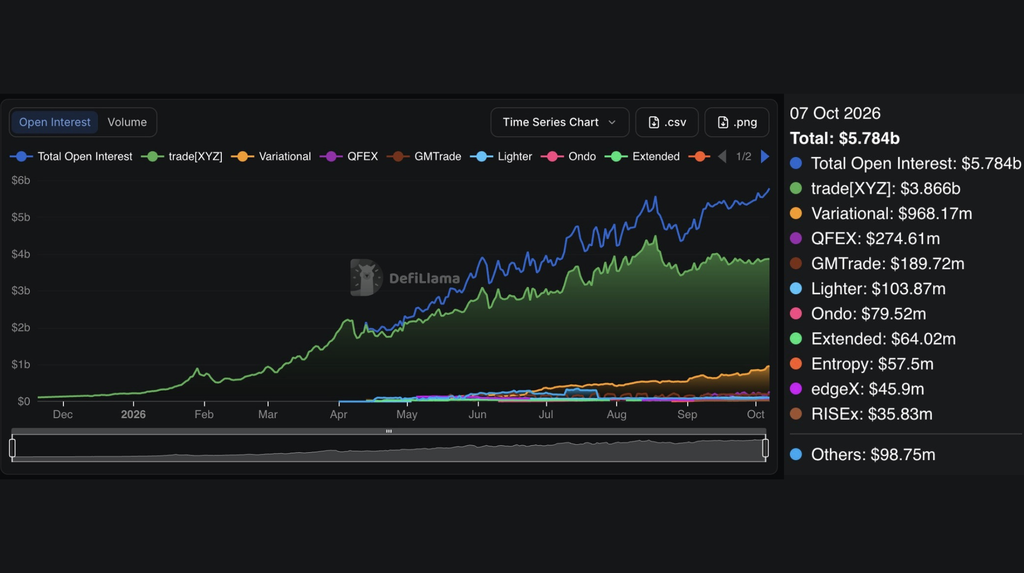
According to the latest data from DefiLlama, the Open Interest (OI) for real-world asset (RWA) perpetual futures on the blockchain has surged to a new all-time high of $5.78 billion. This marks a staggering 25.6x increase from the start of the year, rising from near-zero levels a year ago. Analysis of the market structure reveals that a significant portion of this OI is concentrated on a single platform. Currently, trade[XYZ] dominates with $3.866 billion, accounting for approximately 67% of the market. Following in second place is Variational with $968.17 million, or 17% share. Together, these two platforms hold roughly 84% of all open positions in the RWA perpetual futures sector.

According to the latest data from DefiLlama, the open interest (OI) in Real World Asset (RWA) perpetual futures on the blockchain has reached a new high of $5.78 billion. Open interest in RWAs has increased from near-zero levels a year ago, marking an impressive 25.6x growth since the beginning of the year. An analysis of the market structure reveals that the majority of the OI is concentrated on a single platform.

At the time of writing, trade[XYZ] holds $3.866 billion of the total, representing approximately 67% of the market. Variational ranks second with $968.17 million, or 17%. These two platforms account for about 84% of all open positions in the sector.

Related Questions

QWhat is the current open interest (OI) for RWA perpetual futures on blockchain according to the article?

AAccording to the article, the open interest for RWA perpetual futures on blockchain has reached a new high of $5.78 billion.

QHow much has the RWA open interest increased since the beginning of the year?

AThe RWA open interest has seen a staggering 25.6-fold increase since the beginning of the year, growing from nearly zero a year ago.

QWhich platform holds the majority share of the RWA perpetual futures market's open interest?

AAccording to the article, the platform trade[XYZ] holds the majority share with $3.866 billion in open interest, representing approximately 67% of the total market.

QWhat is the combined market share of the top two platforms in the RWA perpetual futures sector?

AThe combined market share of the top two platforms, trade[XYZ] (67%) and Variational (17%), accounts for approximately 84% of all open positions in the RWA perpetual futures sector.

QWhat does RWA stand for in the context of this article?

AIn the context of this article, RWA stands for 'Real-World Assets'.

Related Reads

Singapore Blockchain Week 2026 Returns This November, Puts Singapore and Johor, Malaysia Cross-Border Digital Economy Opportunities in the Spotlight

Singapore Blockchain Week (SBW) 2026 will take place from 13 to 17 November 2026 as a government-supported flagship event bringing together regulators, financial institutions, sovereign entities, family offices, founders, investors, enterprises, and ecosystem builders. The event features prominent speakers including H.E. Justin Sun (TRON), Jose Fernandez da Ponte (Stellar Development Foundation), representatives from VISA, J.P. Morgan, SAP, the United Nations Development Programme, Société Générale-Forge, Paxos, World Bank, and others. SBW 2026 is positioned as the world's first cross-border blockchain week, connecting Singapore and Malaysia's Johor-Singapore Special Economic Zone (JS-SEZ) to accelerate innovation, investment, and technology collaboration across Southeast Asia. It is supported by partners including Singapore Global Network – Economic Development Board, Singapore Tourism Board, Malaysia Digital Economy Corporation, Iskandar Regional Development Authority, and Johor Corporation. The week-long programme includes: Special Economic Zone Immersion (13 Nov), Tech-Enabled Sports (14 Nov), Learnathon (15 Nov), Inner Circle (16 Nov), and Institution Summit (17 Nov). The event focuses on the convergence of AI, DeFi, Real World Assets (RWA), and Venture Capital, positioning Singapore and ASEAN at the forefront of global digital transformation. Sebastian Zilliacus, Chair of the Advisory Committee, emphasised that the event aims to move beyond headlines so traditional finance and emerging technology "start building together." CK Ong of SBI Digital Markets noted that tokenisation's key question is now market viability, requiring alignment of regulatory clarity, distribution, custody, and commercial viability. Kiran Mistry of SAP highlighted the importance of interoperability between blockchain and enterprise systems, while Rahul Bhargava of the World Bank and Contour Network discussed addressing the $2.5 trillion trade finance gap through digital documentation and multi-rail settlements. Raymond Ngan of Singapore Innovation Centre noted the event strengthens Singapore and Southeast Asia's position, particularly as Singapore prepares for ASEAN Chairmanship in 2027.

TheNewsCrypto15m ago
Singapore Blockchain Week 2026 Returns This November, Puts Singapore and Johor, Malaysia Cross-Border Digital Economy Opportunities in the Spotlight

TheNewsCrypto15m ago

BIT CCO Cynthia Wu Deconstructs Digital Asset Industry Pain Points: Buying Is Only the Starting Point; Holding It Properly Is the Real Competitive Edge

BIT CCO Cynthia Wu spoke at an FTAHK roundtable in Hong Kong on November 3, 2026, alongside Xapo Bank's Belle Leung and Anthea's Alex Pei, discussing the evolution of digital asset wealth management. She noted that after a full market cycle, family clients have shifted focus from prices to operational safety—asking not "can I buy it" but "can I hold it properly." Concerns center on custody, asset segregation, counterparty risk, and inheritance planning, with many families preferring familiar instrument types such as BIT's Swiss-listed spot bitcoin ETF (BBIT). On yield, Wu argued that yield itself is never the problem—unexplained yield is. Real yield is compensation for time and risk, so the key questions are whether risk is isolated, quantified, and capped. She advised families to ask every institution what risk their return corresponds to and where its boundaries lie. Regarding structured products like tokenized funds, RWA, and principal-protected notes, she stressed that structure can reallocate risk but cannot eliminate protocol-level or market risk; tokenization even adds smart-contract risk. Structures mainly change who bears the risk—citing SIX exchange's collateralized issuance since the Lehman crisis—while uncollateralized notes and buffer/income ETFs merely transfer risk at the cost of upside. The biggest red flag is a product promising protection against risks no structure can remove. On AI agents, Wu invoked equal rights and responsibilities: models are software without balance sheets, licenses, or duties of care, so liability rests with whoever deploys the agent and defines its limits, with attribution assessed over the long term as with human managers. "You can delegate trades, but not responsibility." Looking ahead three years, she predicted the first regulated, AI-agent-managed digital asset fund fully running on blockchain, with agents paid in bitcoin. BIT, founded in 2019 and headquartered in Singapore, manages over $6 billion in assets with licenses across multiple jurisdictions.

marsbit20m ago

BIT CCO Cynthia Wu Deconstructs Digital Asset Industry Pain Points: Buying Is Only the Starting Point; Holding It Properly Is the Real Competitive Edge

marsbit20m ago

Just Now, Gemini Omini 1.2 Tops the Leaderboard, 360p Video at $0.07 per Second, with Upscaling to 4K

Google DeepMind has released Gemini Omni 1.2 Flash, a new video generation model that ranks first on Arena.ai for both text-to-video and image-to-video, and third for video editing. It scored 1541 in text-to-video, up 27 points from Gemini Omni 1.1 Flash, with Google's Omni series now holding the top three spots. Key updates include: text-to-video duration extended to 15 seconds, with editing of source clips up to 15 seconds; native audio support; editing of 3–15 second source videos with up to 7 reference images; clip extension of 3–10 seconds per call up to 30 seconds total; re-editing of any output via videoId in later calls; and support for 360p, 720p, 1080p and 4K in 16:9 or 9:16 aspect ratios. Unlike prior waitlist approaches, it is fully available in Google AI Studio and the Gemini API. Pricing is 30% lower than the previous generation. The model introduces a "draft-then-refine" workflow: users generate quick 360p or 720p drafts at about $0.07 per second (roughly 5 cents USD), make multi-turn conversational edits to fix details without regenerating whole clips, then upscale the best draft to 1080p or 4K. This drastically cuts trial-and-error costs for ad agencies, e-commerce sellers and indie filmmakers. Other features include multimodal reference adherence (face portraits, character sheets, product images, motion reference clips up to 3 seconds, audio cues), enhanced cinematic camera control with stable perspective in complex 3D spaces, and improved multi-character dialogue with accurate lip-sync and speaker distinction. Early hands-on tests show 1.2 Flash outperforming 1.1 in FPV camera moves through the Colosseum without flicker or distortion, generating convincing wildlife documentary footage from a single prompt, and maintaining character consistency across dancing and parkour clips, including mixed art styles (stop-motion, realistic 3D, comic, anime) interacting in one scene. The release marks AI video's shift into a third phase focused on cost, deliverability and workflow integration.

marsbit25m ago

Just Now, Gemini Omini 1.2 Tops the Leaderboard, 360p Video at $0.07 per Second, with Upscaling to 4K

marsbit25m ago

Three Harvard Girls Venture into the AI Startup World, She Raised Over $100 Million

This article contrasts the first generation of "Harvard girls"—epitomized by Liu Yiting, whose 1999 full-scholarship admission to Harvard became a bestselling parenting-book phenomenon—with a new wave of Harvard-educated Chinese women who are choosing AI entrepreneurship over traditional elite career paths. Three profiles stand out. Guo Wenjing, a "genius girl" admitted early to Harvard from Hangzhou No. 2 High School, earned degrees in math and computer science, interned at Meta AI, Microsoft, Google Brain and Epic Games, then dropped out of her Stanford PhD in 2023 to co-found Pika Labs, an AI video generation startup. Pika raised $135 million within about a year, reaching a valuation above $470 million. Her father's A-share listed company briefly surged on the "daughter concept stock" hype. Christine Zhang, 19, took a gap year from Harvard to co-found Veil, a GEO (generative engine optimization) startup helping brands become visible when consumers query AI chatbots. Veil raised a $1 million seed round within three months, serving nearly 500 clients with a six-person team. Avery Pan co-founded Class Companion, an AI education company that gives teachers AI-generated personalized feedback while retaining grading authority. It raised a $4 million seed round led by Index Ventures with OpenAI Startup Fund participation, and was acquired by Panorama Education in 2025, just two years after founding. The article notes this "Harvard + Chinese + dropout + AI startup" narrative is spreading beyond Harvard to Stanford and MIT, citing Jessica Wu (MIT dropout, Sola Solutions, ~$21 million raised) and Hong Letong (Stanford PhD dropout, Axiom Math, $200 million Series A, valuation over $1 billion). The generational shift is clear: the earlier narrative centered on being chosen by Harvard as proof of success, while the new one centers on refusing to be defined by Harvard—dropping out, taking gap years, and proving value through ventures and results. Both generations share a belief that timing, not just credentials, changes destiny—and AI provides the opportunity.

marsbit1h ago

Three Harvard Girls Venture into the AI Startup World, She Raised Over $100 Million

marsbit1h ago

Bitcoin holds $75K as AI regulation fears see KOSPI halted after 8% crash

Bitcoin held above $75,000 on Friday after falling as much as 6.6% to $75,109 on Thursday, as a US tech sell-off spread to Asian markets. The S&P 500 and Nasdaq Composite closed down 4.4% and 5.5% respectively. South Korea's KOSPI fell more than 8% shortly after Friday's open, triggering a 20-minute circuit breaker, before paring losses to close 6% lower at 5,059.69 — its lowest close since March 31. Korea's finance minister announced at an emergency meeting that brokerages will be exempt from the 140% collateral ratio requirement on margin loans for three months from Monday, with further measures possible if volatility rises. Analysts linked Thursday's Wall Street losses to fears of tighter US AI regulation after Democrats won the House and Senate, compounding existing concerns about the sector's capital spending. The Philadelphia Semiconductor Index fell 12.2% on Thursday. The Kobeissi Letter argued an outright US AI ban is near-certain not to happen, as it would mean surrendering the global AI race to China, and called the decline "more technical than fundamental," noting the S&P 500 fell only about 2.5% excluding tech. Economist Mohamed El-Erian said lawmakers need to find common ground on AI policy, arguing America's "let it rip" approach has fallen short on safety, diffusion and bringing society along. BTC/USD was trading near its 50-week simple moving average at $75,733.

cointelegraph1h ago

Bitcoin holds $75K as AI regulation fears see KOSPI halted after 8% crash

cointelegraph1h ago

Trading

Spot
活动图片