South Korean Giant BC Card Concludes Stablecoin Payments Pilot Ahead Of 2026 Framework

bitcoinistPublicado em 2025-12-24Última atualização em 2025-12-24

Resumo

South Korean payments giant BC Card has completed a two-month pilot project enabling foreigners to use stablecoins for payments at domestic merchants. The pilot, conducted with partners including Wavebridge and Aaron Group, tested the stability and convenience of converting foreign-held stablecoins into digital prepaid cards for QR code transactions, eliminating the need for physical cards or currency exchange. BC Card integrated the system into its existing payment infrastructure, allowing transactions to function like conventional card payments. The initiative is part of preparations for future regulatory changes, as South Korea anticipates a framework for won-pegged stablecoins by 2026. The project aims to establish a compliant "Korean-style stablecoin payment infrastructure" aligned with upcoming legislation.

South Korean payments giant BC Card has completed its pilot project to verify the stability and convenience of card-integrated stablecoins in collaboration with domestic and international digital asset companies.

BC Card Completes Stablecoin Payment Pilot Project For Foreigners

On Tuesday, South Korea’s largest payment processing company, BC Card, announced it had concluded its two-month pilot project enabling foreigners to use stablecoins as a payment method at domestic merchants.

The project was conducted alongside blockchain financial firm Wavebridge, overseas digital wallet company Aaron Group, and remittance fintech company Global Money Express.

According to BC Card, the pilot focused on “verifying whether foreign currency-based stablecoins held by foreigners could be practically used within the domestic payment environment, while also assessing payment convenience and stability.”

For the project, foreign users converted their stablecoins held in oversea wallets parented with BC Card into digital prepaid cards that could be used at domestic affiliated merchants using a QR code, without requiring a physical card or currency exchange procedures.

The company integrated stablecoin payments into the existing card authorization and settlement structure using a digital prepaid card as an intermediary, the announcement explained, noting that “this design enables both paying customers and merchants to transact in the same manner as with conventional card payments.”

BC Card’s President, Choi Won-seok, stated, “Stablecoins, due to their technical characteristics, are particularly useful for cross-border payments and hold significant potential to improve the domestic payment experience for foreign consumers.”

South Korean Companies Prepares For 2026 Framework

The payments giant affirmed that the pilot was not a “short-term technical verification” but a “process to prepare a stablecoin payment structure responsive to future domestic legal and regulatory changes.”

Notably, the South Korean government recently failed to submit the highly anticipated bill for the Second Phase of the Virtual Asset User Protection Act, which will address the issuance and distribution of won-pegged stablecoins.

As reported by Bitcoinist, the Financial Services Commission (FSC) did not meet the ruling party’s December 10 deadline to submit the government’s legislation to the National Policy Committee.

According to local media, the government bill was delayed after the FSC and the Bank of Korea (BOK) failed to resolve their differences over the issuance of won-denominated stablecoins.

The financial authorities reportedly agree that financial institutions must be involved in the issuance of the tokens but disagree on the extent of banks’ role. While the central bank has been pushing for a consortium of banks owning at least 51% of any stablecoin issuer seeking approval in the country, the FSC has expressed concerns that giving a majority stake to banks could reduce participation from tech firms and limit the market’s innovation.

Recent reports affirmed that the government’s proposal is expected to be announced by early next month at the latest, as the integrated bill must be submitted in January 2026. “To protect the public’s right to know, there will be a separate opportunity to explain the government’s proposed bill to the public while submitting it to the National Assembly,” an FSC official stated last week.

Ultimately, BC Card pledged to strengthen its cooperation with relevant agencies while considering the flow of virtual asset legislation, aiming to “lead the establishment of a ‘Korean-style stablecoin payment infrastructure’ by progressively advancing a payment model compliant with domestic regulations.”

“BC Card will leverage its card payment infrastructure to progressively prepare a stable stablecoin payment model that aligns with Korea’s legal and regulatory environment,” the company’s president concluded.
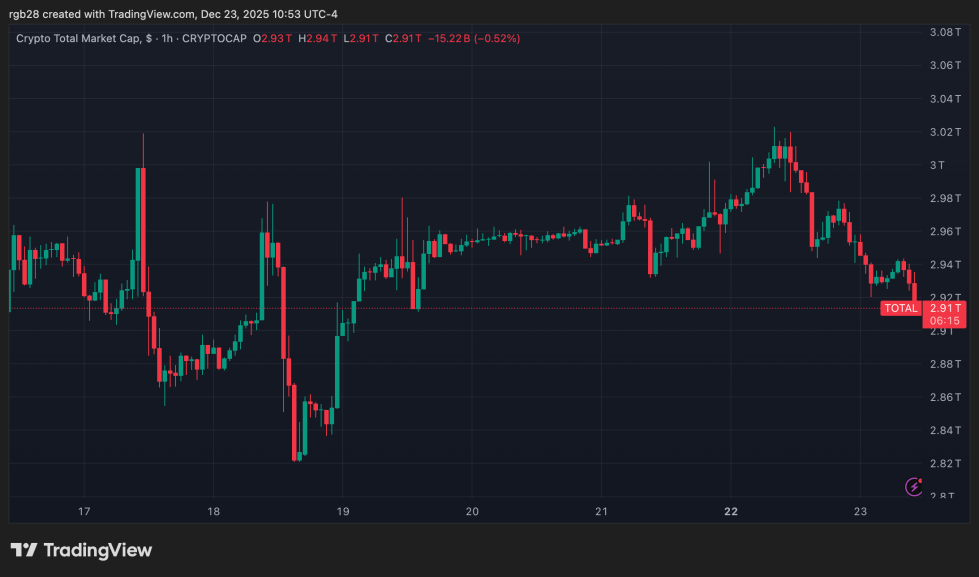
The total crypto market capitalization is at $2.91 trillion in the one-week chart. Source: TOTAL on TradingView


Perguntas relacionadas

QWhat was the main goal of BC Card's pilot project regarding stablecoins?

AThe main goal was to verify the stability and convenience of using card-integrated stablecoins for payments by foreigners at domestic merchants, assessing their practical use within the domestic payment environment.

QWhich companies collaborated with BC Card on the stablecoin payment pilot?

ABC Card collaborated with blockchain financial firm Wavebridge, overseas digital wallet company Aaron Group, and remittance fintech company Global Money Express.

QHow did foreign users utilize their stablecoins for payments in the pilot project?

AForeign users converted their stablecoins held in overseas wallets into digital prepaid cards that could be used at domestic merchants via QR code, without needing a physical card or currency exchange.

QWhy was the South Korean government's bill for the Second Phase of the Virtual Asset User Protection Act delayed?

AThe bill was delayed because the Financial Services Commission (FSC) and the Bank of Korea (BOK) failed to resolve their differences over the issuance of won-denominated stablecoins, particularly regarding the extent of banks' role in the issuance process.

QWhat is BC Card's future plan regarding stablecoin payments in South Korea?

ABC Card aims to lead the establishment of a 'Korean-style stablecoin payment infrastructure' by progressively advancing a payment model compliant with domestic regulations, leveraging its card payment infrastructure and strengthening cooperation with relevant agencies.

Leituras Relacionadas

In Conversation with Ray Dalio: We Are Currently in an AI Bubble, with 1% of My Portfolio in Bitcoin

Ray Dalio, founder of Bridgewater Associates, warns in an interview that the current AI boom shows classic bubble characteristics, which could lead to significant economic downturns as seen in past cycles like 1929 or 2000. He explains that speculative enthusiasm, fueled by debt and overvaluation, often precedes a crash when rising rates or taxation force asset sales, causing widespread losses and recession. Dalio also outlines his "Big Cycle" theory, describing an approximate 80-year pattern where widening wealth gaps, massive government deficits, and shifting geopolitical power (like China's rise) create internal conflict and global instability. He emphasizes that we are in a late-cycle, transitional phase where traditional powers like the US and UK face decline. For personal wealth protection, Dalio advises diversification beyond cash into assets like stocks, bonds, real estate, and particularly gold, which he prefers over Bitcoin. While he holds about 1% of his portfolio in Bitcoin as a non-printable hard asset, he views gold as more secure from technological or governmental threats. Regarding AI's impact, Dalio believes it will disproportionately benefit capital owners, worsening inequality by replacing both physical and cognitive labor. He suggests that human intuition and emotional intelligence, combined with AI, will be key for future workers. On taxation, Dalio argues that wealth taxes are impractical and risk triggering asset sell-offs, reducing productive investment. He points to the UK as a cautionary example of debt, low productivity, and political strife. Geopolitically, Dalio foresees a more regionalized world, with the US showing weakness in prolonged conflicts like with Iran, akin to past imperial declines. The ideal outcome, he suggests, is coexisting powerful blocs (e.g., Americas, China-Asia Pacific) without major war.

marsbitHá 3h

In Conversation with Ray Dalio: We Are Currently in an AI Bubble, with 1% of My Portfolio in Bitcoin

marsbitHá 3h

Daily 7.2 Trillion KRW: Foreign Capital's Record Net Buying on Friday! Wall Street Says Headwinds for Korean Stock Fund Flows Have Subsided

South Korean stock market sees a dramatic shift in fund flows. On July 31, foreign investors made a record net purchase of approximately KRW 7.2 trillion in KOSPI stocks, marking a fundamental reversal from the persistent large-scale net outflows seen in previous months. This contributed to a significant narrowing of foreign net selling in July to KRW 9.8 trillion, down sharply from KRW 48.4 trillion in June and KRW 44.5 trillion in May. Simultaneously, domestic institutional pressure eased. South Korean pension funds and asset managers turned to a net buying position in July, purchasing KRW 1.0 trillion worth of KOSPI shares, contrasting with net sales in May and June. Market volatility is expected to be dampened by new financial regulations. Effective July 31, the Financial Services Commission tightened access for retail investors to single-stock leveraged ETFs by raising the minimum cash deposit requirement. Trading volumes for these products subsequently dropped to about 50% of their monthly average. Citigroup Research maintains its year-end KOSPI target of 10,000 points. The firm cites several supportive factors: the substantial easing of headwinds from capital outflows, a robust fundamental outlook for the semiconductor sector, historically low market valuations, strong economic fundamentals, and the potential for policy support from financial authorities if needed.

marsbitHá 3h

Daily 7.2 Trillion KRW: Foreign Capital's Record Net Buying on Friday! Wall Street Says Headwinds for Korean Stock Fund Flows Have Subsided

marsbitHá 3h

Thanks to Dice Rolls, Bitcoin Keys Are Stored Offline, But Not Everyone Will Do It

The article discusses using dice rolls to generate secure Bitcoin wallet seeds, providing entropy independent of potentially flawed hardware random number generators. It explains that each fair dice roll offers about 2.585 bits of entropy, with around 50 rolls needed for a standard 12-word seed phrase and 99+ recommended for higher security. This method gained attention after a vulnerability was revealed in some Coldcard hardware wallets, where a faulty firmware RNG (dating back to 2021) compromised generated keys. The analysis notes that while a dice-generated main seed was safe from this specific flaw, other Coldcard functions (like creating paper wallets, backup keys, or passwords) could still be vulnerable if they used the defective RNG. The piece argues that while dice-based entropy is technically robust, the manual process is error-prone, tedious, and unrealistic for most new users, who might make mistakes in recording or inputting rolls. It concludes that while manual entropy generation should remain an option for advanced users, the long-term goal is to develop reliable, user-friendly hardware and software that securely generates randomness without requiring specialized knowledge. Coldcard users are advised to check their firmware version and replace any secondary secrets (like paper wallet keys) created with vulnerable devices, while also considering multi-signature setups with devices from different manufacturers for added security.

cryptonews.ruHá 8h

Thanks to Dice Rolls, Bitcoin Keys Are Stored Offline, But Not Everyone Will Do It

cryptonews.ruHá 8h

Trading

Spot
活动图片




