Solving a 20-Year Math Problem, Microsoft Open-Sources Argus, Using Evidence-Driven Automatic Research for 1,548 Hours

marsbitPublished on 2026-09-07Last updated on 2026-09-07

Abstract

Microsoft, in collaboration with institutions like Shanghai Jiao Tong University, has open-sourced Argus, a general-purpose Agent reasoning runtime designed for long-term research tasks. The system addresses a key bottleneck in current AI agents: while they can execute actions (through "Harness"), they lack autonomous, long-term decision-making ("Driving") for projects spanning days. Argus introduces an "Evidence-Driven" approach, where the agent's next steps are determined by accumulated evidence rather than a rigid initial goal. This enables sustained, multi-day operation with minimal human intervention, averaging one human request per 40.7 hours over 1,548 hours of wall-clock time tested. The runtime architecture organizes work into Campaigns and Missions, employing a multi-agent loop with Manager, Planner, Engineer, and Reviewer roles. This separation of planning, execution, and validation improves efficiency and prevents local optimization. Argus is designed with a decoupled core and vertical components, allowing domain experts to customize workflows for fields like mathematics, GPU optimization, and chip design. In less than a month, Argus has delivered concrete research outcomes across AI4AI, GPU kernels, AI4Science, chip design, AI4Math, and AI4System tasks. These results demonstrate its ability to autonomously drive projects from execution to exploration of open-ended research questions, effectively transitioning the human role from a constant driver to a superviso...

From 'Capable of Execution' to 'Capable of Steerage': What Do Long-Horizon Agents Still Lack?

In the rapidly evolving field of Agents, Harness technology has already enabled large language models to interact with the real world, allowing them to call tools, modify code, and run experiments. However, when tasks extend from tens of minutes to several days, systems still require a human to remain at the screen long-term, judging where to go next.

The key bottleneck is not merely insufficient model capabilities, but that most existing Agents have automated "execution" but not truly automated the "steering" above execution. Harness grants the model the ability to act, while humans grant the model decision-making. Once the human leaves, the project stops. Moreover, without dense reward feedback, the Agent's execution and reactions can appear slow and clumsy.

To address this issue, Microsoft, Shanghai Jiao Tong University, and other institutions have open-sourced Argus, a general Agent reasoning runtime for long-horizon research tasks, and released a technical report. Through designs such as evidence-driven operation, self-evolution, multi-agent collaboration, and decoupling of core and vertical domains, the system enables Agents to extend research over multiple domains for days, even without dense standard feedback.

The report covers 27 Campaigns and 1,548 hours of wall-clock time. On average, it requested human intervention once every 40.7 hours; the working duty cycle was 95.1% to 98.7%. What Argus delivers is not just high benchmark scores, but a complete production-grade portfolio of results. The team presents achievements across a wide range of tasks including AI4AI, GPU Kernel, model training, AI4Science, chip design, AI4math, and AI4System, demonstrating Argus's generality and real research-grade intelligence.
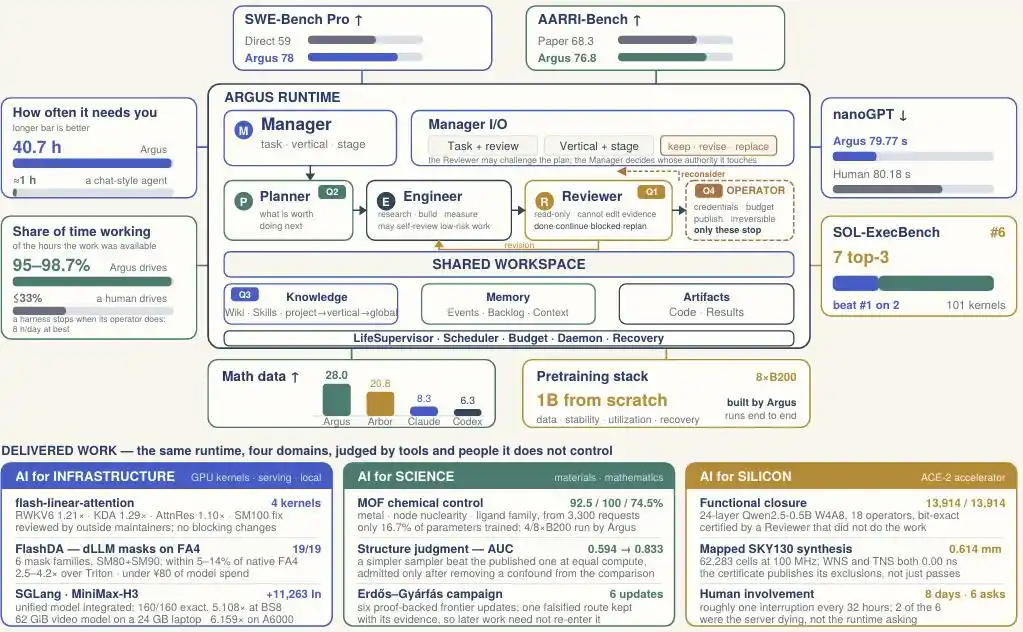
Figure 1: Overview of Argus runtime, capability benchmarks, and delivered results.
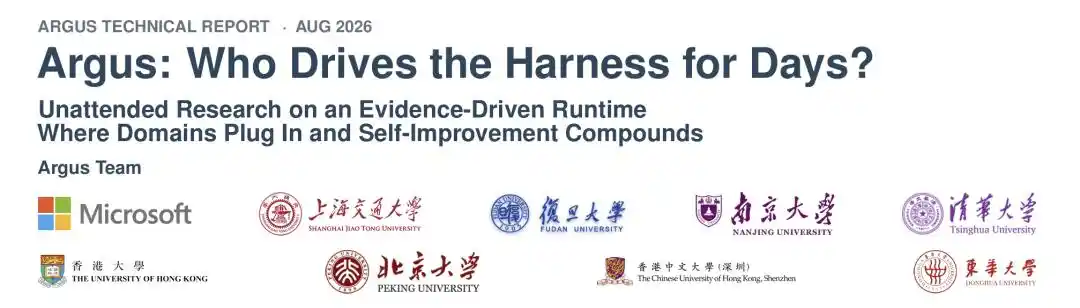
  • Paper Title: Argus: Who Drives the Harness for Days?
  • Paper: https://arxiv.org/abs/2608.05144
  • Code: https://github.com/lbx154/Argus
  • Project Homepage: https://argusbot.cn/
  • Project Results Repository: https://github.com/Argus-AiTeam
  • Project Math Problem Solving Live Stream: https://open.argusbot.cn/#counterexample-live

01

Shifting from Goal-Driven to Evidence-Driven:

Who Decides the Agent's Next Step?

Over the past two years, major progress in Agent engineering has centered on Harness: using the analogy of self-driving FSD, the model is like the engine, Harness is like the drivetrain, but the one truly deciding where the vehicle goes is still the person sitting at the screen. For short tasks, like standard automated parking, the task itself can still provide clear feedback; once tasks extend over days, research problems often lack both stable rewards and clearly defined goals from the start. Existing Agents thus reveal the true bottleneck: they can execute, but they still cannot make continuous judgments under uncertainty.
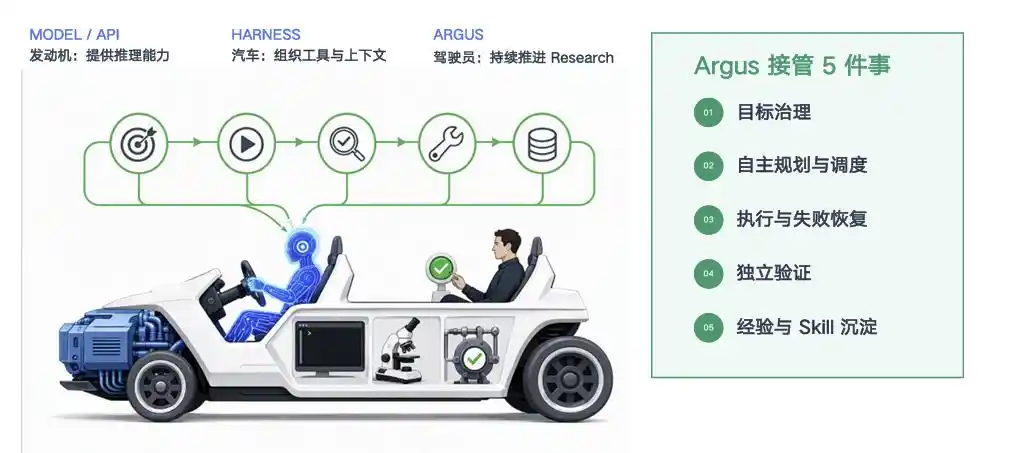
Figure 2: Argus transforms the human role from the ongoing driver's seat to a co-pilot by achieving auto-research for autonomous scientific inquiry.

Argus refers to the previously unautomated position above Harness as the Driver. Its job is to keep steering based on evidence even when plans conflict with reality. The goal written at the start of research is merely the initial hypothesis at the information-poorest stage; if the Agent can only chase preset endpoints in a Goal-Driven manner, or even repeatedly waste tokens on impossible goals, it leads to goal fixation. Evidence-Driven, however, inverts the control logic: the next step is determined by existing evidence, not by the initial hypothesis of the plan. All results during operation are valid evidence that can change the route; the system is precisely driven by evidence. Specifically, the Driver needs to repeatedly answer the following four questions based on current evidence:

1. Is this work already complete, and is the quality sufficient?

2. Based on current evidence, what is the most worthwhile thing to do next?

3. How should the experience gained in this round alter the system's subsequent behavior?

4. Does the remaining problem involve decisions that only humans can make?

02

Building a General, Customizable Long-Horizon Runtime

Argus organizes long-term projects into persistent Campaigns, which are then broken down into a series of well-bounded Missions. Its fundamental loop is: Manager → Planner → Engineer ⇄ Reviewer → Manager:

Using OpenAI Codex's /goal mode as a reference helps clarify Argus's design orientation. /goal extends a single agent's single-turn loop into a persistent loop with a goal state; Argus organizes research projects as a multi-role, multi-harness, knowledge-persisting long-horizon runtime. The former answers "how to keep the agent from stopping," the latter answers "once the agent doesn't stop, how to work effectively." This is precisely the structural difference at the runtime level corresponding to the shift from Goal-Driven to Evidence-Driven.

1. Manager controls phase transitions, process approvals, and global strategy;

2. Planner formulates specific tasks based on current evidence;

3. Engineer enters real codebases, experiments, and executes;

4. Reviewer independently audits artifacts, evaluates novelty and effectiveness, reports to the Manager, or sends tasks back to the Engineer.

The key here is not multi-role itself, but splitting the context—multiple roles collaborate to prevent the agent from becoming a simple local hill climber. Each role has its own unique context but shares a workspace, avoiding entrusting planning, execution, and validation entirely to a single agent, improving token efficiency. This also allows Argus to simultaneously enable different harnesses like Pi, Codex, Claude Code, DeepSeek Harness etc., within a single task, ensuring high customizability.

The system saves a complete set of artifacts; only experiences that pass the evidence threshold enter the Wiki and Skill, and are reused in subsequent tasks within Project, Vertical, or Global scopes.

Simultaneously, Core and Vertical remain decoupled: Core is responsible for role permissions, evidence submission, and human boundaries. Vertical, defined by domain experts, determines what constitutes valid evidence in tasks like mathematics, GPU, materials, etc., along with related human skills and knowledge. Vertical can significantly improve the delivery quality of research tasks and also provides an interface for human experts and agents to co-evolve and customize workflows.
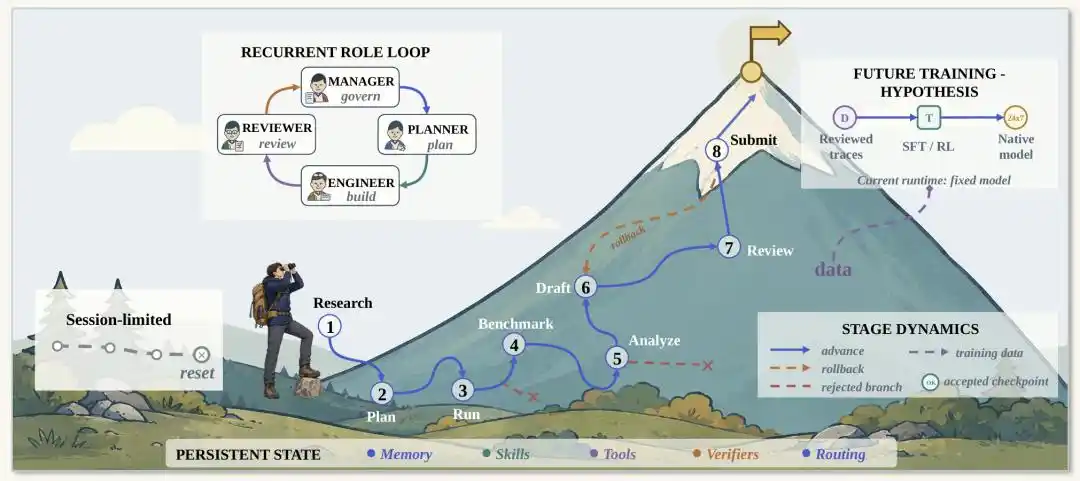
Figure 3: Argus's long-horizon runtime mechanism. Four role types cycle around persistent state; Campaigns can advance or roll back between eight research phases.

03

After 1,548 Hours, What Has Argus Left Behind?

What truly determines the validity of a long-horizon Agent is whether time can be translated into genuine research outcomes. Within less than a month of its open-source release, Argus has already made outstanding contributions in infrastructure, materials, chips, mathematics, and AI system research. The team is also the first to publish complete end-to-end logs for solving mathematical conjecture screening, opening all running trajectory sessions, etc. The following is a summary of Argus's achievements since its open-source release:
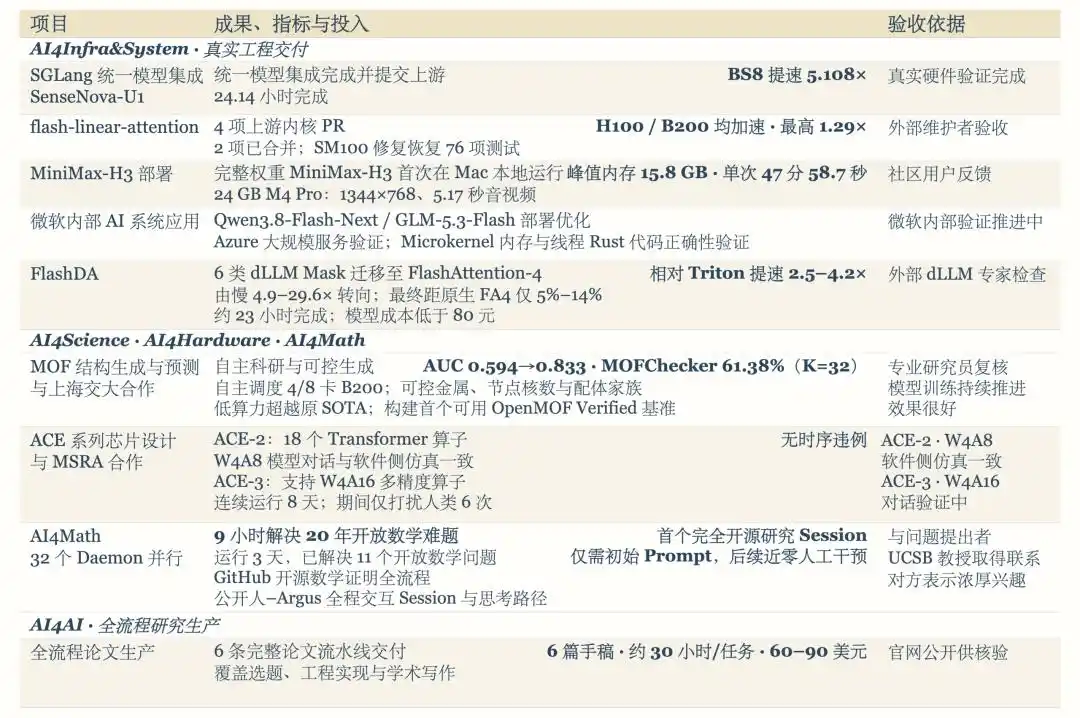
Figure 4: Argus's representative research results, key metrics, and acceptance criteria.

As shown in the table above, Argus first translated continuous operation into verifiable real-world deliverables in AI4System & Infra, achieving the first step from automated execution to autonomous research with clear engineering outcomes. Subsequently, tasks expanded from AI infrastructure to AI4Science, AI4Hardware, and AI4Math, and the evaluation criteria shifted accordingly from "whether the assigned task is completed" to "whether unresolved real-world research problems can be explored." Auto-research thus progressed further from automated delivery to automated exploration. Building on this, Argus extended from point achievements to complete research workflows in the AI4AI direction, continuously driving task progression with evidence without requiring humans to remain at the screen, forming a progressive path from real-world delivery, cross-domain exploration, to full-process autonomous research.
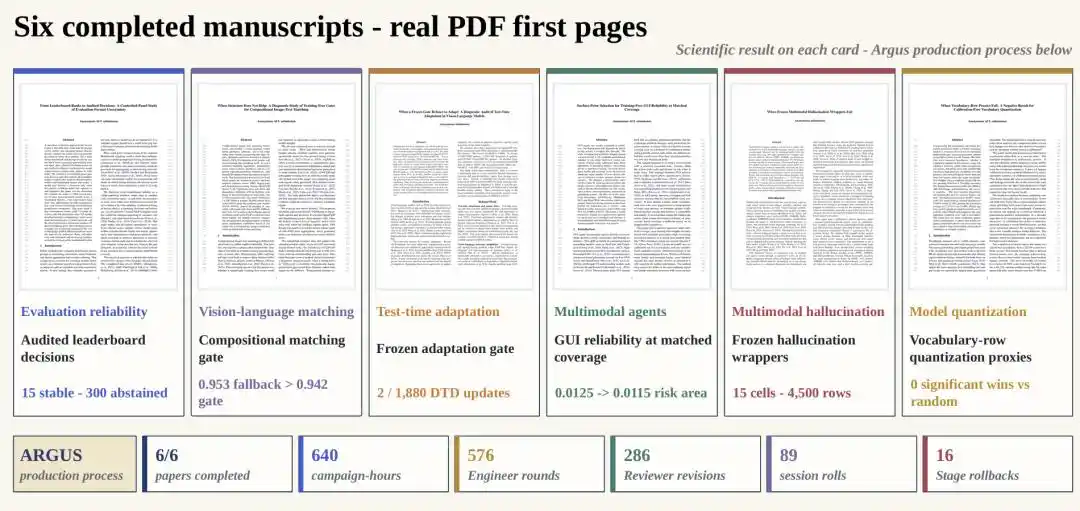
Figure 5: Argus's delivery results in the full-process paper production.

All the above results were achieved within 1 month. Stringing these outcomes together, Argus represents a gradually deepening value chain: the object of automation expands from a single execution to evidence-driven research progression, greatly accelerating research progress. This is the most direct answer to "who steers the Agent after the human leaves the screen."

Conclusion

After the Screen Goes Dark, the Project Doesn't Reset to Zero

Long-horizon intelligence is about transforming tokens into intelligence, then using that intelligence to continuously advance a research project, generating real value. Argus organizes previously disjointed model calls into a continuously operating research system, letting Evidence-Driven control the direction, and then solidifying experience into capability through self-evolution.

Argus demonstrates not just a longer-running Agent, but a new way of organizing research: Harness addresses how the model acts, the Driver determines how the system continuously moves forward, and research speed is no longer constrained by human work and leisure hours. This may signal the arrival of an era of accelerated research. The screen can go dark, but the research continues.

About the Authors

Argus was led by researchers from Microsoft and Shanghai Jiao Tong University, with contributions from researchers at multiple universities.

This article is from the WeChat public account "机器之心" (Almost Human)

Related Questions

QWhat is the core problem that the Argus system aims to solve in long-term AI agent research?

AArgus aims to solve the problem that most existing AI agents automate 'execution' but not the higher-level 'driving' or decision-making required for long-term research tasks. These tasks often lack dense, immediate feedback, causing progress to stall without constant human supervision.

QWhat is the key design shift in Argus's approach compared to traditional agent systems?

AArgus shifts from a 'Goal-Driven' approach to an 'Evidence-Driven' approach. Instead of rigidly following an initial goal, Argus uses evidence gathered during execution to continuously decide the next steps, adapting its course based on real-time results.

QWhat are the four main roles within the Argus runtime's basic operational loop?

AThe four main roles are: Manager (handles phase transitions and global strategy), Planner (creates specific tasks based on current evidence), Engineer (executes tasks in codebases and experiments), and Reviewer (independently reviews work products for validity and innovation).

QAccording to the article, what is a significant outcome demonstrated by Argus in its testing?

AIn testing across 27 campaigns and 1,548 hours of wall-clock time, Argus demonstrated high autonomy with an average of only one human intervention request every 40.7 hours and a work duty cycle of 95.1% to 98.7%, while delivering tangible research results across multiple fields.

QHow does the Argus system architecture separate general and domain-specific functionalities?

AArgus's architecture keeps the Core (handling role permissions, evidence submission, and human boundaries) decoupled from Verticals. Verticals are defined by domain experts to specify what constitutes valid evidence and relevant skills/knowledge for fields like mathematics, GPU programming, or materials science.

Related Reads

Vitalik "Exposes the Shortcomings" of Burn Efficacy, ETH Value Narrative Shifts

Vitalik Buterin argues that Ethereum should focus more on ETH's store-of-value property rather than relying on fee burning to support its valuation. He explains that fee-burning-based valuation rests on a net present value logic—market cap equals annual burned fees divided by discount rate—but this has never provided a truly solid floor. Much of the past burning came from activity within the crypto ecosystem itself, so if ETH's price fell sharply, that revenue would fall too. Only demand from outside crypto can make such a valuation floor convincing, and while RWA growth may help, mature businesses are unlikely to recreate the massive fee consumption seen during speculative frenzies. He also warns of the costs of pursuing fee burning: to justify ETH's ~$270bn market cap through burning, Ethereum would need to operate like a world-class corporation such as L'Oréal—requiring sustained R&D spending (potentially ~700k ETH per year, cutting validator income by roughly two-thirds), active governance, and higher gas prices that could exclude users most in need of privacy and security. Maximizing "price × usage" conflicts with letting as many people as possible use the network within safe resource limits. As a store-of-value asset, the most important metric is survival. Users value decentralization and CROPS (censorship and capture resistance, open source, privacy, security), which also matter to institutions. Ethereum should make prudent security tradeoffs, address quantum computing and AI risks, stabilize the core protocol, push innovation to layer 2, resist complexity and capture-prone reward mechanisms, and support privacy tools, account abstraction, FOCIL, and reduced infrastructure dependence. Store-of-value and application growth are synergistic: more native RWA and decentralized assets on L1 increase ETH's usefulness. Ethereum's social meaning is broad access to decentralization, privacy, and security—and ETH's value comes from these guarantees.

marsbit9m ago

Vitalik "Exposes the Shortcomings" of Burn Efficacy, ETH Value Narrative Shifts

marsbit9m ago

US Stock Market Trends (November 9): Nasdaq Rebounds 1% on Friday, Nvidia Launches Investigation into Jensen Huang Over the Weekend

US stocks closed mixed on Friday, November 6: the Nasdaq rebounded 1.09% to 24,579.42, the S&P 500 rose 0.31% to 7,376.86, and the Dow fell 237.33 points (-0.46%) to 51,285.73. Chip stocks partly recovered after Thursday's selloff, with Micron up about 5%, Nvidia up nearly 3%, AMD up as much as 9%, and Intel up nearly 7% intraday. For the week, the Nasdaq fell 3.4%, the S&P 500 lost 2.7%, and the Dow dropped 0.9%; the tech sector ETF (XLK) had its worst week since early April 2025, down about 8%. October nonfarm payrolls came in at 165,000, far above the 59,000 expected, while unemployment fell to 4.1%. Markets priced a roughly 76.8% chance of a 25-basis-point rate hike at the December 8-9 meeting. WTI settled at $90.83 a barrel, up 0.34%, but fell about 13% for the week; Brent settled at $98.32 and fell over 16% weekly. The 10-year Treasury yield closed at 4.86%. Over the weekend, Nvidia's board launched an independent investigation into reports that CEO Jensen Huang may have been a target of foreign intelligence activity. The board said there is no reason to believe national security or company secrets were compromised, and Huang will remain CEO. Huang admitted to an extramarital affair and apologized. On Monday in Asia, Japan's Nikkei 225 rose about 2% and Taiwan's weighted index gained over 2%, while US futures were mixed, with Nasdaq 100 futures down about 0.2%. Key upcoming events include US inflation data and Nvidia's Q3 earnings on November 17.

marsbit9m ago

US Stock Market Trends (November 9): Nasdaq Rebounds 1% on Friday, Nvidia Launches Investigation into Jensen Huang Over the Weekend

marsbit9m ago

Vitalik 'Exposes' the Limitations of Burning, ETH Value Narrative Shifts

Vitalik Buterin argues that Ethereum should focus more on ETH's store-of-value property rather than relying on fee burning to support its valuation. He explains that fee-burn-based valuation rests on a net present value logic—market cap equals annual burned fees divided by a discount rate—but notes this never provided a truly solid floor. Much of the burning during 2021–2023 came from within the crypto ecosystem itself, so if ETH's price fell, that revenue would fall too. Only demand from outside crypto can make such a valuation floor more convincing, and while RWA growth may help, mature businesses are unlikely to replicate the massive fee consumption seen during speculative manias. He warns that relying on fee burning to justify ETH's ~$270B market cap would require Ethereum to operate like a world-class corporation (roughly L'Oréal's scale), needing sustained R&D spending—perhaps ~700K ETH annually—and highly interventionist governance, both of which create political problems and undermine decentralization and anti-capture properties. Pursuing burning also implies pursuing higher gas prices, potentially excluding users who most need privacy and security; maximizing "price × usage" differs from maximizing safe access for as many people as possible. As a store-of-value asset, the most important metric is survival. Users most value decentralization and CROPS (censorship and capture resistance, open source, privacy, security), which also matter to institutions for risk management and compliance. Ethereum should make prudent security tradeoffs, address quantum computing and AI risks, stabilize the core protocol while shifting innovation to upper layers, and resist complexity-adding features and capture-prone reward mechanisms. Users should be able to hold assets safely and privately, with confidence transactions won't be blocked. Reducing dependence on infrastructure providers matters—he can run a node on a laptop, syncing in under six hours with about one-eighth of disk space, better than 2019. Store-of-value and application growth are synergistic: more native RWA and decentralized assets on L1 increase what holding ETH enables—trustless swaps or using ETH as collateral—boosting its utility, with tradeoffs smaller than maximizing fees.

Odaily星球日报19m ago

Vitalik 'Exposes' the Limitations of Burning, ETH Value Narrative Shifts

Odaily星球日报19m ago

ICLR 2027 First Round Review: Quite a Few Pain Points

ICLR 2027's first-round reviews have sparked widespread complaints among researchers, with many sharing examples of poor-quality or clearly AI-generated feedback on social media. One reviewer asked an author to explain what "standard deviation" means; another review began with the telltale chatbot opener "Certainly! Here is a review of the paper," while two other reviews appeared to be near-identical copies of the same template. One author received criticism for using AI-assisted writing despite having properly disclosed it, and another reviewer openly admitted lacking the expertise to evaluate the paper—prompting debate over whether the real fault lies with reviewer assignment rather than the reviewer. A recurring concern, raised by Jiaxin Pei of UT Austin, is that AI reviewers cannot distinguish between a paper's ordinary limitations and the critical flaws that actually undermine its core contributions. Large language models can list hundreds of limitations for any paper, including the best ones, but they cannot judge which issues truly matter. As a result, reviews grow longer and demand more experiments while the real determinants of paper quality get buried. ICLR 2027 organizers have acknowledged the strain: rapid growth in submissions, a shortage of qualified reviewers, and AI lowering the barrier to paper production. They introduced measures including submission caps, stricter reciprocal review obligations, and rules permitting limited, disclosed AI use in reviewing—with penalties for low-quality or hallucinated AI-generated reviews. Author-reviewer discussion runs until November 18, with final decisions expected December 16.

marsbit54m ago

ICLR 2027 First Round Review: Quite a Few Pain Points

marsbit54m ago

Without Warning, OpenAI Suddenly Mass-Bans Accounts

OpenAI has abruptly banned a large number of ChatGPT accounts without prior notice or email warnings, deleting accounts outright. Affected users see only an error message stating their account has been deleted or deactivated. The purge heavily targets accounts in the Philippines and Turkey, low-cost Team plans, and accounts using reverse proxy relays, and even long-standing paying users with months of subscription have been hit. Free API accounts, shared team accounts, and $200/month Pro accounts were all affected. Developers report losing years of conversation history and personal data locked in the cloud, with appeals unsuccessful. Some speculate OpenAI is cracking down on account stacking to prevent users from exploiting cheap subscriptions. OpenAI's status page showed elevated error rates for some US commercial Mastercards, though OpenAI characterized the incident as a payment channel issue rather than account bans. Users are advised to appeal via OpenAI's official form with account details and Request ID. This move follows earlier steps: OpenAI previously merged ChatGPT and Codex into a single token pool and, five days ago, imposed device and payment card limits, preventing multiple paid subscriptions on one card or device. Starting November 20, new usage policies require third-party API gateways to obtain official written authorization, and from December, Plus, Pro, and Business plans will share a single quota calculated by token consumption. Users are advised to regularly back up cloud conversations and sync Codex projects locally, as the era of freely exploiting AI compute appears to be over.

marsbit59m ago

Without Warning, OpenAI Suddenly Mass-Bans Accounts

marsbit59m ago

Trading

Spot
活动图片