Russia Introduces Protocol for Seizing Crypto Assets, Already Applied in Practice

cryptonews.ruPublished on 2026-10-12Last updated on 2026-10-12

Abstract

Russian authorities have reportedly used a new protocol for seizing crypto assets in a practical case. According to a published investigative action protocol (from October 10, 2026), an investigator in the Republic of Tatarstan seized $6,328 in digital currency. The funds were transferred from a trading account on the RoboForex platform, converting them to USDT and sending them to a specified TRON network address. The procedure was conducted with the participation of the account owner, a defense lawyer, and a specialist, following a court order to seize property. This case aligns with new Russian legislation effective from March and July 2026, which regulates the seizure and storage of digital assets as property in criminal proceedings. The rules establish a framework for transferring seized crypto to special state-controlled addresses. It is noted that the action described constitutes an arrest to secure the assets, not a final confiscation, which would require a separate court ruling. The authenticity of the specific protocol could not be independently verified.

  • An investigator from the Main Investigative Department of the Russian MVD in the Republic of Tatarstan seized digital currency amounting to $6328.
  • From a previously confiscated laptop, he initiated a withdrawal from a RoboForex trading account, choosing to receive the funds in $USDT via the TRON network.

A purported protocol of the investigative action has been published online, showing how the new Russian mechanism for seizing and storing digital assets can work in practice.

According to the document dated October 10, 2026, an investigator from the Main Investigative Department of the Russian MVD in the Republic of Tatarstan

The Happy Coin News editorial team was unable to confirm the authenticity of the published protocol; however, the procedure described in it aligns with the rules for handling seized digital currency that came into force this year.
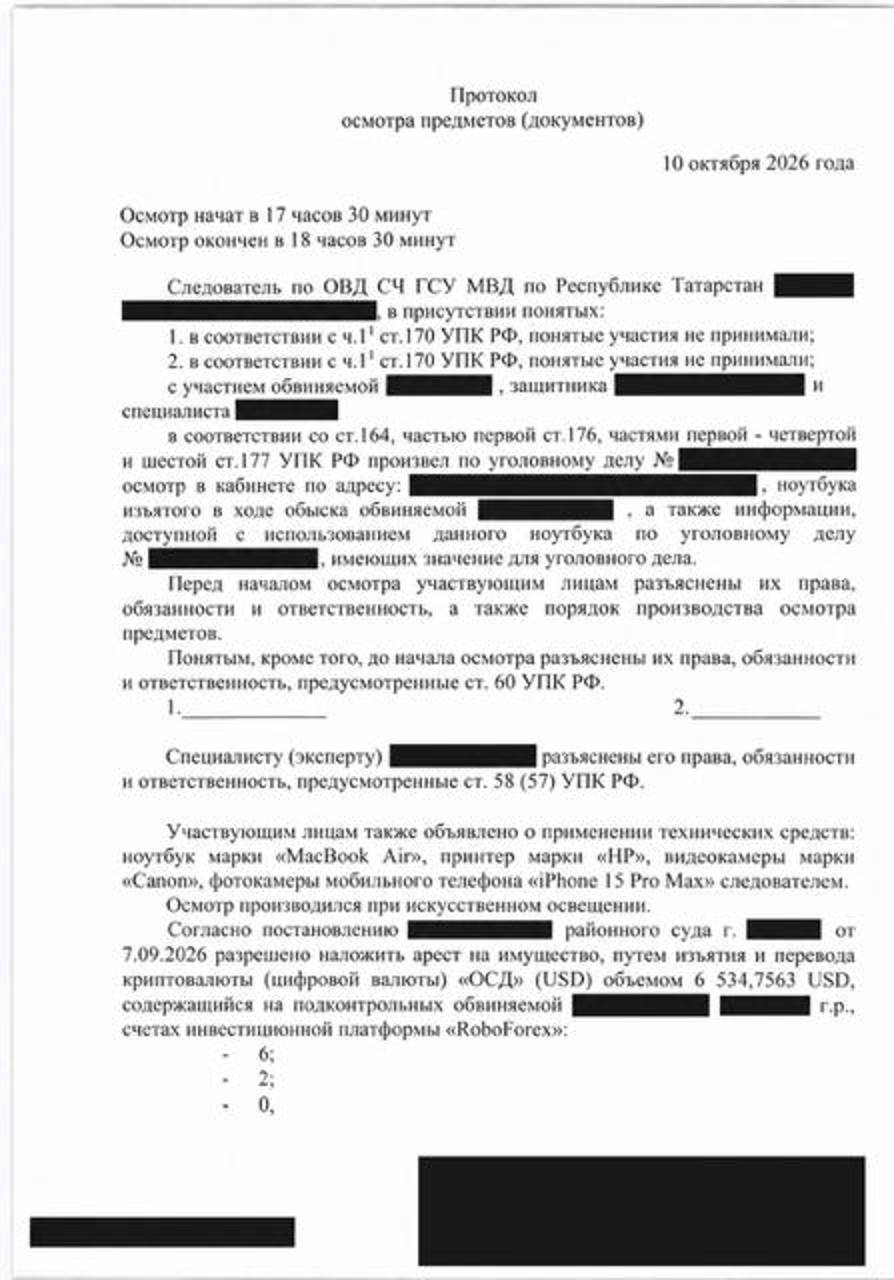
A fragment of the published protocol

How the Investigator Withdrew Funds via RoboForex

It follows from the document that the object of inspection was an HP Pavilion x360 Convertible laptop, previously seized during a search. The basis for the actions was a ruling by a district court in Kazan dated September 7 to seize property.

The accused provided access to the laptop and phone and, according to the protocol, voluntarily confirmed consent to the transfer of funds as part of cooperation with the investigation. Thus, the document does not describe account hacking or bypassing security; the investigative action was conducted with the participation of the owner of the credentials, a defense lawyer, and a specialist.

After logging into RoboForex, the account displayed a balance of $6641.84. The investigator opened the withdrawal section and specified an amount of $6328.

The subsequent operation went through the Difinex payment service. According to the data recorded in the protocol, the interface showed the receipt of approximately 6331.33 $USDT, a commission of 3 $USDT, and the option to choose a blockchain. The investigator specified TRON and entered the recipient address provided to him.

The official RoboForex instructions confirm the general procedure for such operations: the user selects a trading account and payment system, enters a password and amount, after which the selected service may require additional data or confirmation.
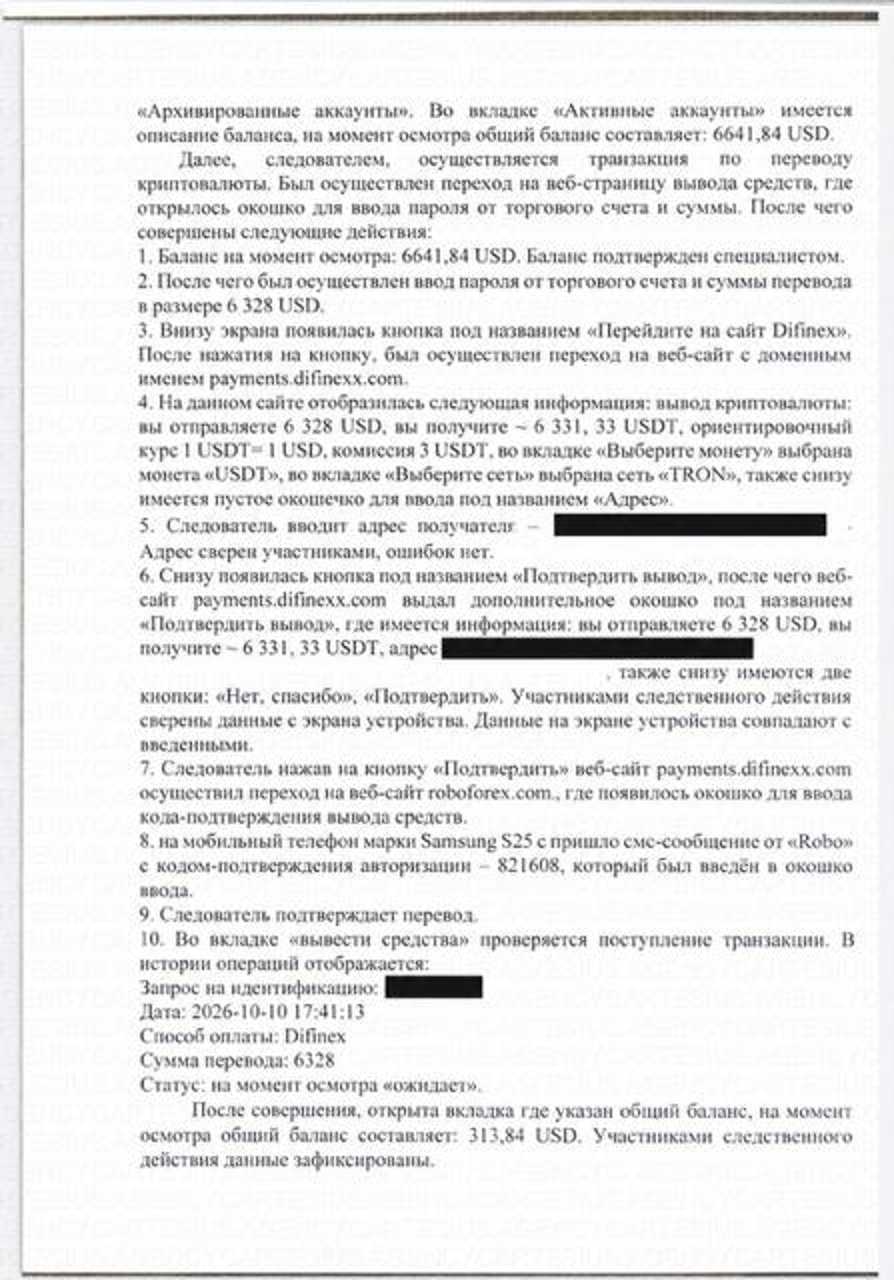
The investigator initiated a withdrawal of $6328 from RoboForex, receiving $USDT via the TRON network. At the time the inspection ended, the transaction was pending

After additional SMS confirmation, the request appeared in the RoboForex transaction history, and the account balance decreased to $313.84.

However, there is a crucial detail here: at the time the inspection was completed, the transfer had not yet been confirmed as received at the final address. Its status in the protocol is designated as "currently pending," with a processing time from five seconds to three days.

New Rules Only Came into Effect This Summer

The practical significance of the document is linked to changes in Russian legislation. Since March 3, 2026, Article 164.2 of the Criminal Procedure Code separately regulates the seizure of digital currency. Investigative actions must be conducted with the participation of a specialist, and to preserve the assets, they are allowed to be transferred to a special identifier address when technically possible. The protocol must record the type and quantity of digital currency, the sender and recipient addresses, and data allowing identification of the transaction.

Since July 3, government-approved Rules for the Storage, Transfer, and Accounting of Digital Currency in Criminal Proceedings have been in effect. They provide for an infrastructure in which a state agent bank, together with an authorized organization, provides identifier addresses for the MVD, FSB, Investigative Committee, Prosecutor's Office, FSSP, Federal Customs Service, and other agencies.

The published protocol fits well into this scheme: the investigator received an address for storing the asset, the participants verified it, after which it was used as the destination address for withdrawing $USDT.

However, it is impossible to determine the owner of the specific TRON address from the document—it is obscured in the published image.

This is Seizure for Now, Not Confiscation

Another important distinction concerns the legal status of the funds. Since March 2026, digital currency has been recognized as property for the purposes of criminal legislation, so it can be seized, including to secure a civil claim, a fine, or possible subsequent confiscation.

But seizure is not the same as confiscation. The latter implies the forced transfer of property into state ownership based on a corresponding court decision. The presented protocol records an investigative action to ensure the preservation of assets, not their final transfer to the state.

Risk Warning:

The information on the site is for informational and educational purposes only and is not investment advice or financial guidance. Cryptocurrencies and digital assets involve a high level of risk, including potential loss of capital. The editorial team is not responsible for decisions made based on published materials. It is recommended to conduct your own research (DYOR) before making investment decisions. Review the editorial policy at https://happycoin.news/about/

Related Questions

QWhat is the main topic and practical significance of the Russian protocol discussed in the article?

AThe article discusses the practical application of a new Russian protocol for seizing and storing cryptocurrency assets. Its significance lies in showcasing the operational mechanics of Russia's recently implemented legal framework, which allows law enforcement to officially arrest and transfer seized digital assets to government-controlled crypto addresses during criminal investigations.

QBased on the protocol, how did the investigator from Tatarstan transfer the cryptocurrency?

AThe investigator accessed a previously seized laptop and, with the owner's cooperation, logged into a RoboForex trading account. From there, he initiated a withdrawal of $6,328. Using the Difinex payment service, he chose to receive the funds in USDT via the TRON blockchain and sent them to a specific recipient address that was provided to him, likely a government-held 'identifier address' as per new regulations.

QWhat are the key differences between 'arrest' and 'confiscation' of cryptocurrency under the new Russian laws mentioned in the article?

AAccording to the article, 'arrest' is a provisional measure to secure and preserve assets during an investigation, ensuring they are available to satisfy potential future civil claims, fines, or confiscation orders. It does not transfer ownership. 'Confiscation' is a final court-ordered penalty where the property is forcibly transferred to state ownership. The described protocol documents an arrest, not a confiscation.

QWhich two key legal changes in 2026 established the framework for the procedure described in the protocol?

A1. Effective March 3, 2026: Amendments to Article 164.2 of the Russian Criminal Procedure Code (УПК РФ) officially recognized cryptocurrency as property for criminal law purposes and established procedures for its seizure, requiring specialist participation and allowing transfer to special storage addresses. 2. Effective July 3, 2026: Government-approved 'Rules for the storage, transfer, and accounting of digital currency in criminal proceedings' created the infrastructure, involving a state agent bank and an authorized organization to provide 'identifier addresses' for law enforcement agencies to hold seized assets.

QWhat crucial detail about the transaction's status was noted at the end of the on-site inspection in the protocol?

AAt the conclusion of the on-site inspection documented in the protocol, the USDT transfer from RoboForex was still pending final confirmation on the blockchain. Its status was recorded as 'currently awaiting' processing, with an estimated completion time ranging from five seconds to three days. The funds had left the trading account but had not yet been confirmed as received at the destination wallet.

Related Reads

Coinone warns of phishing, identity theft after customer data breach

South Korean crypto exchange Coinone warned customers about potential phishing scams and identity theft after an attacker breached its outsourced customer support provider, MetaM, exposing information shared during customer service interactions. Coinone said the attacker accessed MetaM servers on Thursday and viewed or extracted customer support records, learning of the breach the same day. Potentially exposed data includes names, phone numbers, email addresses, dates of birth, bank account numbers, passwords, national identification numbers, home and wallet addresses, and transaction IDs, varying by customer; those who never contacted the support center were unaffected, and Coinone did not disclose how many customers were impacted. The exchange urged customers who shared passwords during support interactions to change them and warned that fraudsters could impersonate Coinone using details from previous conversations. Coinone said its account, trading, and wallet infrastructure operates separately from MetaM's servers, with no evidence of direct compromise, and it has reported the incident to South Korean authorities. The disclosure comes as South Korea strengthens financial-sector cybersecurity; in October the Financial Services Commission identified security deficiencies at 130 of 555 financial firms reviewed, and on Thursday the regulator said it would allow crypto exchanges to suspend withdrawals when hacking is suspected, alongside calls for round-the-clock monitoring.

cointelegraph1h ago

Coinone warns of phishing, identity theft after customer data breach

cointelegraph1h ago

Is There a Hidden Hand Behind Jensen Huang's Departure? Secretary of State Rubio or Anthropic?

The article alleges that Nvidia founder Jensen Huang's departure was the result of a coordinated "hunt" involving two forces: Secretary of State Marco Rubio and AI rival Anthropic. On the policy front, the dispute centers on AI chip export controls—Huang was the most prominent corporate voice opposing built-in tracking and remote kill-switch functions in chips, while three bipartisan chip bills (covering congressional review of export licenses, anti-smuggling measures, and pressure on allies to halt equipment sales) have been folded into the Senate's annual defense authorization bill. The storm began with a highly classified memo leaked to The New York Times; according to The Washington Post, the memo originated with Rubio, who reportedly rewrote a CIA report whose analysts were unconvinced by the underlying intelligence, using "his own more aggressive wording," then sent it to senior officials and briefed the president. David Sacks called the leak a crime and asked why someone would risk prison to bring Huang down. Separately, NYT reporter Tripp Mickle said a mysterious industry contact told him to "drop everything" and investigate Megaspeed, a Singapore-based Nvidia compute rental firm; suspicion points to Anthropic CEO Dario Amodei and a co-founder as the leaker. Anthropic reportedly donated $40 million to Public First Action, which pushes AI safety rules and chip export controls—positions opposite Huang's defense of open-source AI and opposition to backdoors. Nvidia shares fell on the news, and tech leaders including Musk, Garry Tan, and Tim Sweeney are petitioning for Huang's reinstatement, with Sweeney comparing his ouster to Apple firing Steve Jobs.

marsbit3h ago

Is There a Hidden Hand Behind Jensen Huang's Departure? Secretary of State Rubio or Anthropic?

marsbit3h ago

Global Chip Stocks Retreat Nearly 40% from Peak: Has the AI Bubble Burst?

Nvidia is set to report its fiscal Q3 2027 earnings after market close on November 17, but the call will be led by interim CEO and CFO Colette Kress, not Jensen Huang, who resigned as president, CEO, and board member effective November 12 following an apology letter to employees admitting infidelity and a board investigation into reports that he was a target of foreign intelligence activity. The report comes as investors question whether massive AI capital expenditures will pay off. On November 5, the Philadelphia Semiconductor Index plunged 12.25%, its worst single-day drop since March 2020, with Nvidia falling 9.3% and losing about $447 billion in market value; Seoul's KOSPI triggered a circuit breaker the next day. Over the past month, Nvidia has shed nearly $1.4 trillion in market value from its early-October peak, the semiconductor index has pulled back nearly 40% from its June 22 peak of 14,634, Oracle is down over 30% year-to-date, and CoreWeave has retreated about 70% from its June 2025 high. Yet the broader market looks calm: the Nasdaq is only about 12% off its high, and the equal-weighted S&P 500 hit a record during the selloff week—the crash is concentrated in AI. The timeline shows early warnings in Korea in June, with memory stocks falling first; Goldman's AI memory basket is down 51% from its June peak, the largest drawdown since ChatGPT launched. The selloff layered by proximity to end cash flow: memory worst, then leveraged neoclouds like CoreWeave, then power, chips, and optics, while cash-rich cloud giants held up, with the seven giants still up about 9.6% year-to-date before the crash. Nvidia's roughly 14x P/E isn't necessarily cheap—its revenue is others' capex, low multiples on cyclicals often mark peak profits, and chip index declines historically lead semiconductor sales drops by 6-9 months, suggesting real estimate cuts may not appear until Q1 2027. Meanwhile, orders are full but stocks still fall: Lumentum says data center optics are sold out for years, SanDisk beat for six straight quarters yet is down over 60% from its high, and CoreWeave's Q3 beat and $132.5 billion backlog didn't stop a 32% year-to-date decline. Hyperscaler capex guidance for 2026 totals $720-745 billion, up nearly 80% from 2025, but the market's reaction has turned cold—Google fell 12.6% on October 29, its worst day ever. Free cash flow is turning negative: the five biggest players spent $556.9 billion in the first nine months versus $542.9 billion in operating cash flow, with four of the seven giants seeing negative FCF for the first time in a decade, funded by debt—US cloud companies issued about $225 billion in bonds in the first nine months, up 973.7% year-over-year. Oracle's CDS spread widened from about 58 basis points a year ago to 295, and CoreWeave's exceeded 1,000, with bond yields near 15%. The bond market is already pricing default risk while stocks debate bubbles. Politics adds a second layer: Democrats won both chambers in the November 3 midterms, and of 41 local data center ballot measures in 10 states, 40 went against data center construction. Texas, which holds 27% of planned US capacity, elected a governor promising a moratorium. Goldman estimates 45% of planned US data center capacity faces short-term pause risk. Buffers exist—the new Congress seats in January 2027, any restrictions face a presidential veto, and UBS estimates only about 30% of planned 2028 capacity would be affected. Demand hasn't broken; what broke is the belief that spending alone lifts stocks—AI is moving from storytelling to audit. Whether the pullback becomes a collapse depends on three readings: whether cloud giants' free cash flow turns positive, whether Oracle and CoreWeave credit spreads keep widening, and whether state-level data center restrictions take effect.

marsbit3h ago

Global Chip Stocks Retreat Nearly 40% from Peak: Has the AI Bubble Burst?

marsbit3h ago

Successfully Recovering Starship Upper Stage, SpaceX Debuts 'Chopsticks Catching the Ship,' Analyst: The Most Critical Step Supporting a Trillion-Dollar Valuation

SpaceX achieved a historic first on November 15, successfully catching the Starship upper stage in mid-air using the launch tower's giant "Mechazilla" robotic arms after the spacecraft completed 14 orbits and re-entered the atmosphere. More than 5 million viewers watched the live broadcast. It marks the first time since NASA's Space Shuttle in 2011 that a spacecraft returning from orbit has been recovered, and the first-ever capture of an orbital spacecraft by a tower. However, the mission was only half successful: the Super Heavy booster aborted its recovery attempt after an early engine shutdown during descent, splashing down in the Gulf of Mexico and exploding. SpaceX engineers are investigating the cause. This was the 15th test flight and the most ambitious, marking the first simultaneous recovery attempt of both stages. Analysts stress the cost implications. Bernstein called full reusability "the most important step" supporting SpaceX's multi-trillion-dollar valuation, key to high launch frequency and lower orbital costs. Citi called fully reusable rockets the industry's "holy grail." Morgan Stanley argued markets underestimate the significance, noting the ship's capture is harder than the booster's because it endures extreme re-entry stress. Success would reduce execution risk across commercialization, Starlink deployment, and future space-based AI computing. The Starship released 26 Starlink V3 satellites during the flight, re-entering at over 26,000 km/h with temperatures reaching 7,000°F. NASA Administrator Jared Isaacman congratulated SpaceX, and Musk shared video of the recovered ship. NASA's Artemis lunar program and Musk's Mars ambitions both depend on Starship. SpaceX stock (SPCX) dipped 2% after the booster failure, trading just 3% above its $135 IPO price and 38% below its June high of $225.64. Bernstein noted SpaceX remains roughly a decade ahead of competitors in reusability. Starlink, SpaceX's profit center, serves over 13 million users in 170+ countries with over 11,000 satellites, posting about $3.5 billion in Q3 EBITDA. Starship can carry up to 60 Starlink V3 satellites—each nearly four times the volume and ten times the data capacity of V2. Musk hopes to build space-based AI data centers, possibly starting in late 2027, with reusability being the prerequisite for lowering per-unit orbital costs.

marsbit6h ago

Successfully Recovering Starship Upper Stage, SpaceX Debuts 'Chopsticks Catching the Ship,' Analyst: The Most Critical Step Supporting a Trillion-Dollar Valuation

marsbit6h ago

Trading

Spot
活动图片