RIVER drops 30%, yet a rebound could still be coming: Here’s why

ambcryptoPublicado a 2026-03-24Actualizado a 2026-03-24

Resumen

RIVER has experienced a significant 30% decline over 48 hours, erasing gains and returning to price levels last seen in early February. Despite this sharp pullback, it remains one of the top-performing altcoins with 369% gains over 90 days, second only to SIREN. However, the token faces a critical test of momentum sustainability. Market data reveals growing bearish pressure: funding rates turned negative, indicating dominance of short positions, while approximately $27.7 million exited perpetual futures contracts. Spot market activity also weakened, with $1.35 million in net selling over three days. Despite short-term outflows, longer-term net inflows remain positive, suggesting underlying demand hasn't fully reversed. Liquidation heatmaps show clusters above current prices, hinting at potential upward movement if market sentiment stabilizes. While the decline aligns with a corrective phase rather than a confirmed long-term downtrend, continued short dominance may extend losses. A rebound remains possible if long positions re-enter or broader market momentum improves.

River [RIVER] has entered a phase of losses not seen in several weeks. Over the past 48 hours, amid a wider market shake-up, the asset has declined by 30%, revisiting levels last observed around the 4th of February. The move marks a notable shift in short-term sentiment after an extended period of upside performance.

Despite the correction, RIVER still ranks among the top-performing altcoins. Data from the 90-day Altcoin Season Index shows the asset remains the second-best performer, with gains of roughly 369%, trailing only SIREN.

However, history suggests caution. Numerous tokens have previously occupied similar positions but failed to sustain their momentum. This context places RIVER at a critical juncture, where the current decline could either evolve into a broader trend reversal or remain a temporary correction within a larger uptrend.

Capital outflows and funding rates signal pressure

An analysis of capital flows in the perpetual futures market, a key driver of volatility, points to sustained pressure on RIVER.

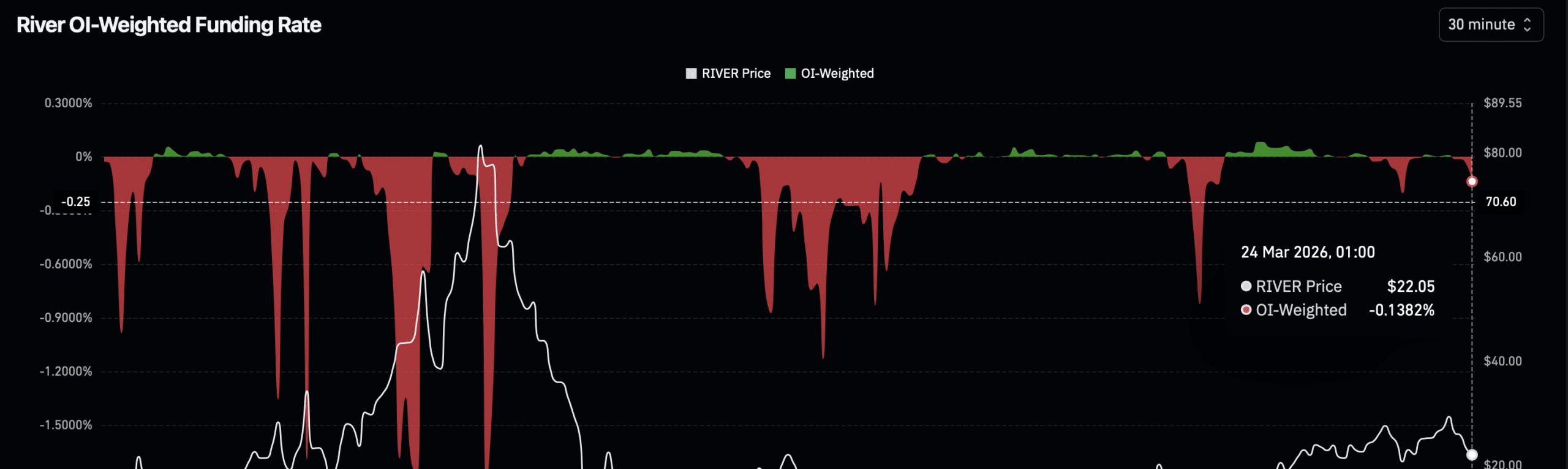
The Funding Rate, which reflects whether long or short positions dominate the market, has turned negative as of writing. A reading of -0.1382% indicated that short positions now outweighed longs, highlighting a growing bearish bias among derivatives traders.

This shift typically reflects expectations that the asset is overvalued, encouraging traders to position for further downside while amplifying selling pressure.
Source: CoinGlass

At the same time, not all participants are actively shorting. A segment of investors has exited positions entirely, reinforcing the narrative of declining conviction. This behavior often emerges when market participants anticipate heightened volatility or lack clarity on near-term direction.

Approximately $27.7 million has flowed out of RIVER’s perpetual contracts within this period. This level of capital movement is significant. If long positions re-enter, it could support a rebound. However, continued dominance of short positions may extend the decline.

Spot market activity supports a bearish narrative

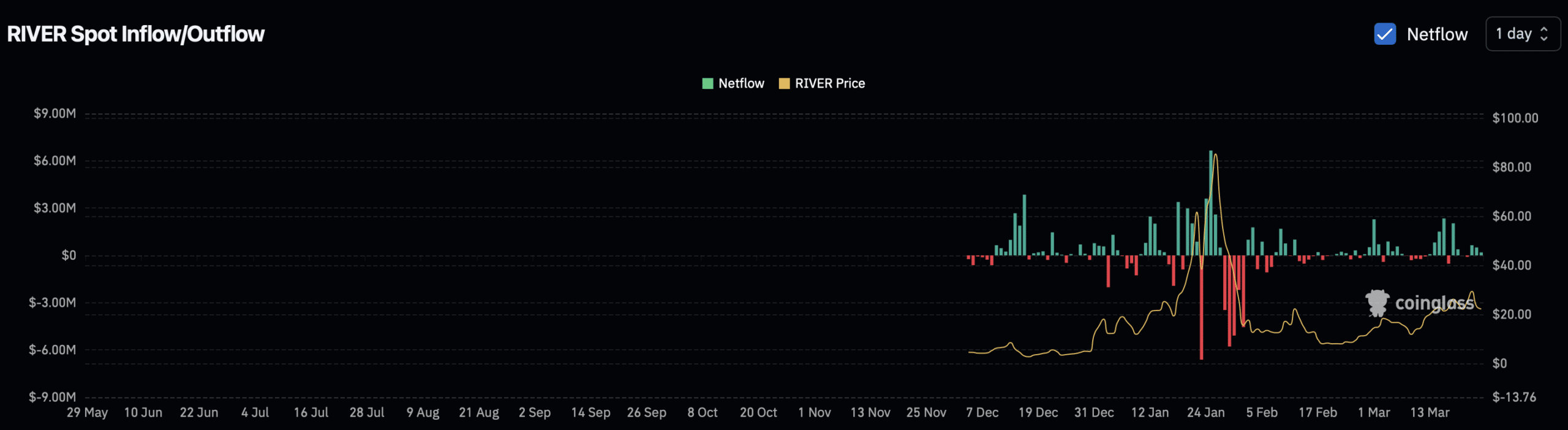
Developments in the spot market further align with the weakening sentiment. Over the past three days, selling activity has outpaced buying, reinforcing downward pressure.

During this window, roughly $1.35 million worth of RIVER has been sold. This trend suggests that investors are reducing exposure in the short term, likely rotating into stablecoins or lower-risk assets while uncertainty persists.
Source: CoinGlass

Nevertheless, a broader perspective provides a more balanced picture. Net inflows for the 10-day, 15-day, and 30-day periods remain positive at $8.74 million, $9.13 million, and $16.71 million, respectively. This suggests that, while short-term sentiment has declined, underlying demand has not completely reversed.

Additionally, daily selling volume has declined over the past three days. This gradual drop indicates that bearish conviction may be losing strength.

In a sustained downtrend, selling pressure would typically intensify as more participants position for further losses. That pattern has yet to fully materialize.

Liquidation clusters hint at upside potential

Liquidation heatmaps provide further insight into possible price direction. These maps identify clusters of liquidation orders, which often act as magnets for price movement. Clusters below the current price represent potential buy-side liquidity, while those above indicate sell-side pressure.

In RIVER’s case, a larger share of clusters sits above the current price. Although these clusters are relatively shallow, meaning they may not exert strong influence individually, their presence still points to a possible upward bias in price movement.
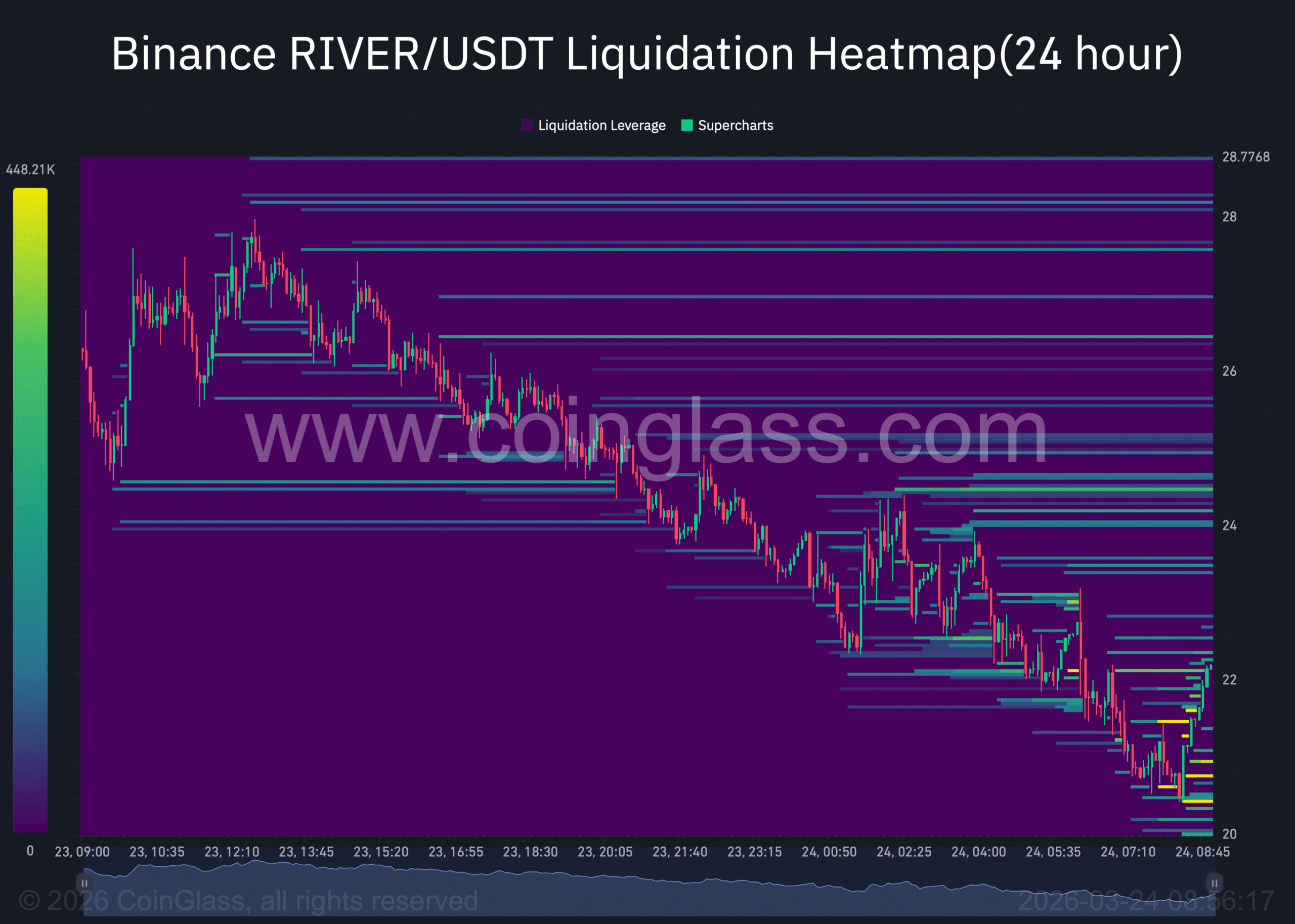
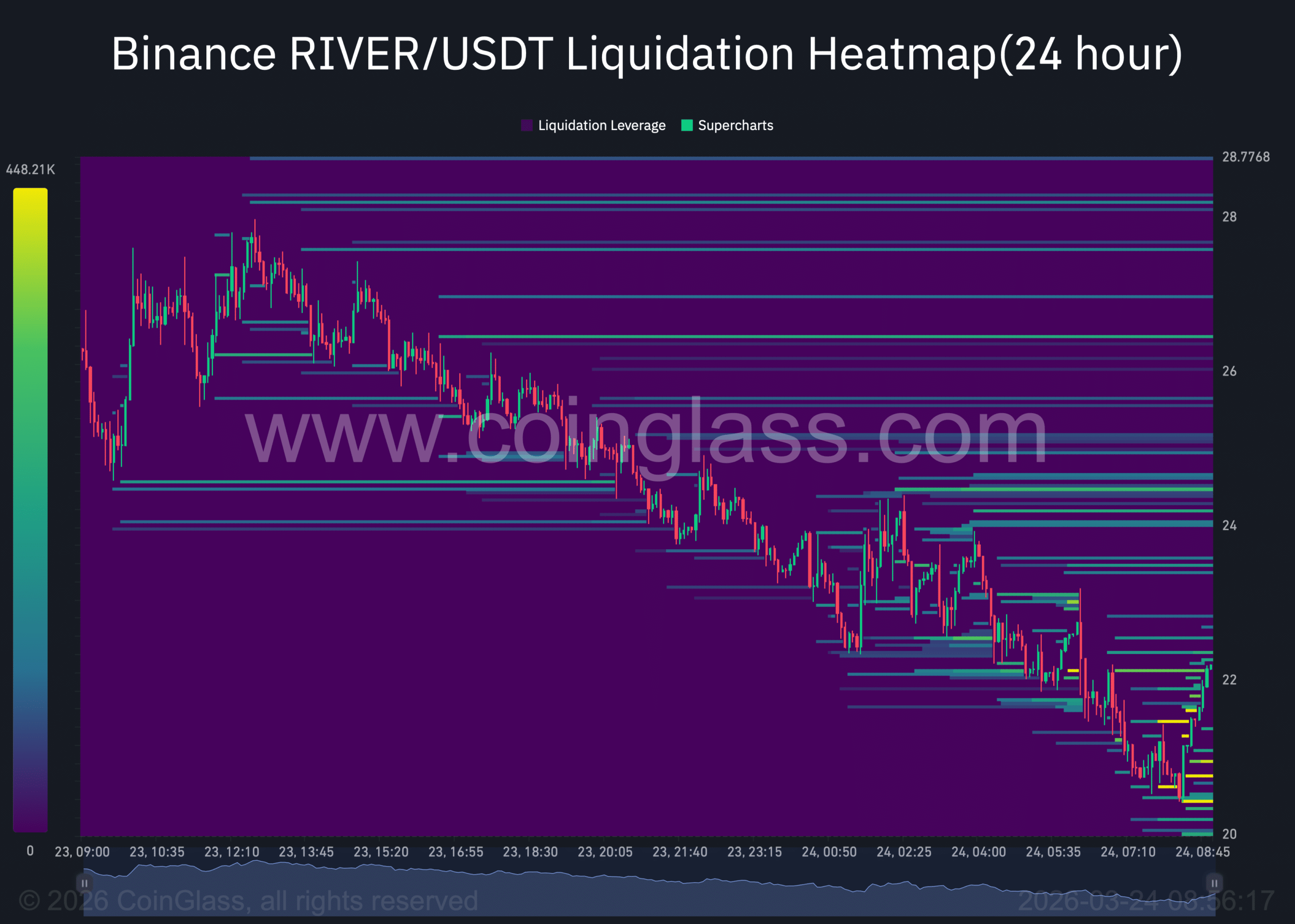
Source: CoinGlass

Such positioning suggests that the market could attempt to move higher to trigger these liquidity zones, particularly if broader sentiment stabilizes.

While bullish momentum across the wider market could still drive a recovery, current data indicates that RIVER’s movement aligns more with a corrective phase than a confirmed long-term downtrend.


Final Summary

  • RIVER records a sharp pullback as capital exits and trader conviction weakens.
  • Spot market momentum favors bears, though the asset’s broader performance remains strong.

Lecturas Relacionadas

Institutional Adoption of Prediction Markets Stuck at the Third Stage

Prediction markets are transitioning from niche platforms focused on elections and sports to mainstream financial tools, as highlighted at Kalshi Research's inaugural conference. While sports still dominate trading volume (around 80%), non-sports categories like macroeconomics, politics, and entertainment are growing faster, signaling a shift from entertainment-based trading to information and risk management tools. Institutions, including Wall Street firms, are increasingly using prediction markets for data reference (Stage 1 adoption), with some progressing to system integration (Stage 2). However, full-scale trading (Stage 3) is limited due to the lack of margin trading, requiring full collateral for positions—a barrier for leverage-dependent entities. Kalshi is working with regulators to introduce margin mechanisms. Key insights from participants like Goldman Sachs and CNBC emphasize the value of real-time pricing for events (e.g., Fed decisions, tariffs), providing benchmarks previously unavailable. The path to maturity mirrors historical financial instruments like options, with expectations that prediction markets will become institutional staples within five years. Political leaders, including Trump and Schumer, now cite Kalshi odds, underscoring its growing influence. The platform rewards domain expertise over traditional finance backgrounds, attracting diverse participants from fields like music and poker. Ultimately, prediction markets are evolving into critical infrastructure for pricing uncertainty.

marsbitHace 11 min(s)

Institutional Adoption of Prediction Markets Stuck at the Third Stage

marsbitHace 11 min(s)

The First Year of Computing Power Inflation: The Cheaper DeepSeek Gets, the Harder It Is to Stop This Round of Price Hikes

The year 2026 marks the beginning of "computing power inflation." While AI inference costs have dropped by over 80% in 18 months globally, China's three major cloud providers—Alibaba Cloud, Baidu AI Cloud, and Tencent Cloud—simultaneously announced price hikes of 20–30%. This reflects a deeper structural shift driven by Jevons Paradox: as unit costs fall (e.g., via models like DeepSeek-R1), demand explodes, especially with the rise of reasoning models and AI agents that consume 10–50x more tokens per task. Although DeepSeek open-sourced its model weights, it did not release its inference optimization stack, leaving a significant engineering efficiency gap between cloud providers and smaller players. The big three are leveraging this advantage to reposition: Alibaba focuses on high-margin premium clients, Baidu filters out low-value users, and Tencent capitalizes on ecosystem lock-in. Meanwhile, ByteDance’s Volcano Engine adopts a more moderate pricing strategy to capture displaced customers. Unexpectedly, the price surge is pushing large enterprises toward self-built computing solutions once their cloud bills exceed a certain threshold. While cloud providers aim to boost profitability, they risk driving away innovative startups and accelerating competition from GPU leasing and domestic hardware providers like Huawei. The涨价 trend is expected to persist for 2–3 years, fueled by rising token consumption from reasoning models, AI agent adoption, and NVIDIA export restrictions. The inflection point depends on whether domestic chips can match NVIDIA’s efficiency, likely around 2027–2028. Until then, cloud providers will maintain pricing power, and the key for AI companies is to optimize token usage—the real moat in this era.

marsbitHace 1 hora(s)

The First Year of Computing Power Inflation: The Cheaper DeepSeek Gets, the Harder It Is to Stop This Round of Price Hikes

marsbitHace 1 hora(s)

Trading

Spot
Futuros

Artículos destacados

Cómo comprar RIVER

¡Bienvenido a HTX.com! Hemos hecho que comprar River (RIVER) sea simple y conveniente. Sigue nuestra guía paso a paso para iniciar tu viaje de criptos.Paso 1: crea tu cuenta HTXUtiliza tu correo electrónico o número de teléfono para registrarte y obtener una cuenta gratuita en HTX. Experimenta un proceso de registro sin complicaciones y desbloquea todas las funciones.Obtener mi cuentaPaso 2: ve a Comprar cripto y elige tu método de pagoTarjeta de crédito/débito: usa tu Visa o Mastercard para comprar River (RIVER) al instante.Saldo: utiliza fondos del saldo de tu cuenta HTX para tradear sin problemas.Terceros: hemos agregado métodos de pago populares como Google Pay y Apple Pay para mejorar la comodidad.P2P: tradear directamente con otros usuarios en HTX.Over-the-Counter (OTC): ofrecemos servicios personalizados y tipos de cambio competitivos para los traders.Paso 3: guarda tu River (RIVER)Después de comprar tu River (RIVER), guárdalo en tu cuenta HTX. Alternativamente, puedes enviarlo a otro lugar mediante transferencia blockchain o utilizarlo para tradear otras criptomonedas.Paso 4: tradear River (RIVER)Tradear fácilmente con River (RIVER) en HTX's mercado spot. Simplemente accede a tu cuenta, selecciona tu par de trading, ejecuta tus trades y monitorea en tiempo real. Ofrecemos una experiencia fácil de usar tanto para principiantes como para traders experimentados.

666 Vistas totalesPublicado en 2026.01.16Actualizado en 2026.01.16

Cómo comprar RIVER

Discusiones

Bienvenido a la comunidad de HTX. Aquí puedes mantenerte informado sobre los últimos desarrollos de la plataforma y acceder a análisis profesionales del mercado. A continuación se presentan las opiniones de los usuarios sobre el precio de RIVER (RIVER).

活动图片