Ripple Enters the Financing Business of Leveraged US Stock Funds. Should XRP Holders Be Excited?

marsbitPublished on 2026-10-08Last updated on 2026-10-08

Abstract

Ripple, through its institutional brokerage arm Ripple Prime, has entered the traditional finance business of providing funding for leveraged stock ETFs. By charging retail-focused funds an estimated 8% annual financing cost, Ripple generates a new fiat revenue stream. However, XRP's price has shown no positive reaction to this news. This capability stems from Ripple's $1.25 billion acquisition of Hidden Road (renamed Ripple Prime), which holds the necessary licenses and relationships. The business involves funds using total return swaps to gain leveraged exposure, with Ripple Prime acting as the financing counterparty. A core issue for XRP holders is that the profits from this Wall Street-style business flow directly to Ripple the company, not to XRP token holders. There is no mechanism for distributing the financing income or using it to buy back XRP. The primary potential benefit for XRP lies in increased institutional adoption if new clients use Ripple Prime's services for XRP spot trading or collateral management. Usage of the XRP Ledger for settlement would generate minimal token demand due to its low, fixed transaction fees. While expanding Ripple's traditional finance footprint, this move highlights the disconnect between the company's profitable ventures and direct value accrual to its native XRP token.

Author: Claude, Deep Tide TechFlow

Deep Tide TechFlow Introduction: Ripple is extending its business tentacles into a hidden profit zone of traditional Wall Street: providing financing for leveraged equity ETFs. By charging retail investors pursuing amplified returns an annualized financing cost of approximately 8%, Ripple has successfully opened up a new fiat revenue stream. However, the XRP price has reacted coolly. For token holders, the core contradiction lies in this: the Wall Street spreads earned by Ripple at the company level are not, by mechanism, converted into genuine buy-side demand for XRP.
In the US stock market, if investors want to magnify their daily returns through a 2x long ETF, the fund issuer must borrow capital from financial institutions to maintain the leveraged exposure, paying ongoing financing fees for it. This business, long monopolized by traditional banks and prime brokers, is now seeing the entry of crypto players.

Citing a report from *The Wall Street Journal*, CoinDesk notes that Ripple's institutional brokerage business, Ripple Prime, has officially entered the financing service for leveraged equity ETFs. Taking the Tradr 2x long SanDisk fund mentioned in the report as an example, this fund pays the overnight bank funding rate plus a 4-percentage-point premium. Calculated at current market levels, this financing cost equates to approximately 8% annualized.

This means that while retail investors on the front end pay for and bear the decay of stock volatility, Ripple is at the back end, as the capital provider, steadily extracting this liquidity premium.

But the price of XRP has not responded accordingly yet. As of the time of writing on October 8th, XRP is approximately $1.41, down about 3.8% over the past 24 hours and down about 6.5% over the past seven days. It closed around $1.49 on September 30th and was around $1.42 on October 7th. There was also no significant pre-announcement price surge.

A $1.25 Billion Wall Street Business

Ripple's ability to charge stock funds relies on an acquired brokerage business.

In 2025, it spent $1.25 billion to acquire Hidden Road, rebranding it as Ripple Prime after completing the transaction in October. Funds can trade, clear, and obtain financing through this company without needing to find separate counterparties for each asset type.

The contracts purchased by the funds are called total return swaps. The broker agrees to pay the fund the returns corresponding to the stock's gains and losses, while the fund pays a financing fee; the broker then manages its risk by holding the actual stock, etc. The leveraged ETFs that retail investors buy on exchanges are backed by these institutional contracts.

Traders hold the fund, the broker sells the leverage. The more capital drawn in by stock market trends, the more financing the funds require, creating more fee opportunities for Ripple.

On August 27th of this year, Ripple formally launched swap services for US stocks, indices, and digital assets. On October 6th, hedge fund management firm Brevan Howard expanded its cooperation with Ripple, adopting its cross-asset brokerage, clearing, and financing services.

Today's report adds specific client and fee details. The licenses, teams, and institutional relationships Ripple bought are now starting to receive business.
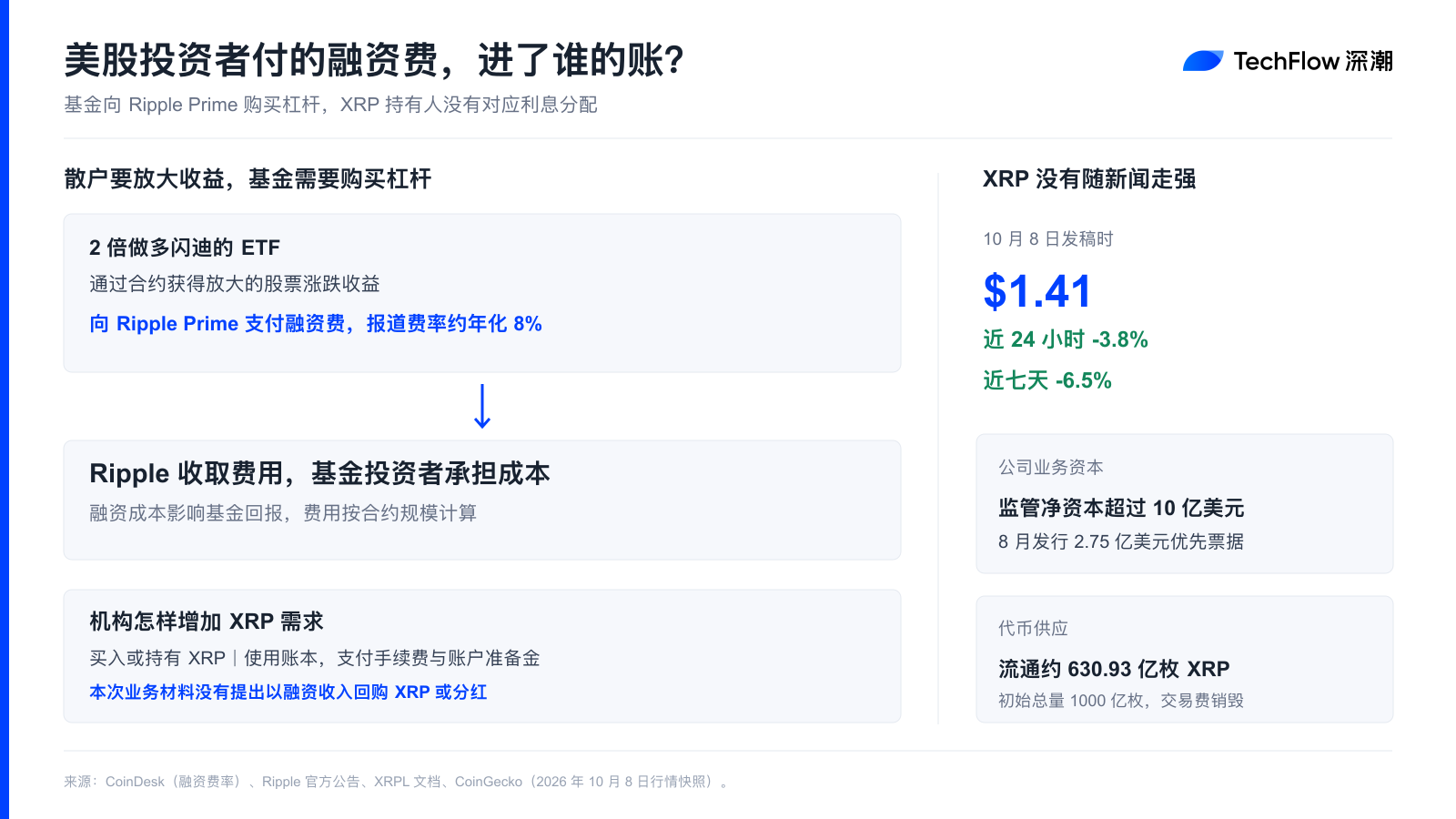
Chart: ETF investors bear the cost of obtaining leverage, the fund pays financing fees to Ripple Prime. XRP gains usage demand through institutional holdings, on-chain fees, and account reserve requirements.

But financing companies also need to borrow money.

Official disclosures state Ripple Prime's regulatory net capital exceeds $1 billion. In August, it issued $275 million in senior unsecured notes and had previously secured $200 million in debt financing. The roughly 8% financing fee paid by clients needs to cover funding, hedging, and operational costs; what remains is profit. Therefore, it remains to be seen whether this business shift will ultimately be profitable.

What XRP Holders Actually Get

Under the currently disclosed arrangement, this financing revenue is collected by Ripple Prime. Holding XRP does not entitle one to a corresponding interest distribution, and the business announcement did not propose using this money to buy back XRP. The addition of new clients first expands the company's business.

Ripple had already outlined how to connect the brokerage to its products during the acquisition. The plans at the time included using the USD stablecoin RLUSD as collateral and migrating some post-trade processing to the XRP Ledger. Funds could manage collateral with the stablecoin, and brokers could use the ledger to reduce settlement and operational costs.

For XRP, the relationship is more direct with actual institutional token holdings and trading.

Ripple Prime already offers OTC spot trading for XRP, and institutions can also manage margin by combining XRP spot holdings with other digital asset positions. If new clients increase their XRP allocations through these services, capital would flow into the token market.

Merely using the ledger generates far less demand. The standard base fee for a regular transaction is 0.00001 XRP, which is directly burned after payment; new accounts currently require reserving 1 XRP. Calculating with the standard base fee, one million regular transactions burn 10 XRP. Low costs facilitate institutional adoption but also indicate that large-scale US stock financing cannot be directly translated into large-scale XRP consumption.

The new revenue also doesn't change the XRP supply arrangement.

Approximately 63.093 billion XRP are currently in circulation. A snapshot from June 30th shown on Ripple's website indicates about 32.6 billion more were still in escrow lock-up. The escrow releases monthly, with unused portions re-locked for subsequent months. This stock financing business announcement did not disclose conditions requiring additional XRP lock-ups.

If you buy XRP because of this news, you are betting that Ripple's new clients will ultimately also become users of XRP. But holding XRP will not entitle you to receive, for instance, the interest paid by the SanDisk leveraged equity fund, nor is this a direct model where business revenue is used for token buybacks.

Or, one might say, many old crypto projects aligning with traditional finance is a current trend, but their original tokens have not been updated to be part of that new calculus.


Related Questions

QWhat is the core contradiction for XRP holders regarding Ripple's new leverage ETF financing business, according to the article?

AThe core contradiction is that while Ripple the company is generating new fiat revenue streams from this traditional finance business, the earnings are not directly converted into real buying demand for the XRP token itself. The revenue goes to Ripple Prime, and there is no mechanism for distributing profits to token holders or using the money for XRP buybacks.

QHow did Ripple acquire the capability to offer financing services to leverage stock ETFs?

ARipple acquired this capability by spending $1.25 billion to purchase the brokerage firm Hidden Road in 2025. After the acquisition was completed in October, it was renamed Ripple Prime, which provides the trading, clearing, and financing services that allow Ripple to enter this business.

QAccording to the article, what are the two main ways for Ripple's new business to potentially generate demand for the XRP token?

AThe two main ways are: 1. If Ripple Prime's institutional clients increase their XRP spot holdings and manage them alongside other digital assets using the platform. 2. By migrating parts of the post-trade settlement processes onto the XRP Ledger, which would generate minimal standard transaction fees (paid in XRP and burned) and potentially require XRP for account reserves.

QWhy is the direct positive impact of this business on the XRP token considered limited, as explained in the article?

AThe impact is considered limited because the transaction fees on the XRP Ledger are very low (e.g., 0.00001 XRP per standard transaction, which is burned), and only a small amount of XRP is needed for new account reserves. Therefore, the large-scale financing business for stock ETFs cannot be directly translated into a significant consumption or demand for XRP tokens.

QWhat did the price of XRP do around the time of the report on this new business development, and what does the article suggest this indicates?

AThe price of XRP did not show a positive response. At the time of writing (October 8), it was around $1.41, down approximately 3.8% in 24 hours and 6.5% over the previous week. There was no noticeable price increase preceding the report either. This suggests the market did not view the news as a direct catalyst for XRP token value.

Related Reads

Crypto Stocks Weekly丨Strategy Adds 1,036 BTC but Holdings Fall Below Cost Basis; Bitmine Holds 4.97% of ETH Supply (November 10)

The article begins by noting that Democrats swept both chambers of Congress, ushering in a divided-government phase, after which markets shifted focus to AI regulation and capex payback cycles, with Anthropic's IPO seen as a bellwether for AI stocks. US equities fell sharply (Nasdaq -5.52% and Philadelphia Semiconductor Index -12.24% on Nov 5) before a Monday rebound driven by falling oil prices and oversold buying—characterized as a repair, not a new high. Macro data showed October nonfarm payrolls +165k and unemployment at 4.1%, keeping 10-year Treasury yields near 4.86% and rate-hike expectations alive. Citi cut US equities and global tech to neutral while upgrading Europe ex-UK, citing unstable AI sentiment; Goldman noted AI stocks are ~40% of the S&P 500 versus ~15% of STOXX 600. Crypto diverged from the equity rebound: US spot Bitcoin ETFs saw $1.282B in weekly net outflows (BlackRock's IBIT -$12.09B... actually $1.209B), Ethereum ETFs -$365M for a sixth straight weekly outflow, with continued outflows on Nov 9. NYSE-affiliated tokenized securities platform chose Avalanche for settlement infrastructure. Corporate treasury updates: Strategy bought 1,036 BTC at ~$79,012 (total 850,364 BTC, average cost ~$75,456, now above spot), funded partly by ATM share sales, with most proceeds used to repurchase STRC preferred shares. Strive added 29 BTC (total 43,153). Listed companies now hold over 6% of Bitcoin's supply (1.2664M BTC across 199 firms). Bitmine added 9,587 ETH, holding 6,070,092 ETH (~4.97% of supply, ~99% of its 5% goal). DeFi Development Corp's SOL rose to 2,609,829. Hyperliquid Strategies raised $911M in Q3, bought ~9.1M HYPE (holdings up to 38.5M, ~16% of circulating supply), and repurchased ~2.7M PURR shares.

marsbit16m ago

Crypto Stocks Weekly丨Strategy Adds 1,036 BTC but Holdings Fall Below Cost Basis; Bitmine Holds 4.97% of ETH Supply (November 10)

marsbit16m ago

When Will the Chip Stock 'Capitulation-Style Selling' End? BofA: Perhaps in Early 2027, Stock Price Pullbacks Typically Lead Fundamental Inflection Points by 6-9 Months

The SOX semiconductor index has fallen 38% (from 14,634 to 9,011) since its June 22, 2026 peak, over 136 days—exceeding the average historical peak-to-trough decline of 32% but less than half the average 253-day duration of past downturns (2011, 2015, 2018, 2022). BofA analyst Vivek Arya expects this "indiscriminate selling," driven by AI capex slowdown fears, to end around early 2027. Historically, SOX declines lead actual semiconductor sales declines by 6–9 months, implying real EPS cuts may emerge from Q1 2027, with capex reductions reflected in H2 2027—though stocks may already price in much of the bad news. SOX currently trades at 13.7x forward P/E versus 17.7x for the S&P 500 (a 22% discount, down from a 15% premium at the AI peak), leaving roughly 12% downside to the historical trough valuation of ~12x. US cloud capex runs at ~$300B/quarter (~$1.2T annualized) versus $1.555T consensus for 2027—about 23% below expectations if spending holds steady, equating to ~30 GW of compute deployment versus BofA's 40+ GW base case. A 20% capex cut would pressure AI semiconductor revenue by 20%+ and EPS by 35–40%. BofA outlines three scenarios: base case ( ~10% downside, bottoming Q1 2027, favor segment leaders), bear case (pressure into mid-2027, favor EDA, high-FCF analog, low-AI-exposure names), and bull case (favor memory, optics, quantum, CPUs). Potential stabilizers include policy clarity in Q1 2027, buybacks (Lam $25B, Nvidia, Micron starting Dec 9), and slower capex extending the upcycle.

marsbit35m ago

When Will the Chip Stock 'Capitulation-Style Selling' End? BofA: Perhaps in Early 2027, Stock Price Pullbacks Typically Lead Fundamental Inflection Points by 6-9 Months

marsbit35m ago

TSMC: October Revenue Up 60%, with Month-over-Month Growth Still Accelerating

TSMC reported October consolidated revenue of NT$586.89 billion, up 59.7% year-over-year and 14.7% month-over-month, signaling accelerating momentum. Converted to RMB, that is about RMB 119.4 billion, with cumulative revenue for the first ten months reaching NT$4.49 trillion, up 43.3% year-over-year. The near-60% growth came on top of an already high base, while the sequential acceleration confirms strengthening demand rather than a slowdown. The report arrived at a delicate moment. The Philadelphia Semiconductor Index had plunged 12.25% over two sessions, its worst single-day drop since March 2020, as political changes in the U.S. prompted new governors in Texas and Ohio to pause approvals for new data center projects. Markets pessimistically priced in a halt across the AI data center supply chain. Sentiment rebounded sharply on November 9, with the semiconductor index jumping 6.86%, and Taiwan's weighted index surging 1,960.06 points, its second-largest single-day gain on record, supported by government stabilization funds and short-selling restrictions. TSMC stands apart from other AI assets. As the only foundry capable of mass-producing 3nm and 2nm chips, it holds about 90% of the global AI chip foundry market, with advanced-node capacity booked through 2028. Its diversified revenue mix—68% high-performance computing, 21% smartphones, 4% automotive and 4% IoT—provides a buffer, allowing it to reallocate capacity to flagship phone chips, automotive computing, and edge AI if data center approvals slow. October's results validate management's guidance of roughly 44% full-year dollar revenue growth and capital spending of US$60-64 billion. Expansion continues, with 2nm ramping and Arizona's second fab moved up to Q3 2027; Goldman Sachs raised its 12-month target price to NT$3,300. Google's expanded eighth-generation TPU lineup adds further demand, with TSMC and other Taiwanese suppliers in the ecosystem. TSMC's ADR trades at about 24x trailing earnings, low relative to its growth. Risks include a prolonged U.S. data center approval freeze and geopolitical or oil-price shocks. In A-shares, domestic substitution names such as SMIC and NAURA remain driven by rising localization rather than Texas approvals.

marsbit36m ago

TSMC: October Revenue Up 60%, with Month-over-Month Growth Still Accelerating

marsbit36m ago

Trading

Spot
活动图片