Republican Lawmakers Push: Will the Clarity Act Pass Next Week?

marsbitPublished on 2026-09-10Last updated on 2026-09-10

Abstract

Republican Senator Cynthia Lummis is intensifying pressure on Democrats to pass the long-delayed crypto market structure bill, the Clarity Act, warning that a key procedural vote next week may be the last realistic chance for passage this decade. She argues that failure would stem from Democrats refusing to embrace a bipartisan bill that protects consumers, secures U.S. leadership in digital assets, and empowers law enforcement, instead seeking last-minute amendments that could grant regulators excessive power to stifle the industry. The bill aims to clarify regulatory jurisdiction by classifying digital assets as securities, commodities, or stablecoins. Key sticking points include whether stablecoin providers can offer customer yields—a major industry concern—and the scope of ethics provisions to prevent officials from profiting from crypto. While the White House supports the bill, Lummis places blame squarely on Democratic negotiators for demanding further changes, which she claims could enable future overreach. If the upcoming cloture vote fails, the legislation is likely to stall indefinitely amid the approaching election cycle, prolonging regulatory uncertainty for crypto firms. Lummis's public statements serve both as a final push for compromise and a preview of attributing potential failure to Democratic intransigence rather than substantive policy disagreements.

Author: Mathew Di Salvo, Bitcoin Magazine

Compiled by: AididiaoJP, Foreisght News

Pro-crypto Republican Senator Cynthia Lummis is once again turning up the heat on Democrats. The target remains the long-delayed crypto market structure bill: the Clarity Act.

She hasn't completely shut the door. The bill could still pass, but only if Democrats make further concessions.

On Tuesday, Lummis responded on X to a report by Semafor. The report cited several Republican senators' assessment that the bill is likely to fail when the Senate reconvenes next week. Lawmakers had hoped for a key vote before the five-week August recess, but it was postponed. The Senate is now scheduled to hold a procedural cloture vote on the Clarity Act next week. Passing this hurdle would allow the bill to proceed to debate; failure would essentially derail the schedule.

Bitcoin Magazine quoted an even stronger statement from Lummis: If it doesn't pass next week, "we will not have another realistic opportunity before the end of this decade."

Translated to the legislative calendar, that means don't expect another round in this session. With midterm elections approaching, focus will shift to campaigning. A lengthy and complex bill like the crypto market structure legislation, which is closely watched by both banks and the crypto industry, risks languishing for years in committees and procedural hurdles if it misses this window.

Lummis Explicitly Writes the Reason for Failure

She wrote in her post: "If this bill fails, the reason will not be ethics. It will be because Democrats failed to join Republicans in embracing a bipartisan bill that protects consumers, secures America's leadership in digital assets, and empowers law enforcement to combat illicit finance."

She said Democrats are still "asking for changes" that could allow future regulators to "choke out the crypto industry."

"If we can bridge these gaps, I am confident we can pass Clarity. But it requires further compromise from Democrats, not the White House."

This isn't the first time she has placed blame on the other side. She said this summer that if Clarity dies, it's the Democrats who killed it. She and other pro-crypto lawmakers have been calling out those they believe are intentionally stalling the bill. In a podcast in late July, she was even more blunt: Since working with Democrats from around last Labor Day, the draft has grown from about 300 pages to nearly 700 pages, most of the additions requested by Democrats; the constant revisions and last-minute additions of provisions are "ridiculous, I'm tired of being played."

In early August, she told Fox Business that she stayed up all night negotiating with Democrats, and the President had accepted an ethics provision "no president has ever agreed to before," yet Democrats wanted more. "We are going to vote. If it dies, it is the Democrats who killed it. I have given them every bit of regulation they could possibly want over 11 years." Her reference to "11 years" is her own sense of time; the intensive drafting with Democrats has been over the past eleven months.

The Bill Itself Aims to Divide the Territory into Three Parts

What the Clarity Act aims to do sounds like regulatory technicalities, but its implementation will determine whether U.S. crypto companies can keep their headquarters in the country. It draws boundaries for digital assets: which are considered securities, falling under the SEC; which are considered commodities, falling under the CFTC; and stablecoins form a separate category. The House passed it last July. It has been stuck in the Senate for a year, not for lack of discussion, but due to disputes over two key pieces.

The first is stablecoin yield. Banking lobbyists don't want crypto companies offering interest or similar returns on stablecoin balances, fearing deposits will be siphoned off. Crypto companies see this as a core product feature: why shouldn't users get returns for holding their cash in on-chain dollars? The two sides have been at odds for a long time over "whether payment stablecoins can offer yields to customers," one of the biggest reasons for delays this year.

The second is ethics. Since July, new draft versions have circulated, prohibiting government officials from promoting crypto or profiting from it. Democrats have been using the Trump family's crypto dealings as a talking point, arguing that rules shouldn't be set for the industry without first codifying conflict-of-interest safeguards. The Republican side's argument is: ethics provisions have already been added, even requiring public officials to sell digital assets or place them in blind trusts; further changes risk writing into law not just conflict prevention, but leaving a knife for future regulators to "kill the industry."

Despite the ethics additions, a group of Democrats still say the draft isn't enough and want amendments. There's also a layer of political calculation within the party: attacking Trump for profiting from crypto in the campaign while simultaneously negotiating rules for the crypto industry could create conflicting narratives. Some reports have noted that some Democrats worry that reaching a deal on Clarity would weaken their ability to attack Trump on conflicts of interest.

The White House is pushing for passage. In August, Donald Trump said that for America to remain the "undisputed leader in Bitcoin and crypto," it must pass this "very, very strong legislation." He wants the U.S. to stay at the center of digital assets, not push companies, talent, and listings toward places like Singapore, Switzerland, or other jurisdictions with clearer regulations. Lummis draws the line of responsibility clearly: the shortfall isn't more concessions from the White House, but more from Democrats.

The signals from Republican colleagues in the Semafor report that the bill might fail and Lummis's public喊出 "it can still pass" are not contradictory. One is preparing the ground for potential failure, the other is piling pressure onto the opposing side's negotiating table. The cloture vote requires a more stringent threshold than a simple majority. Without enough Democrats joining, Republicans alone cannot muster the votes.

For the industry, the cost of the Clarity Act's delay is already concrete. Companies don't know if their issued tokens will be retroactively classified as securities, stablecoin products hesitate to write yields into user agreements, and exchanges and custodians navigate between two sets of regulatory interpretations. Each round of delay for the bill adds another round of "get licensed overseas first" migration. By raising the specter of a ten-year window, Lummis is saying the next political alignment won't come quickly.

If Democrats insist on further changes, their reasons are public: consumer protection, preventing officials from profiting from crypto, and giving enforcement teeth. Lummis acknowledges these topics are already in the bipartisan text but refuses to accept giving regulators discretionary power that could "kill the industry."

The timeline is very tight. Missing the pre-recess vote, the procedural vote next week is the next gate. Whether that gate opens depends not on issuing more statements of principle, but on whether enough Democrats are willing to sign onto the current text. Lummis has written the failure scenario plainly: if it fails, it won't be because ethics weren't discussed, but because the other side didn't get on board.

Related Questions

QWhat is the main political obstacle to passing the Clarity Act next week, according to Republican Senator Cynthia Lummis?

AAccording to Republican Senator Cynthia Lummis, the main political obstacle is that Democrats have not fully embraced the bipartisan bill text and are insisting on further amendments, which Lummis argues could give future regulators the power to 'strangle' the crypto industry.

QWhat are the three key regulatory areas that the Clarity Act aims to define for digital assets?

AThe Clarity Act aims to classify digital assets into three regulatory categories: 1) which assets are securities, falling under the SEC's jurisdiction; 2) which are commodities, falling under the CFTC's jurisdiction; and 3) stablecoins as a separate category.

QWhy are some Democrats reportedly hesitant to finalize the Clarity Act, aside from policy concerns?

AAside from policy concerns, some Democrats are reportedly hesitant because finalizing a crypto regulatory bill could undercut their campaign messaging that criticizes figures like Donald Trump and his family for their involvement in the crypto industry, creating a conflicting political narrative.

QWhat is the significance of the upcoming cloture vote for the Clarity Act?

AThe upcoming cloture vote is a procedural vote to end debate on the bill. If it passes, the Senate can proceed to a full debate and a final vote on the Clarity Act. If it fails, the bill's schedule will likely fall apart, effectively killing its chances in the current legislative session.

QAccording to the article, what is the potential consequence for the U.S. crypto industry if the Clarity Act is delayed further?

AAccording to the article, further delay of the Clarity Act will lead to more U.S. crypto companies and talent seeking regulatory clarity and licenses overseas, moving operations to jurisdictions like Singapore or Switzerland, thereby eroding America's position as a leader in digital assets.

Related Reads

Monad's $909 Million Credit Economics: How a High-Performance Public Chain Breaks Through via Lending

Monad, developed by former Jump Trading quant engineers, has seen its on-chain revenue model shift dramatically from high-frequency trading to lending interest. Over the ten months to September 2026, global DeFi TVL fell from $111.4B to $95.5B, yet Monad's market share rose from 0.14% to 1.09%—an nearly eightfold increase—ranking tenth among all chains by DeFi TVL. Lending now dominates fee revenue: in September, lending apps contributed 71% of application fees versus just 16% from trading, with borrowers paying roughly 6.2% annualized interest on an average $903M loan book. Monad's capital efficiency is notably high, with every $1 of TVL generating $0.89 in borrowings versus 42% on Ethereum and 45% on Base. Institutional credit vaults hold $287M in uncollateralized loans—second only to Ethereum mainnet—with Accountable at 33% and Aave at 29% of lending balances. Aave's Monad market became its third-largest fee-generating deployment globally within 46 days. Spot trading fees fell to 1.2 basis points as monthly volume surged to $4B. MON trades at just 0.25x its DeFi TVL versus 7–12x for peers like AVAX, SUI, SOL, and SEI, and has outperformed competitors since its first full trading day. Annualized interest income stands at about $56.5M at current levels, with each additional $100M in loans adding $6.2M yearly—upside supported by upcoming Aave V4, infiniFi Prime, StraitsX stablecoins, and Category Labs' institutional clearing domain.

marsbit14m ago

Monad's $909 Million Credit Economics: How a High-Performance Public Chain Breaks Through via Lending

marsbit14m ago

BTC Short-Term Bottoming and Gathering Momentum, HYPE Triple Support Faces Critical Test | Guest Analysis

Last week, the crypto market was driven by news. On Nov 4, midterm election news sparked a 3.92% Bitcoin rally above $80K, but a day later, US stock declines triggered a 5.48% drop to ~$75,222, a new low since Sept 21, with fear index near 25. HYPE also fell 15.19% weekly, erasing prior gains and returning to ~$75. Key points: Bitcoin has held above the 52-week MA for eight weeks, satisfying the "price breakout principle," but the pullback confirmation signal is not yet issued and the 52-week MA (~$76,110) remains downward-sloping. The rebound from the July 1 low of $57,820 is still classified as an oversold bounce, not a confirmed bull market. On the daily chart, price remains in a descending channel, has broken below the key MA crossover (~$77,200), but holds above the 0.382 Fibonacci level ($76,130). The correction (wave i) has run 48 trading days with a max drawdown of 15.9%; a wave ii rebound is expected but not yet started. The "Shijie Ribbon" model still signals a long market. Strategy: mid-term stay in cash; short-term use 30% position for range trading, favoring buying dips near $72,500–73,500 with strict stops. HYPE: the weekly bearish engulfing candle was driven by external shocks, not fundamentals. Three support layers: the ribbon upper band (~$74.05, lower ~$71), the box lower edge (~$75, which triggered a 20% bounce on Oct 24), and the long-term uptrend line (~$68). Key support zones: $74–75 (ribbon upper + box bottom), $71 (ribbon lower), $68 (long-term trendline). Strategy: if price stabilizes at $74–75 or $68–71, consider light long positions (≤30%) with strict stops. Special rules: set initial stop at entry; move to breakeven at +1% profit; trail stop 1% per 1% gain. All analysis is personal technical opinion, not investment advice; markets carry risk.

Odaily星球日报29m ago

BTC Short-Term Bottoming and Gathering Momentum, HYPE Triple Support Faces Critical Test | Guest Analysis

Odaily星球日报29m ago

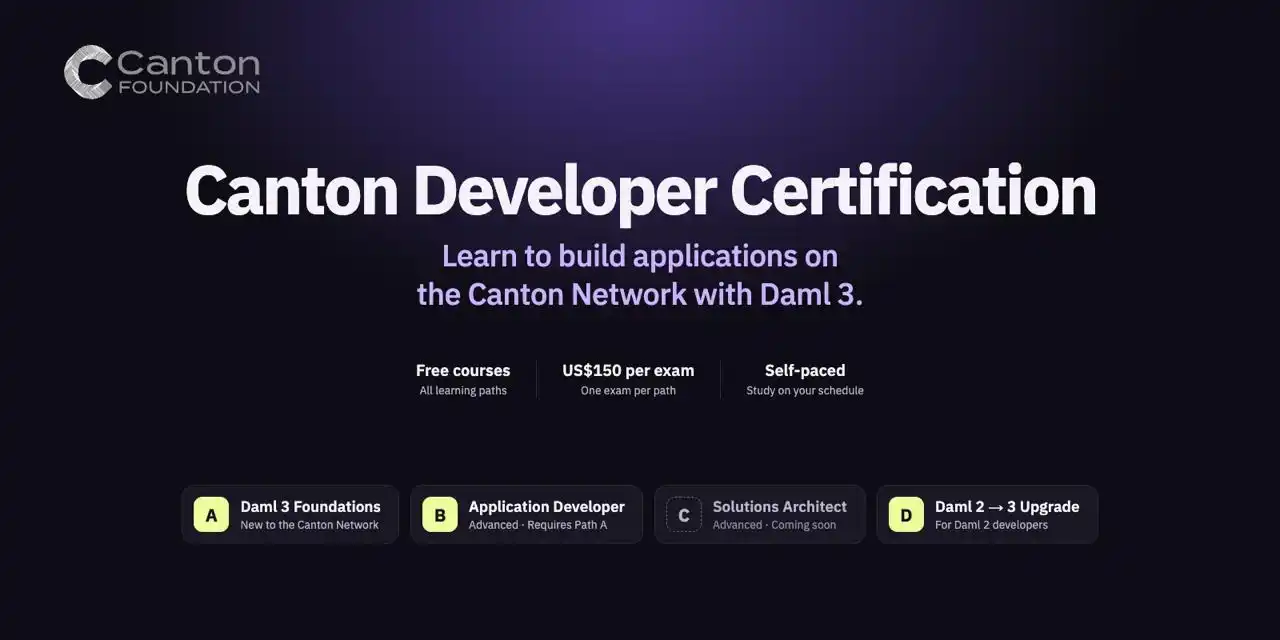
Canton Foundation Launches Official Daml 3 Certification, Expanding Developer Access and Establishing Institutional Finance Standards

Canton Foundation has launched the Canton Developer Certification, an official certification program for Daml 3, the smart contract language of the Canton Network. Combining a self-paced course with a certification exam, it offers developers worldwide a structured path to building applications for regulated financial markets. Canton Network is a public, permissionless blockchain designed for regulated finance, with over $6 trillion in on-chain assets processed by its supported applications. Daml is built to manage who may act on a contract and who may access its terms; the certification validates practical mastery of these authorization and privacy principles, establishing a recognized standard intended to strengthen institutional confidence in applications built on the network. The program is based on Daml 3 and Canton 3.x, the current technology underlying the network, letting newcomers start on the latest stack, helping production engineers deepen expertise, enabling institutional architects to design and integrate Canton deployments, and allowing existing Daml 2 developers to migrate their skills and codebases to Daml 3, unifying the community on a single, current platform. For ecosystem partners—financial institutions, application providers, system integrators, and validators—the certification provides a common technical foundation and a consistent way to assess developers' understanding of authorization and privacy requirements. Canton Foundation COO Amanda Martin said financial institutions need confidence that the applications they rely on are built by developers who understand regulated market requirements, and that the program both opens opportunities for developers globally and establishes a shared professional standard, building a stronger foundation for Canton's future growth by bringing the community together on Daml 3. The certification is now live at certification.canton.foundation; the course is self-paced and free to all developers, and the exam costs $150 per attempt. Canton Foundation is an independent nonprofit responsible for the governance and long-term development of Canton Network's shared infrastructure, supporting transparent and decentralized governance, ecosystem coordination, and broad participation by Global Synchronizer operators and network stakeholders, while working with financial institutions, technology providers, developers, and other participants to support the network's continued global growth and adoption.

marsbit40m ago

Canton Foundation Launches Official Daml 3 Certification, Expanding Developer Access and Establishing Institutional Finance Standards

marsbit40m ago

Nvidia Faces Independent Investigation, Bernstein Maintains $400 Target Price

Nvidia's board has launched an independent investigation following reports about CEO Jensen Huang's contacts with Megaspeed executive Alice Huang, though it says there is no reason to believe U.S. national security or company secrets were compromised. Three Republican House committee chairs have requested Huang attend a closed-door briefing on November 18 to explain the contacts and Nvidia's internal procedures for countering foreign intelligence activities, and Democratic Senator Chris Coons said Congress will investigate. Some reports suggested Alice Huang may have influenced Huang's lobbying to ease chip export restrictions to China, a claim Bernstein doubts, noting Huang has long publicly pushed to expand sales in China and that revenue from mainland China and Hong Kong has fallen sharply since export controls. Only H20 and limited H200 chips were approved for China sales, well behind Nvidia's most advanced products, and Bernstein sees limited room for recovery as Chinese customers prioritize domestic alternatives. Regulatory pressure may persist, with hawkish lawmakers potentially revisiting export limits. Bernstein maintains an Outperform rating and a $400 target price, about 114% above the November 6 close of $186.64, citing data center demand and earnings growth. It projects adjusted EPS of $4.77 for FY2026, $9.20 for FY2027 and $15.80 for FY2028. The target is based on average FY2028-2029 non-GAAP EPS of $19.04 at about 21x. Bernstein also flags Huang's succession as a key risk, given his central role and roughly 60 direct reports.

marsbit50m ago

Nvidia Faces Independent Investigation, Bernstein Maintains $400 Target Price

marsbit50m ago

Two Blocks Hit in 7 Hours: Two Retail Miners Take on the Entire Network's Hashrate and Walk Away with $476,000

Two individual solo miners using home mining rigs hit two Bitcoin blocks within seven hours on November 7, earning a combined $476,000. One miner using a Canaan AvalonQ home miner with roughly 80–87 TH/s earned about $239,000; the other earned roughly $237,000. A CKPool solo platform took about 2% (0.0629 BTC) as a service fee, with the rest going directly to the miners' wallets. Given current network difficulty of about 148.4 trillion, such a rig would normally need over a century to find a block, making the win a luck value of over 10,000%. This is part of a broader trend: in 2026 so far, solo miners have found 36 blocks, nearly one lucky winner per week. Earlier examples include a 6.5 TH/s Avalon Nano 3S worth a few hundred dollars earning $250,000 on October 27, another Nano 3S earning $232,000 on May 30, and a $150 Bitaxe Gamma earning $200,000 on July 10. Home solo mining is often called "plug-in lottery": a 1.2 TH/s mini miner has about a 1-in-16,000 annual chance of winning, far better than Powerball's 1-in-292 million, but rigs cost thousands of dollars and electricity runs $400–$1,100 monthly, with zero income until a block is found. Each viral win serves as free advertising for the industry. Rig manufacturers sell the dream of "maybe I'll win too"; solo pool platforms collect a steady ~2% fee from any winner; and the Bitcoin network preserves its "anyone can participate" narrative despite mining being dominated by large farms. The people paying for it all are ordinary buyers who purchase miners and pay electricity bills hoping for a life-changing jackpot.

marsbit1h ago

Two Blocks Hit in 7 Hours: Two Retail Miners Take on the Entire Network's Hashrate and Walk Away with $476,000

marsbit1h ago

Trading

Spot
活动图片