QuFi Launches Post-Quantum Verification Platform with Proof on Bitcoin Testnet

cryptonews.ruPublished on 2026-09-05Last updated on 2026-09-05

Abstract

QuFi Network, a post-quantum infrastructure company, has launched a verification platform designed to protect digital assets from future quantum computing threats without modifying existing blockchain networks. The platform separates verification from settlement, using a decentralized node network and post-quantum cryptography to validate transactions before they are processed on established blockchains. As a proof of concept, QuFi introduced uBTC, which applies this system to Bitcoin and operates on Bitcoin's Testnet4. It verifies BTC collateral and generates cryptographic proofs for value transfers, with final settlement occurring as standard Bitcoin transactions. The platform utilizes three post-quantum cryptographic standards—ML-DSA-65, SLH-DSA, and ML-KEM-1024—for digital signatures and key exchange. The external verification layer aims to avoid the increased storage, bandwidth, and computational demands that could come from directly integrating larger post-quantum signatures into individual blockchains. This launch aligns with growing industry efforts to enhance quantum resistance, including recent initiatives from StarkWare, a European pilot project testing similar standards, and ongoing protocol-level research by Bitcoin developers exploring options like the SHRINCS signature scheme.

Post-quantum infrastructure company QuFi Network has launched a verification platform designed to protect digital assets from future quantum computing threats without the need to modify existing blockchain settlement networks.

The platform separates verification from settlement, using a decentralized node network to verify transactions with post-quantum cryptography before they are executed on existing blockchain networks.

QuFi also launched uBTC—a proof-of-concept applying the verification system to Bitcoin ($BTC) and operating on Bitcoin Testnet4. The uBTC system verifies collateral in $BTC and generates cryptographic proofs governing the movement of value between settlement environments, while final redemption is executed as a standard Bitcoin transaction.

The platform utilizes three post-quantum cryptographic standards—ML-DSA-65, SLH-DSA, and ML-KEM-1024—for digital signatures and secure key exchange.

QuFi stated that the external verification layer aims to avoid the additional storage, bandwidth, and computational resource requirements that could arise from directly integrating larger post-quantum signatures into individual blockchains.

Related: The First Quantum Attack on Crypto Will Look Like an Unexplained Security Breach: Quantus Founder

Crypto Industry Ramps Up Quantum Defense

The platform launch comes amid a series of recent initiatives preparing blockchain networks for potential threats from quantum computing.

In August, StarkWare tested a quantum-resistant Bitcoin transaction on the mainnet without requiring a fork. However, the computation took several hours and cost roughly $150–$200, and the non-standard transaction format required direct submission to a miner.
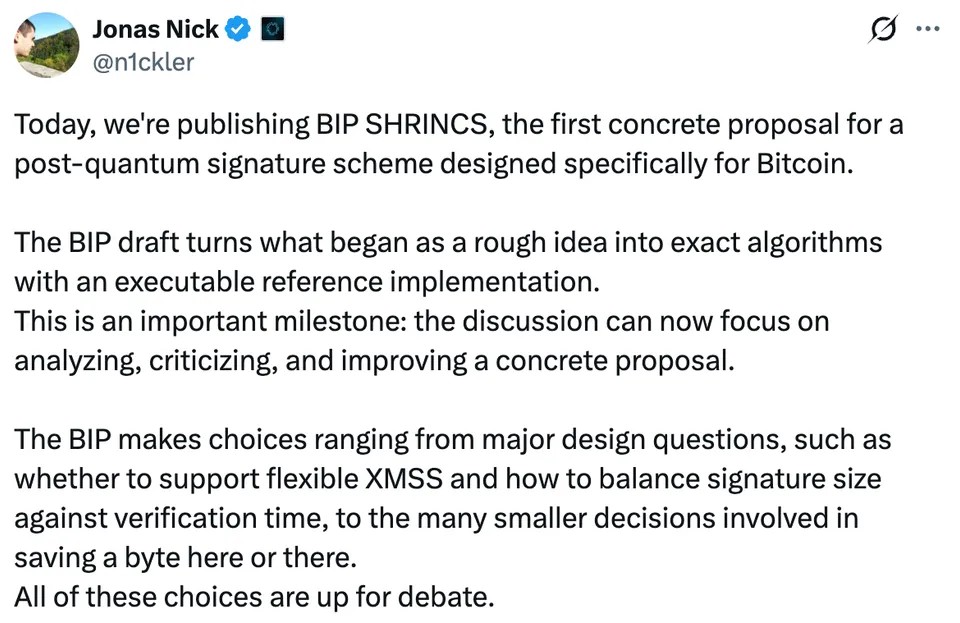
Jonas Nick presenting the BIP SHRINCS proposal on August 26. Source: Jonas Nick

That same month, banks and regulators across Europe, the Middle East, and Asia joined a pilot project testing post-quantum wallets and on-chain transfers using ML-DSA-65—one of the same cryptographic standards included in QuFi's platform. Meanwhile, the Ethereum Foundation removed the Poseidon hash function from its planned post-quantum architecture in favor of proven alternatives like SHA or BLAKE.

Bitcoin developers are also exploring protocol-level defenses. In August, Blockstream researchers published a Bitcoin Improvement Proposal for SHRINCS—an experimental post-quantum signature scheme designed to reduce the size and computational costs associated with quantum-resistant signatures.

This approach has trade-offs. SHRINCS uses stateful signatures to reduce their size, requiring wallets to track previously used signing keys. The scheme remains early-stage, lacking a complete security proof, and its design increases system complexity and creates additional potential user error scenarios.

Magazine: Bitcoin's New Quantum Defense, 18.9M SOL Destroyed: Hodler's Digest

end-content

Related Questions

QWhat is the core function of the verification platform launched by QuFi Network?

AIts core function is to separate verification from settlement, using a decentralized network of nodes to verify transactions with post-quantum cryptography before they are executed on existing blockchain networks.

QWhat is uBTC and what network does it currently operate on?

AuBTC is a proof-of-concept from QuFi that applies its verification system to Bitcoin. It currently operates on the Bitcoin Testnet4 network.

QWhich three post-quantum cryptographic standards does the QuFi platform utilize?

AThe QuFi platform utilizes the ML-DSA-65, SLH-DSA, and ML-KEM-1024 standards for digital signatures and secure key exchange.

QWhat is one main advantage claimed by QuFi for its external verification layer?

AIt aims to avoid the increased data storage, bandwidth, and computational resource requirements that could arise from directly implementing larger post-quantum signatures into individual blockchains.

QAccording to the article, what are some potential drawbacks or trade-offs of the SHRINCS post-quantum signature scheme being researched for Bitcoin?

ASHRINCS uses stateful signatures, requiring wallets to track previously used signing keys. It is still at an early stage without a completed security proof, and its design adds system complexity and creates additional potential for user error scenarios.

Related Reads

How Various Assets Have Performed So Far This Year: Bitcoin at -22% Return, Dead Last

As of November 13, 2026, Bitcoin has posted a -22.0% year-to-date return, ranking last among major asset classes. In contrast, the Philadelphia Semiconductor Index gained 43.2% despite a sharp pullback from its mid-year peak of 106.6%, while the S&P 500 and Nasdaq Composite held steady gains of roughly 8% to 10%. Even the CSI 300 (-13.3%) and gold GLD (-10.3%) outperformed Bitcoin. The article argues the key difference lies in the presence of real buying support. Semiconductors are backed by massive capital expenditure and order backlogs from major tech companies, giving them an earnings floor even after steep corrections. Bitcoin, by contrast, lacks such support. After spot ETFs helped Wall Street finish building core positions in 2024–2025, 2026 brought neither broad macro liquidity nor a new narrative capable of drawing fresh capital. ETF inflows slowed from a flood to a seasonal trickle. Without sustained new buyers, Bitcoin's high beta works only to the downside: in a stock-picking, zero-sum market it becomes the asset everyone wants to sell into strength. The article further notes that Bitcoin's positioning is losing focus. It has failed to act as either a "digital gold" hedge or a high-beta proxy for tech stocks. It lagged the Nasdaq and S&P 500 during the tech rally, and fell harder than gold when global assets contracted in November. The conclusion: Wall Street treats Bitcoin not as a safe haven but as a highly liquid, 24/7 liquidation tool—the first asset sold when institutions need to meet margin calls or lock in yearly profits. Crypto has been admitted to the table, but often as the one picked to pay the bill.

marsbit37m ago

How Various Assets Have Performed So Far This Year: Bitcoin at -22% Return, Dead Last

marsbit37m ago

From QR Codes to Physical Goods: How Consumer RWA Verifies Products and Rights

A single QR code can be printed on two bottles and scanned twice to open the same page, so verifying a physical item requires confirming the binding between the bottle in hand and its listed number. Consumer RWA verification has two parts: whether the goods or services are real, and whether the rights recorded in the digital credential are valid. For rights provenance, take a co-branded gift box: authorization documents define the term and scope in which a brand may use the co-branded mark, production and warehousing records show whether the box was stocked by batch, and rights registration states what holders can redeem and who delivers it. Linking all three lets consumers check authorization scope, supply, and their own eligibility. Identifiers, events, and evidence must work together. High-value items can use unique serial numbers, uniform-spec goods can use batch numbers, and courses or events can use session numbers. Events such as warehousing, sampling, outbound shipment, receipt, and redemption should be tied to the corresponding object, with operation time and responsible party retained. Test reports correspond to submitted samples; linking results to specific goods also requires checking the sample, batch, and inbound/outbound records. Ordinary batch goods can combine serialized QR codes with abnormal-scan records, while high-value items may add tamper-evident labels or independent authentication. Trusted records must also reflect current status. If a coffee batch has 500 bags at warehousing, 10 used for sampling, and 100 reserved for other channels, then absent other changes, 390 bags remain available for new rights. The warehousing record shows historical quantity; current redeemable quantity must be updated based on actual occupancy. A query page should at minimum state the goods or service, evidence source, last update time, and whether the credential is currently usable.

marsbit1h ago

From QR Codes to Physical Goods: How Consumer RWA Verifies Products and Rights

marsbit1h ago

10 Years Is Too Slow: Gu Quanquan's Team Challenges Dario, Compressing Cancer Cure to 4 Years

A UCLA professor, Quanquan Gu, has founded Geodesic Intelligence, a 15-person startup that after only five months has released NovaAtom-Lite, an all-atom structure prediction model that outperforms DeepMind's Isomorphic Labs flagship IsoDDE on FoldBench, the toughest biomolecular benchmark. The model predicts the 3D coordinates of every heavy atom in protein, DNA, RNA, and ligand complexes with near-experimental precision. NovaAtom-Lite posted top scores on two core pharma tests: antibody-antigen binding (79.07% success, 31 points above AlphaFold 3 and 3.5 above IsoDDE, with 2.2x AlphaFold 3's accuracy at high-precision thresholds) and protein-ligand binding (top 1 on both RMSD and contact metrics). On the Runs N' Poses benchmark, which separates memorization from genuine physics understanding, NovaAtom-Lite's lead grows on the most novel, out-of-distribution ligands (47.6% vs AlphaFold 3's 24%), showing it learns transferable physical rules rather than memorizing structures. The model also supports test-time scaling—raising sampling from 1 to 100 seeds lifts antibody success from 74.3% to 83.1%—and condition constraints, where a single contact-pair hint boosts success to 91.28% and full pocket hints lift hard-case ligand accuracy by nearly 16 points. It solved two nightmare cases: a wildly flexible 22-residue MERS nanobody loop (0.56 Å error, all 25 samples correct) and the KRAS G13D hidden switch-II pocket (0.98 Å ligand RMSD vs OpenDDE's 17.74 Å). Gu previously led ByteDance's SeedFold, the first model to beat AlphaFold 3 on FoldBench, forcing Isomorphic Labs to respond with IsoDDE. A stronger NovaAtom-Pro is coming. Days after launch, a16z cited NovaAtom-Lite in a report arguing pharma is entering its "GPT-3 moment," naming Geodesic as the sole company highlighted in its industry map. Geodesic's closed loop spans structure prediction, scientific reasoning, and wet-lab validation—aiming to compress drug discovery from a decade to four years.

marsbit1h ago

10 Years Is Too Slow: Gu Quanquan's Team Challenges Dario, Compressing Cancer Cure to 4 Years

marsbit1h ago

Trading

Spot
活动图片