Qualcomm Sues Arm: Seeks 5-Year Royalty Exemption, Demands Compulsory Licensing of V10 Instruction Set

marsbitPublished on 2026-10-07Last updated on 2026-10-07

Abstract

Qualcomm has sued Arm Holdings in Delaware District Court, seeking two primary remedies. First, Qualcomm alleges Arm breached their contract by withholding necessary chip testing tools and leaking a confidential 2024 termination threat letter to the media, which Qualcomm claims damaged its chip partnership negotiations with Meta. For these alleged breaches, Qualcomm is asking the court to allow it to stop paying Arm licensing royalties for up to five years, a sum potentially worth billions. Second, in a separate bench trial running parallel to the jury trial, Qualcomm accuses Arm of failing to negotiate in good faith regarding a license for Arm's next-generation V10 instruction set architecture. Qualcomm argues that monetary damages are insufficient, as missing out on V10 access could cause long-term competitive harm. It seeks a court order forcing Arm to license the V10 architecture. Arm denies all allegations, countering that Qualcomm suffered no real damages and is using litigation as leverage. Arm also moved to dismiss the V10-related claim, arguing it exceeds contractual agreements and is time-barred. The trial's outcome could significantly impact the future relationship and revenue between the two chip industry giants.

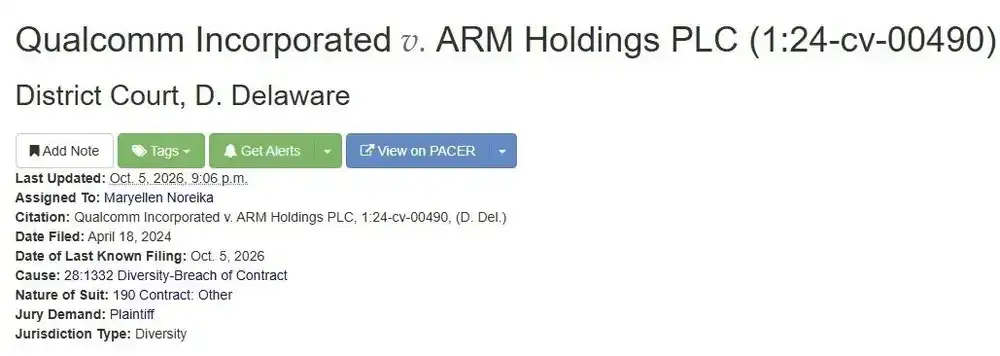
According to information disclosed by the U.S. District Court for the District of Delaware (Case No. 1:24-cv-00490), a five-day jury trial in the case where Qualcomm Technologies, Inc. sued Arm Holdings plc began on Monday, October 5, at the District Court for the District of Delaware.
Qualcomm accuses Arm of failing to provide necessary chip testing tools as per the contract and leaking a threat letter from 2024 about terminating a crucial licensing agreement, which allegedly damaged Qualcomm's chip collaboration negotiations with Meta. In response, Qualcomm is seeking to halt royalty payments to Arm for up to five years in the future, a sum that could amount to tens of billions of dollars. Furthermore, in the same consolidated lawsuit, Qualcomm also hopes to force Arm to license the V10 instruction set architecture.

Qualcomm Seeks to Suspend Arm Royalty Payments for 5 Years

According to quarterly filings submitted by Arm to the U.S. Securities and Exchange Commission (SEC), Qualcomm initially filed the lawsuit in April 2024, and subsequently amended the complaint twice in 2025 and again in March 2026, adding additional breach-of-contract allegations, including Arm's failure to negotiate certain license terms in good faith.

Qualcomm has made two main claims in this case: First, Qualcomm alleges that Arm refused to deliver chip testing tools it was entitled to under the license agreement; Second, Qualcomm accuses Arm of leaking to the media a threat letter it sent in 2024 regarding the termination of a key licensing agreement. Qualcomm claims this leak directly harmed its ongoing chip collaboration talks with Meta Platforms.

In opening statements, Qualcomm's lawyer Karen Dunn directed the jury's attention to Qualcomm's 2021 acquisition of chip startup Nuvia, citing internal documents that allegedly show Arm executives referred to Qualcomm as an "enemy" and expressed concerns about declining royalty revenue. Dunn stated that Arm's response was to breach the contract and sabotage Qualcomm's business relationship with Meta, including through a "coordinated media leak."

As one of Arm's largest customers, Qualcomm is seeking special relief from the court: permission to stop paying license royalties to Arm for a period of up to five years. This amount could reach tens of billions of dollars.

However, Judge Maryellen Noreika, who is presiding over the case, is weighing whether to void this contract clause. This means Qualcomm would not be able to directly "stop paying" future royalties and could only seek a relatively smaller amount of damages.

Arm Denies Allegations

Arm has categorically denied Qualcomm's allegations. Arm's lawyer Gregg LoCascio stated in his opening statement that the core of Qualcomm's entire case is "using litigation as leverage in a business dispute." He presented evidence to the jury arguing that Qualcomm failed to prove it suffered any actual harm. "They were not harmed in the slightest," LoCascio said.

Arm also countered that the potential chip deal with Meta mentioned by Qualcomm was merely "speculative" and did not cause any substantive harm. Furthermore, Arm turned the tables, pointing out that Qualcomm itself had leaked non-public details to the media regarding antitrust investigations into Arm, thus disqualifying Qualcomm from seeking damages over the leak of the termination letter.

According to information disclosed in Arm's latest annual report, Qualcomm accounted for 9% of Arm's total revenue in the fiscal year ending March 31, 2026. Arm stated in the filing: "We cannot provide any assurance regarding the outcome of any litigation or how litigation will affect our relationship with Qualcomm or revenue from Qualcomm."

Qualcomm Hopes to Force Arm to License V10 Architecture

In addition to the five-day jury trial, Judge Noreika will also preside over a parallel bench trial within the same consolidated lawsuit to consider whether Arm acted in good faith during its negotiations with Qualcomm regarding the licensing of the next-generation instruction set architecture, V10.

According to disclosed court documents, in its amended complaint, Qualcomm asserts, besides breach of contract by Arm (testing tools, leaked letter), that Arm breached its duty to negotiate in good faith (V10 license). These two claims are being tried within the same case, but the former is conducted as a jury trial and the latter as a bench trial.

According to disclosed court documents, there is intense conflict between the parties over the licensing of Arm's next-generation V10 instruction set architecture. Arm had attempted to rely on agreements with other licensees (such as Ampere, Apple) as benchmarks to justify its V10 offer to Qualcomm. However, Qualcomm countered that Arm was "cherry-picking" agreements favorable to it, and that Qualcomm needs to know the contents of all relevant agreements to verify Arm's claims. Court documents also show that Arm made a V10 offer to Qualcomm on December 10, 2025.

Qualcomm's current license agreement with Arm extends until 2033. Qualcomm alleges in its complaint: "There is no substitute or replacement for a V10 (Arm's next-generation instruction set architecture) license, and the consequences of Arm's failure to negotiate in good faith cannot be remedied by damages."

The legal logic behind Qualcomm's claim is: if the court only awards monetary damages against Arm, but Qualcomm still cannot obtain a V10 license, then Qualcomm may face a structural disadvantage in the next-generation chip competition. Chip architecture iterations are long-term and irreversible; missing a generation's architecture license could lead to overall product roadmap delays, and this damage to competitive position is difficult to quantify monetarily. Therefore, Qualcomm seeks to compel Arm to fulfill its duty of good faith negotiation (i.e., actually provide the V10 license), rather than just seeking damages.

Arm is attempting to have this claim dismissed through legal proceedings. According to a letter Arm submitted to the court on February 13, 2026, Arm's motion to dismiss specifically advanced one issue: requesting the court to dismiss Qualcomm's claim that Arm breached the "implied covenant of good faith and fair dealing," arguing that Qualcomm failed to obtain a license for the V10 architecture. Arm argues this claim should be dismissed because: (1) it attempts to impose restrictions beyond what the parties actually agreed to in their agreements; (2) it is barred by the statute of limitations.

This article is from WeChat Official Account: Xinzhixun (Chip Insight) , Editor: Xinzhixun - Lang Ke Jian, Author: Xinzhixun - Lang Ke Jian, Original Title: 《Qualcomm Sues Arm: Seeks 5-Year Royalty Exemption, Demands Compulsory Licensing of V10 Instruction Set!》


Related Questions

QWhat are the two main accusations Qualcomm has made against Arm in the lawsuit?

AQualcomm's two main accusations are: 1) That Arm refused to deliver chip testing tools that Qualcomm was entitled to under their licensing agreement. 2) That Arm leaked a threatening letter from 2024 about terminating a key license agreement to the media, which Qualcomm claims damaged its ongoing chip collaboration negotiations with Meta Platforms.

QWhat is the specific remedy Qualcomm is seeking regarding royalty payments to Arm, and what is the potential financial impact?

AQualcomm is seeking a court order to stop paying licensing royalties to Arm for up to five years. The amount of unpaid fees involved could be tens of billions of dollars.

QBeyond the royalty issue, what other critical demand is Qualcomm making in the parallel 'bench trial' part of this consolidated lawsuit?

AIn the parallel bench trial, Qualcomm is demanding that the court force Arm to license its next-generation V10 instruction set architecture (ISA) to Qualcomm, arguing that Arm failed to negotiate in good faith regarding the V10 license.

QHow does Arm's legal counsel characterize the core of Qualcomm's lawsuit in their opening statement?

AArm's lawyer, Gregg LoCascio, stated in his opening argument that the core of Qualcomm's entire case is 'using litigation as a pressure tactic in a business dispute.' He presented evidence claiming Qualcomm failed to prove it suffered any actual damages.

QWhat is Arm's legal argument in its motion to dismiss Qualcomm's claim related to the V10 architecture license?

AArm's motion to dismiss argues that Qualcomm's claim regarding the breach of the implied covenant of good faith and fair dealing (for the V10 license) should be dismissed because: 1) It attempts to impose restrictions beyond what the parties actually agreed to in their contract, and 2) The claim is time-barred (exceeds the statute of limitations).

Related Reads

Former OpenAI Researcher Changes His Tune: Super AI Researcher Could Arrive as Early as Next Year

Former OpenAI researcher Daniel Kokotajlo and the AI Futures Project have revised their timelines, now predicting superhuman AI researchers (SARs) could arrive as early as 2027 rather than 2029. The key driver is a METR assessment of Anthropic, which found that since October 2025, the benchmark score growth rate of Anthropic's internal models reached about 1.9x the previous pace (95% CI: 1.5–2.8x) — roughly two years' worth of progress in one year. METR estimates that by October 2026, about 80% of the extra acceleration may come from AI itself, though this is a subjective guess with high uncertainty. AI is already helping researchers write experiment code, run tests, and try out more ideas. Using METR's estimates, the team calculated that by early November 2026, AI-driven acceleration alone could push overall model progress to 1.7x the historical rate — a speed that, in the original AI 2027 scenario, wouldn't be reached until around April 2027, about five months later. Notably, METR says most of the evidence underpinning its core conclusions was redacted from the public report at Anthropic's request, to avoid helping competitors; only the benchmark curves are publicly verifiable. Depending on the method used, SAR arrival estimates range from February 2027 to mid-2028. If acceleration compounds across model generations, superintelligence could arrive sooner than expected.

marsbit19m ago

Former OpenAI Researcher Changes His Tune: Super AI Researcher Could Arrive as Early as Next Year

marsbit19m ago

Aave V3.8 Officially Launches: Covering 15 Public Chains, $15.2 Billion Liquidity Pool, Introducing Low-Gas-Cost Reentrancy Protection

Aave has launched V3.8 across 15 active V3 markets, following approval by the Aave DAO and development by Aave Labs. According to DeFiLlama, Aave's total value locked exceeds $16.4 billion, with active V3 markets holding over $15.23 billion. The upgrade was deployed via AIP #541, completing a 22-day governance process that began with a forum proposal on October 21 and a Snapshot vote on October 27. V3.8 covers active instances on Ethereum (Core and Lido), Plasma, Avalanche, BNB Chain, Monad, Base, and Arbitrum, along with Mantle, X Layer, Polygon, Linea, Optimism, Gnosis, MegaETH, and Celo. Legacy markets that were frozen with zero caps were deliberately skipped. The release introduces kernel-level reentrancy protection for external callback operations on liquidity pools. Traditionally, preventing cross-function reentrancy requires writing a lock flag before state changes, but after EIP-3529 capped SSTORE refunds at 20%, maintaining persistent locks in high-frequency lending pools became gas-intensive. V3.8 instead uses EIP-1153 transient storage, where TSTORE and TLOAD cost only 100 gas per read or write and automatically clear at transaction end, providing reentrancy hardening at minimal cost. Aave Labs addressed developer concerns that the lock might block liquidation composability within flash loan callbacks. The flashLoan and flashLoanSimple entry points only check the lock status without setting it, creating asymmetric isolation: users can still compose liquidations, deposits, or repayments inside a flash loan callback, but attempts to initiate a flash loan from within a regular pool operation callback are rejected and reverted. Security verification included Certora formal verification and independent external audits before the AIP vote. The new contract code is published in the official Aave V3 repository under the Business Source License. Developers also noted that downstream integrators reading view functions such as account health factors or reserve data during callbacks should account for intermediate ledger states and ensure peripheral risk controls remain compatible.

marsbit20m ago

Aave V3.8 Officially Launches: Covering 15 Public Chains, $15.2 Billion Liquidity Pool, Introducing Low-Gas-Cost Reentrancy Protection

marsbit20m ago

Trading

Spot
活动图片