Ocean Network launches Inference

cointelegraphPublished on 2026-09-11Last updated on 2026-09-11

Abstract

Ocean Network, a peer-to-peer GPU cloud, has launched "Inference," a new service allowing users to deploy AI models as persistent, HTTP-accessible services on dedicated GPU hardware. The service aims to address key industry pain points: unpredictable billing, lack of model transparency, and hardware uncertainty. Ocean Network provides upfront, hourly pricing, ensures the user-selected model runs on dedicated hardware, and avoids shared infrastructure. Pricing starts at $2.16 per hour for an H200 GPU. The platform offers four deployment options: Curated Models for pre-configured packages, Custom Models for full control via Hugging Face, Services like ComfyUI, and Templates for specific outcomes like video generation. To celebrate the launch, 6 hours of complimentary H200 inference is being offered. The service is available now, requiring a wallet with funds on the Base blockchain.

Singapore, September 10, 2026 - Ocean Network, the peer-to-peer GPU cloud for AI where inference and compute jobs are booked by the hour and yours alone while they run, today announced the launch of Inference, enabling users to deploy AI models and applications as persistent, HTTP-accessible services on dedicated GPU hardware. The launch represents the platform’s largest capability expansion to date.

Ocean Network Inference is designed to resolve three recurring friction points in the AI infrastructure market: unpredictable billing, lack of model transparency, and hardware uncertainty. Independent community research has documented widespread concern about inference providers substituting or routing models without user visibility, alongside billing surprises on long-running workloads.

Ocean Network addresses these through its architecture. The platform displays the full session cost before any funds are committed, bills by the hour rather than by the token, and routes each request to a dedicated node rather than shared infrastructure. The model selected by the user is the model that runs.
“We did the research, read the threads, and built what the community kept asking for: a normal endpoint, a normal card, and a price you know before you start. Compute jobs gave users the tools to build and test. Inference lets them run. That is the full circle, and we have been building toward it since day one,” says the Ocean Network team.

The pricing for an H200 GPU on Ocean Network starts at $2.16 per hour. In internal testing, a 30 second video generated using the platform’s Templates feature was produced in approximately 20 minutes at a cost of $0.72. Payment is handled on-chain through an escrow contract on Base, with the node operator claiming the full booked session window before the container starts.

Ocean Network Inference offers four entry points, differing only in how much configuration is handled by the user versus the platform:

  • Curated Models: Pre-configured model and hardware packages for immediate deployment, including Qwen3-8B and large reasoning models across GPU configurations from 16GB single-card to multi-card setups.
  • Custom Models: Full configuration control for any model on the Hugging Face Hub, running on vLLM or llama.cpp, with an OpenAI-compatible API output.
  • Services: Containerised applications published by node operators, including ComfyUI, Open WebUI, JupyterLab, and others.
  • Templates: Ready-to-run application and model bundles for specific outcomes, including text-to-image, image-to-video, and reference-to-video generation.

To mark the launch, Ocean Network is making 6 hours of H200 inference available in complimentary tokens. Inference is available now at dashboard.oncompute.ai. Users require a wallet with funds on Base, available through an external wallet or the platform’s built-in Smart Wallet with email or social login.

About Ocean Network

Ocean Network is a decentralized, peer-to-peer GPU compute network that turns idle and underutilized hardware into accessible, pay-per-use compute resources. It lets users choose a node with the resources they need, submit a containerized compute job, and get results back without managing servers or infrastructure. With the launch of Inference, the network now also supports long-running AI model deployments and applications, reachable over HTTP for as long as the session is booked.


Related Questions

QWhat is Ocean Network launching and what problem does it aim to solve?

AOcean Network is launching 'Inference', a service for deploying AI models as persistent, HTTP-accessible services on dedicated GPU hardware. It aims to solve three friction points in the AI infrastructure market: unpredictable billing, lack of model transparency, and hardware uncertainty.

QHow does Ocean Network ensure transparent and predictable billing for its Inference service?

AOcean Network displays the full session cost before funds are committed and bills by the hour rather than by the token, ensuring users know the price before starting.

QWhat are the four entry points offered by Ocean Network Inference, and what do they provide?

A1) Curated Models: Pre-configured model and hardware packages. 2) Custom Models: Full control for any model on Hugging Face Hub. 3) Services: Containerized applications like ComfyUI and JupyterLab. 4) Templates: Ready-to-run bundles for specific outcomes like text-to-image.

QWhat are the starting price for an H200 GPU and the launch promotion for the new Inference service?

AThe pricing for an H200 GPU starts at $2.16 per hour. To mark the launch, Ocean Network is offering 6 hours of H200 inference in complimentary tokens.

QHow is payment handled on Ocean Network and what technology underpins its decentralized nature?

APayment is handled on-chain through an escrow contract on Base. Ocean Network is a decentralized, peer-to-peer GPU compute network that utilizes idle hardware.

Related Reads

Changing Gas Metering Could Break Smart Contracts? Ethereum Urgently Halts Hoodi Fork to Investigate Eight Major Security Risks

Ethereum core developers have paused the Hoodi testnet upgrade after security auditors found that two upcoming Gas improvement proposals could invalidate long-standing assumptions underpinning many deployed smart contracts. The proposals, EIP-8037 and EIP-8038, part of the Glamsterdam upgrade, aim to reprice state storage by decoupling state creation from state access and setting dynamic weights for certain opcodes, in order to curb unchecked growth of Ethereum's state data. However, this overhaul disrupts static Gas constants that developers have relied on as fixed system parameters. ChainSecurity identified eight invariant risks. Many contracts and off-chain infrastructure depend on hardcoded Gas limits, for example to prevent reentrancy or bound execution scope; higher costs could cause cross-contract calls to run out of Gas and revert. Other risks lie in error-handling logic that relies on precise prediction of inner execution costs, and in proxy contracts that forward Gas based on fixed ratios, potentially distorting execution paths or locking funds in incomplete state-machine branches. To avoid systemic compatibility failures and cascading disruptions across multisig wallets, bridges, and lending protocols, developers agreed at an ACD meeting not to hard-fork Hoodi until the affected contracts are fully mapped and compatibility guidance is issued. Because much logic lives off-chain in proprietary routing, settlement scripts, and liquidation bots, the Ethereum Foundation acknowledged it cannot audit the entire ecosystem alone. It has published a public repository detailing the eight affected invariants, sample problem code, and prompt templates for audit and scanning tools, so teams can check their own logic. Findings will be reviewed at next week's ACD meeting, when Hoodi activation conditions will be reassessed.

marsbit1h ago

Changing Gas Metering Could Break Smart Contracts? Ethereum Urgently Halts Hoodi Fork to Investigate Eight Major Security Risks

marsbit1h ago

What Exactly Drives the Value of Layer 1?

This analysis by Marc Arjoon, CFA, examines what actually drives Layer 1 valuation through time-series regression on major L1 assets. Short-term, all L1 price movements remain dominated by Bitcoin beta. Over longer horizons, Ethereum's market cap has fully decoupled from its own protocol revenue—a deliberate policy outcome of Dencun and higher gas limits rather than a demand collapse—with its 2025 rally driven instead by spot ETF and corporate treasury demand. Solana, by contrast, shows revenue and market cap moving in tandem, both rising ~15x since January 2023 and peaking the same week. Active addresses and DEX volumes show weak weekly correlations and large divergences despite long-cycle drift. Testing Metcalfe's Law, the fitted elasticity of market cap to active addresses is only 0.56 for Ethereum and 0.62 for Solana and BNB—closer to the square root of addresses than the square. None of six valuation multiples reliably mean-reverts; Mcap/REV is the only one that predicts positive 13-week returns from low valuation quantiles on Ethereum and TRON. No L1 has Bitcoin's deep holder base: only 4% of Solana and 10% of Ethereum supply has been dormant over three years versus 42% for Bitcoin. Ethereum's pricing anchors to peer capital share—59% of L1 market cap, 70% of DeFi TVL, 75% of tokenized RWA—rather than on-chain activity, where it holds just 5% of active addresses. Across chains, market cap rank correlates strongly with TVL (Spearman 0.87) and stablecoin supply (0.63) but weakly with transactions (0.17). The core conclusion: L1s are valued less as fee-generating businesses and more as monetary assets competing for capital settlement and liquidity share.

marsbit1h ago

What Exactly Drives the Value of Layer 1?

marsbit1h ago

From 85% to 9%: The Dramatic Shift in Korean Exchange Listing Logic—Tokens Are Safer, but Is the Business Harder?

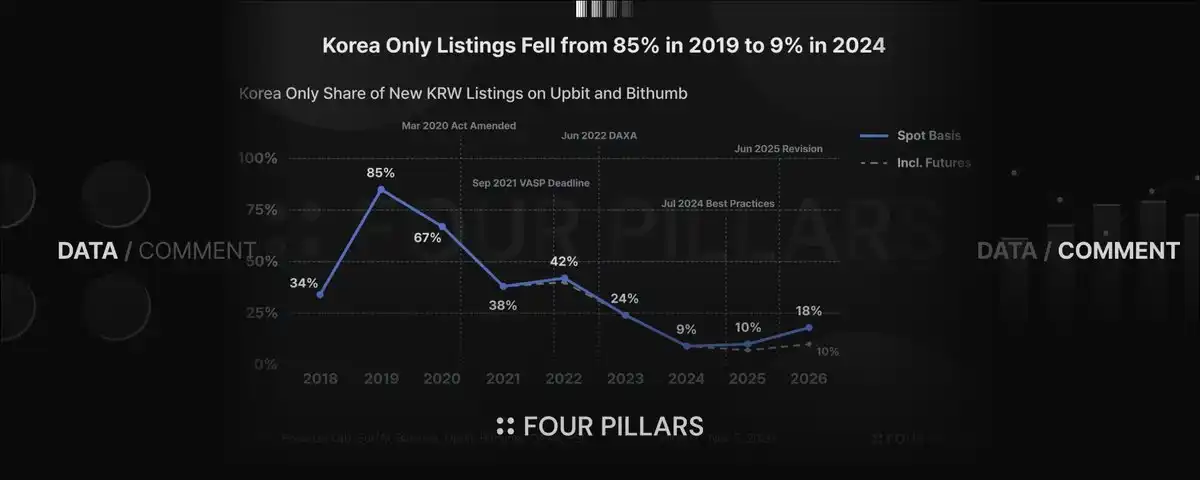
South Korea’s KRW crypto exchanges have fundamentally changed their listing logic. According to Bonanza Lab data across Upbit, Bithumb, Coinone, Korbit, and Gopax, the share of Korea-only token listings fell from 85% in 2019 to 9% in 2024, with a slight rebound to 18% in 2026 that drops back to about 10% when excluding assets first traded on overseas futures markets. The shift began with the 2021 Specific Financial Information Act, which required real-name bank accounts and traditional-finance-level AML compliance, and was reinforced by DAXA’s unified listing review guidelines effective July 2024, under which assets with two or more years of trading history on compliant overseas exchanges can automatically satisfy baseline disclosure and whitepaper requirements. Despite the collapse in local-first listings, total listings have grown: Upbit and Bithumb added 43 KRW-market tokens in 2022, 116 in 2023, 125 in 2024, and 238 in 2025. Listing timing remains cyclical—in the 2025 bitcoin high, 111 assets (47%) were brought to Korea within 30 days of overseas listing, while in 2026 mature assets with over a year of overseas trading became the mainstay (52 assets, 31%), including older tokens such as CRV and RSR. The consequences are clear. The share of assets hit by investment warnings or delisting within two years fell from 24% for the 2020 cohort to 10% for 2024. Among 2020–2024 listings, 44 of 148 Korea-only tokens (30%) faced warnings or delisting within two years, versus only 26 of 279 overseas-first tokens (9%). Overseas seasoning also reduces post-listing drawdowns: assets listed in Korea within 30 days of overseas launch saw a median 30-day price decline of 39%, compared with just 7% for assets with over a year of overseas trading history. The trade-off is revenue. Heavily traded overseas assets generate limited first-day speculative volume, and since Korean exchanges rely overwhelmingly on spot trading fees, weaker listing-day surges can hurt earnings. A renewed bull market could temporarily revive listings of newly launched overseas assets, but exchanges cannot build a durable, cycle-resistant business on listing structure alone. Their core challenge is to create new trading demand and diversify revenue beyond listing-driven fees.

marsbit1h ago

From 85% to 9%: The Dramatic Shift in Korean Exchange Listing Logic—Tokens Are Safer, but Is the Business Harder?

marsbit1h ago

Trading

Spot
活动图片