Nearly $300 Million Aimed at U.S. Midterm Elections, Tether Executive Takes Helm of Crypto Industry's Second-Largest Political Fund

marsbitPublicado a 2026-04-03Actualizado a 2026-04-03

Resumen

A crypto super PAC named Fellowship, which claims to have raised over $100 million but has reported zero spending to the FEC, has appointed Jesse Spiro, Tether’s VP of Regulatory Affairs, as its chairman. This marks the first official public link between Tether and the PAC, despite earlier denials. Meanwhile, another major crypto PAC, Fairshake—backed by Coinbase, Ripple, and a16z—has amassed $193 million and has already spent over $8.6 million in Illinois primary races. Combined, the two PACs control nearly $300 million aimed at influencing the November midterm elections. The move comes as the crypto industry faces a critical legislative battle over the CLARITY Act, currently stalled in the Senate. A key point of contention is whether stablecoins can pay yields to users—a issue directly affecting Tether, the issuer of the world’s largest stablecoin, USDT. A recent Senate proposal would ban passive yield but allow transaction-based rewards, a compromise the industry finds too restrictive. With the White House’s top crypto advocate departing and the legislative window narrowing, Tether’s heightened political engagement signals a strategic push to shape regulation and protect its business interests through financial influence.

Deep Tide Guide: Fellowship, a crypto super PAC that was established seven months ago and claimed to have raised over $100 million but has yet to spend a single dollar, announced on Wednesday the appointment of Jesse Spiro, Vice President of Regulatory Affairs at Tether US, as its chairman. This marks the first official and public connection between Tether and the PAC. Meanwhile, another major crypto PAC, Fairshake, has amassed a war chest of $193 million. Combined, the two PACs are targeting the November midterm elections with nearly $300 million in political funds, while legislative battles over stablecoin yields in Congress remain unresolved.

The political arms race in the crypto industry is escalating.

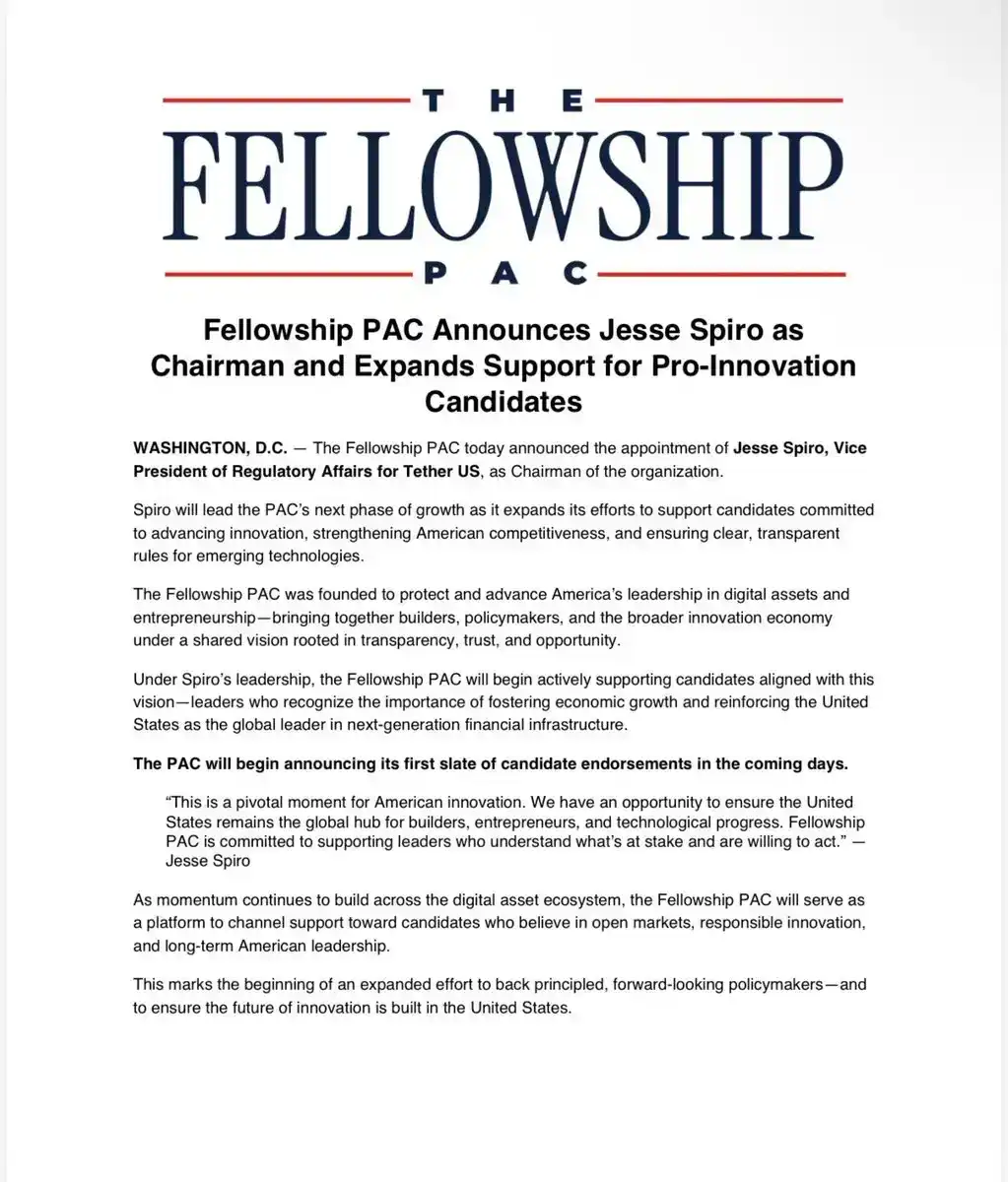
According to a Cointelegraph report on April 1, Fellowship PAC announced on Wednesday that Jesse Spiro, Vice President of Regulatory Affairs at Tether US, will assume the role of chairman, leading the organization's next phase of expansion. The first list of endorsed candidates will be announced in the coming days. Fellowship is a super PAC founded in August 2025, which claimed last September that it had raised "over $100 million" from unnamed donors aligned with the crypto industry.

Spiro stated in a declaration: "This is a critical moment for American innovation. We have the opportunity to ensure that the United States continues to be the global hub for builders, entrepreneurs, and technological progress. Fellowship PAC is committed to supporting leaders who understand what is at stake and are willing to take action."
From 'Denying Ties' to 'Executive Leadership': Tether's Relationship with Fellowship Comes to Light

Since its high-profile debut last September, the identity of Fellowship PAC's backers has been one of the industry's biggest mysteries.

At its inception, the PAC did not disclose any management, donors, or key employees. Early reports listed Tether as an expected supporter, but Tether International subsequently formally denied any connection to the PAC. According to a CoinDesk report in February, a Tether International spokesperson explicitly stated that "Tether International has no affiliation whatsoever with Fellowship."

But FEC records tell a different story. Fellowship's registered treasurer, Mitchell Nobel, is an executive at Cantor Fitzgerald, the custodian institution managing Tether's multi-billion dollar reserves. The PAC's registered address is in Bethesda, Maryland.

Now, with a current Tether US executive officially taking the helm as PAC chairman, the previous rumors have finally solidified into public record. According to BeInCrypto, this marks the first formal, public connection between Fellowship PAC and Tether officially.

Spiro joined Tether in 2024 as Head of Government Affairs. Prior to that, he was responsible for blockchain and digital asset regulatory relations at PayPal and held a leadership role in government affairs at the on-chain analytics company Chainalysis.

$100 Million 'War Chest' Yet to Fire a Single Shot, FEC Records Show Zero Expenditures

Despite Fellowship's assertion of holding $100 million in funds, FEC records show that as of December 31 last year, the PAC reported no donation income or expenditures. Since last September's announcement, Fellowship has only made three public statements on platform X, operating almost "invisibly."

This contrast has raised widespread questions. CoinDesk's investigative report on February 25 pointed out that Fellowship had "never shown up" in its seven months of existence, with its promised $100 million showing no trace in Federal Election Commission disclosures.

Spiro's appointment is seen as a signal of Fellowship's return to the public eye from its period of dormancy. The PAC stated it will announce its first endorsements of candidates in the coming days, with just over seven months remaining until the November midterm elections.

Bo Hines, Executive Director of the White House Digital Asset Advisory Council, expressed support for the appointment on platform X, posting: "The fight for American innovation needs serious advocates. Looking forward to seeing leaders who truly understand the stakes get elected."

Crypto PAC Arms Race: Fairshake Holds $193 Million, Already Spent $8.6 Million in Illinois

Fellowship is not the crypto industry's only political funding machine. The Fairshake PAC and its affiliated organizations, backed by Coinbase, Ripple, and a16z, reported holding $193 million in cash as of January this year, making it the crypto industry's largest super PAC by funding size.

Fairshake has already begun taking action. According to Cointelegraph, the PAC and its affiliates have spent approximately $8.6 million on a congressional race in Illinois, six times its spending in the state in 2024. In the Illinois primary in March, some candidates supported by Fairshake did not win, but there is still a seven-month window until the midterm elections.
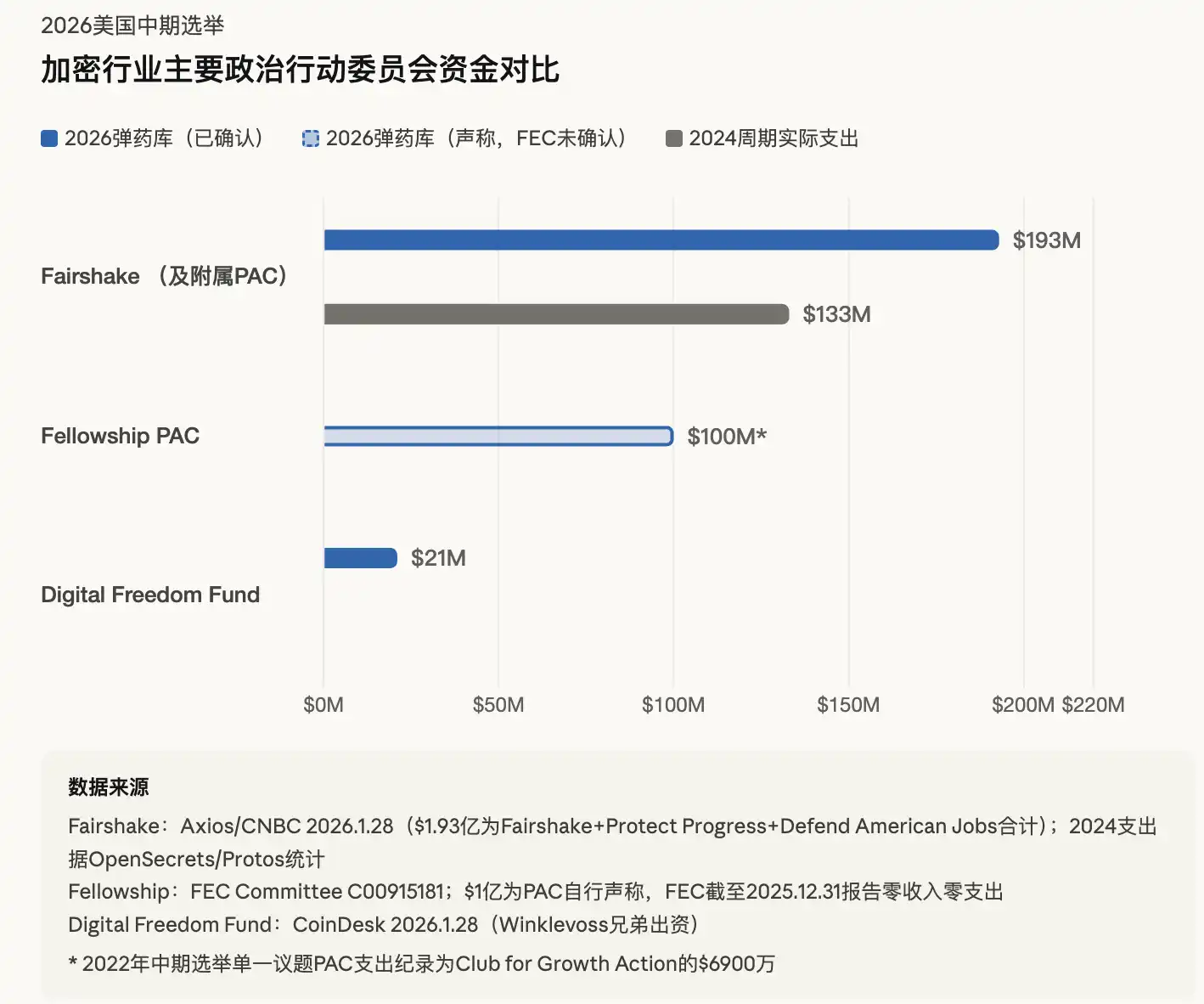
During the 2024 election cycle, Fairshake spent over $130 million on media placements, with the majority of the more than 50 candidates it supported successfully elected. According to statistics from the non-profit oversight organization Public Citizen, nearly half of the corporate money flowing into the 2024 elections came from the crypto industry.

Now, with the combined war chest of nearly $300 million from Fellowship and Fairshake, plus other political donation forces in the crypto industry, the 2026 midterm elections are expected to set a new record for industry political spending.

Legislative Battle: Stablecoin Yield Dispute Stalls CLARITY Act, Tether's Interests at Stake

Spiro's appointment is not coincidental in its timing. The Clarity Act for Digital Asset Markets (CLARITY Act), the crypto industry's core legislative priority, is currently stalled in the Senate, with one of the contentious points being stablecoin yields, which directly impacts Tether's business model.

The CLARITY Act passed the House of Representatives in July 2025 by a vote of 294 to 134 and passed review in the Senate Agriculture Committee in January this year. However, at the Senate Banking Committee level, a fierce battle is underway between the banking industry and the crypto industry over whether stablecoins can pay yields to users.

On March 20, Senators Thom Tillis and Angela Alsobrooks reached a principled compromise on stablecoin yields: prohibiting passive yield payments based on holding balances, but allowing reward programs based on transaction activity. According to CoinDesk, after crypto industry representatives reviewed the latest text behind closed doors on Capitol Hill on March 23, they found the language too narrow and ambiguous. Coinbase has stated twice that it does not support the current draft.

The markup in the Senate Banking Committee is currently scheduled for after the Easter recess in late April. Senator Bernie Moreno warned that if the bill does not advance by May, crypto legislation may not receive serious consideration again during the midterm election cycle.

Compounding the issue, the White House AI and Crypto Tsar, David Sacks, confirmed on March 26 that his 130-day term had expired and the administration would not appoint a successor. The crypto industry's most critical legislative sprint will proceed without its chief advocate in the White House.

Tether's USDT is the world's largest stablecoin, with a market cap of approximately $184 billion, but it is not available to U.S. residents. Tether launched a compliant stablecoin for the U.S. market, USAT, last year. The final outcome of the stablecoin yield provisions will directly determine the operating space for Tether and its competitors in the U.S. market.

Against this backdrop, by having an executive assume the chairmanship of the PAC, Tether is pushing its political influence building from behind the scenes to the forefront, sending a clear signal: during the critical window of legislative博弈 (game/struggle), using political funds to protect industry interests.


Preguntas relacionadas

QWho was appointed as the new chairman of the crypto super PAC Fellowship, and what is his role at Tether?

AJesse Spiro, the Regulatory Affairs Vice President of Tether US, was appointed as the chairman of Fellowship PAC.

QHow much combined political funding do Fellowship and Fairshake PACs have for the midterm elections, and what are their reported amounts?

AFellowship and Fairshake PACs have a combined nearly $300 million in political funds, with Fellowship claiming over $100 million and Fairshake holding $193 million.

QWhat discrepancy was reported regarding Fellowship PAC's fundraising claims and FEC records?

AFellowship PAC claimed to have raised over $100 million, but FEC records showed zero reported donations or expenditures as of December 31.

QWhat is the key legislative issue affecting stablecoins like Tether's USDT, and what is the compromise proposed in the CLARITY Act?

AThe key issue is whether stablecoins can pay yields to users. The proposed compromise in the CLARITY Act prohibits passive yield based on holdings but allows reward programs based on transaction activity.

QWhy is Jesse Spiro's appointment significant for Tether and the crypto industry's political strategy?

AIt marks the first formal, public link between Tether and Fellowship PAC, signaling Tether's move to openly influence politics during a critical legislative period for crypto regulations, particularly affecting stablecoin operations.

Lecturas Relacionadas

Anthropic Cries Wolf: Is the AGI Threat Real, or Just an IPO Story?

Anthropic has published an article titled "When AI builds itself," discussing the emerging concept of "recursive self-improvement," where AI begins to actively participate in designing, training, testing, and optimizing its own subsequent versions. The company presents internal data showing that by May 2026, over 80% of code merged into its codebase was written by Claude, its AI model. Claude's capabilities have expanded to handling complex, open-ended engineering tasks, achieving a 76% success rate in such areas, and even contributing to research processes, such as optimizing code performance and conducting AI safety experiments. Anthropic outlines an evolution from human-driven development to AI-assisted workflows, culminating in the current stage where AI agents can autonomously write, run, and delegate code. The company cautions that the path toward a "closed loop," where AI continuously improves itself, is becoming visible. It calls for coordinated global mechanisms to potentially slow or pause frontier AI development to allow safety research and societal structures to catch up. However, the timing of this warning coincides with Anthropic's preparations for an IPO, framing the narrative not just as a safety concern but also as a demonstration of Claude's advanced capabilities and its integral role in accelerating Anthropic's own R&D—creating a potential "flywheel" effect for competitive advantage. This contrasts with OpenAI's recent, more policy-oriented discussion of the same risks, highlighting the competitive dynamics in the AI industry as companies position themselves in both the technological and regulatory landscape.

marsbitHace 25 min(s)

Anthropic Cries Wolf: Is the AGI Threat Real, or Just an IPO Story?

marsbitHace 25 min(s)

BIT Research: ETF Purchases Have Slowed, Strategy (MicroStrategy) Has Slowed, What Else Can Drive Bitcoin's Rise?

Market Refocus on Inflation and Rate Expectations Weighs on Bitcoin Currently, the market is in a phase of macro-repricing dominated by inflation and interest rate expectations. Bitcoin, which previously benefited from easy liquidity and low inflation, is seeing its core bullish drivers weaken. These drivers were market expectations for interest rate cuts and strong inflows from Bitcoin ETFs and institutions like MicroStrategy (referred to as "Strategy" in the text). The logic has shifted. Recent high inflation data (e.g., CPI hitting 3.8% in a May 2026 report) has caused the market to sharply reduce its rate cut expectations for 2025 and even price in potential hikes. This is a key constraint for Bitcoin, as it lacks cash flows and is highly sensitive to rate expectations. Concurrently, institutional capital flows have slowed significantly. Following the hot CPI data, Bitcoin ETFs saw accelerated outflows, with around $4.3 billion leaving over a period. MicroStrategy's ability to keep adding substantial Bitcoin to its balance sheet is also diminishing. Together, ETF and MicroStrategy holdings total roughly $110 billion, but their momentum as growth engines is cooling. In summary, Bitcoin's current pressure stems not from its own fundamentals but from a changing macro environment. As long as inflation stays elevated, Bitcoin is likely to remain in a consolidating phase. However, historically, inflation eventually peaks. Once it recedes and rate cut expectations rebuild, institutional capital could return, potentially fueling a new and more robust recovery phase for Bitcoin.

marsbitHace 32 min(s)

BIT Research: ETF Purchases Have Slowed, Strategy (MicroStrategy) Has Slowed, What Else Can Drive Bitcoin's Rise?

marsbitHace 32 min(s)

Earning 1000 Trillion in Half a Year, 'Pocketing' 20 Million per Capita: This Round of Wealth Creation in the Korean Stock Market is Unprecedented in Scale

The South Korean stock market is experiencing an unprecedented wealth surge in 2026, with household equity and fund asset values soaring by over 1,000 trillion KRW (~$730bn) year-to-date. This translates to an average per capita wealth increase of roughly 20 million KRW, fueled by a historic 109% rally in the KOSPI index. The boom is driven by three converging forces: an AI-driven semiconductor supercycle boosting giants like Samsung and SK Hynix; the government's "Value-Up" market reforms addressing long-standing corporate governance issues; and aggressive real estate regulations that have locked capital within financial markets, preventing profits from flowing back into property. This has triggered a wealth effect, boosting high-end consumption significantly. However, the gains are highly concentrated. The two semiconductor behemoths account for over half the index's value, but retail investors own relatively low stakes in them, systematically missing the biggest rallies. Wealth and consumption benefits are skewed towards luxury goods and imported cars, bypassing mainstream retail. Further risks stem from excessive leverage, with high trading volume in leveraged ETFs, and a market sentiment heavily reliant on the AI sector's fortunes and speculative rumors. While this cycle marks a potential shift from real estate to equities as a primary wealth generator for Koreans, its sustainability, amid structural imbalances and leverage, remains a critical test.

marsbitHace 38 min(s)

Earning 1000 Trillion in Half a Year, 'Pocketing' 20 Million per Capita: This Round of Wealth Creation in the Korean Stock Market is Unprecedented in Scale

marsbitHace 38 min(s)

Behind ZEC's Over 30% Plunge: An 'Unlimited Minting' Vulnerability with No Way to Prove if It Was Ever Exploited

A critical vulnerability was discovered in Zcash's Orchard privacy pool, allowing for the theoretical creation of undetectable counterfeit ZEC. Researcher Taylor Hornby found the flaw on May 29th, 2024, within the Orchard circuit's cryptographic constraints, which could let an attacker bypass asset conservation rules. Although a rapid emergency fix was deployed within days via a coordinated soft and hard fork, a core uncertainty remains: due to Orchard's privacy features, it is impossible to cryptographically prove whether this "unlimited mint" flaw was exploited in the nearly four years since the pool's 2022 launch. This uncertainty, rather than the patched flaw itself, triggered a market panic, causing ZEC's price to drop over 30%. While the Zcash Foundation stated no evidence of exploitation was found, independent entity Shielded Labs emphasized the impossibility of definitively proving no counterfeit ZEC was ever created. The incident highlights the unique trust challenge in privacy systems. To address this, developers are proposing a new network upgrade with enhanced auditing to allow verifiable proof of supply integrity. Notably, the researcher utilized the newly released AI model Claude Opus 4.8 as a tool during the security review, signaling the growing role of advanced AI in uncovering complex cryptographic vulnerabilities.

marsbitHace 40 min(s)

Behind ZEC's Over 30% Plunge: An 'Unlimited Minting' Vulnerability with No Way to Prove if It Was Ever Exploited

marsbitHace 40 min(s)

Trading

Spot
Futuros

Artículos destacados

Cómo comprar SUPER

¡Bienvenido a HTX.com! Hemos hecho que comprar SuperFarm (SUPER) sea simple y conveniente. Sigue nuestra guía paso a paso para iniciar tu viaje de criptos.Paso 1: crea tu cuenta HTXUtiliza tu correo electrónico o número de teléfono para registrarte y obtener una cuenta gratuita en HTX. Experimenta un proceso de registro sin complicaciones y desbloquea todas las funciones.Obtener mi cuentaPaso 2: ve a Comprar cripto y elige tu método de pagoTarjeta de crédito/débito: usa tu Visa o Mastercard para comprar SuperFarm (SUPER) al instante.Saldo: utiliza fondos del saldo de tu cuenta HTX para tradear sin problemas.Terceros: hemos agregado métodos de pago populares como Google Pay y Apple Pay para mejorar la comodidad.P2P: tradear directamente con otros usuarios en HTX.Over-the-Counter (OTC): ofrecemos servicios personalizados y tipos de cambio competitivos para los traders.Paso 3: guarda tu SuperFarm (SUPER)Después de comprar tu SuperFarm (SUPER), guárdalo en tu cuenta HTX. Alternativamente, puedes enviarlo a otro lugar mediante transferencia blockchain o utilizarlo para tradear otras criptomonedas.Paso 4: tradear SuperFarm (SUPER)Tradear fácilmente con SuperFarm (SUPER) en HTX's mercado spot. Simplemente accede a tu cuenta, selecciona tu par de trading, ejecuta tus trades y monitorea en tiempo real. Ofrecemos una experiencia fácil de usar tanto para principiantes como para traders experimentados.

219 Vistas totalesPublicado en 2024.12.11Actualizado en 2026.06.02

Cómo comprar SUPER

Discusiones

Bienvenido a la comunidad de HTX. Aquí puedes mantenerte informado sobre los últimos desarrollos de la plataforma y acceder a análisis profesionales del mercado. A continuación se presentan las opiniones de los usuarios sobre el precio de SUPER (SUPER).

活动图片