Musk Admits in His Own Words: Only 3 Entities Have Sufficient Data Globally, and He's Not Among Them

marsbitPublished on 2026-10-12Last updated on 2026-10-12

Abstract

Elon Musk Admits He Lacks Critical AI Training Data, Buys Cursor for $60 Billion In a recent interview, Elon Musk stated that only three entities globally possess sufficient high-quality programming data to train a true superintelligence: OpenAI, Anthropic, and Cursor, with Google as a half. Notably, his own companies, xAI and Grok, were absent from the list. Musk emphasized that programming data is uniquely valuable because software logic is deterministic and testable, providing clear right/wrong feedback. Real-world developer interactions within code editors—accepting, rejecting, or modifying AI suggestions—create a massive, clean "graded workbook" for AI training. This data, he argued, cannot be simply scraped from the web or synthetically generated; it must be accumulated from daily use by thousands of real programmers. Despite owning vast resources like Tesla's real-world data, X's text corpus, and the Colossus supercomputer, Musk acknowledged a critical gap in proprietary programming data. This shortage reportedly led xAI to use OpenAI's outputs to train Grok, an unsustainable path. To acquire this essential "admission ticket," SpaceX exercised an option to acquire Cursor for approximately $60 billion—reportedly the most expensive startup acquisition ever. Musk framed the deal as purchasing not just a product, but a strategic asset: Cursor's vast dataset, its established user base, and an enterprise sales team that provides a direct channel into real-world work envi...

$60 Billion, Buying a Ticket.

On October 10th, at the X Takeover event with over two thousand attendees, Elon Musk joined remotely. The host directly asked him: Why did you buy Cursor?
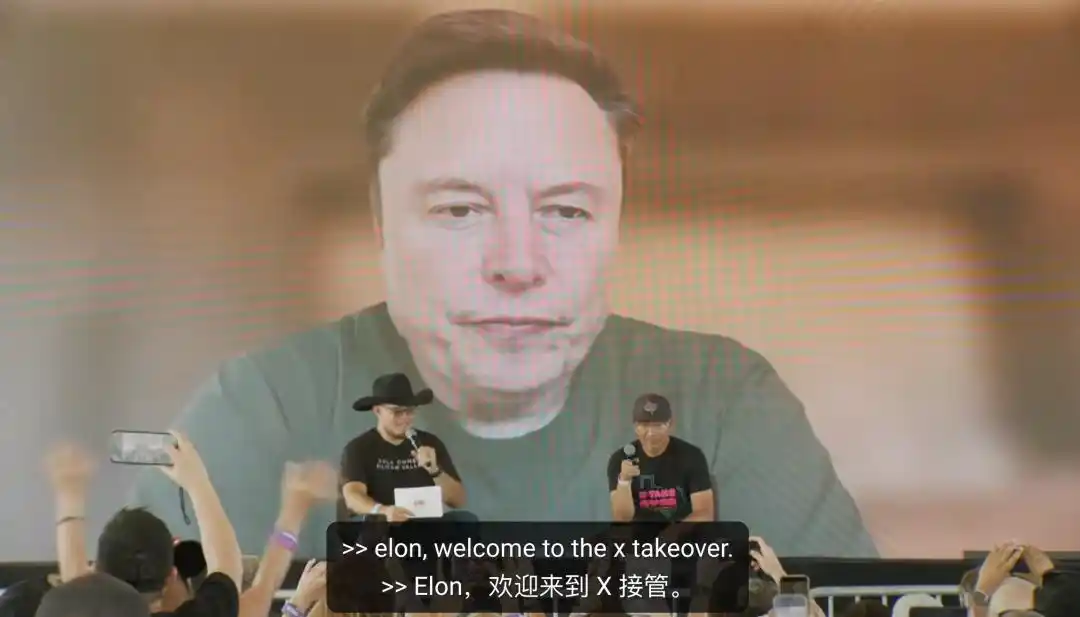
Musk's answer took only 61 seconds and quickly spread across the internet.

He said, to build a proper superintelligence, you have to solve programming. And as far as he knows, only three entities in the world have amassed enough programming training data—

OpenAI, Anthropic, and Cursor. Google barely counts as half.

His own name, xAI, or Grok, were not on that list.

A man holding rockets, the Colossus supercomputing power, and Tesla admitted in front of two thousand people:

On the most critical path to superintelligence, he originally did not have a ticket.

So, he bought Cursor.

What Makes Programming Data So Valuable?

Cursor is the editor where programmers write code every day.

The AI gives you a suggestion, you can accept it by pressing Tab, delete it, or modify a few lines before using it.

Each such operation is equivalent to grading a piece of homework for the AI—checking what's right, crossing out what's wrong, and even providing the correct answer for partially correct ones.
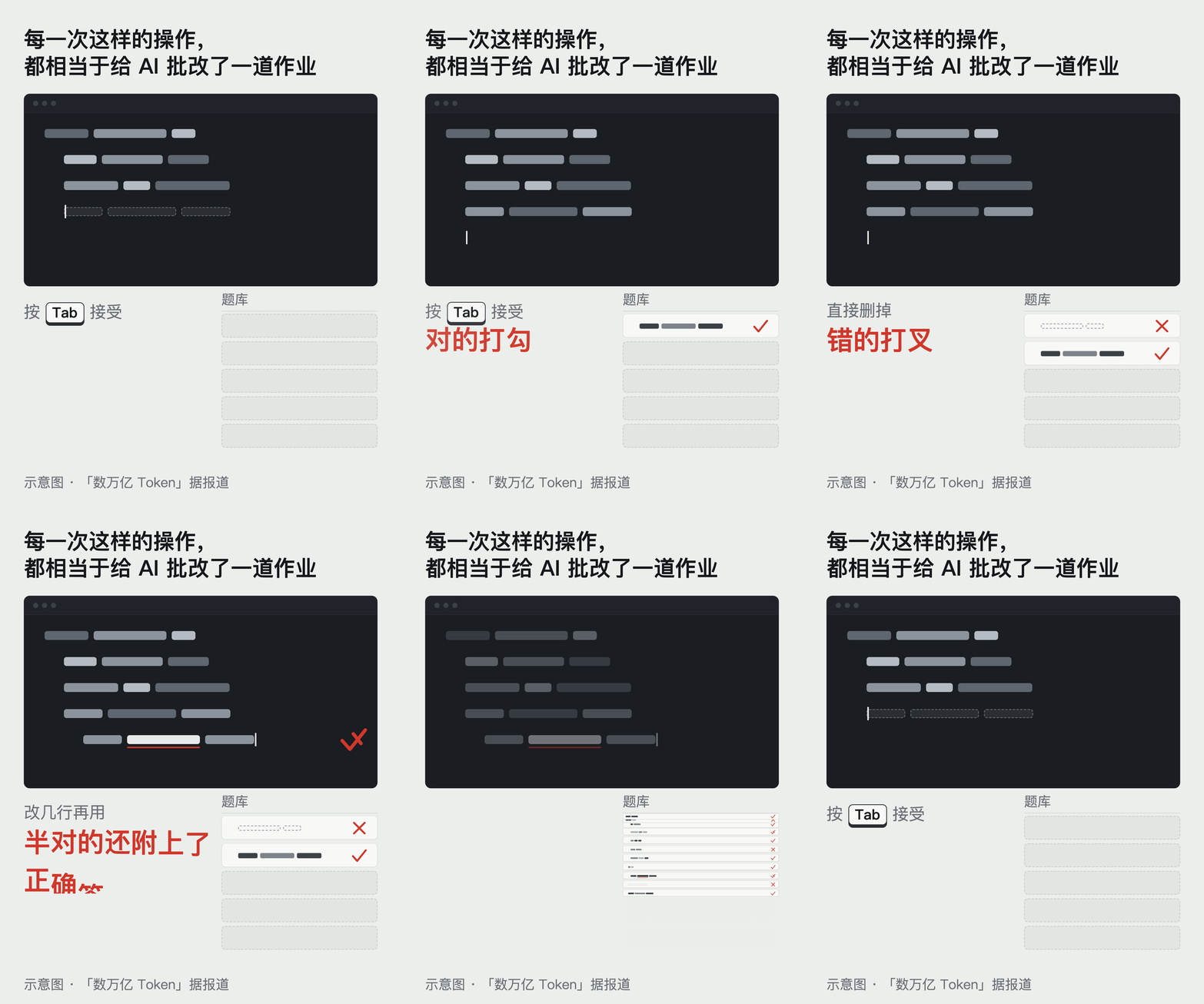
Reports indicate Cursor's training involved trillions of tokens of this real developer interaction data.

This kind of data cannot be scraped from the web or manufactured in a lab. It can only be accumulated day by day, line by line, by thousands of real programmers.

Musk himself explained in the same interview why programming is most unique: software logic is deterministic, it can run unit tests.

Whether the code is correct or not can be determined by running it; the answer isn't based on subjective grading.

Programming is the subject where AI can most easily 'practice and level up' on its own. The larger the question bank and the more grading there is, the faster it learns.

And the quality of that grading is crucial.

Musk shared a detail that left a deep impression. He looked at the reinforcement learning logs for the new Grok and found that sometimes the AI gave the correct answer but was marked wrong because the question itself was flawed. The AI would then desperately try random answers, as if held at gunpoint.

He said he would hate that feeling too.

If the question is wrong, the AI practices in vain, or even learns incorrectly. And every real programmer's decision—accepting this snippet, rejecting that one, modifying a few lines here—constitutes the most reliable grading record because it comes from real work, judged right or wrong by a real person.

Whoever holds the largest, cleanest question bank is one step closer to ASI.

He Has Everything Except This One Piece

Looking back at Musk's assets: X has vast amounts of text, Tesla has road data, SpaceX has engineering data, Colossus has top-tier global GPU computing power. Nothing seems lacking.

Except for the piece about real people actually writing code.

There's telling evidence. In an IDC analysis from early September this year, it was mentioned that Musk admitted in sworn testimony that xAI used OpenAI's outputs to train Grok.

When your own question bank isn't enough, you can only copy others' answers to practice. But Musk knows better than anyone that this path doesn't go far.

Computing power can be built with money, models can be chased with time. But programming data must be accumulated line by line by users.

Cursor is a company founded in 2022. In just a few years, it has amassed what Musk said only three entities in the world possess.

In April this year, SpaceX and Cursor announced a partnership, with SpaceX securing an option: either pay $10 billion to continue the collaboration, or spend approximately $60 billion to buy the entire company.

SpaceX chose to buy it all.

$60 billion, the most expensive acquisition in startup history. Musk himself gave the reason—this isn't buying a product; it's buying a ticket.

Four Things for Building Superintelligence, the Fourth is the Most Surprising

At this event, Musk bluntly shared the recipe for building superintelligence:

Data, talent, computing power, plus a good enterprise sales team.

The first three are widely agreed upon. The fourth is the truly surprising one—an enterprise sales team?

What does building superintelligence have to do with sales?

Everything. Relationships with thousands of companies mean Cursor is already installed on the computers of programmers at these companies.

For superintelligence to enter real work scenarios, these are ready-made doors. The more doors opened, the more users, the more new programming data generated, the better the model trains, and the more companies it can sell into.

Building it and using it connect to form a flywheel here.

Musk's calculation is actually sharper than anyone's: in real companies, programmers write code and reject suggestions every day. Questions come from real tasks, correctness judged by real people. Every company door the sales team knocks on means the AI gets another real workbook.

Superintelligence isn't just a technical problem; it's also a business problem.

On July 8th, SpaceXAI and Cursor jointly released Grok 4.5, focusing on programming and Agent capabilities, trained on tens of thousands of NVIDIA GB300 chips.

Musk called it Opus-level, faster, more token-efficient, and cheaper.

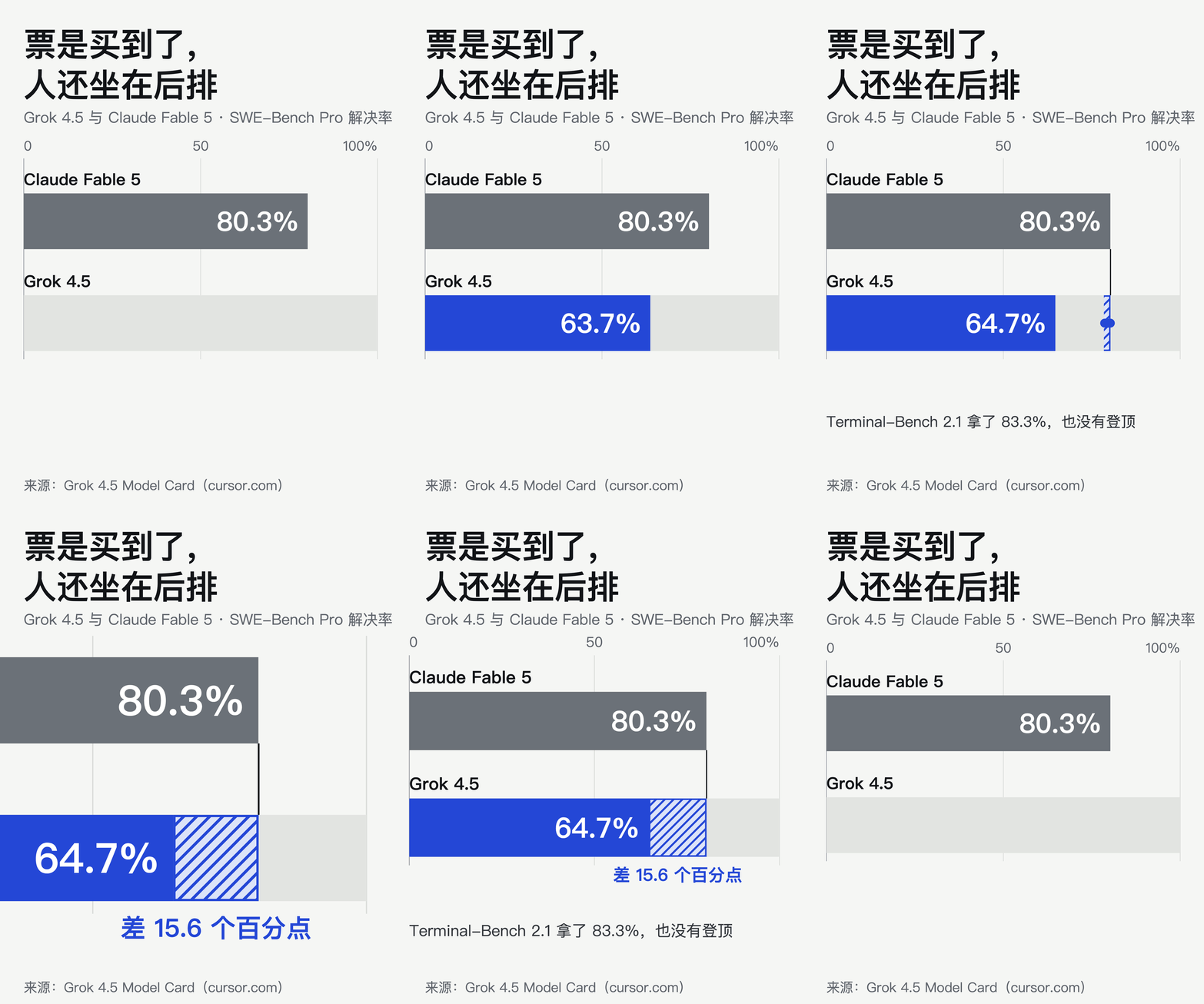
But actual scores: a 64.7% solve rate on SWE-Bench Pro, behind Claude Fable 5's 80.3%; 83.3% on Terminal-Bench 2.1, also not topping the charts.

The ticket is bought, but he's still sitting in the back row.
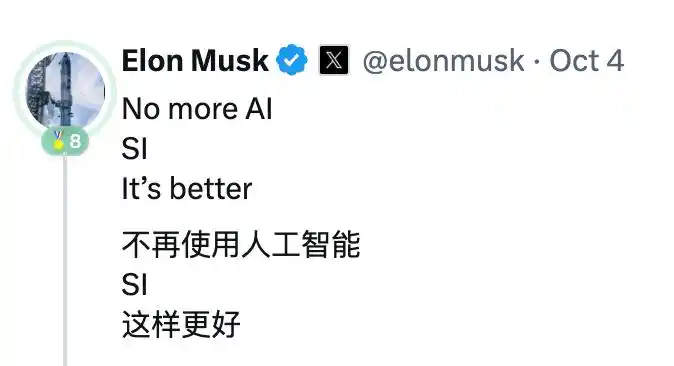
On October 4th, Musk confirmed on X that SpaceXAI was renamed SpaceXSI—SI stands for Super Intelligence. The destination is written in the name; whether it's been reached is another matter.
OpenAI has Codex and massive amounts of programming dialogue within ChatGPT.

Anthropic has Claude Code, with an astonishingly large volume of programming scenario usage.

The first two entities Musk named have long held their models, programming products, and programming data in their own hands.

Interestingly, Musk's evaluation of his competitors isn't low. In the interview, discussing AI-made music videos, he specifically praised Claude, saying "give them a lot of credit." Talking about AI safety, he added, "agree with some of the things Anthropic has said."

You Think You're Writing Code, But You're Actually Teaching Superintelligence to Write Code

Musk's interview essentially publicly rewrote the scoring rules for the ASI race.

In recent years, everyone was counting chips. Who has more GPUs, who is closer to the finish line.

But now, the man holding the world's largest computing cluster掏出the highest price in startup acquisition history to buy something computing power can't replace—

Human judgment.

Computing power can be stacked with money; data can only be accumulated by people. Every record in programming data is a real programmer's single decision: accept this snippet, reject that one, modify a few strokes before submitting. Right or wrong is judged by a real person, verified by the machine, undiluted.

So, the tuition for superintelligence isn't paid by giants burning electricity; it's paid by programmers worldwide, one keystroke at a time.

References:

https://x.com/ns123abc/status/2109105516941107311

Editor: Solomon

This article is from the WeChat public account "New Zhiyuan", author: ASI Revelation
Trending Cryptos

Related Questions

QAccording to Elon Musk in the article, which companies possess sufficient programming data for training a superintelligent AI?

AAccording to Elon Musk, only three entities have gathered enough programming training data: OpenAI, Anthropic, and Cursor. Google is mentioned as barely counting as half.

QWhy did Elon Musk acquire Cursor for approximately $60 billion according to the article?

AElon Musk acquired Cursor to gain access to its vast repository of high-quality, real-world programming interaction data. This data, derived from developers using the Cursor editor, is considered crucial and irreplaceable for training a superintelligent AI, and was something his own companies lacked.

QWhat are the four key components Musk identified for building a superintelligent AI?

AElon Musk listed four key components for building a superintelligent AI: data, talent, computing power (compute), and a good enterprise sales team. The sales team is important for integrating the AI into real work environments, generating more high-quality user data, and creating a feedback loop.

QWhat makes programming data uniquely valuable for AI training, as explained in the article?

AProgramming data is uniquely valuable because software logic is deterministic and can be verified by running unit tests. Every interaction a developer has with an AI coding assistant—accepting, rejecting, or modifying code suggestions—provides a clear, human-judged, and machine-verifiable data point on correctness. This creates a massive, clean, and high-quality dataset for AI to learn from effectively.

QWhat was the result of Grok 4.5 on the SWE-Bench Pro test mentioned in the article?

AAccording to the article, Grok 4.5 achieved a 64.7% solve rate on the SWE-Bench Pro test. This result was noted as trailing behind Claude Fable 5, which scored 80.3%.

Related Reads

10 Years Is Too Slow: Gu Quanquan's Team Challenges Dario, Compressing Cancer Cure to 4 Years

A UCLA professor, Quanquan Gu, has founded Geodesic Intelligence, a 15-person startup that after only five months has released NovaAtom-Lite, an all-atom structure prediction model that outperforms DeepMind's Isomorphic Labs flagship IsoDDE on FoldBench, the toughest biomolecular benchmark. The model predicts the 3D coordinates of every heavy atom in protein, DNA, RNA, and ligand complexes with near-experimental precision. NovaAtom-Lite posted top scores on two core pharma tests: antibody-antigen binding (79.07% success, 31 points above AlphaFold 3 and 3.5 above IsoDDE, with 2.2x AlphaFold 3's accuracy at high-precision thresholds) and protein-ligand binding (top 1 on both RMSD and contact metrics). On the Runs N' Poses benchmark, which separates memorization from genuine physics understanding, NovaAtom-Lite's lead grows on the most novel, out-of-distribution ligands (47.6% vs AlphaFold 3's 24%), showing it learns transferable physical rules rather than memorizing structures. The model also supports test-time scaling—raising sampling from 1 to 100 seeds lifts antibody success from 74.3% to 83.1%—and condition constraints, where a single contact-pair hint boosts success to 91.28% and full pocket hints lift hard-case ligand accuracy by nearly 16 points. It solved two nightmare cases: a wildly flexible 22-residue MERS nanobody loop (0.56 Å error, all 25 samples correct) and the KRAS G13D hidden switch-II pocket (0.98 Å ligand RMSD vs OpenDDE's 17.74 Å). Gu previously led ByteDance's SeedFold, the first model to beat AlphaFold 3 on FoldBench, forcing Isomorphic Labs to respond with IsoDDE. A stronger NovaAtom-Pro is coming. Days after launch, a16z cited NovaAtom-Lite in a report arguing pharma is entering its "GPT-3 moment," naming Geodesic as the sole company highlighted in its industry map. Geodesic's closed loop spans structure prediction, scientific reasoning, and wet-lab validation—aiming to compress drug discovery from a decade to four years.

marsbit16m ago

10 Years Is Too Slow: Gu Quanquan's Team Challenges Dario, Compressing Cancer Cure to 4 Years

marsbit16m ago

Anthropic Misses Out on 'Largest IPO in History'—Who Should Foot the Bill?

Anthropic's IPO has gone from being touted as a potential record-breaking "largest IPO in history" to falling short of that title. Months ago, analysts estimated its IPO could surpass SpaceX, but current data shows it will not. Both its fundraising size and initial market capitalization fall below SpaceX's records of $75 billion raised and $1.78 trillion initial valuation. Anthropic's IPO is priced at $70–78 per share, offering 825 million shares, for a base fundraising of roughly $57.75–64.35 billion. Even with the 15% over-allotment fully exercised, proceeds would reach about $74 billion—still below SpaceX's $75 billion initial raise (and SpaceX's final over-allotment total of $86.25 billion). Anthropic's initial market cap is estimated at $1.26–1.41 trillion, well below both the earlier $2 trillion expectations and SpaceX's $1.78 trillion. However, combined with a $26 billion private placement, Anthropic's total fundraising could approach $100 billion. Three main factors are cited for the setback. First, after Democrats swept both chambers in the U.S. midterm elections, they pushed aggressive AI regulation, with some lawmakers calling for a pause on advanced AI development and a ban on superintelligence. Second, Nvidia founder Jensen Huang resigned as CEO amid a scandal, disrupting the AI supply chain; Nvidia was expected to subscribe about $10 billion of Anthropic's $26 billion private placement, and its instability threatens market confidence. Third, Anthropic's Q3 results show hidden concerns: revenue hit $16.956 billion (up ~11.27x year-over-year), but sequential growth slowed from 144.2% to 46.7%, new quarterly revenue fell from $6.824 billion to $5.401 billion, GAAP operating profit swung from a $974 million gain to a $567 million loss, and adjusted operating margin dropped from 19% to 15%. Notably, reports suggest Huang's ouster involved Democratic figures and media, and that Anthropic founder Dario and the company itself provided funding to related political organizations and donated tens of millions to Democratic midterm campaigns. In this light, Anthropic's dashed "largest IPO" dream is tied to its political bets.

Odaily星球日报56m ago

Anthropic Misses Out on 'Largest IPO in History'—Who Should Foot the Bill?

Odaily星球日报56m ago

Asian chip stocks tumble ahead of Nvidia Q3 earnings

Asian semiconductor stocks fell on Monday ahead of Nvidia's quarterly earnings, as analysts look for signs that the AI spending boom remains on track amid uncertainty over the chipmaker's leadership and future growth. Japanese chip-testing equipment maker Advantest dropped about 10.4%, semiconductor inspection equipment maker Lasertec declined more than 10.7%, and chipmaking equipment supplier Tokyo Electron fell 5.7%. South Korean memory-chip makers Samsung Electronics and SK Hynix lost 5.8% and 4.2%, respectively, while Taiwan Semiconductor Manufacturing Co. slipped 3.8%. The broad decline could reflect caution toward AI-linked stocks ahead of Nvidia's results, though the weakness came amid a wider sell-off in regional equity markets, with Japan's Nikkei 225 down 2% and South Korea's Kospi losing 2.6%. Nvidia is scheduled to release its fiscal third-quarter results on Tuesday, followed by an earnings call. The results will be Nvidia's first since founder Jensen Huang resigned as CEO. Investors and analysts will be watching how Nvidia responds to the AI demand boom while its leadership is in turmoil. Morningstar said it will be looking to see whether the mid-term elections have led to any concern about future demand and whether Nvidia's outlook for the industry has changed. In August, Nvidia forecast fiscal third-quarter revenue of $108 billion, plus or minus 2%, excluding any data center compute revenue from China. Analysts expect Nvidia to report slightly higher quarterly revenue of $109.3 billion, including $101.8 billion from its data center business, according to Visible Alpha consensus figures published by S&P Global Market Intelligence. S&P Global said revenue expectations had risen since the previous quarter on anticipated strength in Nvidia's Blackwell chips. Morningstar analysts also said they expect another "beat-and-raise quarter" out of Nvidia, given strong capex trends among hyperscalers and enterprises, adding they would be stunned if Nvidia provided an earnings miss or weak forecast. Nvidia shares closed Friday down 2.01% at $162.85.

cointelegraph1h ago

Asian chip stocks tumble ahead of Nvidia Q3 earnings

cointelegraph1h ago

WBTC Expands Application Scenarios, Covering Privacy DeFi, Native Staking Rewards, and Institutional Lending

WBTC is expanding its use cases through integrations with Zama, Twinstake, and Two Prime, extending its reach into privacy-focused DeFi, native staking rewards, and institutional lending. Through Zama, WBTC gains privacy protection using fully homomorphic encryption (FHE), allowing smart contracts to process encrypted data while keeping on-chain activity publicly verifiable. Users can access the Wintermute Confidential WBTC pool via the Zama app, managed by Armitage by Wintermute and built on Morpho. Deposit amounts, withdrawal amounts, and pool share balances are encrypted, while wallet addresses, timestamps, pool metrics, and underlying lending allocations remain public. Privacy depends partly on batch participation—if a batch contains only one depositor, aggregate data may reveal their transaction amount. Through Twinstake, eligible WBTC holders can participate in Starknet's native staking ecosystem by depositing WBTC into an ERC-4626 vault operated by Endur. The vault delegates to institutional validators including Twinstake, with staking rewards generated in STRK and automatically converted to WBTC, reflected in the xWBTC-to-WBTC exchange rate. Rewards are variable and not guaranteed. Holders avoid managing validator delegation themselves or using leverage. Through Two Prime, users can access the Two Prime Axiom WBTC yield pool via Pareto, participating in institutional lending strategies. The pool lends to vetted institutional borrowers, including public companies, credit-rated entities, and diversified financial institutions. Two Prime handles borrower credit review and ongoing risk assessment. The strategy combines Two Prime's institutional credit management with Pareto's on-chain private credit infrastructure, with ICE Digital Trust providing custody and Copper providing smart contract signing and asset security infrastructure. These integrations broaden the financial applications available to WBTC holders across privacy-preserving DeFi, native staking rewards, and institutional lending.

marsbit1h ago

WBTC Expands Application Scenarios, Covering Privacy DeFi, Native Staking Rewards, and Institutional Lending

marsbit1h ago

Trading

Spot

Hot Articles

How to Buy DATA

Welcome to HTX.com! We've made purchasing DATA Network (DATA) simple and convenient. Follow our step-by-step guide to embark on your crypto journey.Step 1: Create Your HTX AccountUse your email or phone number to sign up for a free account on HTX. Experience a hassle-free registration journey and unlock all features.Get My AccountStep 2: Go to Buy Crypto and Choose Your Payment MethodCredit/Debit Card: Use your Visa or Mastercard to buy DATA Network (DATA) instantly.Balance: Use funds from your HTX account balance to trade seamlessly.Third Parties: We've added popular payment methods such as Google Pay and Apple Pay to enhance convenience.P2P: Trade directly with other users on HTX.Over-the-Counter (OTC): We offer tailor-made services and competitive exchange rates for traders.Step 3: Store Your DATA Network (DATA)After purchasing your DATA Network (DATA), store it in your HTX account. Alternatively, you can send it elsewhere via blockchain transfer or use it to trade other cryptocurrencies.Step 4: Trade DATA Network (DATA)Easily trade DATA Network (DATA) on HTX's spot market. Simply access your account, select your trading pair, execute your trades, and monitor in real-time. We offer a user-friendly experience for both beginners and seasoned traders.

4.0k Total ViewsPublished 2026.07.01Updated 2026.07.01

How to Buy DATA

Discussions

Welcome to the HTX Community. Here, you can stay informed about the latest platform developments and gain access to professional market insights. Users' opinions on the price of DATA (DATA) are presented below.

活动图片