Morgan Stanley Research Report Analysis: S&P Equal-Weight Drops 5%, AI Concentration Risk Builds Up Before Year-End

marsbitPublished on 2026-10-12Last updated on 2026-10-12

Abstract

Morgan Stanley's research report highlights a divergence in the S&P 500: while the market-cap weighted index fell only 0.5% in September, the equal-weight version dropped 5%. This resilience masks broad market weakness, concentrated in the outperformance of the top six contributors (like Meta, Apple, Nvidia), which added about 190 basis points, while the rest dragged the index down by ~240 basis points. The report notes a "flight to quality," with AI and semiconductor stocks still supported by capex expansion and earnings revisions. However, their elevated valuations (median forward P/E ~32x vs. 10-year average of ~19x) and rising interest rates pose sustainability challenges, drawing parallels to the dot-com bubble in terms of price action and potential supply pressures from IPOs/secondary offerings. For Japanese markets, seasonal foreign capital inflows are expected to resume from October, potentially supporting AI-related stocks there. Morgan Stanley's strategy advises selectively maintaining AI/semiconductor exposure while gradually reducing theme concentration. It recommends tactically adding low-volatility stocks for downside protection and allocating to financially sound value stocks, which may benefit if the AI rally broadens out. The core message is to prepare for potential turning points by year-end/early 2027 by de-risking concentrated positions and adding defensive elements to portfolios.

Author: Rita

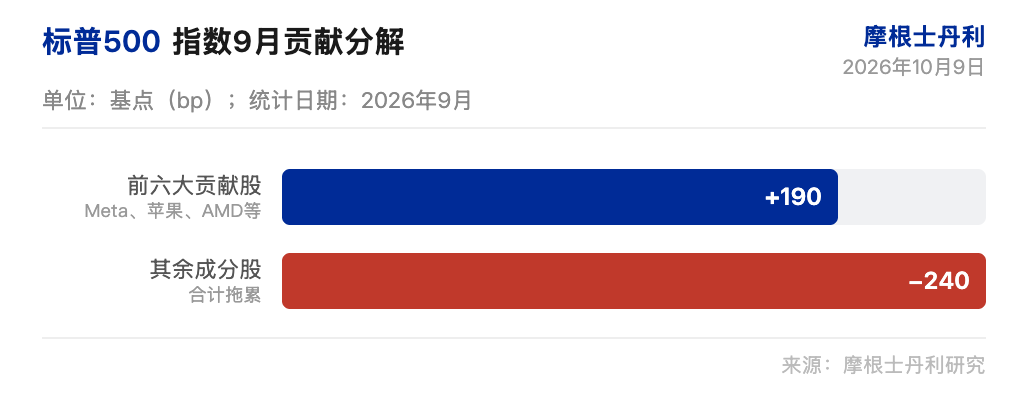
The S&P 500 Index fell 0.5% in September, while the equal-weight version declined 5%. The top six contributing stocks collectively contributed approximately 190 basis points, while the remaining constituents collectively dragged down about 240 basis points. The index's resilience masks broad weakness.

In a global strategy report released on October 9, 2026, Morgan Stanley pointed out that AI and semiconductor-related stocks remain supported by capital expenditure expansion and earnings revisions, but rising interest rates and elevated valuations pose challenges to the sustainability of the rally. The report suggests selectively maintaining AI positions, gradually reducing thematic concentration, tactically increasing holdings in low-volatility stocks, and allocating to financially robust value stocks.

The article begins by examining market structure, analyzing fund flows related to the quality factor, and then discusses allocation directions and potential turning point risks before year-end.

Index Resilience Masks Broad Weakness

In September, the global high-yield bond index fell sharply. The equal-weight S&P 500 dropped 5%, while the market-cap-weighted version declined only 0.5%. The index's resilience stems from support by a few strong individual stocks, indicating the overall market strength is not solid.

The divergence between market-cap-weighted and equal-weight indices illustrates that capital is concentrating towards high-quality assets. Morgan Stanley refers to this as a "flight to quality." The top six contributors were Meta, Apple, AMD, Nvidia, Intel, and Micron, collectively contributing about 190 basis points. The remaining constituents collectively dragged down about 240 basis points.
Returns for the quality factor in US equities have steadily risen, with low-volatility factor valuations at the 98th historical percentile. The quality factor in the Japanese market began to strengthen in late September, while the value factor weakened during the same period. In an environment of rising interest rates, investor concerns over financial fragility have outweighed preferences for valuation.

Capital expenditure from hyperscalers continues to expand, with earnings forecasts for AI and semiconductor stocks persistently revised upward. Morgan Stanley believes such companies possess thematic appeal in the current market, primarily stemming from earnings visibility and quality attributes. High return on equity and other profitability metrics align with definitions of quality stocks.

Foreign Inflows Support Japanese AI Stocks

Seasonal behavior of foreign capital in the Japanese stock market warrants attention. Data from 2011 to 2025 shows foreigners were typically net sellers in August and September, turning net buyers in October and beyond.

In the first half of 2026, foreign buying of Japanese AI-related stocks provided support. Morgan Stanley anticipates similar fund flows could reappear. Following net selling in August and September, the tendency for net buying starting in October will form a support base.

In a report on August 14 titled "The Second Half of the AI Rally," Morgan Stanley recommended holding AI and semiconductor stocks, citing strong earnings. The current view remains unchanged, but market recognition of entering the second half is strengthening. The report advises against further concentration in the theme, suggesting gradually reducing concentration and selectively investing in stocks with earnings support.

Risks for AI and semiconductor stocks also exist. In a May 14 report, "Are We Going Back to 1999?" Morgan Stanley noted multiple similarities between the AI-driven market and the internet bubble. A July 6 report further analyzed the causes of the internet bubble, with the overlap between the two periods increasing.

Elevated Valuations Coexist with Supply Pressure

The median forward price-to-earnings ratio for core AI and semiconductor stocks is around 32x, compared to about 38x three months ago. This level remains above the ten-year average of approximately 19x.

Earnings revisions remain positive but have retreated from recent peaks. A comparison of the SOX index trajectory with the internet bubble period shows high similarity in the patterns of sharp rises, sharp declines, and rebounds.

Supply-side pressure is accumulating. IPOs, new issuances, and secondary offerings could disperse investment capital, creating pressure on stock supply and demand. During the internet bubble, the number of shares available for sale after lock-up expirations increased leading up to the March 2000 peak. The current market harbors similar potential for supply expansion.

The interest rate environment also warrants attention. The internet bubble peaked in March 2000, in the middle of a Federal Reserve rate-hiking cycle. The recent Fed pivot towards tightening monetary policy could undermine market sustainability. Debates persist regarding overinvestment in data centers and the credit conditions of AI-related companies. While capital expenditure expansion supports near-term earnings, concerns over mid-term investment returns may rise.

Concentration Risk Calls for Defensive Allocation

Morgan Stanley recommends selectively maintaining AI and semiconductor exposure while gradually reducing thematic concentration. Tactically adding low-volatility stocks can enhance resilience against broader market pullbacks.

Low-volatility stocks are suitable as a defensive allocation to cope with overall market corrections. Morgan Stanley also believes investor positioning in these stocks is relatively light.

Financially robust value stocks represent another allocation avenue. The Japanese value factor has shown weakness since late September, primarily pressured by the rise of AI and quality stocks. Value stocks typically have weaker financial strength compared to growth and quality stocks, raising investor concerns about their financial fragility during rising rates. If the AI stock consolidation dissipates and preferences broaden, relative performance of value stocks may improve. The value factor has a seasonal tendency to rise towards year-end, and its medium-term allocation value remains.

Morgan Stanley maintains its judgment on earnings support for AI and semiconductor stocks but reminds investors to prepare for a potential turning point from December to early 2027. Concentration risk is accumulating. Reducing concentration and increasing allocations to low-volatility and financially sound value stocks are the core strategic directions at present. Foreign capital flows and changes in earnings forecasts are subsequent observation points.

Disclaimer

This article is a compilation and interpretation by Chao Xiang Research of a third-party brokerage research report (Morgan Stanley, October 9, 2026), combined with the organization of publicly available market information. The ratings, target prices, earnings forecasts, and related judgments cited herein are the views of the analyst(s) at the mentioned brokerage firm, representing only the stance of their affiliated institution. They do not represent the views of Chao Xiang Research nor constitute any investment advice.

Markets involve risks, and decisions require independence. This article should not serve as the basis for trading any securities.


Related Questions

QAccording to Morgan Stanley's report, what is the main contrast in performance between the S&P 500 capitalization-weighted index and the equal-weighted index in September, and what does this divergence indicate?

AIn September, the S&P 500 capitalization-weighted index fell only 0.5%, while the equal-weighted index fell 5%. This divergence indicates that the index's resilience is being supported by a handful of strong-performing stocks, masking broader market weakness and a concentration of capital into high-quality assets.

QWhat specific investment strategy does Morgan Stanley recommend regarding AI and semiconductor stocks in the current market environment?

AMorgan Stanley recommends selectively maintaining positions in AI and semiconductor stocks while gradually reducing thematic concentration. Additionally, they advise tactically increasing exposure to low-volatility stocks and allocating to financially sound value stocks to enhance defensive capabilities against a potential market downturn.

QWhat key risk parallels does the Morgan Stanley report draw between the current AI-driven market and the internet bubble of 1999-2000?

AThe report draws parallels in several areas: the sharp rise, correction, and rebound pattern of the SOX index compared to the internet bubble era; high valuations; and accumulating supply-side pressures from potential IPOs and secondary offerings, similar to the increase in lock-up expirations before the March 2000 peak.

QHow does Morgan Stanley analyze the role of foreign capital flows in the Japanese stock market, particularly concerning AI-related stocks?

AMorgan Stanley notes that foreign investors in Japanese stocks have a seasonal pattern of net selling in August and September, often turning to net buying from October onward. They expect similar supportive foreign capital inflows for Japanese AI-related stocks to potentially reoccur following this seasonal pattern.

QWhat are the two main defensive asset classes Morgan Stanley suggests adding to a portfolio to prepare for a potential market turning point around year-end?

AMorgan Stanley suggests two main defensive asset classes: 1) Low-volatility stocks, which are suitable for defending against a broad market pullback, and 2) Financially sound value stocks, which may see improved relative performance if the concentration in AI stocks dissipates and preferences broaden, especially given value factors' historical tendency for a seasonal rise toward year-end.

Related Reads

MSCI Confirms Removal of Strategy and Metaplanet From Stock Indexes

MSCI has confirmed that Strategy (NASDAQ: MSTR) and Japan's Metaplanet will be removed from its equity indexes following its November 2026 review, effective at the market close on November 30. Strategy will leave the MSCI USA Index, while Metaplanet will be removed from the MSCI Japan Small Cap Index. The decision follows MSCI's adoption of new eligibility rules for companies classified as non-operating businesses, including firms whose assets are largely held as investments rather than used in traditional operations. Four other companies were also identified for deletion under the screening: UK-based Yellow Cake, Iceland's Skel Fjárfestingafélag, UK-listed Agronomics, and US-based Upexi. Another 19 companies were placed on a watchlist but not confirmed for removal. MSCI's methodology examines operating assets and five financial measures, including operating expenses, cash flow, changes in the value of non-operating assets, and dependence on external financing. Companies whose operating assets exceed 50% of total assets pass the initial test; those below face further screening, and existing index members can be removed if they fail the required tests across their two most recent annual reporting periods. The decision drew attention because Strategy and Metaplanet have built large Bitcoin reserves as core corporate strategies. Strategy previously challenged MSCI's proposed rules, arguing that treating digital asset treasury companies as non-operating businesses was discriminatory. The removals could affect demand for their shares, as index-tracking funds generally adjust holdings when companies leave benchmarks, potentially creating selling pressure around November 30. Strategy warned its exclusion could lead to roughly $2.8 billion in share sales by index-tracking funds, though this remains an estimate. JPMorgan estimated potential selling could reach $8.8 billion if other index providers follow MSCI's approach. The decision does not require either company to sell its Bitcoin holdings; it changes their index eligibility, not their ownership of digital assets.

TheNewsCrypto51m ago

MSCI Confirms Removal of Strategy and Metaplanet From Stock Indexes

TheNewsCrypto51m ago

The 10 People Who Decide Jensen Huang's Fate: A Power Map of Nvidia's Board

The article discusses the uncertainty surrounding Jensen Huang's future at Nvidia amid a scandal, and profiles the 10 board members who will decide his fate. The board includes: 1. Stephen C. Neal – Joined 2019; honorary chairman and senior counsel at Cooley LLP, Nvidia's longtime legal counsel; Harvard and Stanford Law graduate. 2. Tench Coxe – Billionaire VC and early Nvidia investor; board member since 1993; former managing director at Sutter Hill Ventures. 3. John O. Dabiri – Joined 2020; Caltech professor of aeronautics and mechanical engineering; National Medal of Science recipient. 4. Dawn Hudson – Board member since 2013; former NFL CMO and CEO of Pepsi-Cola North America. 5. Harvey C. Jones – Joined 1993; former Synopsys CEO; managing partner at Square Wave Ventures. 6. Melissa B. Lora – Joined 2023; former president of Taco Bell International; praised for financial expertise. 7. A. Brooke Seawell – Joined 1997; partner at New Enterprise Associates; former NetDynamics executive. 8. Aarti Shah – Joined 2020; former Eli Lilly SVP and chief information and digital officer; PhD in applied statistics. 9. Mark A. Stevens – Board member 1993–2006 and again since 2008; managing partner at S-Cubed Capital; former Sequoia Capital managing partner. 10. Suzanne Nora Johnson – Newest member, joined July; former Goldman Sachs vice chairman with 21 years at the firm. The board's decision will significantly impact Nvidia's future.

Odaily星球日报56m ago

The 10 People Who Decide Jensen Huang's Fate: A Power Map of Nvidia's Board

Odaily星球日报56m ago

Trading

Spot
活动图片