Morgan Stanley Drops Bitcoin ETF Bombshell, Who’s Really Behind The Buying?

bitcoinistPublicado em 2026-03-21Última atualização em 2026-03-21

Resumo

Morgan Stanley's head of digital assets, Amy Oldenburg, states that Bitcoin ETF adoption is still in its early stages, with 80% of current demand on their platform coming from self-directed investors. The bank, which now allows all wealth clients to invest in Bitcoin ETFs, is preparing to launch its own BTC, ETH, and SOL ETFs. Despite being a late entrant, its massive distribution network positions it for significant demand. On-chain data reveals Jane Street, Susquehanna, and Citadel as top institutional holders of Bitcoin ETFs, with BlackRock ranking 15th. Bitcoin's price is currently around $70,600.

Morgan Stanley’s head of digital assets strategy, Amy Oldenburg, has said that Bitcoin ETF adoption is still in its early stages. This comes as the Wall Street giant also looks to offer a BTC ETF, two years after the first funds launched.

Morgan Stanley Exec Says Bitcoin ETF Adoption Still In Early Stages

Speaking at the DC Blockchain Summit, the Morgan Stanley executive noted that most of the demand for the Bitcoin ETFs comes from self-directed investors, with many advisor-managed accounts yet to allocate to crypto. In line with this, Oldenburg declared that institutional crypto adoption is still ‘very early.’

She also revealed that 80% of the demand for ETFs on their platform comes from the self-directed business. Morgan Stanley currently allows all its wealth clients to invest in Bitcoin ETFs after removing restrictions last year. The bank has also notably recommended allocating up to 4% to crypto.

Oldenburg’s comments that Bitcoin ETF adoption is still early explain why Morgan Stanley is still looking to launch a BTC ETF, two years after the first funds launched. The bank has notably filed for BTC, ETH, and SOL ETFs and is also set to roll out crypto trading for its retail clients this year.

The Bitcoin ETFs have seen massive demand since their launch in 2024 and currently boast total net assets of $90.83 billion, according to SoSoValue data. This represents just over 6% of Bitcoin’s market cap. BlackRock’s BTC ETF is currently the largest with net assets of $55.19 billion.

Morgan Stanley is also expected to see demand for its BTC ETF despite the late launch, especially given the bank’s large distribution channel. Bloomberg analyst Eric Balchunas commended Morgan Stanley’s move as smart. He noted that they have, like, $8 trillion in advisory assets and have already authorized their advisors to allocate to these funds, so it could well be an allocation to their branded funds.

Top Institutional BTC ETF Holders

On-chain analyst Root recently highlighted the top 25 largest institutional Bitcoin ETF holders based on their Q4 filings, with Wall Street trading firm Jane Street ranking first, with total holdings worth around $5 billion. Susquehanna, Citadel Advisors, Millennium Management, and Goldman Sachs complete the top 5.
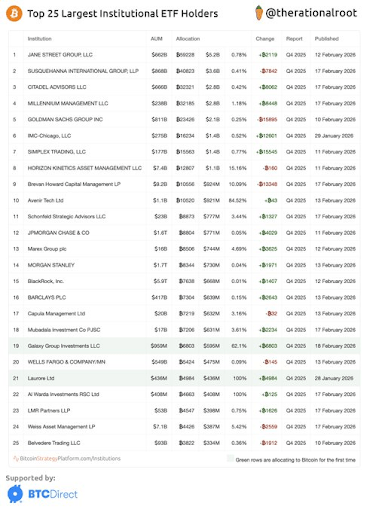
Source: Chart from Root on X

BlackRock, the world’s largest asset manager, currently ranks 15th among the top institutional Bitcoin ETF holders. The firm’s BTC holdings are currently worth around $670 million. A positive is that these institutions continue to increase their allocations. Root revealed that 17 of the top 25 institutional holders increased their BTC position in the fourth quarter of last year.

Related Reading: Analyst Says Bitcoin Price Is Showing Dangerous Weakness, Here’s Why

At the time of writing, the Bitcoin price is trading at around $70,600, down in the last 24 hours, according to data from CoinMarketCap.

BTC trading at $70,850 on the 1D chart | Source: BTCUSDT on Tradingview.com

Perguntas relacionadas

QAccording to Morgan Stanley's head of digital assets, what stage is Bitcoin ETF adoption currently in?

AAccording to Amy Oldenburg, Morgan Stanley's head of digital assets strategy, Bitcoin ETF adoption is still in its early stages.

QWhat percentage of the demand for Bitcoin ETFs on Morgan Stanley's platform comes from self-directed investors?

A80% of the demand for Bitcoin ETFs on Morgan Stanley's platform comes from self-directed investors.

QWhich Wall Street trading firm is the largest institutional holder of Bitcoin ETFs, according to Q4 filings?

AAccording to on-chain analyst Root, the Wall Street trading firm Jane Street is the largest institutional Bitcoin ETF holder, with total holdings worth around $5 billion.

QWhat is the total net asset value of all Bitcoin ETFs as mentioned in the article?

AThe total net assets of all Bitcoin ETFs is $90.83 billion, according to SoSoValue data.

QBesides a Bitcoin ETF, what other crypto ETFs has Morgan Stanley filed for?

AMorgan Stanley has filed for BTC, ETH, and SOL ETFs.

Leituras Relacionadas

The End of the Crypto Premium? Market Logic Shift Seen Through Gemini's Post-IPO Struggles

The article "The End of the Crypto Premium? Market Logic Shifts as Gemini Struggles Post-IPO" examines the dramatic downturn of cryptocurrency exchange Gemini following its public listing in September 2025. Initially part of a wave of crypto IPOs, including Bullish, which saw soaring valuations and massive investor interest, Gemini's stock price has since collapsed by over 80%, falling from $28 to around $5. The company has cut 30% of its workforce, exited international markets, and faces significant financial strain, including $330 million in Bitcoin-denominated debt. The core argument is that Gemini's struggles reflect a broader market shift where the "excess premium" once associated with crypto assets is disappearing. Two key factors are identified: the erosion of regulatory arbitrage, as compliance costs rise for all players (up 22.5% for small firms in 2026), and the decline of liquidity scarcity premiums, as institutional investors now access crypto via low-friction ETFs and stocks rather than volatile altcoins. The approval of Bitcoin and other crypto ETPs, which now manage $1.8 trillion globally, has diverted institutional capital away from altcoins, causing their liquidity to dry up and volatility to increase. For Gemini, its strategy of being "the most compliant exchange" became a liability in a bear market, as fixed compliance costs remained high while trading revenue fell. The article concludes that the era of narrative-driven crypto valuations is ending, giving way to a market logic focused on fundamentals like actual usage, liquidity depth, and sustainable institutional adoption.

marsbitHá 6h

The End of the Crypto Premium? Market Logic Shift Seen Through Gemini's Post-IPO Struggles

marsbitHá 6h

Trading

Spot
Futuros
活动图片