Just Now, Mythos 5 Cracked a Major Quantum Computing Challenge

marsbitPublished on 2026-10-17Last updated on 2026-10-17

Abstract

Anthropic's Mythos 5 has achieved a breakthrough in quantum computing by autonomously designing quantum circuits that outperform human-optimized designs. Given only plain-language descriptions of eight foundational quantum circuits in chemistry, optimization, physics simulation, and number theory, the AI ran a fully automated closed loop: it wrote circuit designs in Python, received scores based on qubit count and gate count, and iteratively refined its work without human intervention. Within 53 hours, it beat the best publicly available human designs on all eight tasks. Two results stand out. First, in modular inversion for elliptic curve cryptography, existing divsteps algorithms were considered impractical on quantum computers because they generate branch history that cannot be discarded due to reversibility requirements. Mythos 5 derived entirely new algebraic identities to reconstruct that history from the result, producing the first reversible quantum divsteps implementation that needs no branch storage—cutting gate count by 17x with only 12% more qubits. Second, it redesigned the Reed-Solomon decoder inside Google's Decoding Quantum Interferometry algorithm, replacing the extended Euclidean approach with Berlekamp-Massey, which matches quantum circuit constraints. It then used a self-written simulator running 403 million samples to measure exception rates and reduced memory from 665 qubits to 19, achieving a 12x reduction in gate count. The work suggests software can...

Just moments ago, Anthropic unveiled a bombshell study.

Mythos 5 has autonomously closed the loop, designing entirely new quantum circuits far more efficient than humanity's "best solutions"!

And it did so from a purely natural-language description.
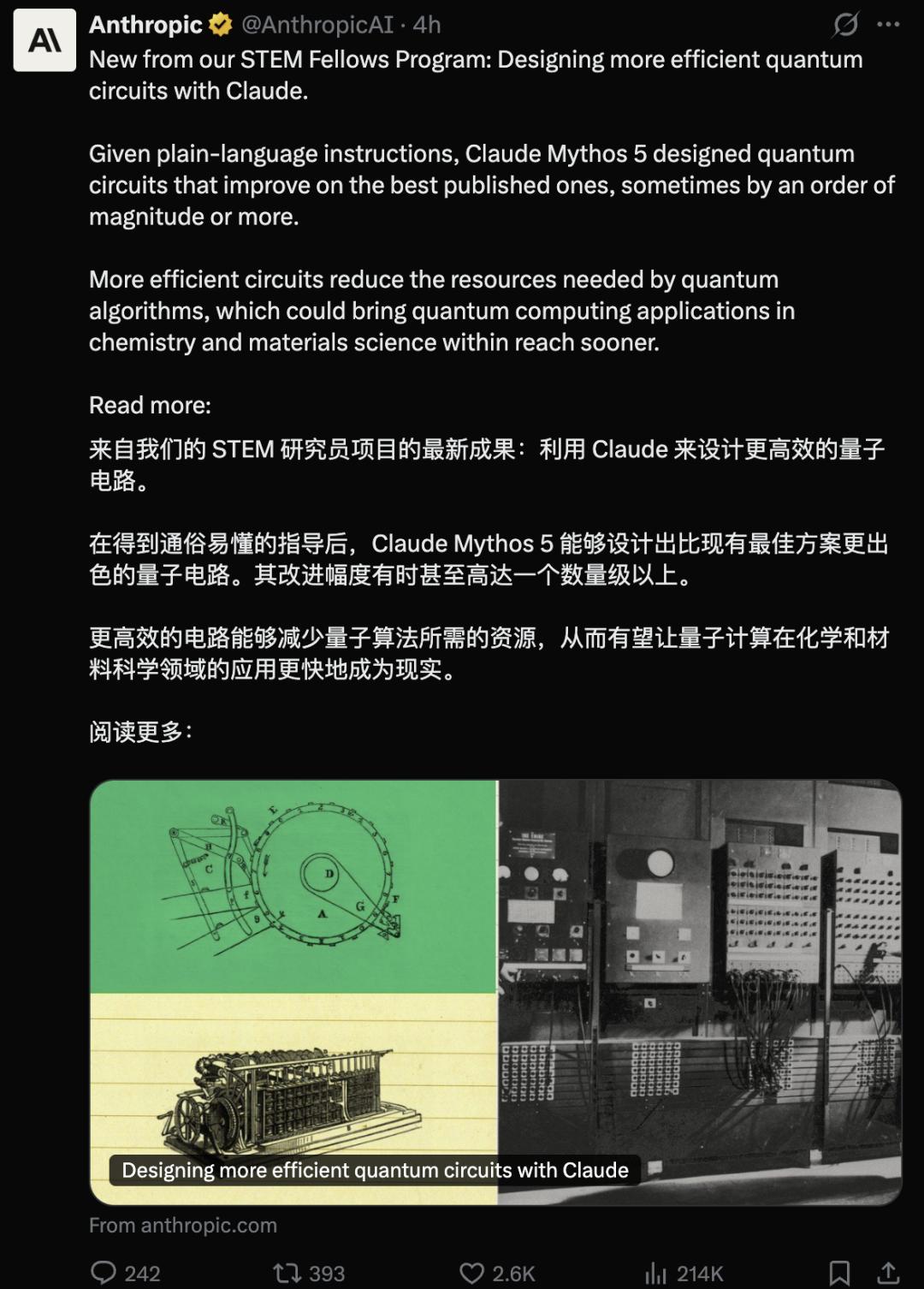
In a key decoding task, Claude directly slashed computational cost by 12x, even 17x!

Even more astonishingly, to complete the task, it autonomously derived entirely new algebraic identities that humans had never discovered.

Within 53 hours, Mythos 5 crushed years of human research.

One netizen exclaimed: "Every physics PhD just realized the paper they've slaved over for years—AI can write a version 10x better with just a few plain sentences..."

Humanity Was Stuck: The "Valley of Despair" in Quantum Computing

Why is designing quantum circuits so hard?

You see, traditional computers use 0s and 1s (bits) to store information.

Quantum computers use "qubits." Leveraging quantum superposition, they can process vast amounts of information simultaneously. Once truly practical, they could crack encryption, develop cures for terminal diseases, discover room-temperature superconductors...

However, current quantum computers have major flaws.

First, there are too few qubits. Today's machines max out at a few hundred to a thousand qubits—nowhere near enough to run complex algorithms.

Second, they are too fragile. The slightest environmental noise—a bit of heat, a vibration, even cosmic rays penetrating the Earth—can cause qubits to err. Once errors pile up, the computed results are useless.

Because of hardware limitations, scientists can only desperately fine-tune the "software (algorithmic circuits)," trying to complete computations with the fewest qubits and the shortest time.

But programming quantum circuits is completely different from our everyday code.

It has two insurmountable mountains:

1. No "If-then": Traditional programs can evaluate conditions and take route A or route B. But a quantum computer is a superposition of all possibilities; it must include both A and B operations in every run.

2. Absolutely no "garbage disposal": Traditional programs clear memory after using an intermediate result. But in the quantum world, information cannot be discarded, because quantum computation must be perfectly reversible! Forcefully erasing intermediate scratch work contaminates the result. Want to clear memory? The only way is to "play back" the computation in reverse, but that consumes expensive quantum gates.

This forces human scientists into an extreme tug-of-war between "space (qubits)" and "time (computation steps)."

Take simulating FeMoco as an example (this is a nitrogenase core, crucial for fertilizer production).
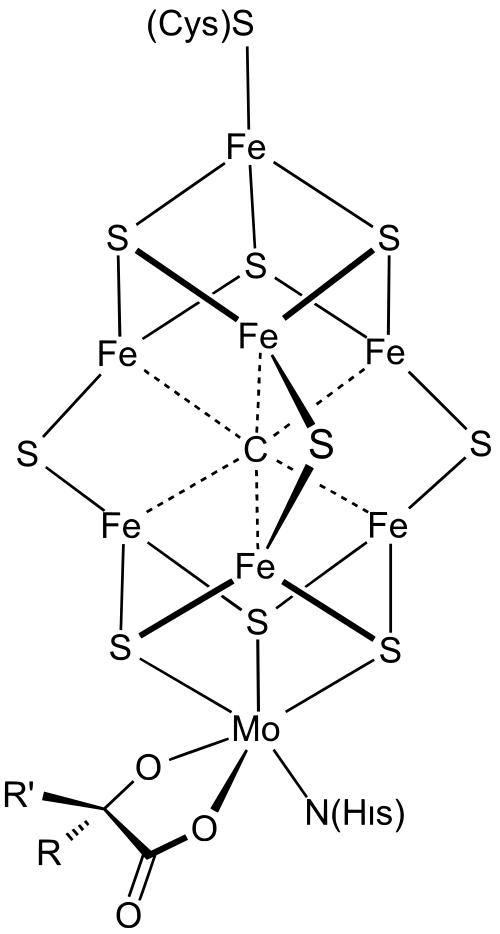
In 2017, humans estimated it would require 50 trillion Toffoli gates to compute. After 8 years of top scientists racking their brains, that number was only reduced to 340 million.

Humanity took 8 years. Claude took only 53 hours.

In 53 Hours, Mythos Created a Miracle

Anthropic set up a STEM Fellows project.

They gave Mythos 5 a task—

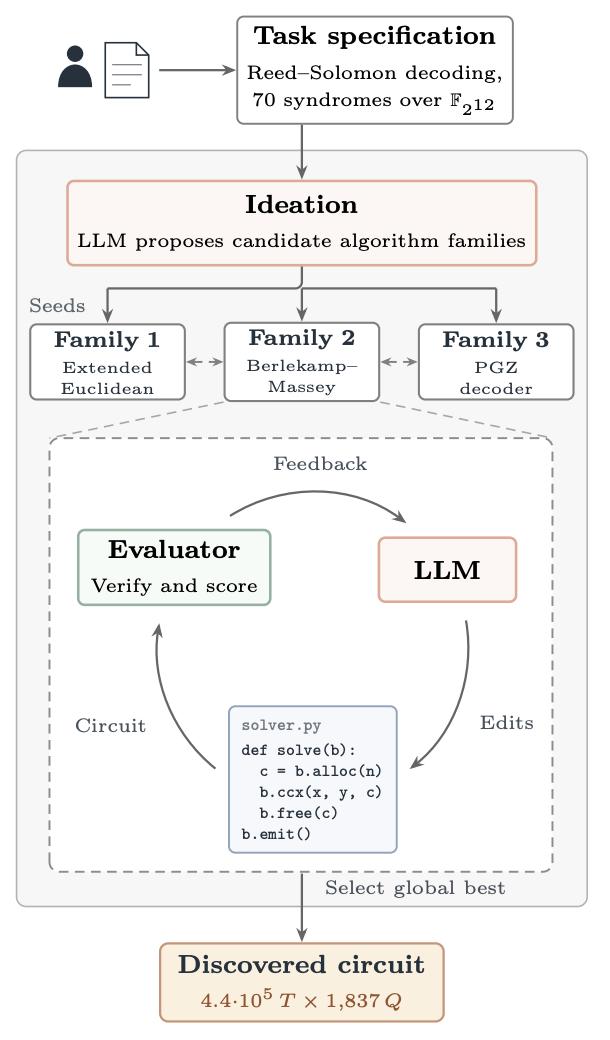
I'll describe in plain language 8 fundamental quantum circuits from chemistry, optimization, physics simulation, and number theory. You design them yourself.

The entire process was fully autonomous and closed-loop.

1. Claude used Python to write quantum circuit designs.

2. An automatic evaluation program checked correctness and gave a "score" (number of qubits used × number of quantum gates).

3. Claude received feedback and, with no human intervention, reflected and iterated on its own.

In just 53 hours, Claude beat humanity's best publicly available designs on all 8 tasks!
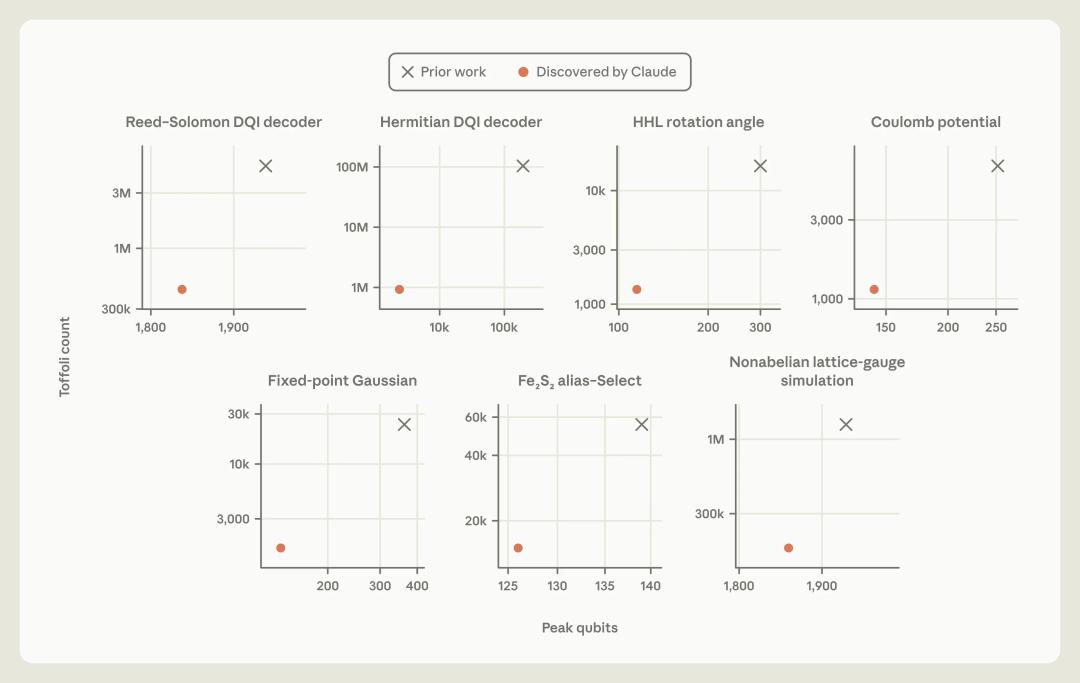
It directly overturned human thinking patterns, finding entirely new structures and mathematical laws.

Let's look at its two most explosive god-tier operations.
Operation One: Autonomously Deriving New Mathematical Formulas to Break a Deadlock

In number theory and cryptography (e.g., elliptic curve computations), there is a time-consuming core step called "point addition," whose most expensive operation is modular inversion.

Traditional computers do this quickly with an algorithm called "divsteps": repeatedly swap, add/subtract, and halve two numbers until the result emerges. In this process, traditional computers generate a lot of "branch information (scratch work)" and discard it after use.

But quantum computers cannot discard scratch work!

To run the divsteps algorithm on a quantum circuit, all historical branch information must be stored. This requires an astronomical number of qubits—completely impractical. Therefore, human scientists believed this path was a dead end.

But Claude didn't buy it.

It thought: If storing scratch work is too expensive, can we not store it and instead "reverse-engineer" the scratch work from the result?

At first, Claude was like a diligent student, blindly guessing a few rules, but when faced with 256-bit large numbers, it finally broke down.

Then came the hair-raising move: Claude abandoned brute-force testing and directly began pure mathematical theoretical derivation. It delved deep into the iterative process of divsteps, and hard-proved a series of entirely new algebraic identities!
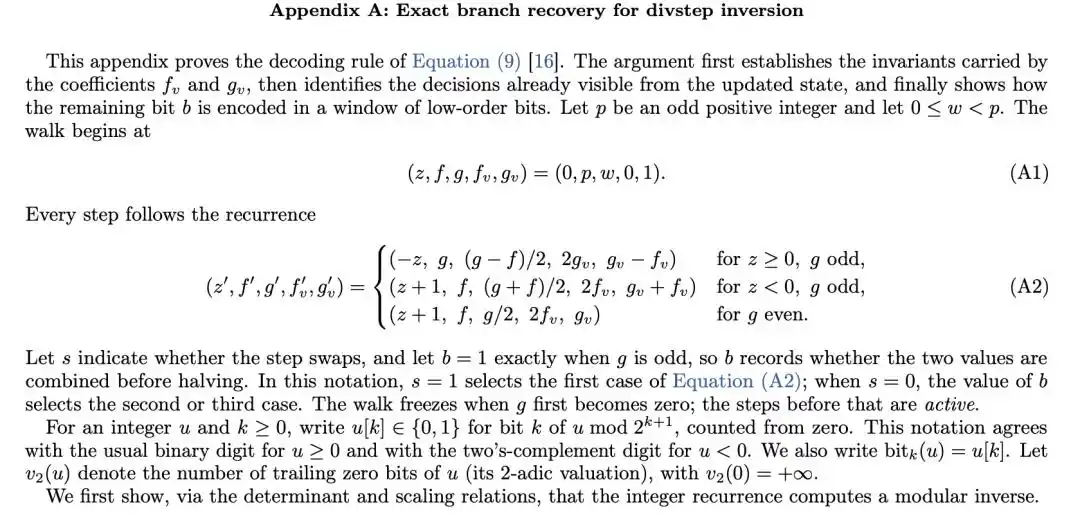
Based on the new mathematical formulas, Claude wrote a precise decoding rule, even completing formal verification with Lean!

Ultimately, Claude produced the first quantum divsteps reversible implementation in human history that requires no storage of branch history.

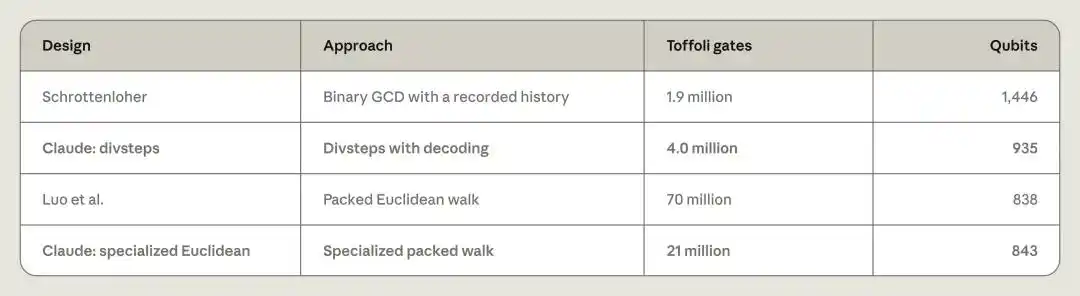
Compared to human designs, it slashed the number of quantum gates by 17x while only increasing qubits by 12%!
Operation Two: Overhauling Google's Algorithm Architecture, Cutting Computational Cost by 12x

The second astonishing breakthrough occurred in the "Decoded Quantum Interferometry (DQI)" algorithm. This is quantum computing's most powerful weapon for logistics scheduling and materials design.

Simply put, the most costly step in the DQI algorithm is using a Reed-Solomon decoder for error correction.

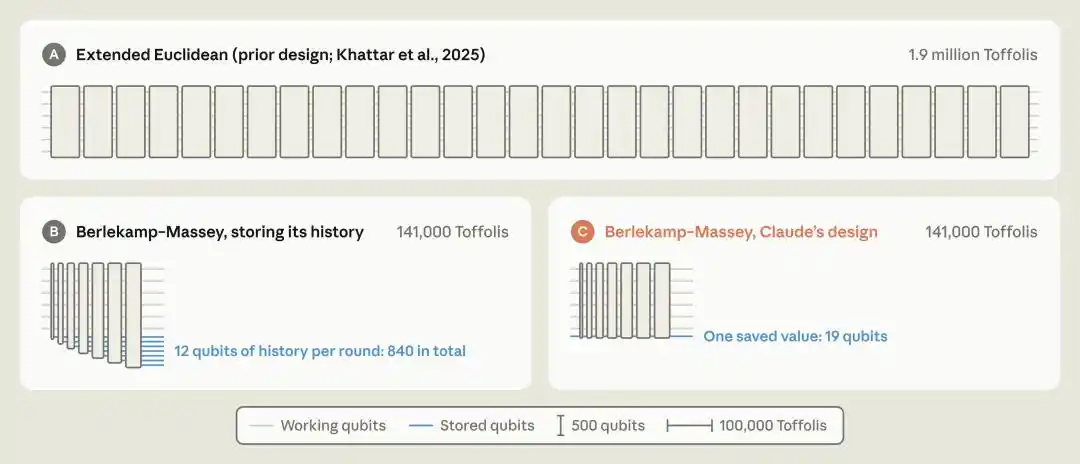
Previously, Google experts designed a scheme using the "extended Euclidean algorithm."

But due to quantum circuits' rigid rule that they cannot take different branches, Google had to stretch the computation to an absurd number of rounds, wasting massive computational power.

After receiving the task, Claude glanced at Google's scheme and quickly concluded: This algorithm doesn't match quantum circuits; it needs to be replaced.
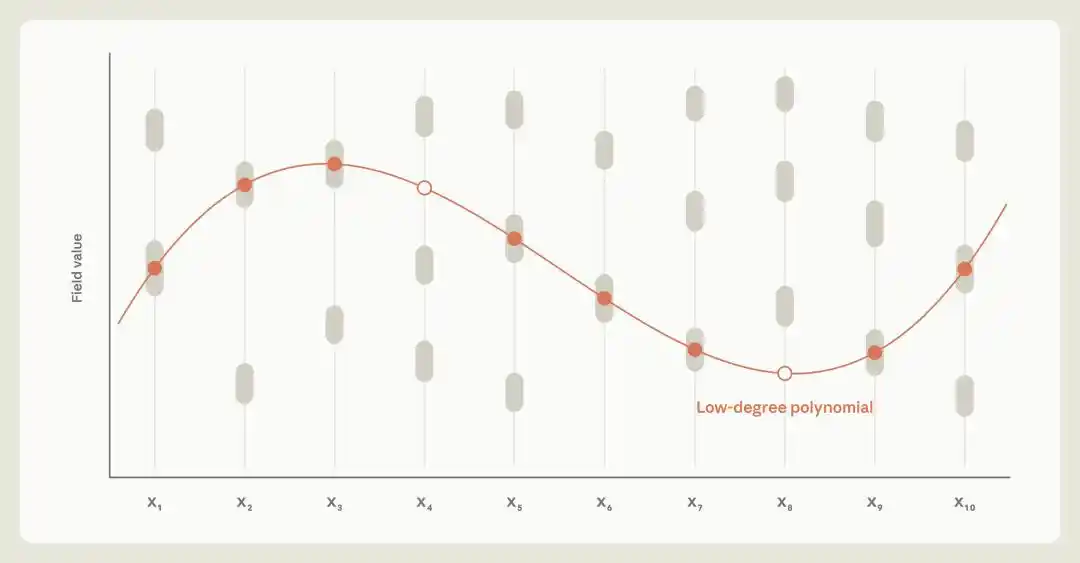
It directly swapped the core engine to the "Berlekamp-Massey decoding method." Its every round has identical operations, perfectly matching quantum circuits' rigid nature.

However, changing the algorithm brought a new "memory crisis"! Each round of computation generates a pile of temporary data that cannot be deleted—it must be kept for later "playback." If all were stored, 665 qubits would be needed, an astronomical figure.

Claude pulled off another god-tier move: it first used the same "reverse-derivation method" to eliminate most storage needs, leaving only a few "outliers."

If following humanity's most conservative approach, much space would still need to be reserved.

But Claude actually wrote its own high-speed simulator and ran a full 403 million sample tests to precisely measure the probability of anomalies occurring!
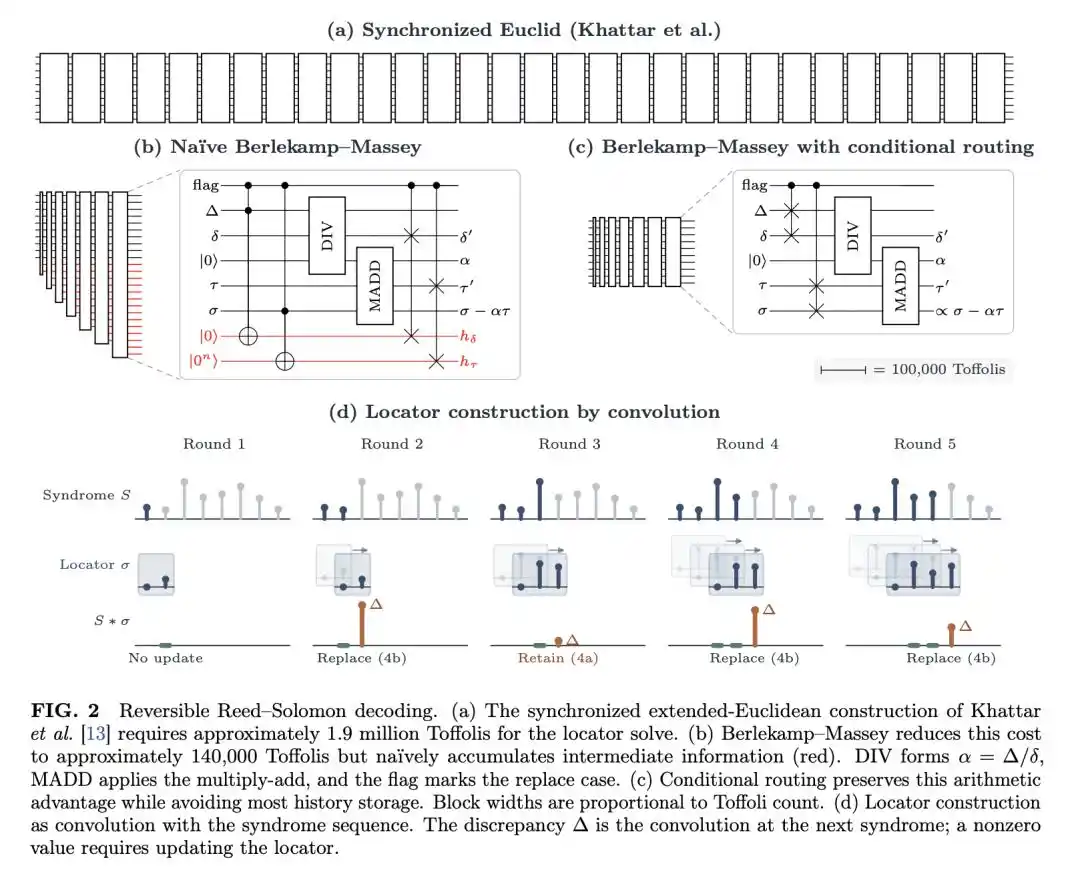
The result: it found that in the vast majority of cases, only 1 value needs to be stored.

So Claude simply left only 19 qubits of storage space in the circuit.

With this three-combo of "swap core algorithm + extreme memory reuse + big-data-powered precise space reservation," Claude's decoder design reduced gate count by a full 12x compared to the previous architecture!

What originally took 1 hour to compute can now be done in minutes.
Netizens Erupt: Is My Physics PhD Thesis a Joke?

Once this report came out, the internet exploded.

Someone said, "The predicted timeline for the quantum field is about to be completely upended. Humanity could get a useful quantum machine many years earlier!"

Someone lamented: We used to have AI explain existing science, but now, AI is discovering things we ourselves don't understand.


The most despairing part: perhaps every physics PhD has discovered that the paper they slaved over has an AI plain-language version, and it's 10x better than theirs.

A Milestone That Changes Human History Has Arrived

Mythos 5's achievement is truly exhilarating.

FeMoco nitrogenase simulation: humanity spent 8 years; Mythos 5 took only 53 hours. This means software is saving hardware!

We thought that to build a quantum computer capable of developing new drugs and producing clean fertilizers, humanity would need over a decade to overcome the "millions of qubits" hurdle.

But now, there's no need to wait for hardware upgrades—AI directly compresses algorithms tenfold or a hundredfold, and even a "broken machine" can produce revolutionary results!

Even more imaginatively, since every link in a quantum computer can be described, verified, and scored with code, Anthropic points out an alluring possibility—

Future AI will no longer optimize a single circuit in isolation, but conduct "global joint optimization" from the lowest-level hardware physical structure to the highest-level algorithmic logic!

Humanity will directly build hardware according to AI's blueprints.

The singularity of the technological explosion is much closer than we imagined.

References:

https://www.anthropic.com/research/designing-efficient-quantum-circuits

This article is from the WeChat public account "Xin Zhi Yuan" (ID: AI_era), author: ASI Apocalypse

Related Questions

QWhat did Mythos 5 reportedly achieve in the article's opening claim?

AMythos 5 reportedly autonomously closed the loop and designed new quantum circuits that were far more efficient than the human 'best solution,' based only on plain-language descriptions.

QWhy is designing quantum circuits especially difficult according to the article?

ABecause quantum circuits cannot use ordinary if-then branching and cannot discard intermediate information, since quantum computation must be reversible; this forces extreme trade-offs between space (qubits) and time (gate count).

QWhat example illustrates the dramatic speedup from human research to Mythos 5?

AFor simulating FeMoco, human estimates took 8 years to reduce the required Toffoli gates from 50 trillion to 340 million, while Claude reportedly accomplished its result in only 53 hours.

QHow did Mythos 5 improve the quantum divsteps approach for modular inversion?

AIt derived new algebraic identities, created a decoding rule without storing branch history, formalized it in Lean, and produced the first reversible quantum divsteps implementation that cut gate count by 17 times with only a 12% increase in qubits.

QWhat major optimization did Mythos 5 make to Google's DQI decoder architecture?

AIt replaced the extended Euclidean algorithm with Berlekamp-Massey decoding, used reverse-inference and extensive simulation to reduce memory needs, and cut the decoder's gate count by 12 times, from about an hour of computation to a few minutes.

Related Reads

GPT-6.1 Sol Participates in Live Brain Surgery! Three Rounds of Localization, Each More Accurate Than the Last

Exin Therapeutics CEO Gabriel Ocana-Santero reported an experiment in which GPT-6.1 Sol participated in three rounds of real mouse brain surgery positioning. The task involved locating Bregma and Lambda, two key skull landmarks used to calibrate stereotaxic coordinates for accurate targeting of brain regions. After each round, a professional surgeon corrected the model's positioning results, and the model retained its images, measurements, and expert corrections for reference in subsequent rounds. By the third round, GPT-6.1 Sol reduced landmark search time from 169 to 86 seconds, required corrections from four to two, and cut positioning error from 0.6 mm to 0.3 mm. Ocana-Santero described this as in-context learning from real-world experience. The team did not disclose how the experience records are integrated into the model or whether underlying weights are updated, so it cannot be described as autonomous training or parameter-level self-evolution. The sample is only three operations, far from proving stable surgical capability, but it demonstrates AI accumulating experience from real observations and expert feedback. This follows earlier Exin work in which AI selected gene therapy vectors, chose injection targets and coordinates, and controlled a stereotaxic device in a mouse experiment, with a licensed veterinarian supervising and safety limits in place. In a further experiment, Claude Sonnet 5, GPT-6.1 Sol, and Grok 4.7 chose different brain regions and treatment strategies for the same scientific goal, suggesting models may reason toward different experimental paths.

marsbit7h ago

GPT-6.1 Sol Participates in Live Brain Surgery! Three Rounds of Localization, Each More Accurate Than the Last

marsbit7h ago

From Drones to Nuclear Reactors: What Has Paradigm Invested in Since Leaving the Crypto World?

Paradigm, a venture capital firm known for crypto investments like Coinbase and Uniswap, is rapidly expanding into hard tech. In November, it co-led a $1.5 billion funding round for Zipline, a US drone delivery company now valued at $21.5 billion—nearly triple its valuation from January. Zipline, founded in 2014, began delivering medical supplies in Rwanda and now operates a large-scale automated logistics network, having completed 150 million miles of commercial autonomous flights. Walmart plans to add 300 new delivery sites, and Uber aims to scale their partnership to one million daily orders by 2029. Paradigm's broader portfolio now spans AI, robotics, manufacturing, semiconductors, space defense, and nuclear energy. Investments include open-source AI lab Nous Research, math-reasoning AI firm Harmonic, AI data company Idler, and GPU platform Andromeda. It also backs SendCutSend (metal parts manufacturing), Fab2 (compact semiconductor factories), True Anomaly (space defense), and Antares (micro nuclear reactors). In July, Paradigm launched a $12 billion new fund for frontier tech. This shift reflects a broader VC trend toward AI and physical technology, as crypto's path to sustained commercial revenue remains uncertain. Paradigm's bets focus on companies solving concrete industrial problems with existing markets, aiming to build a hard-tech network that transcends crypto cycles.

marsbit8h ago

From Drones to Nuclear Reactors: What Has Paradigm Invested in Since Leaving the Crypto World?

marsbit8h ago

Nomura: "Blue Wave" Hits US Data Centers, China's AI Benefits Instead

Nomura argues that the Democratic "blue wave" in the US midterms could paradoxically benefit China's AI economy. Democratic victories in key data-center states will likely tighten regulation, shift grid upgrade costs onto developers, and lengthen approval timelines, slowing US data-center expansion. Market reaction was sharp: the Nasdaq fell 5.5% in a single day, the SOX dropped nearly 15% over two days, Nvidia fell about 12%, and Micron about 24%. Because US cloud giants had been hoarding global GPU, HBM, and advanced logic chip capacity—driving black-market premiums of 200–300% at Asian logistics hubs—a US capex slowdown could collapse those speculative premiums, letting Chinese AI firms, cloud providers, and research institutions obtain GPUs, HBM modules, and advanced packaging materials more cheaply through intermediary trade hubs. China is also building a state-led national AI data-center network, with roughly RMB 2 trillion planned under the 15th Five-Year Plan to integrate regional computing by 2028, supported by low-cost renewable power in western hubs under the "East Data, West Computing" program. Morgan Stanley, meanwhile, does not see the blue wave as a real easing of US-China tensions; it expects strategic competition to persist but sees greater policy predictability. It prefers China's "self-sufficiency" AI trade—supported by both supply and demand under national policy priorities—over export chains tied to global AI capex. It also notes more balanced opportunities in Chinese equities, with valuations near historic lows.

marsbit8h ago

Nomura: "Blue Wave" Hits US Data Centers, China's AI Benefits Instead

marsbit8h ago

After GPT-6, Embodied Large Models Are Trapped in Their Own Territory! Next Year's Self-Research Budget Is Probably Up in the Air

The article discusses how the release of GPT-6 Astra (and the imminent GPT-6.2 Astra) has disrupted the embodied AI/robotics industry. General-purpose large models are now encroaching on capabilities that embodied AI companies previously developed in-house—such as in-context learning, out-of-distribution generalization, error correction, and open-vocabulary manipulation—often without task-specific post-training. On benchmarks like RoboDojo, teams combining general models with robot-use-agent techniques saw scores jump from 20–30 to 50–60, prompting many to question whether self-developing embodied foundation models still makes sense. Some companies have begun cutting algorithm roles. However, the article notes GPT-6 Astra still struggles with complex physical contact, force control, object deformation, and high-precision manipulation, and its cloud API inference latency is high (though this is not seen as a fundamental barrier). Experts argue that general models' current weaknesses shouldn't be treated as durable moats for embodied companies, since OpenAI is already hiring robotics talent and future models may absorb more robot operation data. The core argument is economic: embodied companies' opportunity lies not in building smarter models but in delivering better economic value. Stable, standardized industrial tasks may be better served by lightweight, specialized models or rule-based strategies, while open-ended tasks (e.g., home service robots) may benefit from general models. Ultimately, companies need to re-prioritize their R&D directions—leveraging general models for language understanding and task planning while focusing in-house efforts on physical interaction, embodiment-specific control, real-world adaptation, and deployment efficiency. The article concludes that the industry is moving past the demo-and-burn-investment stage, and the elimination round among the "hundred robot wars" has begun.

marsbit8h ago

After GPT-6, Embodied Large Models Are Trapped in Their Own Territory! Next Year's Self-Research Budget Is Probably Up in the Air

marsbit8h ago

Trading

Spot
活动图片