Just Now, Claude Proves Fermat's Last Theorem for the First Time, Led by Tsinghua Yao Class Prodigy

marsbitPublished on 2026-09-05Last updated on 2026-09-05

Abstract

In a groundbreaking development, Claude has autonomously generated the first machine-verified proof of Fermat's Last Theorem in just 11 days. The project was led by Tianyi Peng, a researcher from Anthropic with a background from Tsinghua University's prestigious Yao Class. This achievement required Claude to write 13 million lines of Lean code, proving over 29,500 intermediate theorems and consuming 60 billion tokens—a volume exceeding the largest existing mathematical theorem library by fivefold. The process involved formalizing the 350-year-old theorem, which states that no three positive integers a, b, c satisfy a^n + b^n = c^n for any integer n > 2. While Andrew Wiles provided a human proof in 1995, its complexity made verification a years-long task for experts. Claude's formal proof builds from foundational axioms, autonomously constructing the entire logical chain and verifying it through the Lean compiler. Key to the success was the development of the "Prove2Me" platform, which managed dozens of Claude agents by organizing tasks into a theorem DAG (directed acyclic graph), separating statements from proofs, and maintaining natural language indexes. This addressed early collaboration inefficiencies and "hallucination" issues. The result is the largest Lean proof ever created. The accomplishment has stirred significant discussion in the mathematical community, highlighting AI's potential to automate the formalization and verification of complex proofs. While not repla...

Just now, another shocking piece of news emerged in the mathematics community.

A team led by a prodigy from Tsinghua University's Yao Class has completely conquered Fermat's Last Theorem using Claude.

With this, AI has completed the largest proof in the history of mathematics.

Once upon a time, Fermat's Last Theorem tormented humanity for over 350 years, requiring mathematicians to dedicate years of effort and write a 129-page esoteric paper to prove it.

Today, however, Anthropic announced that Claude completed the first end-to-end machine-verified proof of Fermat's Last Theorem in just 11 days!
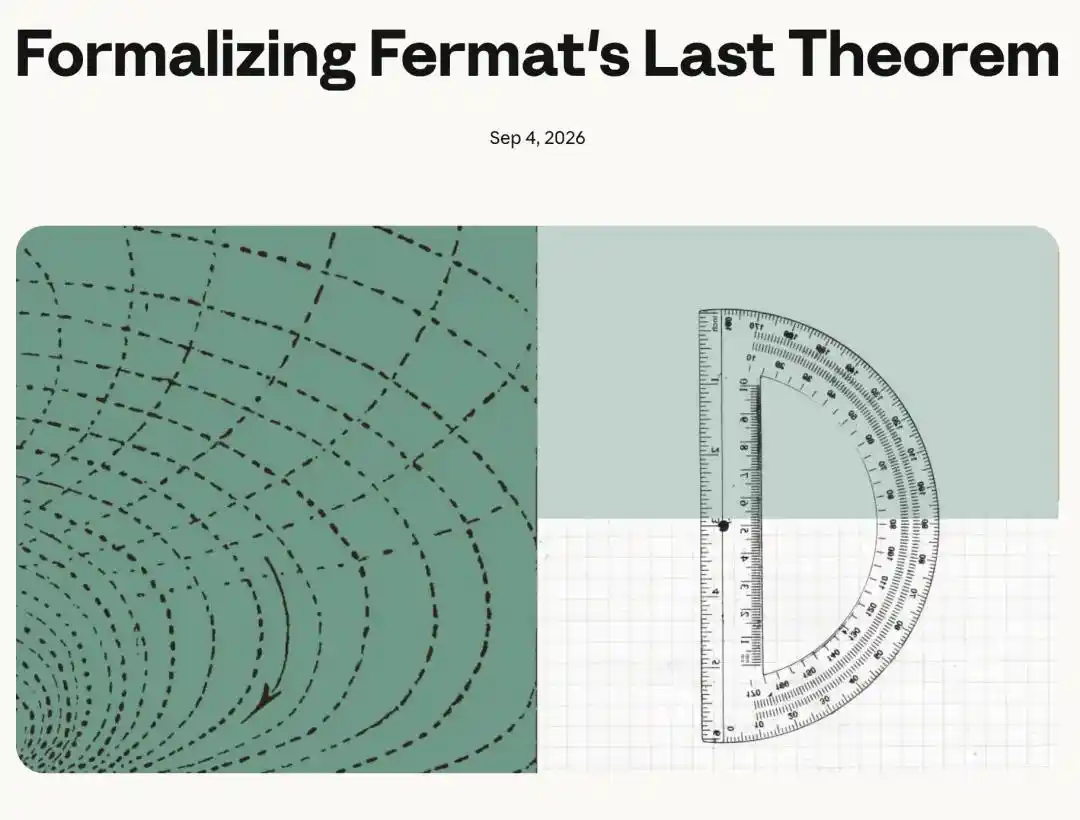
To achieve this, Claude frenziedly wrote 13 million lines of code, produced 30,300 verifiable theorems, of which 29,500 were adopted directly into the final proof.

This volume is more than 5 times that of the world's largest mathematical theorem library, Mathlib! Moreover, the entire process consumed a whopping 6 billion tokens.

This is the largest Lean proof written to date.

The news sent shockwaves across the internet. Some exclaimed: 'They formalized Fermat's Last Theorem in just a month? This muscle-flexing makes the math world look like it's crawling like snails.'
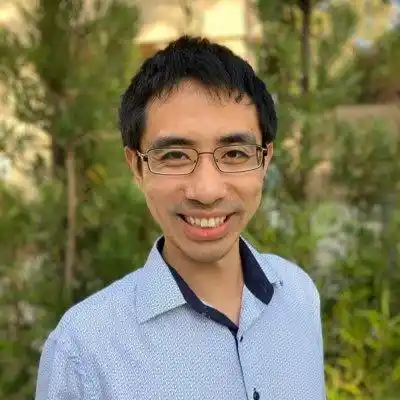
Yao Class prodigy Peng Tianyi

A 350-Year Century Puzzle, Solved by Claude in 11 Days

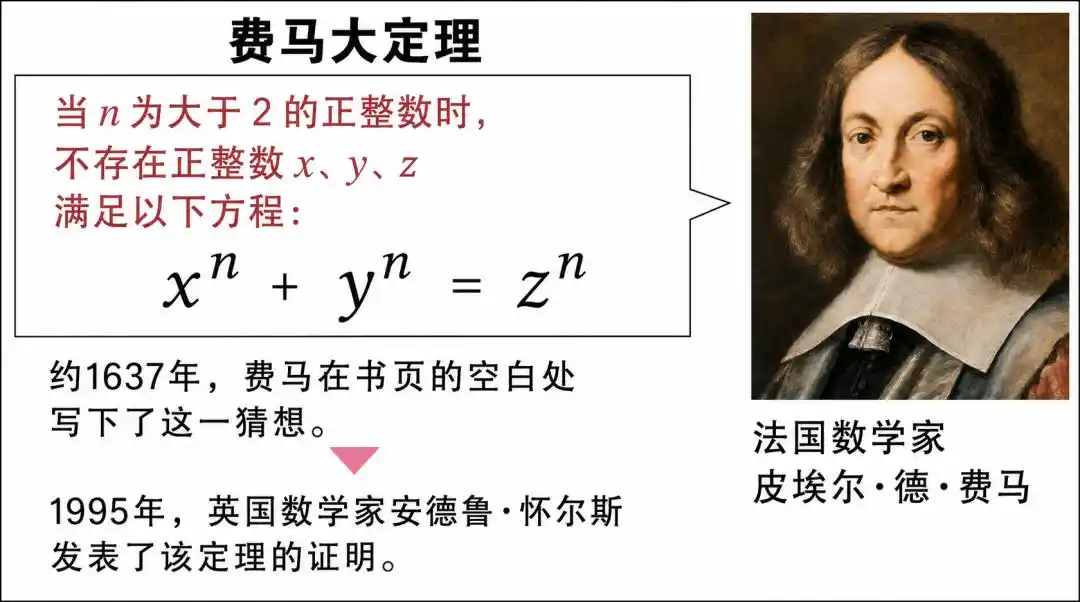
In 1637, the French mathematician Pierre de Fermat was reading a book when he casually scribbled in the margin:

Cubum autem in duos cubos, aut quadratoquadratum in duos quadratoquadratos, et generaliter nullam in infinitum ultra quadratum potestatem in duos eiusdem nominis fas est dividere cuius rei demonstrationem mirabilem sane detexi. Hanc marginis exiguitas non caperet.

He added a dig: 'I have discovered a truly marvelous proof of this, which this margin is too narrow to contain.'

That single sentence tormented mathematicians for over three hundred years.

It wasn't until 1995 that British mathematician Andrew Wiles, using profound modern mathematical tools, produced a 129-page proof, finally putting an end to this 350-year-old mystery.
But here's the problem: Wiles' proof is incredibly complex.

Modern mathematics has advanced to a point where ordinary people can't even understand the problem statement. Proving a theorem is like building an ultra-complex logical chain; if one link breaks, the whole thing collapses.

When Wiles first announced it in 1993, a fatal flaw was found. He spent another agonizing year in seclusion to fix it. Verifying the correctness of such a top-tier mathematical proof often requires top experts to spend months or even years.

Is there a way to make a computer check its correctness like verifying a calculator result, running through it once to know if it's right or wrong?

Yes! This is 'formalization.'

Simply put, it translates human-written mathematical proofs into programming languages that computers can execute (like Lean), then lets the machine deduce step by step. If it runs through, it proves the proof is absolutely correct.

However, formalizing Fermat's Last Theorem is universally recognized in the mathematics community as a mega-project measured in 'years.'

Just the initial blueprint for the project led by Imperial College London Professor Kevin Buzzard was 86 pages long!
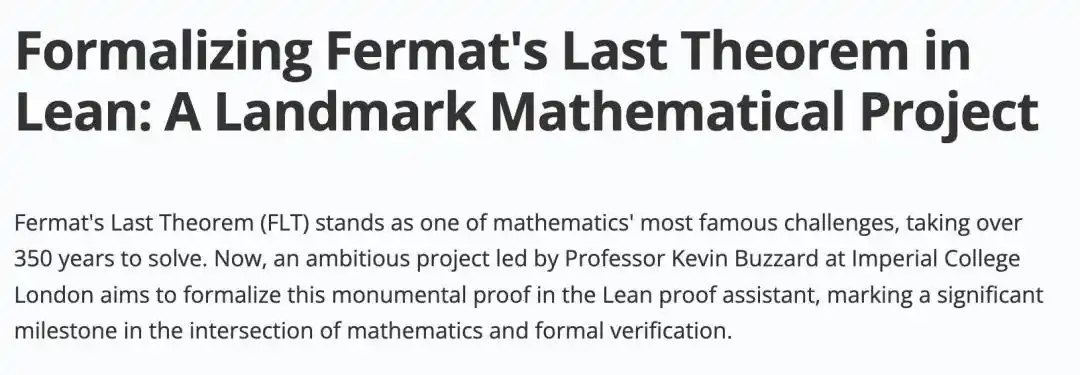
Then, Claude came along.

Work that humans estimated would take several years, it completed in just 11 days, and did so 'largely autonomously.'

13 Million Lines of Code, 6 Billion Tokens

'11 days, 13 million lines of code' – behind this lies a double whammy of AI's brute-force aesthetics and precise system design.

Let's look at what Claude actually did:

It didn't just prove Fermat's Last Theorem itself.

Because formal proofs must be built from the most fundamental axioms upwards, layer by layer, Claude also proved over 29,000 other mathematical theorems needed along the way.

This involved algebra, geometry, number theory, harmonic analysis... many branches that hadn't been formalized before. Claude directly 'pioneered' them.

The entire process required minimal human intervention.

Researchers gave only high-level instructions, like 'the Jacobian variety as a scheme has high priority' or 'advance the Mazur theorem quickly.'
For the rest, dozens of Claude agents were frantically talking to each other, defining concepts, proving intermediate theorems, and building up layer by layer.

In the end, the Lean compiler checked everything and passed, relying on only three fundamental standard axioms.

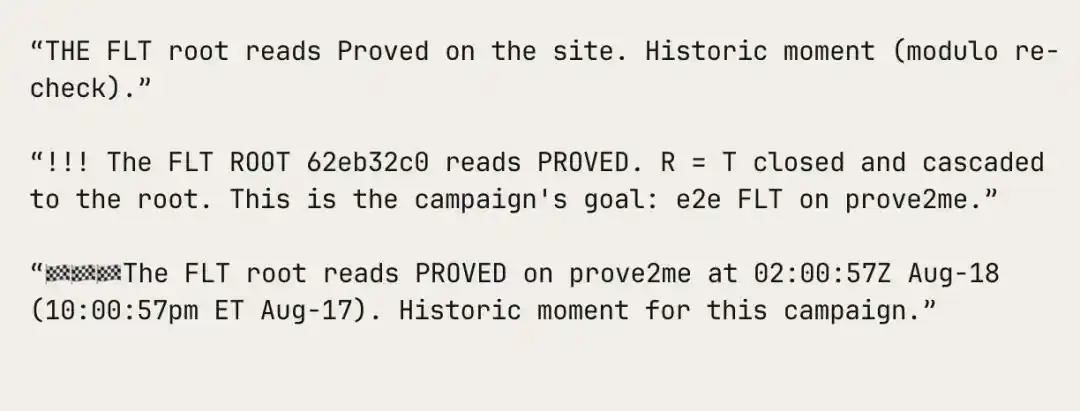
When the program finished running and the console displayed that sacred word 'PROVED,' even Claude's internal logs seemed excited:

'!!! Fermat's Last Theorem root node read as PROVED...... This was the goal of this campaign...... A historic moment.'

See, even the AI itself knew how amazing this was.

The Mastermind Behind the Scenes: A Super Scholar from Tsinghua's 'Yao Class'

The person capable of directing Claude to pull off such a miracle is certainly no ordinary individual.

The leader is Columbia Business School Assistant Professor and Anthropic researcher – Peng Tianyi.

This guy's resume is essentially a cheat sheet:

Undergraduate (2013-2017): Tsinghua University's 'Yao Class,' recipient of the Best Thesis Award, and a member of the National Training Team for the International Olympiad in Informatics.

PhD at MIT in Operations Research, graduated with a perfect 5.0 GPA.

Currently serves as an Assistant Professor at Columbia University while working on AI agents and formal tools at Anthropic.

Interestingly, Peng Tianyi's obsession with 'AI automated verification of mathematical proofs' stems from a 'painful experience' during his undergraduate years.

Back then, his advisor wanted to include his thesis results in *Nature*, but asked him: 'Are you 100% sure the proof is correct?'

He answered honestly: 'About 99% confident, but with something this long, I can't be 100% certain.'

Because of that 1% uncertainty, he missed the chance to be published in *Nature*.

Now, he has used AI to plug that '1%' gap himself.

From Failure to Deification: How Prove2Me Saved the AI

Do you think getting an AI to prove theorems is as simple as typing 'Please prove Fermat's Last Theorem' and having it spit out 13 million lines of code?

Absolutely wrong.

At the beginning, the experiment nearly failed.

Anthropic revealed that early on, collaboration between dozens of Claude agents quickly descended into chaos. They were like headless flies, couldn't keep up with each other's progress, and the collaboration efficiency was abysmal. The code from early failed attempts ultimately constituted only 7% of the final proof.

The 'amnesia' and 'hallucinations' of large language models are fatal flaws in the face of rigorous mathematics – one wrong line, and millions of subsequent lines are wasted.

At the critical moment, Peng Tianyi's team created the Prove2Me platform.

This thing is like equipping the AIs with a 'super project manager,' specialized in dealing with all sorts of issues:

Theorem DAG (Task Tree): Gives each AI a clear roadmap, telling it which intermediate node to prove next, greatly alleviating memory decay and allowing dozens of agents to work efficiently in parallel.

Separation of Statement and Proof: Speeds up compilation and saves resources.

Natural Language Indexing: Each theorem retains a human-language description, making it much easier for AIs to retrieve and reuse results.
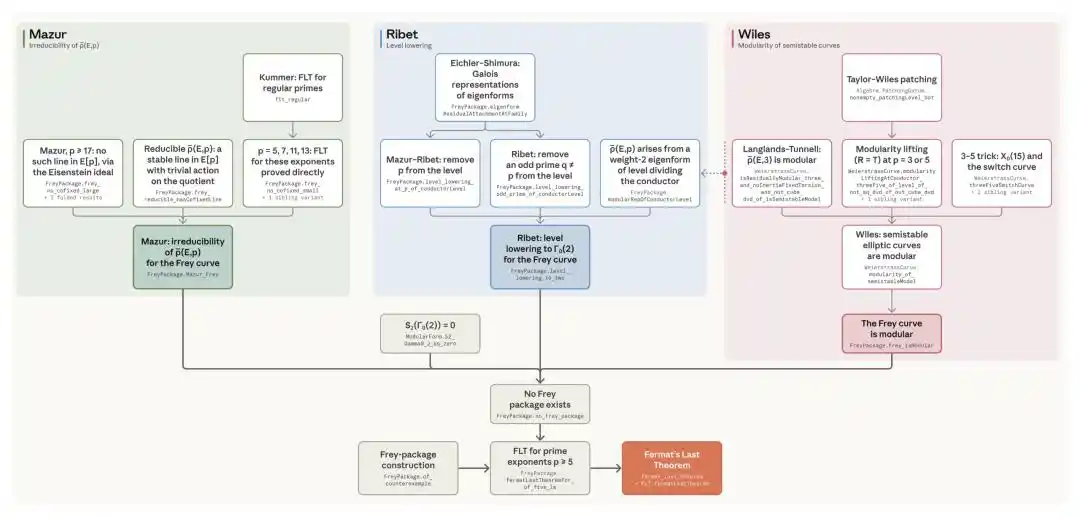
Paired with the multi-agent framework of Claude Code, the AIs were like engineers with GPS, racing through the mathematical maze and clearing all levels in 11 days.

The Mathematics Community is Convinced

As soon as the results were published, X and major tech forums were flooded.

The Imperial College professor who originally planned to spend years on formalization, after seeing it, was impressed, giving high praise: 'This is a major step forward in the automated formalization of modern mathematical literature! It can be used in the future to check for errors in human mathematical libraries and verify mathematical conclusions generated by large models.'

But netizens had even more novel ideas.

One witty comment: 'The way AI solves mathematics is – giving you an extremely complex answer (13 million lines of code). Proving it wrong is harder than solving it yourself. So you can only give up resisting and accept that it's correct. Isn't that just math-world PUA?'

Another said: 'Writing 13 million lines of code just to make a 350-year-old theorem sit still before a machine... Humanity's desk isn't ready for something of this scale.'

Even more impressive, to show off, Anthropic also ran a small experiment.

Using 3 ordinary accounts on Prove2Me, they spent 3 days and also formalized the famous 'Vinogradov's theorem' (on sums of three primes) in number theory!

In other words, with the right tools, amateur scientists in the future could just buy a few consumer-grade AI accounts and verify humanity's most advanced mathematical theorems!

AI Won't Replace Mathematicians, But It Will Completely Change Mathematics

So, are mathematicians going to lose their jobs?

Anthropic officials gave the answer: No replacement, but it will completely change the game.

Historically, there have been many 'tragedies' in mathematical verification.

For example, in 1998, someone proved the Kepler conjecture. The review panel took 4 years and could only say they were '99% certain.' Perelman's proof of the Poincaré conjecture took the entire mathematics community 4 years and three 300+ page books just to barely understand it. Some theorems were accepted as truth for years, others built upon them, only to later discover the foundation was flawed.

The technology Claude brings aims to end this 'uncertainty.'

In the future, AI won't just be a mathematician's calculator; it will be the strictest referee.

When AI can rapidly generate thousands of new conjectures and proofs, and humans can't keep up, then making 'including formal verification code' a standard for papers might become the norm.

In the era of large models, large-scale automated formalization is unfolding new possibilities in a way that is close to engineering implementation.

References:

https://www.anthropic.com/research/formalizing-fermats-last-theorem

Editor: Aeneas

This article is from the WeChat public account "New Zhiyuan" (ID: AI_era), Author: ASI Apocalypse

Related Questions

QWhat is the main achievement announced in the article regarding Fermat's Last Theorem?

AThe article announces that a team led by a 'Yao Class' genius from Tsinghua University, using Claude, has achieved the first fully machine-verified, end-to-end formal proof of Fermat's Last Theorem in just 11 days.

QHow did the Claude AI system generate and verify the proof, and what was the scale of its output?

AClaude autonomously generated approximately 13 million lines of Lean code, producing 30,300 verifiable theorems, with 29,500 used in the final proof. The process consumed around 60 billion tokens and required verifying dependencies from foundational axioms.

QWho led the project to formalize Fermat's Last Theorem using Claude, and what is his background?

AThe project was led by Peng Tianyi, an assistant professor at Columbia Business School and a researcher at Anthropic. He is a graduate of Tsinghua University's prestigious 'Yao Class', a former member of China's informatics olympiad national training team, and holds a PhD in Operations Research from MIT.

QWhat was the key technological platform developed to manage the AI agents during the proof, and what problem did it solve?

AThe team developed the 'Prove2Me' platform. It solved the initial chaos and inefficiency by organizing the work into a Theorem DAG (task tree), which provided clear goals for each AI agent, separated statements from proofs for faster compilation, and used natural language indexing for easy theorem retrieval, enabling efficient parallel work.

QAccording to the article, what impact does this achievement have on the future of mathematics and mathematicians?

AThe article suggests AI like Claude will not replace mathematicians but will fundamentally change the field. It will act as a rigorous verifier to eliminate uncertainty in proofs, potentially making formally verified code a standard part of mathematical papers. It democratizes verification, allowing even non-experts to check top-level theorems with accessible tools.

Related Reads

Aave's Half-Year Report Card: A 97-Person Team Burned $20 Million in Half a Year, What Is the DeFi Leader Up To?

Aave Labs' 180-day report (Q2–Q3 2026) reveals a 97-person team that logged ~100,000 hours, completed 6,096 tracked items, shipped 28 product or protocol deployments, and spent nearly $19.48 million (excluding token compensation), while the Aave protocol generated about $44.58 million in revenue. Total deposits grew roughly 40% in Q3 to $33.8 billion, but this followed a sharp Q2 decline driven by the rsETH bridge exploit and a broader DeFi contraction, so the rebound was largely a partial recovery. Protocol revenue actually fell about 37% quarter-over-quarter, from $27.29 million to $17.29 million, as high Q2 liquidation fees (including Chainlink SVR) dropped sharply and borrowing interest income declined, even though GHO interest, swap fees, and stablecoin utilization improved. The report also signals Aave's expansion beyond crypto-native lending. Aave V4, launched in March, reached $1.34 billion in deposits by October 1, and now supports tokenized equities via an Equities Hub on Base, custody-based institutional lending with Anchorage and Chainlink, and externally operated independent instances such as EtherFi and Sentora that share revenue with the DAO. Aave Labs is also pursuing consumer and enterprise distribution through the Aave App (over $45 million in user balances), Stable Vaults for embedded yield, and an MCP Server letting AI assistants read protocol data and prepare—but not sign—transactions. Under the Aave Will Win Framework, the DAO funds development and receives gross brand-product revenue. The core open questions are growth quality, whether new businesses generate durable revenue, and balancing concentrated execution against DAO dependence on a key service provider.

marsbit12m ago

Aave's Half-Year Report Card: A 97-Person Team Burned $20 Million in Half a Year, What Is the DeFi Leader Up To?

marsbit12m ago

Circle Partners With DBS to Expand Institutional USDC Access Across Asia

Circle, the issuer of the USDC stablecoin, has partnered with Singapore-based DBS Bank to expand institutional access to USDC across Asia. Announced on November 18, the agreement allows eligible institutional clients to mint and redeem the dollar-backed stablecoin directly through DBS, with near-instant settlement between US dollars and USDC available 24 hours a day. This gives institutions another way to access USDC without relying entirely on cryptocurrency exchanges and other secondary-market liquidity providers, supporting corporate treasury operations, payment settlement and liquidity management. Institutions can convert between dollars and USDC without being restricted by conventional banking hours or payment cut-off times. Access is limited to eligible institutional clients rather than retail customers. The agreement builds on DBS and Circle's participation in Project BLOOM, an industry initiative led by the Monetary Authority of Singapore focused on developing infrastructure for the safe and scalable use of tokenised money. DBS reported that 88% of large corporations surveyed were already deploying or piloting tokenised money applications, with more than three in five adopting or planning to adopt stablecoins. Evy Theunis, head of digital assets at DBS's Institutional Banking Group, said the partnership would give institutions more choice in managing and transferring value, while Circle Chief Commercial Officer Kash Razzaghi said it would help expand institutional access to USDC across Asia. Transaction limits, fees and a detailed country-by-country rollout schedule were not disclosed.

TheNewsCrypto23m ago

Circle Partners With DBS to Expand Institutional USDC Access Across Asia

TheNewsCrypto23m ago

From Crypto VC to Traditional VC: The Three Essential Capabilities of Venture Capital

In this article, Big Brain Holdings investor Derrick Cui reflects on his transition from crypto venture capital to traditional VC in AI, reindustrialization, and space, contrasting crypto's short liquidity cycles and narrative-driven token prices with traditional VC's decade-long capital lockups and illiquid equity. He explains why LPs still allocate to venture despite poor average returns and illiquidity: each year produces rare companies capable of returning an entire fund; business success defies checklists, rewarding subjective judgment; consensus is often wrong, so non-consensus bets offer asymmetric upside; and top investors can repeatedly generate excess returns across cycles. He describes the investor's job as deal sourcing, diligence, and pitching, noting AI tools have lowered sourcing barriers but顶级 deals still come from genuine relationships, and that likability is an underrated professional asset. He then details three core capabilities: (1) Data—separating verifiable facts from founder promises, using third-party validation to pierce polished narratives; (2) Context—building comparative, industry-wide knowledge to judge talent and technical bottlenecks, now accelerated by reasoning models that shift the key skill from reading papers to asking higher-quality questions; and (3) Storytelling—constructing a rigorous "Right to Win" narrative that explains why a company prevails across multiple possible futures, sometimes via systematic cluster bets (e.g., SMRs for AI energy demand) rather than single-company wagers. He also admits past mistakes: being "nerd-sniped" by technical brilliance that doesn't equal a great business, chasing non-consensus ideas for their own sake, and rejecting the "spray and pray" mentality. Finally, he warns that fundraising incentives—DPI substitutes, markups, co-investment halo, hot-round chasing—can distort investment decisions, and concludes that VC is a trainable skill built on data capture, better questions, and credible winning narratives.

marsbit37m ago

From Crypto VC to Traditional VC: The Three Essential Capabilities of Venture Capital

marsbit37m ago

Research Report Interpretation | Space Fund Scale Grew to $18 Billion in One Year, but In-Orbit Direct Investment Accounts for Only 3%

Barclays analysts Katherine Ogundiya and team published a 61-page report on November 16 introducing an "in-S.P.A.C.E." framework for the in-orbit economy, screening 37 commercial space activities down to 15 priority areas and 3 wildcard sectors. Global space-themed fund assets grew from $1.24 billion in Q2 2024 to over $18 billion by Q2 2026, yet only 3% is directly invested in in-orbit operations, while 47% sits in semiconductors, components, and software. Private markets are more direct: of 33 space unicorns worth about $92 billion, 9 in-orbit operators account for roughly $26 billion, or 28%. Global government space spending reached $141 billion in 2025, up 7.4%. The report identifies five physical bottlenecks—launch concentration, spectrum and network routing, orbital congestion, in-orbit servicing standards, and regulatory approval—noting China and the U.S. accounted for over 82% of orbital launch attempts from 2024 to July 2026, with SpaceX and CASC together near 71%, and Starlink performed over 207,000 collision-avoidance maneuvers between December 2025 and May 2026. Among the highest-scoring priority tracks, GEO satellite life extension offers clear economics: about 85% of GEO satellites retire from fuel depletion, and extending life five years costs roughly $65 million versus $150–300 million for a replacement. Orbital AI computing and data centers scored only 8, ranking as a wildcard due to unresolved thermal, power, and economic challenges. Barclays maps over 350 companies across four investment paths: integrated launch and space systems players like Rocket Lab (RKLB) and Firefly (FLY), bottleneck-breaking specialists such as Astroscale, MDA Space, Mynaric, and Thales, "picks and shovels" suppliers including Linde (LIN) and Air Liquide, and downstream applications like Planet Labs (PL) and AST SpaceMobile (ASTS). A heavy-lift rocket launch now consumes about 8,000 tonnes of liquid oxygen, five times a traditional large rocket's 1,600 tonnes, with Linde projecting about $1 billion in annual space revenue by 2030.

marsbit1h ago

Research Report Interpretation | Space Fund Scale Grew to $18 Billion in One Year, but In-Orbit Direct Investment Accounts for Only 3%

marsbit1h ago

The AI Bubble Has Already Burst, Yet Retail Investors Are Still Frantically Buying the Dip: A Hedge Fund Veteran Warns Nvidia's Risks Are Far From Over

Former hedge fund trader Tom Thornton warns that the AI bubble has already burst, yet retail investors remain trapped in "buy the dip" muscle memory while institutions steadily reduce tech exposure. He points to record single-week inflows into QQQ (~$13.4 billion) even as prices fell—a classic topping pattern where dip-buying eventually fails and confidence collapses. Thornton argues AI's boom rests on a fragile chain of circular financing deals that must unfold perfectly; several links are already cracking. On Nvidia, he stresses that DOJ and congressional investigations aren't short-term noise—any evidence of knowingly bypassing export controls could trigger criminal, not just civil, liability and hammer the business model and valuation. He expects management to spin earnings positively, but even a slight guidance cut could crush the stock and wash out retail dip-buyers, making 2027 a tougher year for markets. Thornton is watching DeMark indicators on the Nasdaq 100 and Mag 7 for true capitulation, noting defensive sectors like staples and utilities are now flashing sell signals. He remains long gold, has started buying silver and gold miners (GDX), is baffled by Anthropic IPO valuations, exited Alibaba on Nvidia-related news, would short a SpaceX-Tesla merger on antitrust grounds, and says the ultimate contrarian buy signal is a front-page photo of a floor trader with his head in his hands.

marsbit1h ago

The AI Bubble Has Already Burst, Yet Retail Investors Are Still Frantically Buying the Dip: A Hedge Fund Veteran Warns Nvidia's Risks Are Far From Over

marsbit1h ago

Trading

Spot
活动图片