Jeff Dean's startup Discovery Loop has produced what can be called the most luxurious pitch deck (business plan) in history.
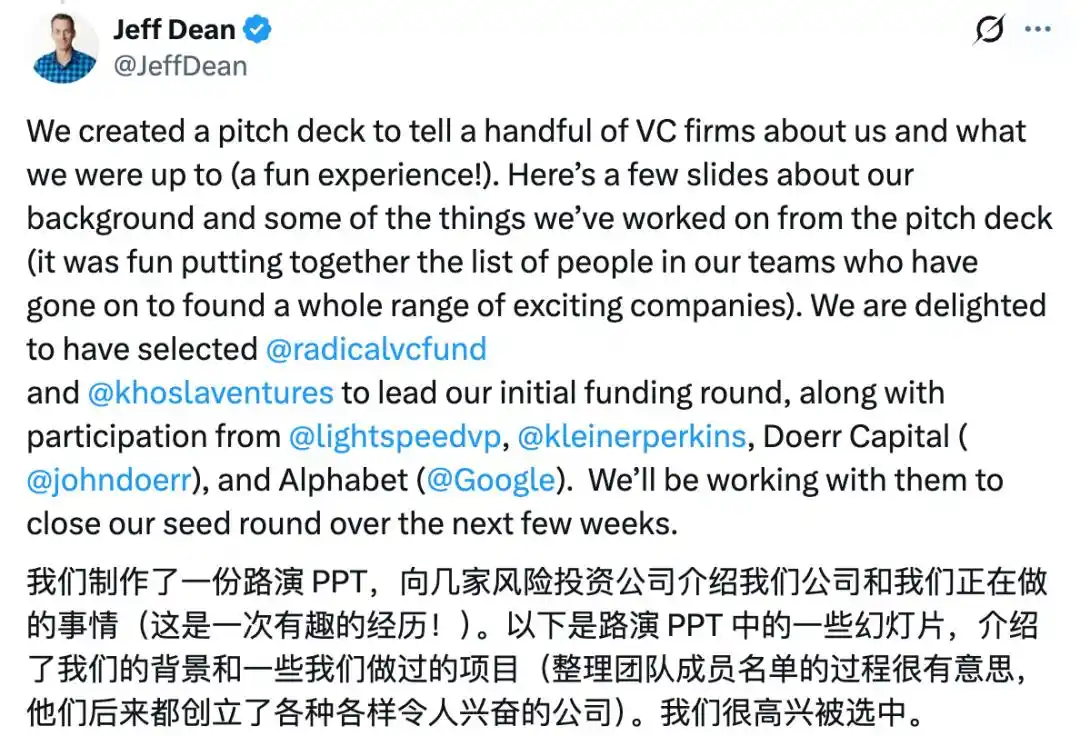
Here are three of its pages:
First page, What we have built together;
Second page, How large were the teams we managed;
Third page, How strong is our technical influence.
Another page: Here are some personal photos of us...
That's it, just that simple.
Big G's Big Bro (Jeff Dean) be like: Fundraising? Isn't that a walk in the park?
Silicon Valley VCs are already lining up to wire the money.
The founder of one of the lead investors directly stated:
We feel "chosen" to invest in Big Bro's new company, truly an honor!!
Netizens were ecstatic after seeing it: When you run into Big Bro, it's not even clear who's pitching to whom.


Oh Big Bro, Big Bro, even three slides are too many.
"Your pitch deck only needs one page: Google me".

The Most Luxurious Pitch Deck in AI Startup History: What Does It Look Like?
A normal pitch deck usually answers: What problem are you solving, what is your product, how big is the market, how do you plan to make money...
And, why are you the one to do it.
Big Bro, true to his status... starts answering from the last question.
But then again, this is Jeff Dean we're talking about!
You know, back in the old days, this word was synonymous with vibe coding (doge).
He could have just gone with "I, Jeff Dean, send money", yet the big shot still handcrafted such a simple and honest PPT.
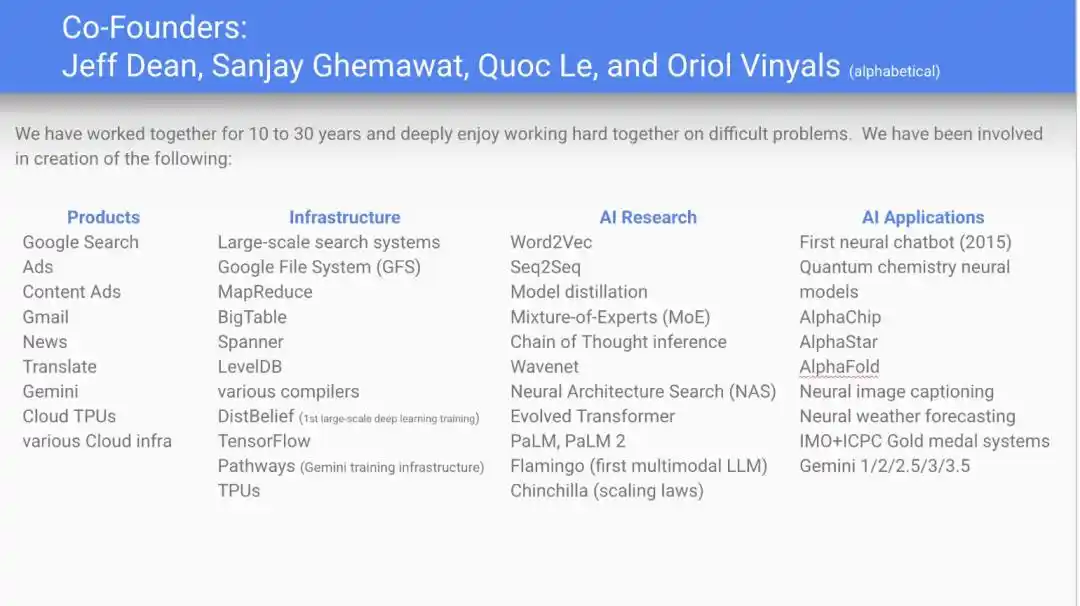
First page: What we have built together.
It lists the names of the 4 founders and their major achievements, categorized into 4 groups:
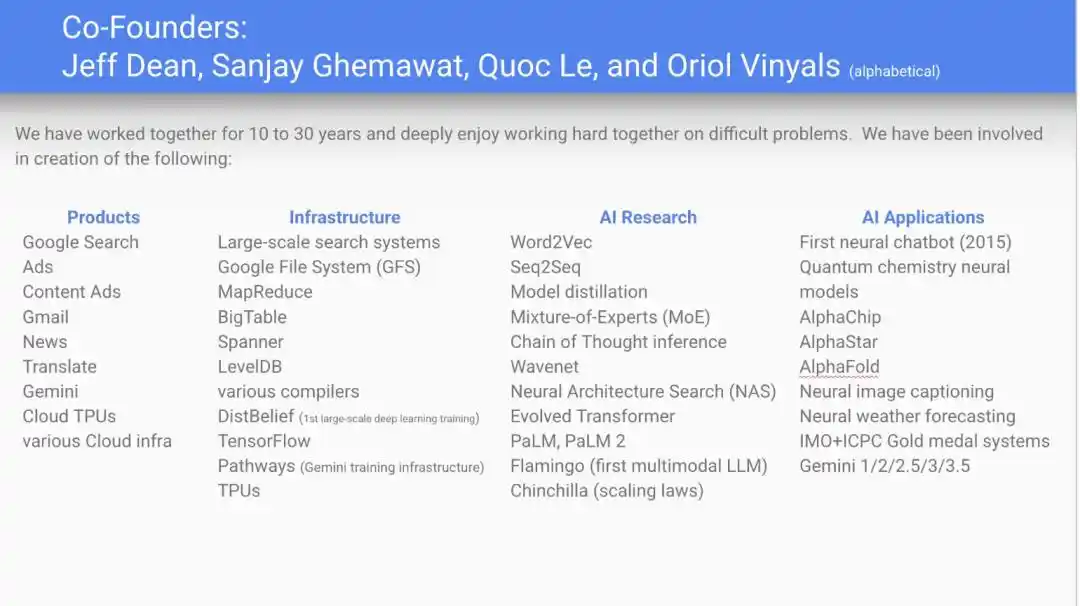
Products: Google Search, Ads, Gmail, Translate, Gemini, Cloud TPU;
Infrastructure: GFS, MapReduce, Bigtable, Spanner, TensorFlow, Pathways;
AI Research: Word2Vec, Seq2Seq, MoE, Model Distillation, PaLM, Flamingo, Chinchilla;
AI Applications: AlphaChip, AlphaStar, AlphaFold, Weather Forecasting, and various generations of Gemini models.
...What is this? It's like they brought the entire Google product catalog up there.
As netizens joked:
The best product I ever made at Google: Google.
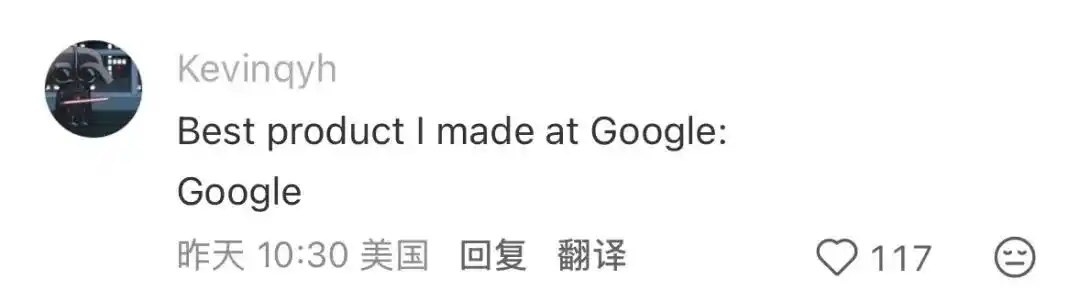
△ Source: Xiaohongshu user comment @Kevinqyh
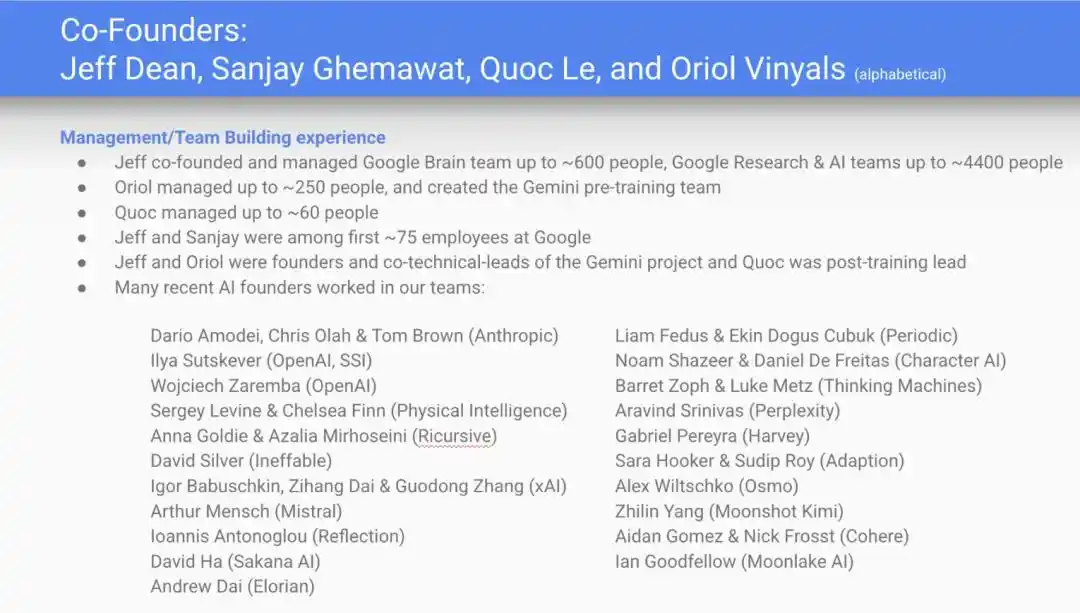
Second page: How large were the teams we managed, and which AI entrepreneurs did we mentor.
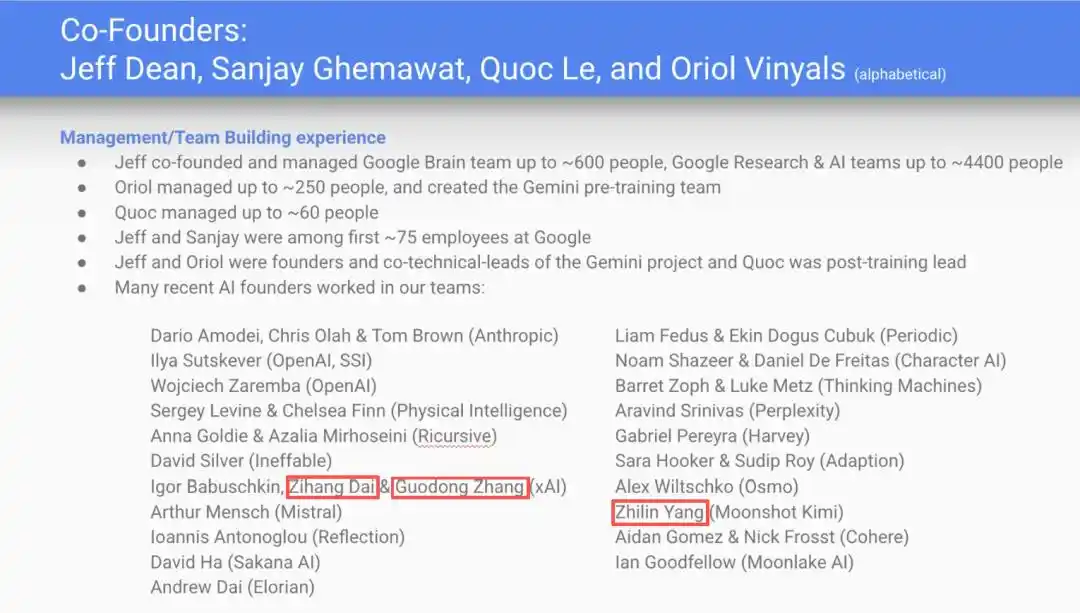
Jeff Dean co-founded and managed Google Brain, with a team size that once reached about 600 people; the Google Research and AI teams he managed peaked at around 4400 people.
Oriol Vinyals managed a team of about 250 people and created the Gemini pre-training team.
Quoc Le managed a team of about 60 people.
All three have respectively served as Gemini co-tech leads, working on pre-training and post-training.
Even more outrageous is the long list pulled out below... basically covering half the AI world today.
Dario Amodei, Ilya Sutskever, Noam Shazeer... these household names aside, there are also founders of well-known AI labs like Physical Intelligence, Thinking Machines, and Sakana AI.
Among the familiar Chinese faces is Yang Zhilin.
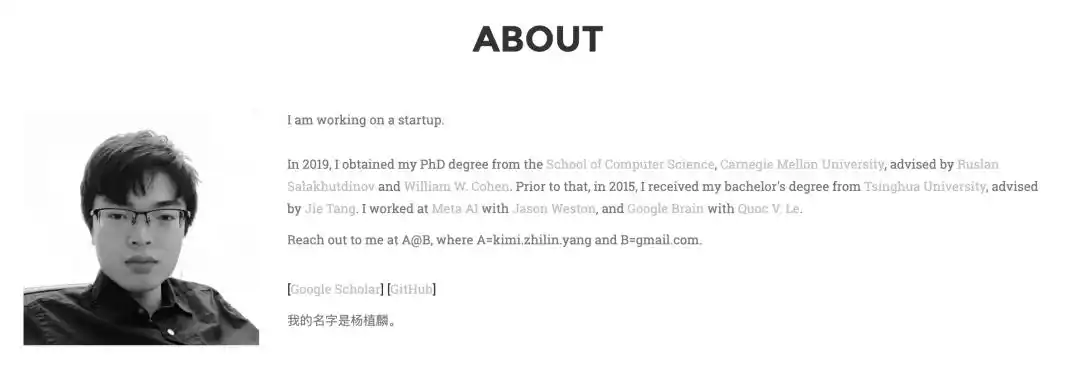
During his PhD at Carnegie Mellon, he joined Google Brain, collaborating with Quoc Le's team on language model architectures and pre-training methods.
During this period, he, together with Dai Zihang and others, proposed Transformer-XL and XLNet.
The former attempted to break through the fixed text window of ordinary Transformers, allowing the model to span different paragraphs and retain longer-range information; the latter explored a different pre-training path compared to BERT, surpassing BERT on 20 natural language processing tasks reported in the paper.
The rest, as they say, is history.
Yang Zhilin founded Moonshot AI and created Kimi. Kimi was first remembered by users for its long-context capabilities.
Technologies later disclosed by Moonshot AI, such as Mooncake, MoBA, and Kimi Linear, already employed different methods to address the reasoning costs, attention computation, and caching pressures brought by long contexts.
Dai Zihang, Yang Zhilin's long-time partner, later joined the founding team of xAI.
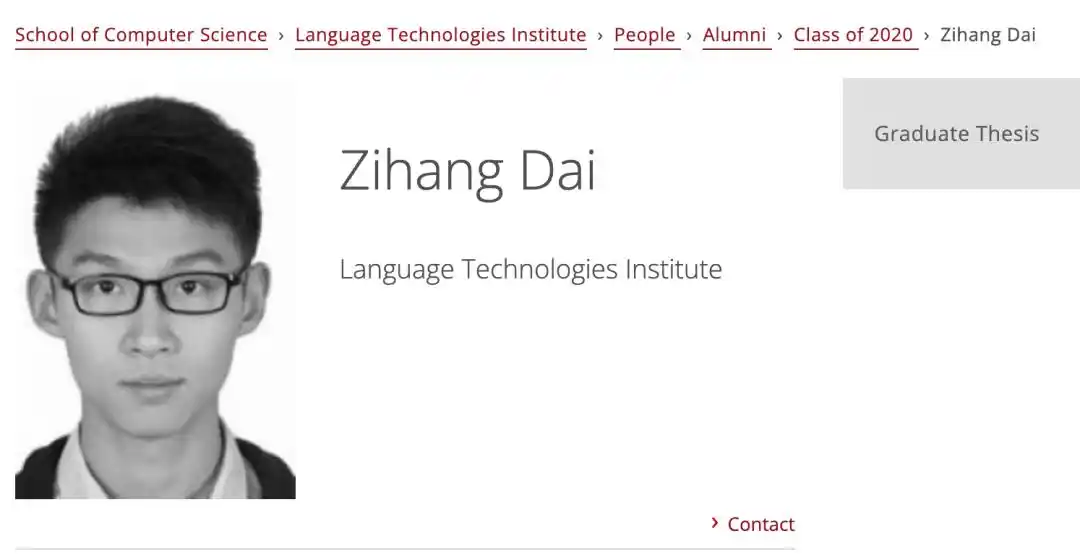
During his PhD at Carnegie Mellon, he collaborated with the Quoc Le team at Google Brain, co-authoring Transformer-XL and XLNet with Yang Zhilin. In both papers, they were noted as co-first authors.
After completing his PhD, Dai Zihang joined Google Brain as a research scientist, continuing his work on language models and efficient Transformers.
For example, he contributed to proposing FLASH, which uses a new efficient attention structure to allow models to process longer sequences approximately linearly while maintaining performance. The paper reported up to ~12x training speed gains on different language modeling tasks.
He also appears in the author list of the first Gemini technical report.
Big Bro's PPT also includes another Zhejiang University alumnus, Zhang Guodong.
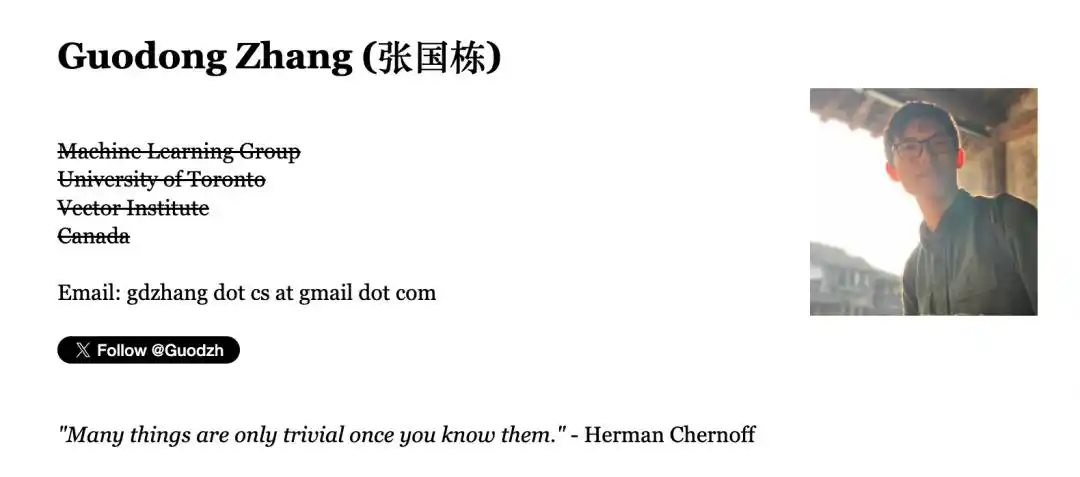
He interned at Google Brain and DeepMind. His representative research includes analyzing which training algorithm choices truly matter under different batch sizes; he has also studied minimax optimization, multi-agent optimization, and how to make models give checkable answers via a Prover-Verifier mechanism.
He is also a co-author of the Deformable Convolutional Networks paper. This work later became an important foundational module in the computer vision field.
In 2023, Zhang Guodong joined the initially publicized founding team of xAI.
Back to Big Bro's PPT.
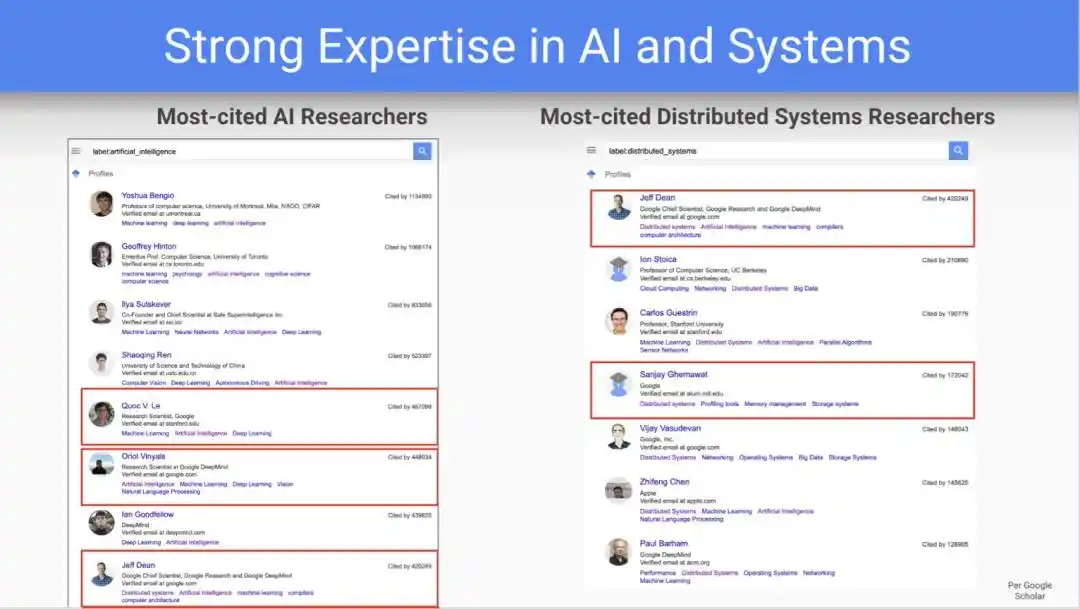
Third page: How strong is our academic influence in AI and distributed systems.
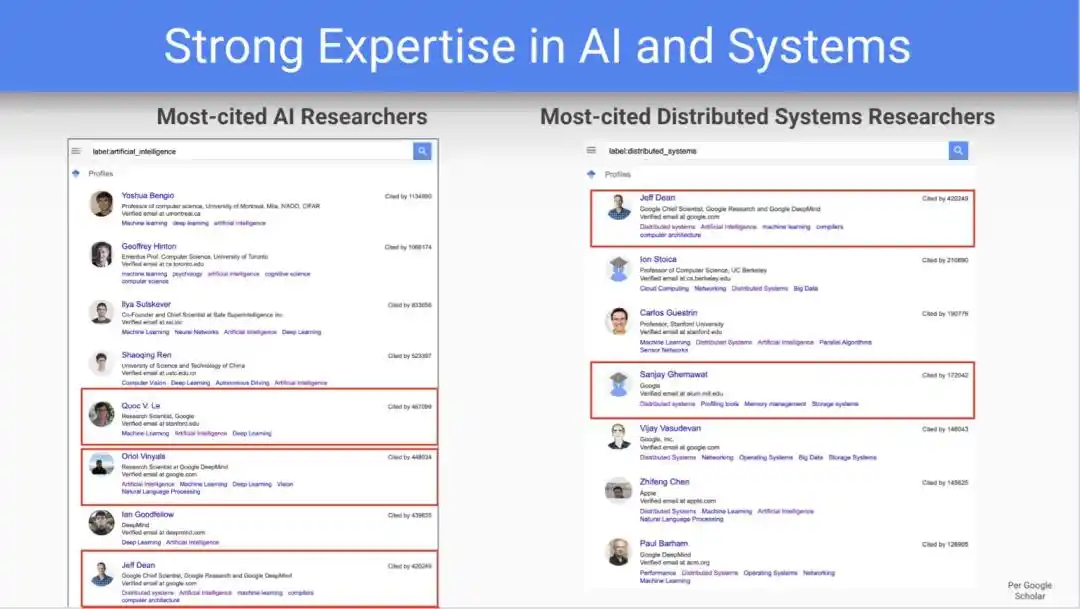
On the left is a Google Scholar screenshot showing "Highly Cited AI Researchers".
Quoc Le, Oriol Vinyals, and Jeff Dean are all highlighted with red boxes.
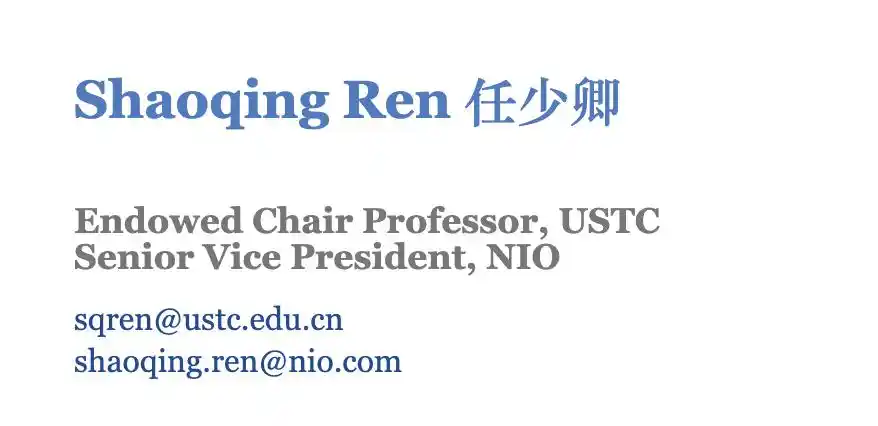
On the same page, you can also see influential scholars like Yoshua Bengio, Geoffrey Hinton, Ilya Sutskever, Ian Goodfellow, and Chinese AI researcher Ren Shaoqing.
Ren Shaoqing is a core author of classic computer vision research like Faster R-CNN, later entering the fields of autonomous driving and AI research.
On the right are "Highly Cited Distributed Systems Researchers".
It primarily shows the Google Scholar page for highly cited scholars under the related research tag, with citation counts also constantly updating.
Jeff Dean and Sanjay Ghemawat are again circled in red. Among them, Jeff Dean's total Google Scholar citations have exceeded 420,000, and Sanjay Ghemawat's exceed 170,000.
This also reveals the composition of Discovery Loop's founding team:
Quoc Le and Oriol Vinyals are closer to machine learning and cutting-edge model research, while Jeff Dean and Sanjay Ghemawat possess immense experience in building large-scale systems.
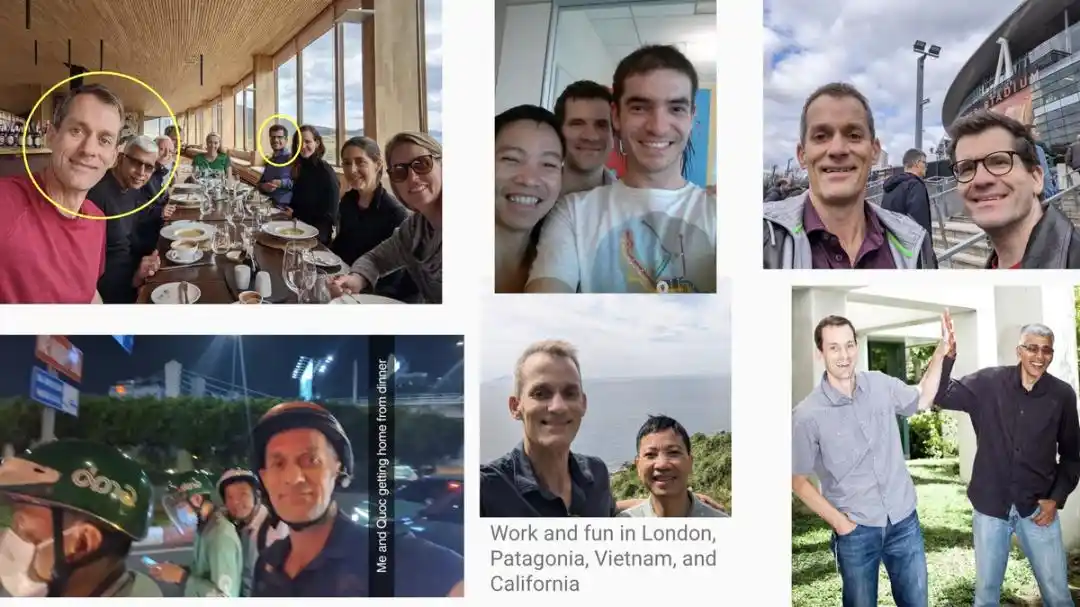
Additionally, Big Bro even included photos of their various gatherings, outings, and fun times in the pitch deck...
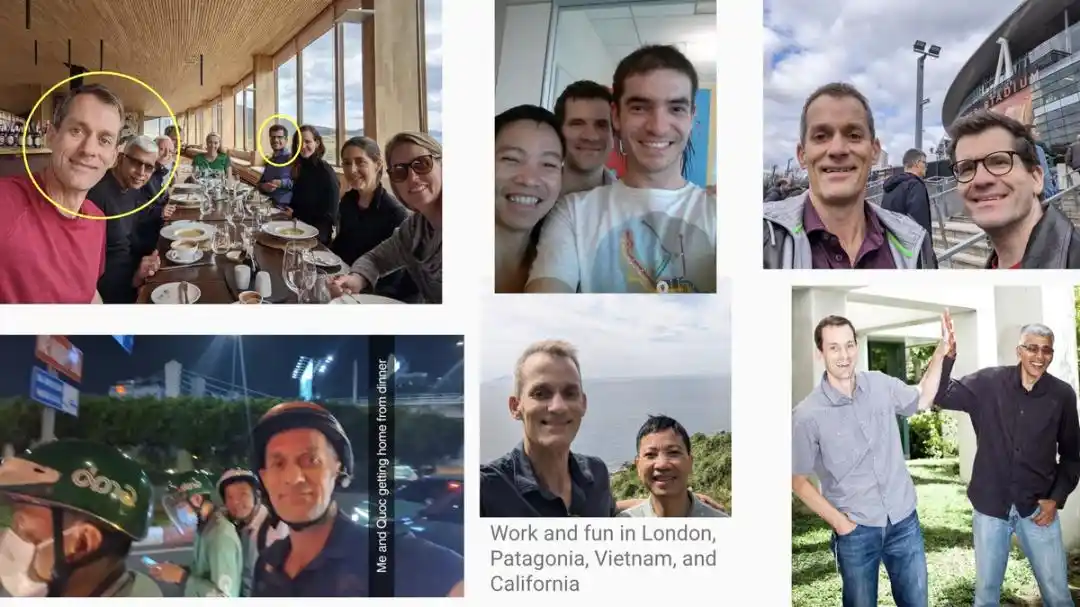
The large yellow circle in the upper left is Jeff Dean himself; next to him with glasses and gray hair is Sanjay Ghemawat; the person with glasses in the small yellow circle in the middle of the table is Oriol Vinyals.
The other photos show various snapshots of their lives together: watching a game in London, dining in Patagonia, riding a motorbike in Vietnam, high-fiving in California.
At the bottom, a line reads: "We work and play together in London, Patagonia, Vietnam & California."
Showing this in a pitch deck... gotta say, Big Bro, you guys are way too chill. This might be the most relaxed pitch deck presentation in history.
But it also shows that these founders have worked together for decades, well-tuned. This is a huge plus for a startup, as there's no shortage of talented teams that self-destruct due to infighting.
(Like, for example, the Thinking Machines Lab next door)
So, what exactly do they plan to do?
Discovery Loop summarizes its mission as:
Automating Machine Learning, Science & Engineering to Accelerate Discovery & Progress.
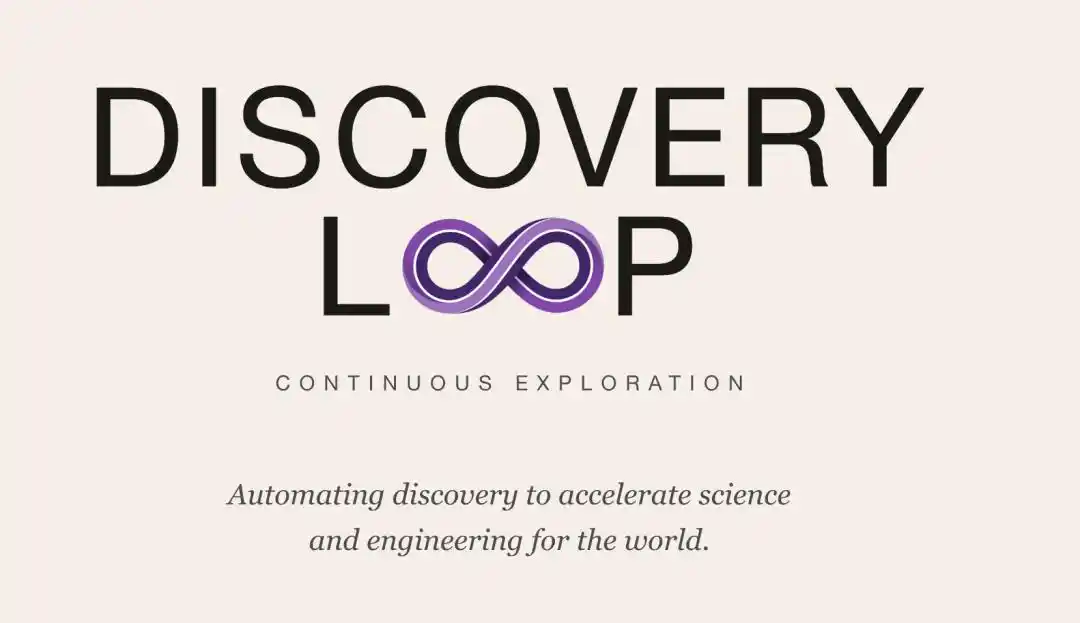
Its basic idea is the "Automated Experiment Loop".
Research today often involves repeatedly going through a cycle: Propose a hypothesis, design an experiment, run the experiment, analyze results, modify the plan, then start the next round.
Discovery Loop aims to bring AI into this loop, running massive numbers of experiments simultaneously and automatically adjusting the next round's plan based on the results.
Initially, the company will focus on the machine learning research and engineering the four founders are most familiar with. In the future, this methodology could be extended to computer hardware, drug discovery, and other scientific and engineering problems.
Many VCs Have Already Snagged a Ticket
With such a luxurious lineup, it's simply a matter of Big Bro picking VCs, not the other way around.
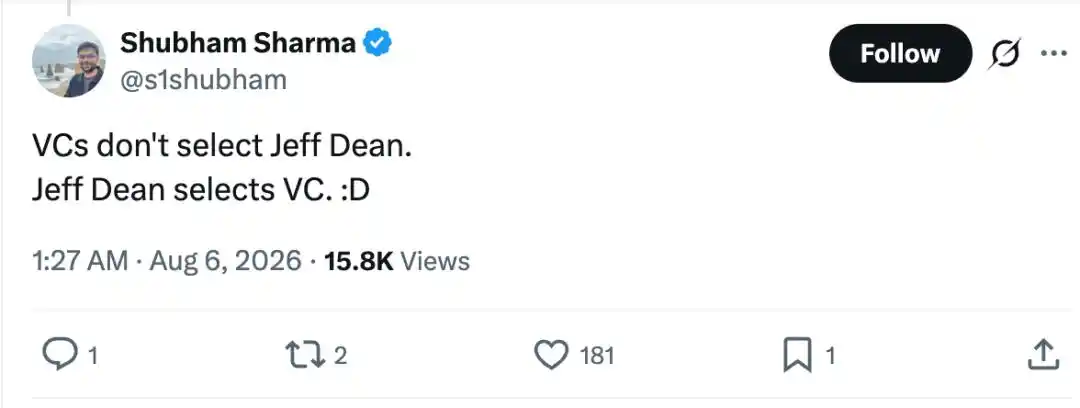
Indeed, some VCs have already secured tickets. Confirmed investors include Khosla Ventures, Radical Ventures, Lightspeed Venture Partners, Kleiner Perkins, and Doerr Capital.
Among them, Khosla Ventures and Radical Ventures are co-lead investors.
They are almost all old-school players in the Silicon Valley VC scene.
Khosla Ventures has long bet on high-risk, heavy-tech projects, having invested in OpenAI back in 2018; Radical Ventures is a Canadian venture firm focused on AI, with a portfolio including Cohere, Waabi, and World Labs.
Furthermore, Jeff Dean's former employer Alphabet also participated in the investment and signed a long-term cloud computing cooperation agreement with Discovery Loop.
The specific financing amount has not been officially announced. Axios, citing insiders, reported the round size reached "hundreds of millions of dollars", but this has not been confirmed by Discovery Loop or the investment firms.
Interestingly, some VCs that got tickets are actively stepping forward, beating the drums and spreading the news.
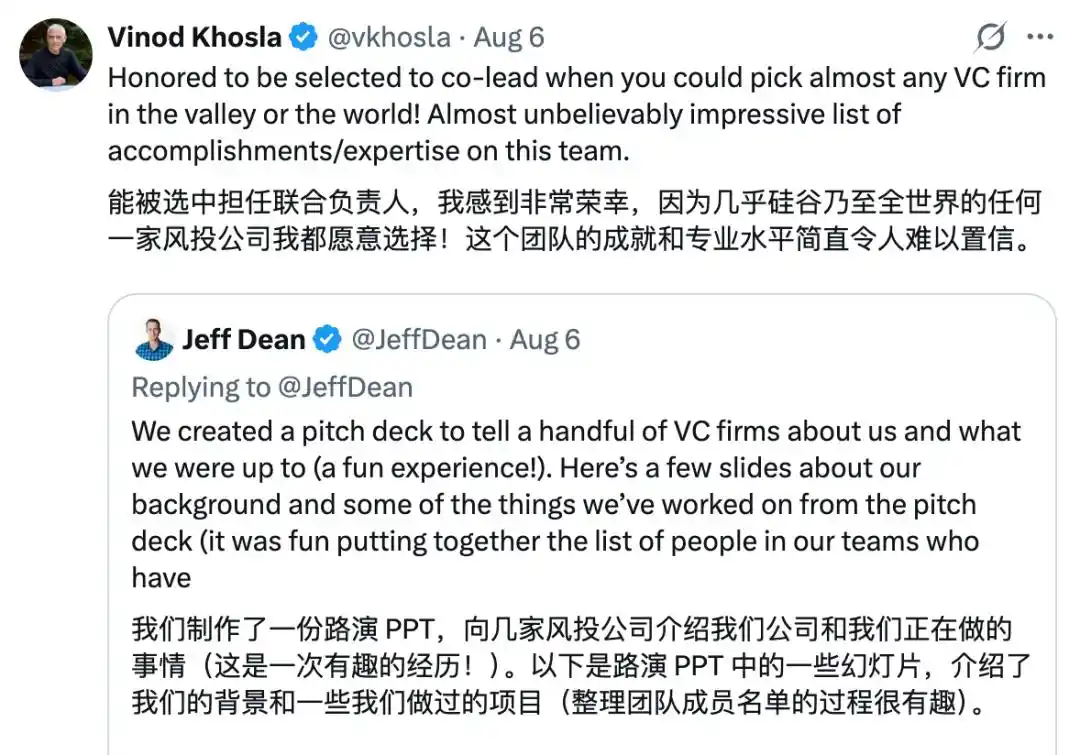
For example, Khosla Ventures founder Vinod Khosla specifically posted on X to announce:
Feeling very honored to be chosen to lead the investment in Discovery Loop!
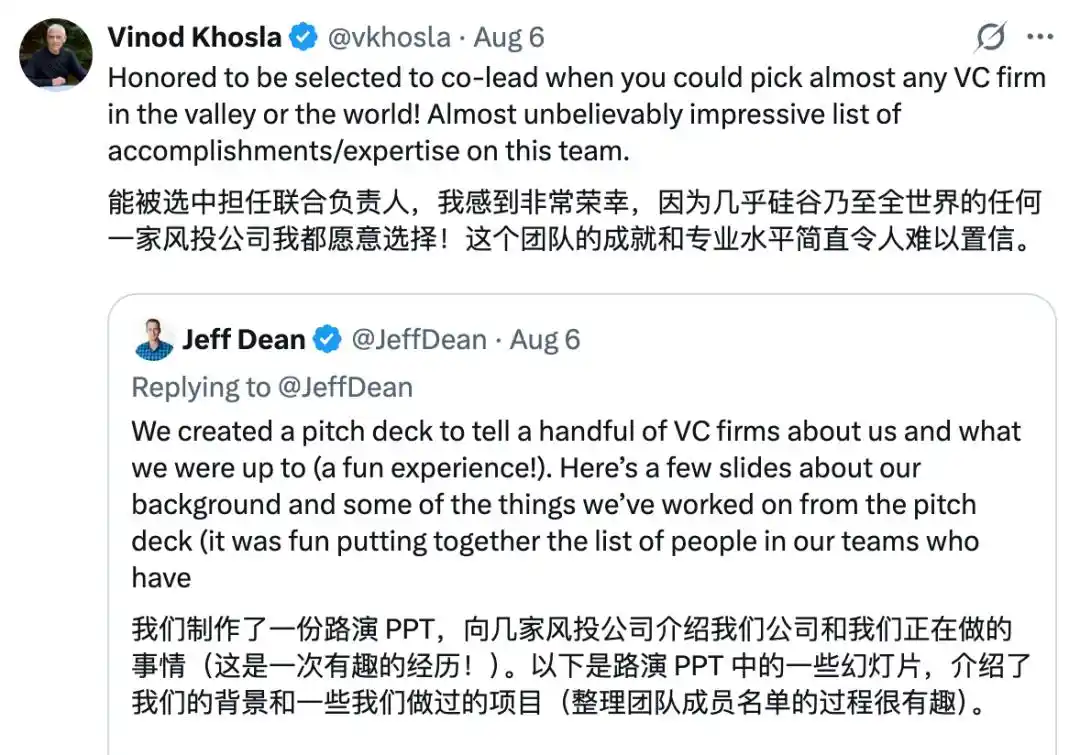
He even compared this bet to the 2018 investment in OpenAI, believing Discovery Loop could bring an impact of a similar magnitude.
Another lead investor, Radical Ventures, also had its partner announce the news on domestic social media.
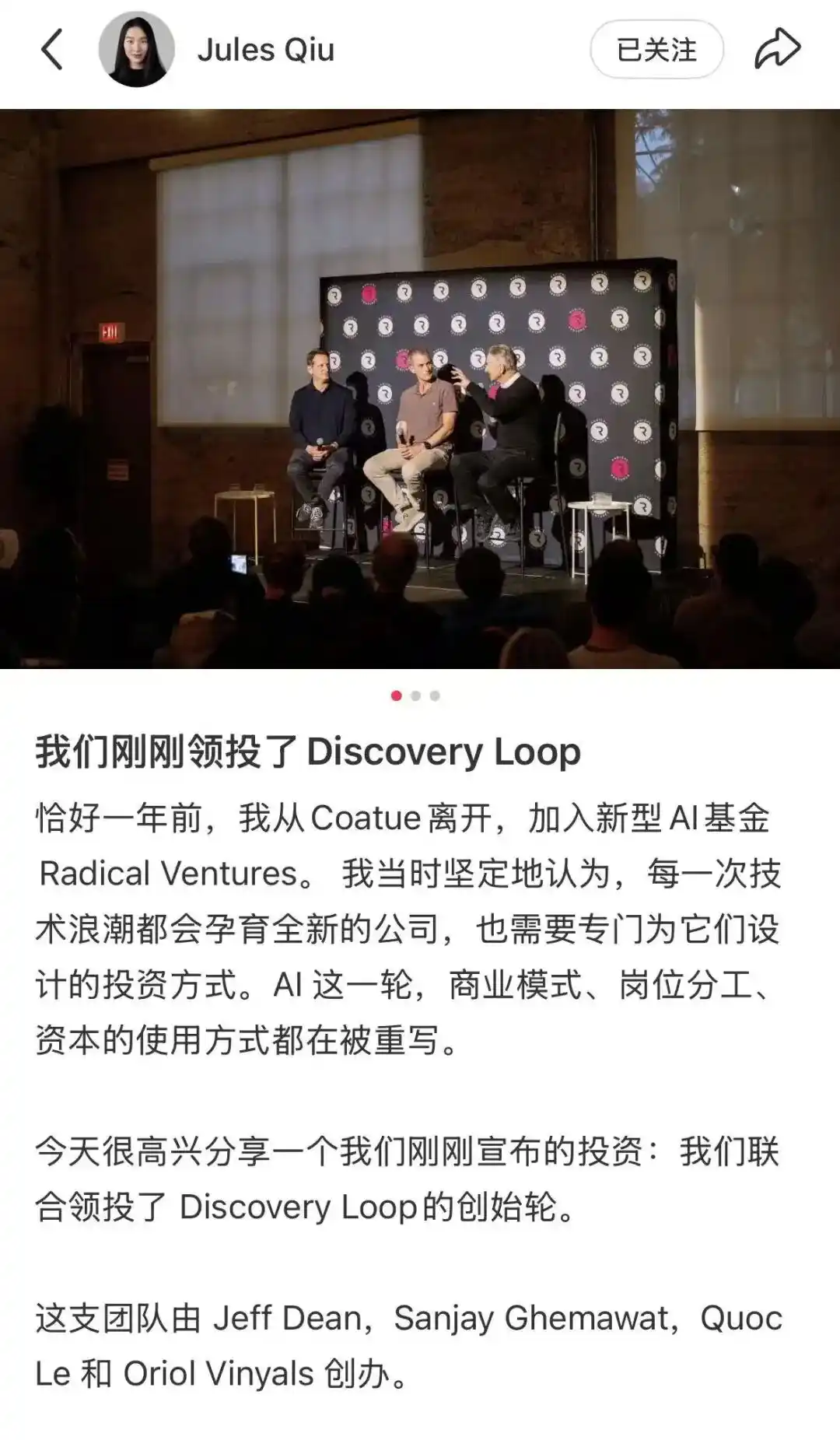
Source: Radical Ventures investor Xiaohongshu @Jules Qiu
The immense influence of Google's Big Bro is evident.
VCs be like:
"Big Bro, here's the check, you... you just fill in the amount."

One More Thing
Speaking of which, after Big Bro left, Google employees weren't exactly heartbroken.
Their first reaction was:
"Google hasn't lost Big Bro; it has finally open-sourced him to all of humanity!"
"Jeff Dean left Google so that the development speed of machine learning can finally catch up to him!"
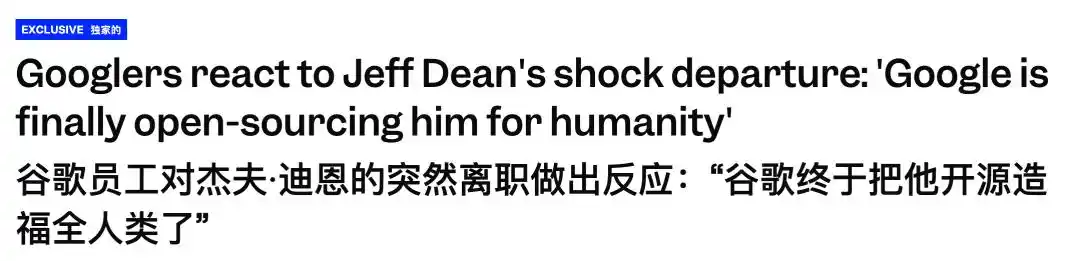
Alright, alright, how can this not be considered a major contribution from Google to the open-source world?
(It would be even better if Gemini 4 gets released directly)
Big Bro's new company: https://www.discoveryloop.com/
References:
[1]https://x.com/JeffDean/status/2085036253263921218
[2]https://x.com/JeffDean/status/2085034604172603724
[3]https://x.com/vkhosla/status/2085034150361453032
This article is from the WeChat public account "QbitAI", author: Ting Yu