Infinex Token Sale New Rules: $0.0099 Locked for One Year or $0.03 for Immediate Unlock, Choose One

marsbitPublished on 2025-12-26Last updated on 2025-12-26

Abstract

Infinex, a DeFi platform founded by Synthetix's Kain Warwick, has revised its token sale terms for its INX token. The fully diluted valuation (FDV) has been significantly reduced from $300 million to $99.99 million. The sale will offer two options: tokens can be purchased at $0.0099 each with a mandatory one-year lockup, or participants can opt for immediate unlocking at TGE for a higher price of $0.03 per token, which corresponds to the original $300 million FDV. The token sale is scheduled for January 3-6, 2026, with TGE planned for late January. The changes have sparked strong negative reactions, particularly from Patron NFT holders. They had purchased these NFTs under the previous assumption that they would receive priority allocation and earlier unlock options at a higher valuation. The new rules, which lower the unlock valuation threshold, have devalued their NFTs and undermined the initial value proposition. Despite the FDV reduction, the one-year lockup period remains a major point of community criticism, with many viewing it as overly restrictive in the current market.

Author | Asher(@Asher_ 0210)
Yesterday, Infinex founder Kain Warwick posted on X platform, stating that due to feedback indicating the pricing was too high, the valuation for the Sonar token sale conducted by Infinex on Echo has been lowered from the initially set $300 million to $99.99 million, while the lock-up period remains unchanged at one year, to better adapt to the current market environment.

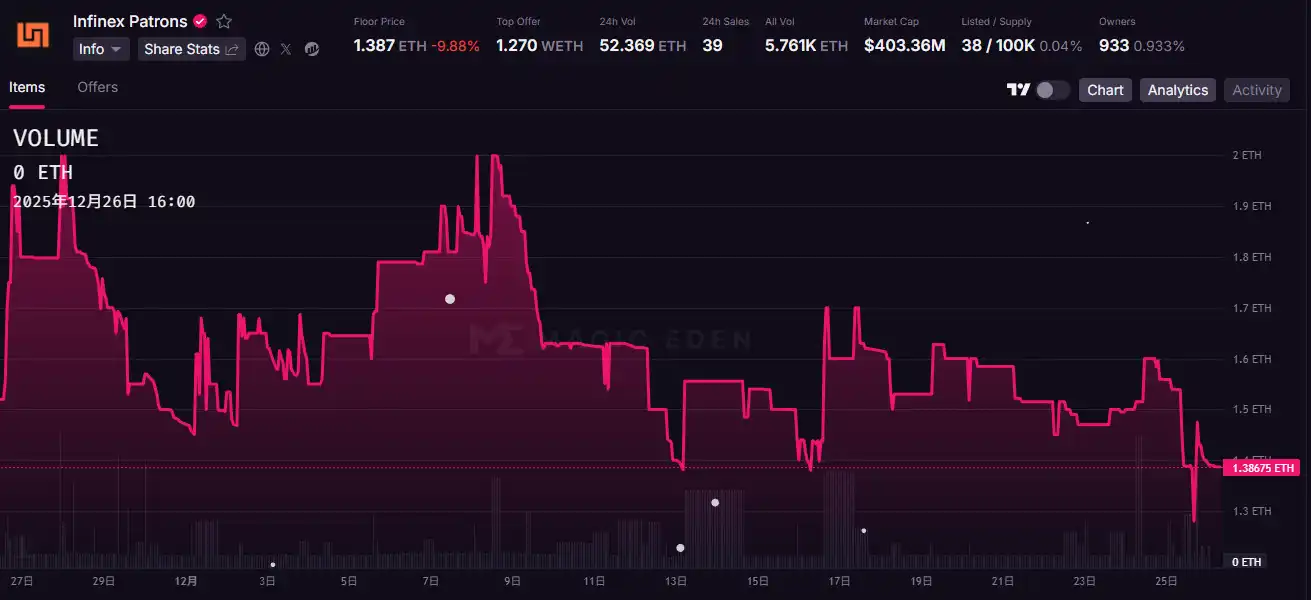
Affected by the FDV reduction, the overall allocation quota for the Sonar sale has decreased, making it impossible to guarantee the priority allocation arrangements for the original Patron NFT holders. The floor price of Infinex Patrons NFT dropped nearly 10% in 24 hours, temporarily reported at 1.387 ETH.
Below, Odaily Planet Daily takes you through the Infinex project, the new token sale rules, and community sentiment.

Infinex: Full-Stack DeFi Services

Infinex is a decentralized finance platform launched by Synthetix founder Kain Warwick in April 2024. Its goal is to provide a product form close to the experience of a centralized exchange under the premise of decentralization, thereby narrowing the usability gap between CeFi and DeFi. While maintaining non-custodial assets and on-chain security, the platform focuses on optimizing the interaction process and user experience.
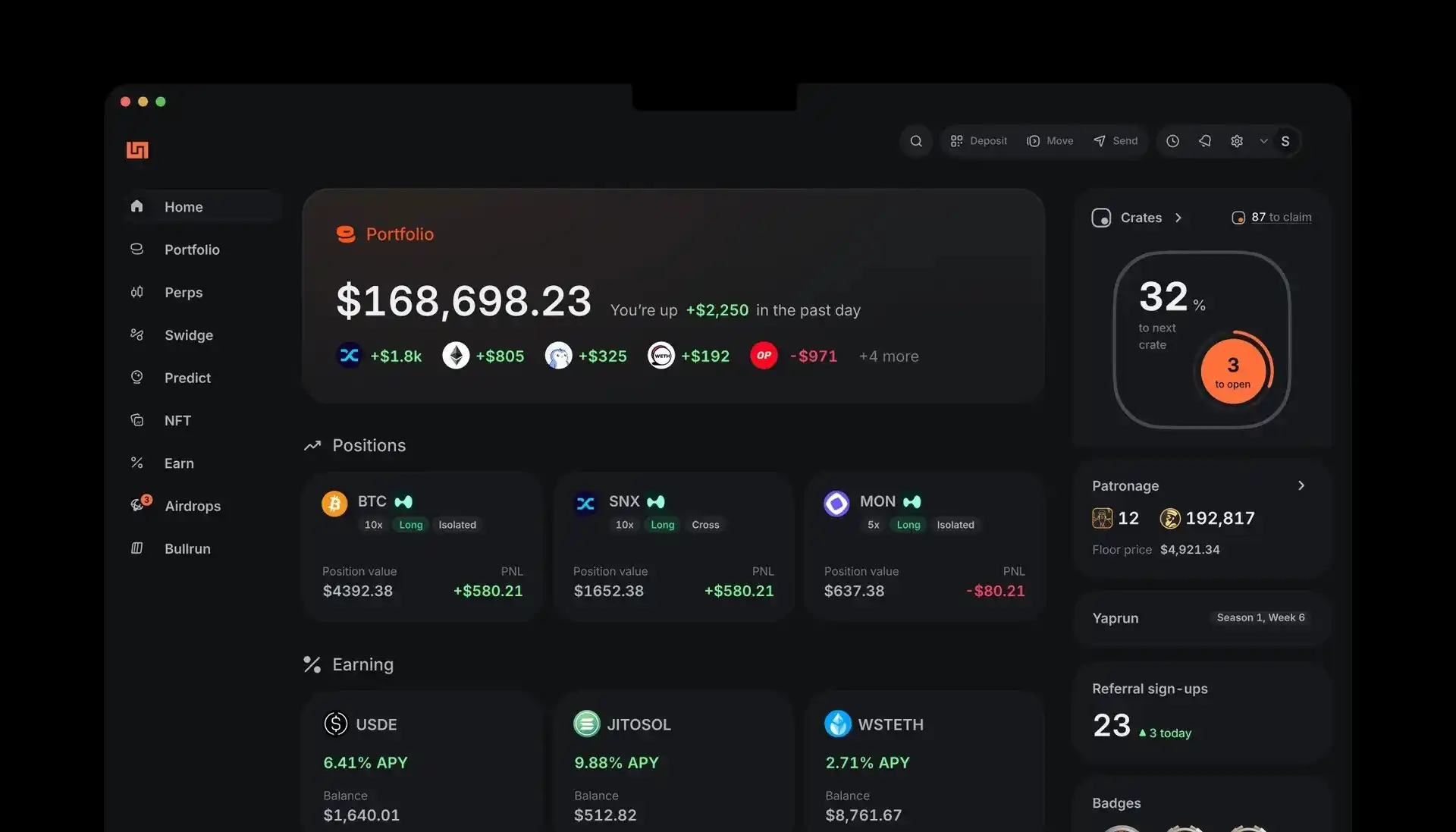
From a product positioning perspective, Infinex is not a single-function application, but rather closer to a full-stack DeFi service entry point. Its core capabilities include: acting as a non-custodial wallet covering multiple chains to host user assets; serving as a unified interface, aggregating and integrating various on-chain DeFi protocols and services; and simultaneously, through highly abstract interaction design, hiding complex concepts such as address management, cross-chain bridging, seed phrases, and Gas fees in the background. This allows users to complete interactions with DeFi applications without needing to understand the underlying mechanisms, making the overall user experience closer to CeFi products.

To date, Infinex has supported 15 blockchain networks including Ethereum, Solana, and Base. The integrated DeFi functions cover cross-chain trading (Swidge), perpetual contracts (Perp), liquid staking, and other yield-generating services (Earn), among others.

Infinex Token Sale New Regulations

According to the official Infinex documentation, the updated details of the Infinex token sale are as follows:

  • INX Token Sale Account Registration Date: Starting December 27th;
  • INX Token Official Sale Date: January 3rd to January 6th, 2026;
  • Infinex TGE Date: Planned for late January 2026;
  • Sale Quantity: 5% of the total token supply;
  • FDV: Valuation lowered from the initially set $300 million to $99.99 million;
  • Lock-up Situation: Locked for one year;
  • Purchase Quantity: Minimum amount is $200, maximum amount is $2500. If the token sale is oversubscribed, the chance of obtaining an allocation can be increased by sharing participation details on X. Regular users can get a 3x multiplier by sharing on X, while Patreon NFT holders can get a 10x multiplier.

Additionally, the INX tokens in this sale offer an early unlock option. If early unlock is chosen, the corresponding valuation at TGE is a $300 million FDV, with a single token price of $0.03. Thereafter, this valuation will be linearly reduced over the following year, finally settling at a $99.99 million FDV, corresponding to a single token price of $0.0099.

Community Sentiment: Negative Voices Dominate, Patron NFT Holders Particularly Dissatisfied

"A $300 million valuation allows for full unlock at TGE, so what does that make the Patron NFT I bought at an implied $500 million valuation worth?" This is the most direct question raised by many Patron NFT holders after the announcement of the new rules. According to the previous sale expectations, participants could join the token sale at a $300 million FDV. If they wished to unlock at TGE, they would need to correspond to a higher valuation threshold, approximately a $1 billion FDV. It was under this expectation that some users chose to purchase Patron NFTs at a higher implied valuation to secure more certain allocation rights and earlier liquidity.

However, after the adjustment of the new plan, the valuation threshold for early unlock was significantly reduced to a $300 million FDV, noticeably weakening the Patron mechanism which originally relied on a high valuation to exchange for unlock rights and priority. This means that the premium paid by Patron NFT holders previously for "certainty" and "early unlock" is no longer valid, and some holders have turned to a state of negative returns both on paper and in expectation.

In response to this controversy, Kain Warwick stated that the purpose of the new plan is to promote broader distribution of the token and increase overall participation and market heat before TGE. However, in the view of some Patron holders, this explanation hardly covers their core losses and fails to fully address the expectation gap suffered by early supporters due to the mechanism change, thus not completely quelling the controversy.

Furthermore, the unchanged 1-year lock-up period remains the biggest pain point in community discussions. Although the significant reduction in FDV has somewhat alleviated market criticism of the high valuation, it has not changed the strong dissatisfaction of most community members towards the "1-year lock-up period," which they believe is almost equivalent to a "death sentence in advance" in the current market environment.


Trending Cryptos

Related Questions

QWhat are the two options for purchasing INX tokens in the updated Infinex token sale?

AParticipants can choose between two options: 1) Purchase tokens at $0.0099 per token with a one-year lockup period, or 2) Purchase tokens at $0.03 per token for immediate unlocking at TGE.

QWhy did Infinex reduce the fully diluted valuation (FDV) for its Sonar token sale?

AInfinex reduced the FDV from the initially set $300 million to $99.99 million in response to community feedback that the original pricing was too high, aiming to better adapt to the current market environment.

QWhat negative impact did the FDV reduction have on Infinex Patron NFT holders?

AThe FDV reduction decreased the overall token allocation, eliminating the guaranteed priority allocation for Patron NFT holders. This caused the floor price of Infinex Patrons NFT to drop nearly 10% in 24 hours to 1.387 ETH.

QWhat is the core product vision of the Infinex platform?

AInfinex is a full-stack DeFi service platform aiming to provide a user experience close to that of a centralized exchange (CeFi) while maintaining non-custodial asset security and on-chain decentralization. It simplifies DeFi interactions by abstracting complex concepts like address management and gas fees.

QWhat was a major point of community criticism regarding the token sale terms that remained unchanged despite the FDV adjustment?

AThe one-year lockup period remained a major point of community criticism. Many members expressed strong dissatisfaction, believing that a one-year lockup is excessively long and unfavorable in the current market climate.

Related Reads

In Conversation with Ray Dalio: We Are Currently in an AI Bubble, with 1% of My Portfolio in Bitcoin

Ray Dalio, founder of Bridgewater Associates, warns in an interview that the current AI boom shows classic bubble characteristics, which could lead to significant economic downturns as seen in past cycles like 1929 or 2000. He explains that speculative enthusiasm, fueled by debt and overvaluation, often precedes a crash when rising rates or taxation force asset sales, causing widespread losses and recession. Dalio also outlines his "Big Cycle" theory, describing an approximate 80-year pattern where widening wealth gaps, massive government deficits, and shifting geopolitical power (like China's rise) create internal conflict and global instability. He emphasizes that we are in a late-cycle, transitional phase where traditional powers like the US and UK face decline. For personal wealth protection, Dalio advises diversification beyond cash into assets like stocks, bonds, real estate, and particularly gold, which he prefers over Bitcoin. While he holds about 1% of his portfolio in Bitcoin as a non-printable hard asset, he views gold as more secure from technological or governmental threats. Regarding AI's impact, Dalio believes it will disproportionately benefit capital owners, worsening inequality by replacing both physical and cognitive labor. He suggests that human intuition and emotional intelligence, combined with AI, will be key for future workers. On taxation, Dalio argues that wealth taxes are impractical and risk triggering asset sell-offs, reducing productive investment. He points to the UK as a cautionary example of debt, low productivity, and political strife. Geopolitically, Dalio foresees a more regionalized world, with the US showing weakness in prolonged conflicts like with Iran, akin to past imperial declines. The ideal outcome, he suggests, is coexisting powerful blocs (e.g., Americas, China-Asia Pacific) without major war.

marsbit2h ago

In Conversation with Ray Dalio: We Are Currently in an AI Bubble, with 1% of My Portfolio in Bitcoin

marsbit2h ago

Daily 7.2 Trillion KRW: Foreign Capital's Record Net Buying on Friday! Wall Street Says Headwinds for Korean Stock Fund Flows Have Subsided

South Korean stock market sees a dramatic shift in fund flows. On July 31, foreign investors made a record net purchase of approximately KRW 7.2 trillion in KOSPI stocks, marking a fundamental reversal from the persistent large-scale net outflows seen in previous months. This contributed to a significant narrowing of foreign net selling in July to KRW 9.8 trillion, down sharply from KRW 48.4 trillion in June and KRW 44.5 trillion in May. Simultaneously, domestic institutional pressure eased. South Korean pension funds and asset managers turned to a net buying position in July, purchasing KRW 1.0 trillion worth of KOSPI shares, contrasting with net sales in May and June. Market volatility is expected to be dampened by new financial regulations. Effective July 31, the Financial Services Commission tightened access for retail investors to single-stock leveraged ETFs by raising the minimum cash deposit requirement. Trading volumes for these products subsequently dropped to about 50% of their monthly average. Citigroup Research maintains its year-end KOSPI target of 10,000 points. The firm cites several supportive factors: the substantial easing of headwinds from capital outflows, a robust fundamental outlook for the semiconductor sector, historically low market valuations, strong economic fundamentals, and the potential for policy support from financial authorities if needed.

marsbit2h ago

Daily 7.2 Trillion KRW: Foreign Capital's Record Net Buying on Friday! Wall Street Says Headwinds for Korean Stock Fund Flows Have Subsided

marsbit2h ago

Thanks to Dice Rolls, Bitcoin Keys Are Stored Offline, But Not Everyone Will Do It

The article discusses using dice rolls to generate secure Bitcoin wallet seeds, providing entropy independent of potentially flawed hardware random number generators. It explains that each fair dice roll offers about 2.585 bits of entropy, with around 50 rolls needed for a standard 12-word seed phrase and 99+ recommended for higher security. This method gained attention after a vulnerability was revealed in some Coldcard hardware wallets, where a faulty firmware RNG (dating back to 2021) compromised generated keys. The analysis notes that while a dice-generated main seed was safe from this specific flaw, other Coldcard functions (like creating paper wallets, backup keys, or passwords) could still be vulnerable if they used the defective RNG. The piece argues that while dice-based entropy is technically robust, the manual process is error-prone, tedious, and unrealistic for most new users, who might make mistakes in recording or inputting rolls. It concludes that while manual entropy generation should remain an option for advanced users, the long-term goal is to develop reliable, user-friendly hardware and software that securely generates randomness without requiring specialized knowledge. Coldcard users are advised to check their firmware version and replace any secondary secrets (like paper wallet keys) created with vulnerable devices, while also considering multi-signature setups with devices from different manufacturers for added security.

cryptonews.ru7h ago

Thanks to Dice Rolls, Bitcoin Keys Are Stored Offline, But Not Everyone Will Do It

cryptonews.ru7h ago

Trading

Spot

Hot Articles

How to Buy ONE

Welcome to HTX.com! We've made purchasing Harmony (ONE) simple and convenient. Follow our step-by-step guide to embark on your crypto journey.Step 1: Create Your HTX AccountUse your email or phone number to sign up for a free account on HTX. Experience a hassle-free registration journey and unlock all features.Get My AccountStep 2: Go to Buy Crypto and Choose Your Payment MethodCredit/Debit Card: Use your Visa or Mastercard to buy Harmony (ONE) instantly.Balance: Use funds from your HTX account balance to trade seamlessly.Third Parties: We've added popular payment methods such as Google Pay and Apple Pay to enhance convenience.P2P: Trade directly with other users on HTX.Over-the-Counter (OTC): We offer tailor-made services and competitive exchange rates for traders.Step 3: Store Your Harmony (ONE)After purchasing your Harmony (ONE), store it in your HTX account. Alternatively, you can send it elsewhere via blockchain transfer or use it to trade other cryptocurrencies.Step 4: Trade Harmony (ONE)Easily trade Harmony (ONE) on HTX's spot market. Simply access your account, select your trading pair, execute your trades, and monitor in real-time. We offer a user-friendly experience for both beginners and seasoned traders.

4.7k Total ViewsPublished 2024.03.29Updated 2026.06.02

How to Buy ONE

Discussions

Welcome to the HTX Community. Here, you can stay informed about the latest platform developments and gain access to professional market insights. Users' opinions on the price of ONE (ONE) are presented below.

活动图片