How to Understand CFTC's Regulation of Prediction Markets

marsbitPublished on 2026-10-12Last updated on 2026-10-12

Abstract

On October 9, the U.S. Commodity Futures Trading Commission (CFTC) released two documents with opposing directions. One proposal seeks to include contracts on events like sports, politics, culture, and weather—common in prediction markets—within the definition of a "swap." Simultaneously, an interim final rule explicitly excludes licensed sports betting and casino games from the swap definition. The core issue is regulatory jurisdiction: if a contract is classified as a swap, it falls under exclusive federal CFTC oversight, preempting state gambling laws and taxes. This creates a split where bets on the same NFL event could be regulated as state-licensed gambling if placed at a Las Vegas sportsbook, but as a CFTC-regulated swap if traded on a federally registered exchange like Kalshi. CFTC Chairman Michael Selig asserts that event contracts for hedging, speculation, or information are commodity derivatives under CFTC jurisdiction, while casino-style products are not. The move comes as trading volume for event contracts, particularly in sports, has surged, with platforms like Kalshi and Polymarket reporting billions in weekend volume. The interim rule aims to shield licensed casinos from federal illegality claims in ongoing court battles. However, federal appellate courts are divided: the Third Circuit ruled such contracts are swaps, while the Sixth and Ninth Circuits disagreed. This "circuit split" has prompted New Jersey to petition the Supreme Court for review, supported...

On October 9th, the U.S. Commodity Futures Trading Commission (CFTC) simultaneously released two documents with opposing directions. One proposal aims to include contracts for events such as sports, politics, culture, and weather in prediction markets into the definition of a "swap," while another interim final rule explicitly excludes licensed sports wagering and casino games from being classified as swaps.

In plain terms, a swap is a contract where payment is determined by an outcome. Under U.S. derivatives law, once a type of contract is classified as a swap, it typically falls under the unified regulation of the CFTC. State gambling licenses and state taxes cannot govern it—this is federal preemption.

Therefore, the core of the dispute is who gets to set the rules for the same NFL game: if placed at a Vegas counter or on the DraftKings app, it's state-regulated gambling; if listed as an event contract on a federally registered exchange like Kalshi, the CFTC asserts it's a swap.

Michael Selig, the Chairman of the CFTC, is the only currently serving member among the five commissioners. His statement is straightforward: Americans use event contracts for hedging, speculation, and information acquisition; these products are commodity derivatives and fall under the exclusive jurisdiction of the CFTC. Casino-style products, however, are not derivatives.

Trading volume is the backdrop for this round of actions. According to the CFTC's own report, the scale of event contracts on U.S. registered exchanges (DCMs) in August was approximately $1.5 billion, with sports contracts accounting for about $1.2 billion. Market figures are much larger: Kalshi and Polymarket recorded a combined trading volume of roughly $8.56 billion over a weekend in October, with sports contracts being the primary driver of this surge.
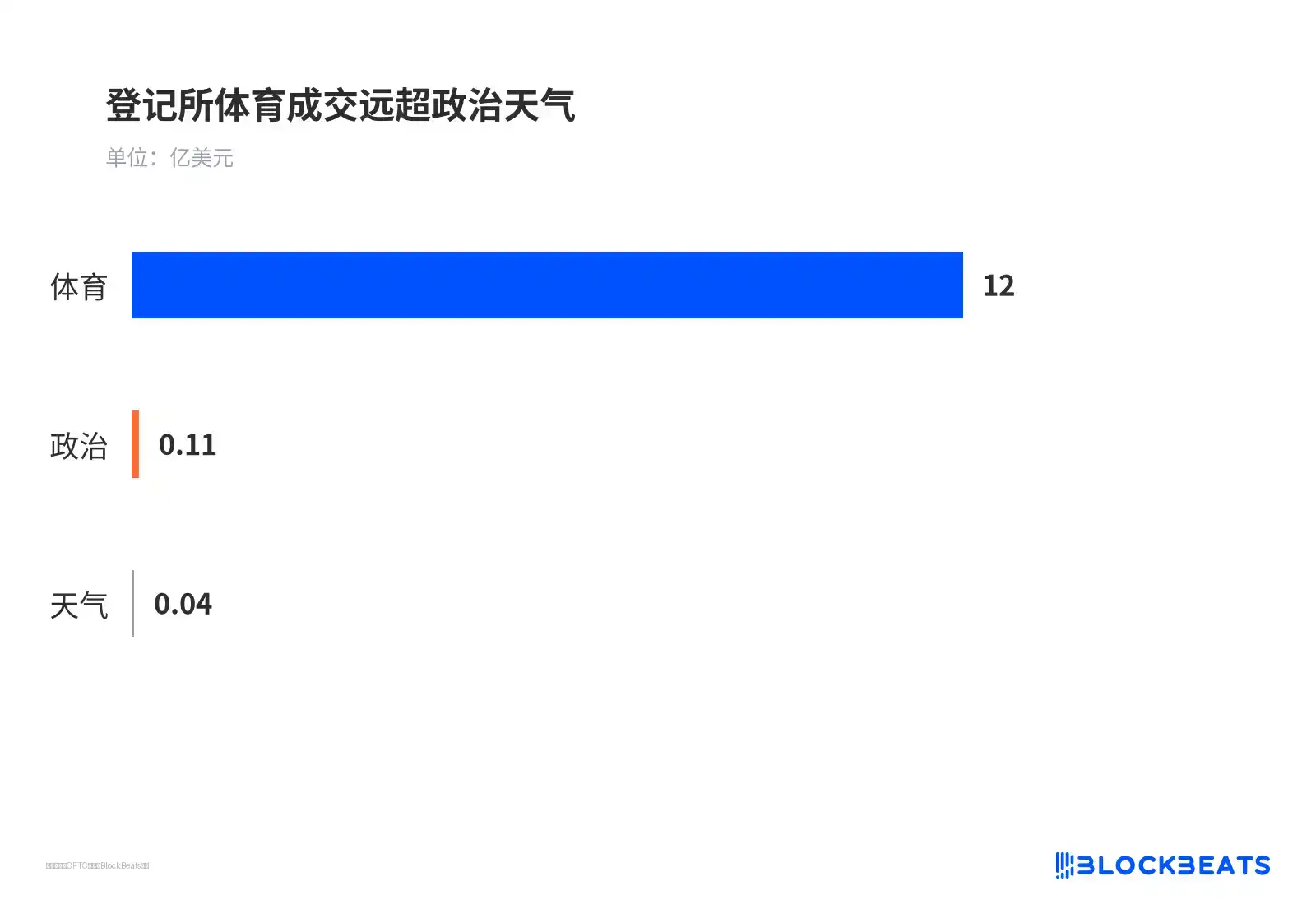
Exchange-Registered Sports Trading Volume Far Exceeds Politics and Weather

One Inclusion, One Exclusion: The Swap Definition is Pushed in Two Directions

The proposal addresses what counts as a swap, while the interim final rule addresses what does not. The latter uses two tests to draw the line: only wagers offered by licensed state or tribal gaming operators *and* not executed on a multilateral trading facility are excluded. Both conditions must be met to qualify as "casino" wagers.

Combining these two boundaries effectively splits sports wagering in half: one half remains with the states, the other is handed over to the federal government. The same sports wager, if placed at a counter in Las Vegas, is gambling; if placed on a federally registered exchange like Kalshi, it becomes a swap.
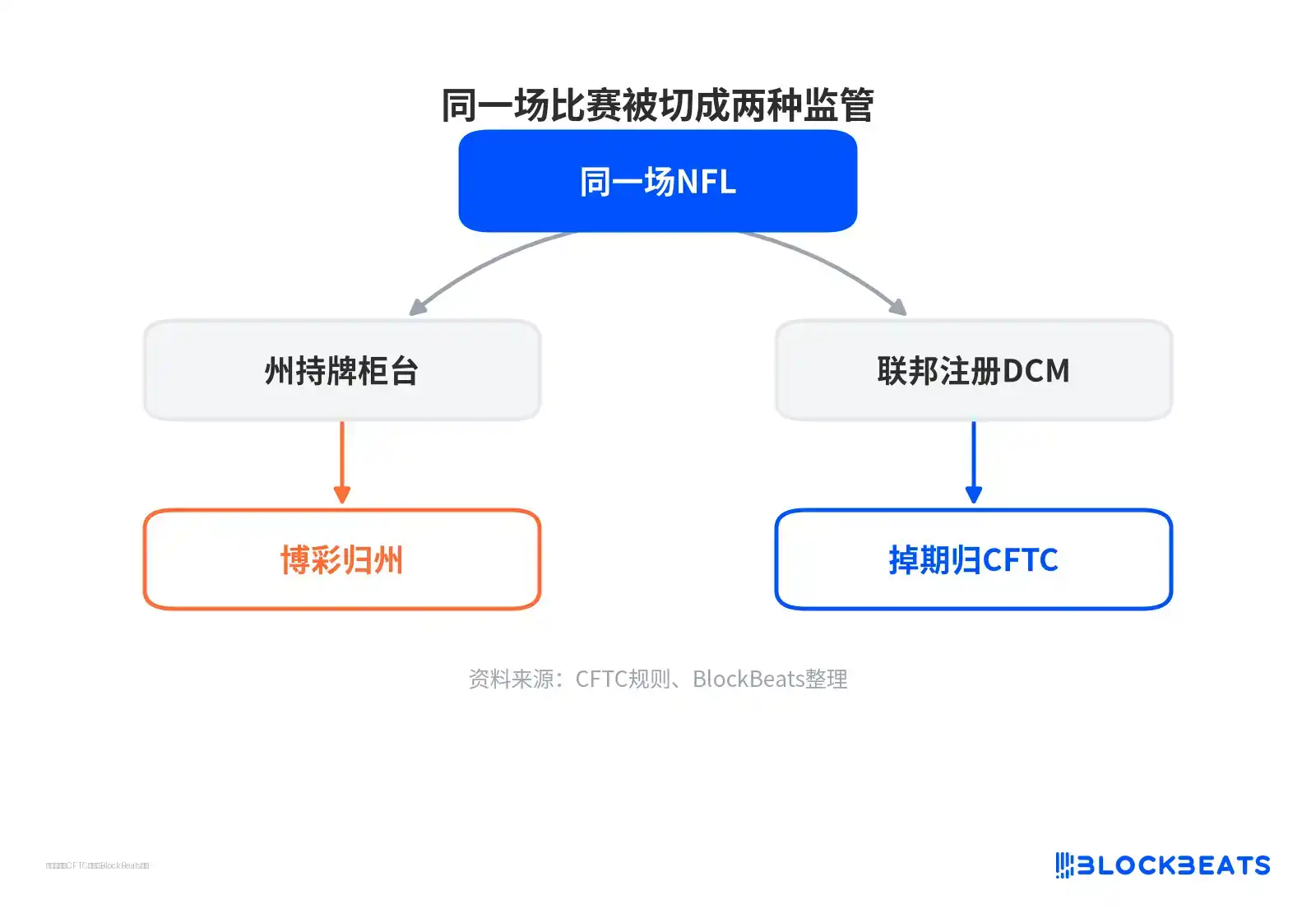
The Same Game Split Under Two Regulatory Regimes

Similar questions have appeared in the American Gaming Association's court brief: if sports bets are swaps, shouldn't wagers placed at Las Vegas counters also have to be on DCMs?

Jaret Seiberg, a policy analyst at TD Cowen, offers another reading. States have repeatedly argued in litigation that the CFTC's definition of a swap is so broad for event contracts that it would make wagers at state and tribal casinos federally illegal as well.

The interim final rule first carves out casinos, precisely to dismantle this line of attack in court. Seiberg's assessment is that this move is primarily to improve the CFTC's legal position; whether it works is another matter.

If this distinction fails to hold up in court, states could use the casino line to pull event contracts back under state law.

The NFL and 39 States: Who Should Set the Rules for the Same Game?

A clear judicial split has already formed. New Jersey has petitioned the Supreme Court regarding its jurisdictional dispute with Kalshi. The NFL and 39 states plus Washington D.C. have filed amicus briefs supporting New Jersey.

The NFL argues that sports event contracts are gambling that creates new risk, not swaps that hedge existing risk. It specifically points out that the CFTC does not prohibit easily manipulated betting lines, nor does it cover wagers related to injuries, referees, or enforce a 21-year age limit. On the first Sunday of this season, prediction markets traded approximately $3.3 billion, with $1.8 billion related to football.

U.S. federal appeals courts are divided into regional circuits, and different circuits can issue conflicting rulings on the same legal issue, creating a "circuit split." The Supreme Court is more likely to intervene once such a split exists. This year, three federal circuit courts of appeals have reached opposite conclusions:

Third Circuit (April this year): Held that sports contracts on DCMs are swaps and can preempt state law.

Sixth Circuit (September) and Ninth Circuit (August): Reached the opposite conclusion, holding that these contracts are not swaps and state law can apply.
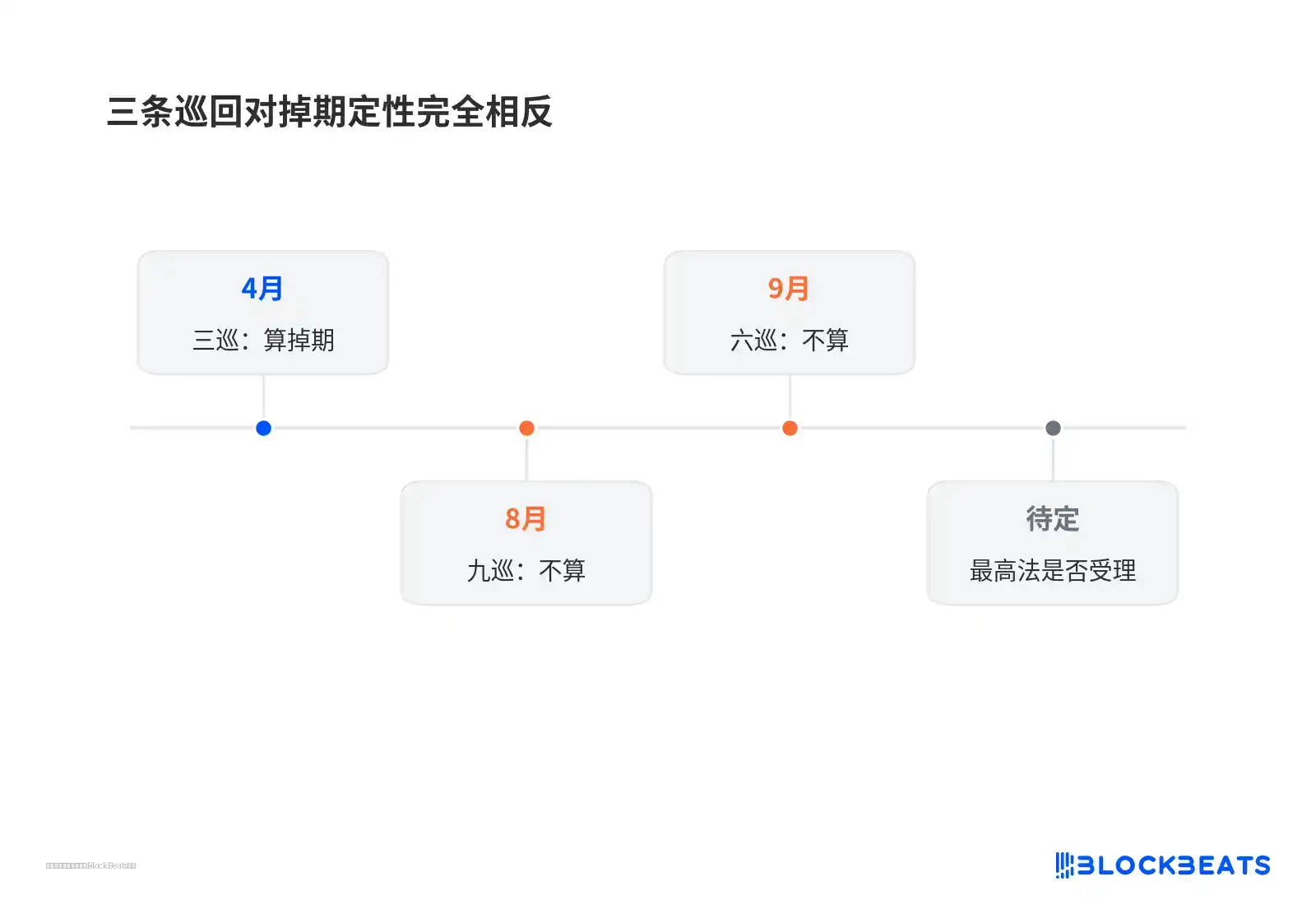
Three Circuits Completely Opposed on Swap Classification

With the three circuits at odds, the same contract could receive opposite classifications in different jurisdictions. This is precisely why New Jersey is taking the issue to the Supreme Court. Kalshi's response deadline is November 9th; the Supreme Court has not yet decided whether to hear the case.

Rules Not Yet Effective; Variables Lie in Courts and Commissioner Seats

As of now, neither document has been published in the *Federal Register*. The comment period for the proposal begins upon publication and lasts 30 days; the interim final rule also takes effect upon publication. Stating that it has "entered the comment period" or "has taken effect" at this point is inaccurate.

A more critical variable lies with the courts. New Jersey's petition places the split between the Third Circuit and the Sixth/Ninth Circuits before the nine Justices. Whether they will hear the case remains unknown. Administrative rules can strengthen the arguments supporting the Third Circuit's template, but the ultimate authority to interpret the text lies with the judges.

Selig is the only serving member of the five-seat Commission. While moving forward with the rules is legally permissible in its understaffed state, the checks and balances are thin. If the Commission is later fully staffed, or if the courts do not accept this definition, today's protective shield could be rewritten.

In this round of contention, the primary subjects of regulation have remained quiet; Kalshi and Polymarket have not yet made any public, named statements.


Related Questions

QWhat is the core regulatory conflict highlighted in the article regarding prediction markets and events contracts in the US?

AThe core conflict is whether certain events contracts (e.g., for sports, politics) offered on federally registered exchanges should be classified as 'swaps' under CFTC jurisdiction or as 'gambling/bets' under state law. The CFTC asserts they are swaps and thus under its exclusive federal oversight, while states and entities like the NFL argue they are gambling products that should be regulated at the state level.

QWhat is the practical implication of classifying an events contract as a 'swap' according to the article?

AIf classified as a swap, the contract falls under the exclusive jurisdiction of the CFTC. This triggers federal preemption, meaning state gambling laws, licensing requirements, and taxes cannot be applied to those contracts, creating a unified federal regulatory framework instead of a patchwork of state rules.

QHow have different US Federal Courts of Appeals ruled on the classification of sports prediction contracts?

AThere is a clear 'circuit split'. The Third Circuit Court (April 2024) ruled that sports contracts on Designated Contract Markets (DCMs) are swaps and can preempt state law. In contrast, the Sixth Circuit (September) and the Ninth Circuit (August) reached the opposite conclusion, ruling that these contracts are not swaps and thus state laws can apply.

QWhat was the purpose of the CFTC's 'interim final rule' excluding certain gaming activities from the swap definition?

AAccording to analyst Jaret Seiberg, the interim final rule's main purpose was to improve the CFTC's legal position in court. By explicitly excluding licensed state/tribal casino and sportsbook wagers from the swap definition, it aims to defuse the states' legal argument that the CFTC's broad definition would illegally federalize all traditional gambling, thereby weakening a key line of attack from the states in ongoing litigation.

QWhat are the current status and key variables that could change the outcome of this regulatory debate?

AThe CFTC's proposed rule and interim final rule are not yet in effect, awaiting publication in the Federal Register. The most critical variable is the judiciary. The Supreme Court is being asked to resolve the circuit split, and its potential decision could override the CFTC's regulatory actions. Additionally, the CFTC currently operates with only one seated commissioner (Chairman Selig), and future decisions by a fully staffed commission or unfavorable court rulings could rewrite the current regulatory approach.

Related Reads

MSCI Confirms Removal of Strategy and Metaplanet From Stock Indexes

MSCI has confirmed that Strategy (NASDAQ: MSTR) and Japan's Metaplanet will be removed from its equity indexes following its November 2026 review, effective at the market close on November 30. Strategy will leave the MSCI USA Index, while Metaplanet will be removed from the MSCI Japan Small Cap Index. The decision follows MSCI's adoption of new eligibility rules for companies classified as non-operating businesses, including firms whose assets are largely held as investments rather than used in traditional operations. Four other companies were also identified for deletion under the screening: UK-based Yellow Cake, Iceland's Skel Fjárfestingafélag, UK-listed Agronomics, and US-based Upexi. Another 19 companies were placed on a watchlist but not confirmed for removal. MSCI's methodology examines operating assets and five financial measures, including operating expenses, cash flow, changes in the value of non-operating assets, and dependence on external financing. Companies whose operating assets exceed 50% of total assets pass the initial test; those below face further screening, and existing index members can be removed if they fail the required tests across their two most recent annual reporting periods. The decision drew attention because Strategy and Metaplanet have built large Bitcoin reserves as core corporate strategies. Strategy previously challenged MSCI's proposed rules, arguing that treating digital asset treasury companies as non-operating businesses was discriminatory. The removals could affect demand for their shares, as index-tracking funds generally adjust holdings when companies leave benchmarks, potentially creating selling pressure around November 30. Strategy warned its exclusion could lead to roughly $2.8 billion in share sales by index-tracking funds, though this remains an estimate. JPMorgan estimated potential selling could reach $8.8 billion if other index providers follow MSCI's approach. The decision does not require either company to sell its Bitcoin holdings; it changes their index eligibility, not their ownership of digital assets.

TheNewsCrypto1h ago

MSCI Confirms Removal of Strategy and Metaplanet From Stock Indexes

TheNewsCrypto1h ago

The 10 People Who Decide Jensen Huang's Fate: A Power Map of Nvidia's Board

The article discusses the uncertainty surrounding Jensen Huang's future at Nvidia amid a scandal, and profiles the 10 board members who will decide his fate. The board includes: 1. Stephen C. Neal – Joined 2019; honorary chairman and senior counsel at Cooley LLP, Nvidia's longtime legal counsel; Harvard and Stanford Law graduate. 2. Tench Coxe – Billionaire VC and early Nvidia investor; board member since 1993; former managing director at Sutter Hill Ventures. 3. John O. Dabiri – Joined 2020; Caltech professor of aeronautics and mechanical engineering; National Medal of Science recipient. 4. Dawn Hudson – Board member since 2013; former NFL CMO and CEO of Pepsi-Cola North America. 5. Harvey C. Jones – Joined 1993; former Synopsys CEO; managing partner at Square Wave Ventures. 6. Melissa B. Lora – Joined 2023; former president of Taco Bell International; praised for financial expertise. 7. A. Brooke Seawell – Joined 1997; partner at New Enterprise Associates; former NetDynamics executive. 8. Aarti Shah – Joined 2020; former Eli Lilly SVP and chief information and digital officer; PhD in applied statistics. 9. Mark A. Stevens – Board member 1993–2006 and again since 2008; managing partner at S-Cubed Capital; former Sequoia Capital managing partner. 10. Suzanne Nora Johnson – Newest member, joined July; former Goldman Sachs vice chairman with 21 years at the firm. The board's decision will significantly impact Nvidia's future.

Odaily星球日报1h ago

The 10 People Who Decide Jensen Huang's Fate: A Power Map of Nvidia's Board

Odaily星球日报1h ago

Trading

Spot
活动图片