Apple's Fall 2026 'Surprise and Shine' event was John Ternus's first major product launch as CEO. J.P. Morgan believes the event largely met expectations, but Apple's approach to pricing warrants more attention than a simple price increase.
The starting prices for the iPhone 18 Pro and 18 Pro Max have been raised to $1,199 and $1,299 respectively, an increase of $100 over the previous generation, with base storage remaining at 256GB. This increase aligns with J.P. Morgan's baseline forecast and is lower than the more aggressive pricing some investors feared due to rising memory costs.
However, Apple did not fully absorb the cost increases internally. Instead, it applied larger price hikes to higher-storage configurations.
The 1TB versions of the iPhone 18 Pro and Pro Max are priced at $1,799 and $1,899, a $300 increase year-over-year. The 2TB versions reach $2,399 and $2,499 respectively, with the Pro model offering a 2TB option for the first time, and the Pro Max's top-tier model seeing a $500 increase over its predecessor.
The premium between different storage tiers has widened from the previous generation's $200, $200, and $400 increments to $200, $400, and $600. J.P. Morgan views this as the primary method through which Apple is directly passing on memory cost increases.
Given that Pro Max users typically lean towards higher-capacity models, Apple's product mix may further skew towards premium configurations this cycle. Consequently, while the entry-level models increased by only $100, the blended average selling price (ASP) increase for the Pro series could still exceed $100.
Hardware upgrades also support the price increases. The iPhone 18 Pro series features the A20 Pro chip built on a 2-nanometer process and introduces a new vapor chamber, delivering up to a 40% improvement in sustained performance. Video playback battery life for the two models has increased from 33 and 39 hours to 36 and 45 hours respectively, and the main camera for both has been upgraded to a 48-megapixel sensor supporting a physical variable aperture.
Apple's in-house C2 modem also debuts across the entire fall product line. J.P. Morgan believes that in-house chip development and vertical integration can help Apple reduce costs for certain components, creating a buffer against rising material costs like memory.
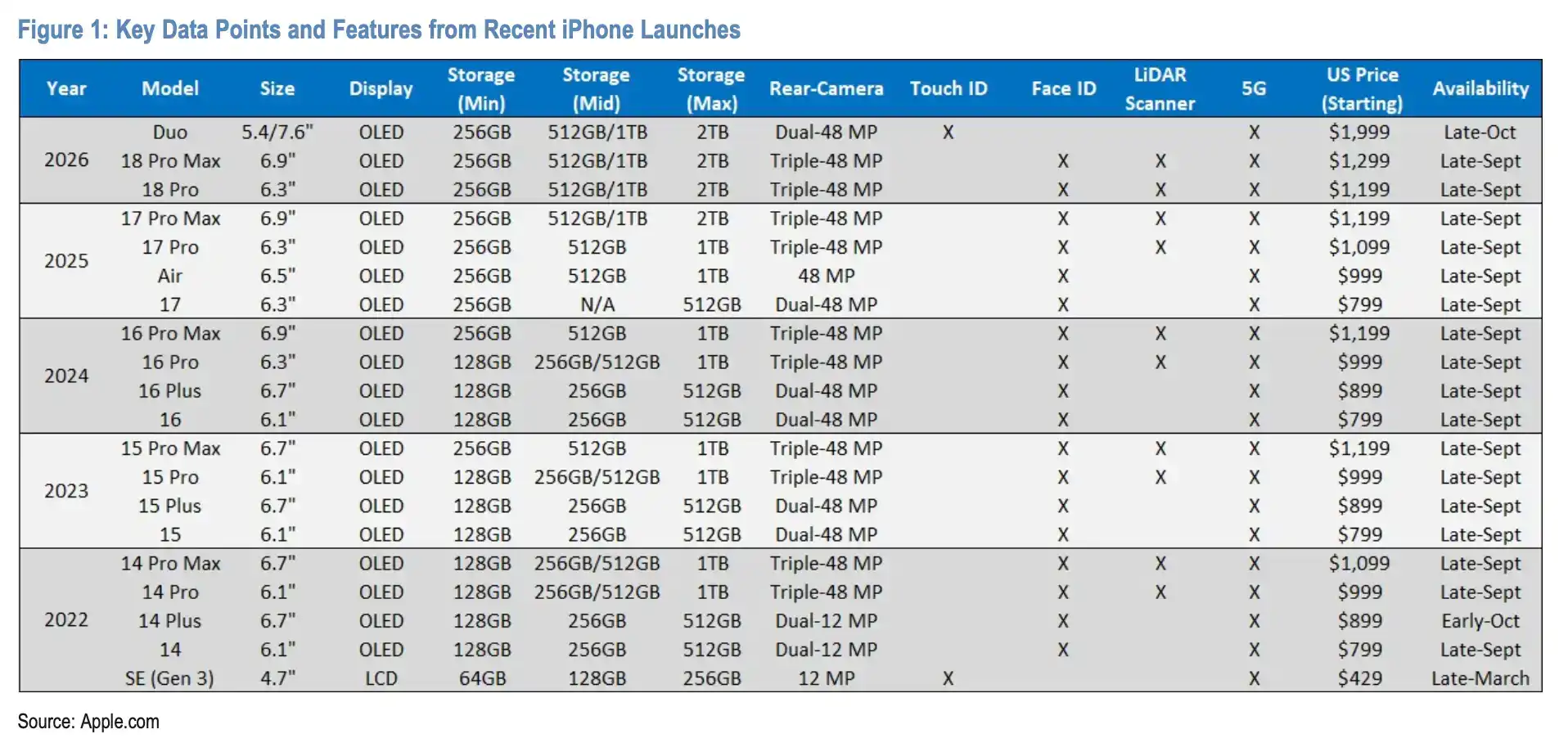
Comparison of core specifications, storage capacities, and starting prices for previous iPhone generations.
Apple is Raising Prices, But Monthly Payments Stay Almost the Same
J.P. Morgan's optimism regarding sales this cycle hinges not on the $100 increase itself, but on how Apple manages to reduce consumer perception of the price hike.
The iPhone 18 Pro is the first new product included in the Apple Upgrade plan. This Klarna-supported leasing service offers two main options: the 256GB version can be paid for over 24 months at $34.99 per month, or over 12 months at $49.99 per month.
Under the 24-month plan, the total amount paid during the lease period is approximately 70% of the retail price. At the end of the term, users can choose to upgrade, purchase the device outright, or return it. For consumers, the focus of the decision shifts from the full $1,199 price tag to a monthly cash outlay of a few dozen dollars.
Carriers are also offering substantial upgrade subsidies. AT&T and T-Mobile are providing up to $1,200 in trade-in credits for iPhone 14 and newer models, while Apple's official trade-in program offers a maximum credit of $885.
J.P. Morgan believes that leasing, carrier subsidies, and trade-in programs can offset most of the headline price increase, keeping the actual monthly expenditure for upgrading users roughly at last year's level. This allows Apple to simultaneously raise ASPs, absorb memory costs, and mitigate the impact of price increases on sales volume.
In other words, Apple isn't foregoing price increases; it's trying to make consumers not feel them.
The $1,999 Duo Could Be the Biggest Surprise This Cycle
Compared to the Pro series, which met expectations, the first foldable iPhone, the Duo, was the true highlight of the event.
The Duo features a 7.6-inch inner display and a 5.4-inch outer display, with the inner screen being approximately 50% larger than that of the iPhone 18 Pro Max. Apple uses a nano-textured surface to reduce the visibility of the crease and a five-grade titanium frame, making it the thinnest iPhone when unfolded.
Its 256GB model starts at $1,999, with the 512GB, 1TB, and 2TB models priced at $2,199, $2,599, and $3,199 respectively. Compared to the Samsung Galaxy Z Fold8, which starts at $1,899, the Duo is only $100 more expensive.
J.P. Morgan views this pricing as more attractive than previous market expectations. For high-end users already entrenched in the Apple ecosystem, $1,999 may not pose a significant barrier; for Android foldable users, the relatively small price gap also creates an opening for switching to Apple.
More importantly, Apple is attempting to shift the competitive focus from hardware specifications to software experience. The Duo's operating system automatically adjusts the interface based on the folding angle and half-folded posture. Apps like Zoom, Slack, and Netflix have already been adapted using new APIs, and Apple Pencil support is scheduled for later this year.
This highlights Apple's core advantage over existing Android foldables: not merely adding a large, foldable screen, but leveraging its integrated hardware and software capabilities to redesign how applications interact across different screen states.
The Duo will be available for pre-order on October 16th and officially launch on October 23rd. Current market expectations peg its 2026 sales at around 10 million units, but J.P. Morgan believes actual performance could exceed this forecast.
Apple Watch Begins Competing Head-On in the AI Hardware Arena
Apple also unveiled the Apple Watch Series 12 and Ultra 4, priced at $399 and $799 respectively, with no price increases following the iPhone's lead.
Both models feature the S11 chip and a redesigned health sensing system. Heart rate reading frequency has increased to once every five seconds, and heart rate variability data updates at a minimum interval of every five minutes, enabling a new Body State Score.
However, J.P. Morgan is more focused on the new "Audio Intelligence" features added to the Apple Watch.
Among these, Live Rewind can transcribe content the user just heard; Siri Recap can record conversations based on user settings and generate summaries and highlights using AI. Apple states that these features use end-to-end encryption and do not store the original audio.
J.P. Morgan believes that Siri Recap may formally position the Apple Watch within the category of AI wearable devices. Facing competition from new products like AI recording hardware and smart glasses, the Apple Watch is no longer just a health monitoring device but is also becoming a personal information recording and processing terminal.
AirPods Price Drop Shows Apple Still Has Cost Adjustment Flexibility
The AirPods 5 come in two versions: the base model with active noise cancellation (ANC) is priced at $129, the same as the previous-generation AirPods 4 which lacked ANC. The $149 version adds a wireless charging case, longer battery life, and volume control via swiping on the stem, and is $30 cheaper than the previous-generation ANC model.
While iPhone prices are rising due to memory costs, the Apple Watch maintains its price and AirPods see an active price reduction, indicating that Apple is not facing simultaneous pricing pressure across all product lines.
J.P. Morgan believes that Apple can offset some material cost increases through component cost reductions, product redesigns, and in-house chip development. The savings created from these efforts can be used to maintain prices for certain products, enhance feature configurations, or subsidize more strategically important new products.
J.P. Morgan's Assessment: A New Growth Cycle Relies on More Than Just Price Hikes
J.P. Morgan maintains its "Overweight" rating on Apple. Its core thesis is not that Apple can achieve a one-time revenue boost from price increases, but that the company is simultaneously unlocking three growth avenues.
The first is ASP growth driven by Pro series price increases and a higher mix of high-capacity models. The second is sales volume support from leasing, subsidies, and trade-ins. The third is the entirely new high-end product category created by the Duo.
On top of this, the Siri AI features that entered testing in mid-September have the potential to further boost the appeal of upgrading to the new iPhones. If sales growth, ASP increases, and the rollout of AI features materialize concurrently, Apple could usher in a more complete iPhone revenue growth cycle than one driven by price hikes alone.
Moving forward, what the market needs to observe is not the event itself, but initial pre-order data and changes in supply chain orders. J.P. Morgan expects early sales feedback to likely be positive and serve as the next catalyst for Apple's stock price.