Goldman Sachs Research Report Analysis: Sandisk NBM Locks in 80% Gross Margin, Target Price Sees 26% Upside

marsbitPublished on 2026-09-10Last updated on 2026-09-10

Abstract

Goldman Sachs report analysis: Sandisk's NBM contracts are expected to secure an 80% gross margin floor, with a target price implying 26% upside. At the Communacopia conference, Sandisk revealed that its long-term NAND Business Model (NBM) agreements cover 50% of planned FY27 and 67% of FY28 shipments. Crucially, these contracts contain floor-price clauses designed to protect approximately 80% gross margins even in a pessimistic NAND price downturn scenario. Goldman Sachs, in a September 9 report, reiterated its Buy rating with a 12-month price target of $2,200, implying 26.6% upside from the current $1,738. The core thesis is shifting from cyclical play to structural upgrade. The NAND market is transitioning from short-term spot pricing to long-term agreements, driven primarily by data center demand. Supply growth remains constrained while demand expands, fueled by AI inference. Sandisk, via its joint venture with Kioxia and its low capital intensity, is positioned for stronger earnings visibility. Key points from the report and management commentary: - **NBM & Margin Visibility:** The floor-price mechanism in NBMs significantly reduces exposure to spot price volatility, locking in high-margin revenue for a substantial portion of future shipments. - **Tight Supply Dynamics:** Management expects limited NAND supply growth, with AI inference driving demand. Chinese competitors' capacity expansions are viewed as largely absorbed by the domestic market. - **Long-Term Growth v...

Author: Rita

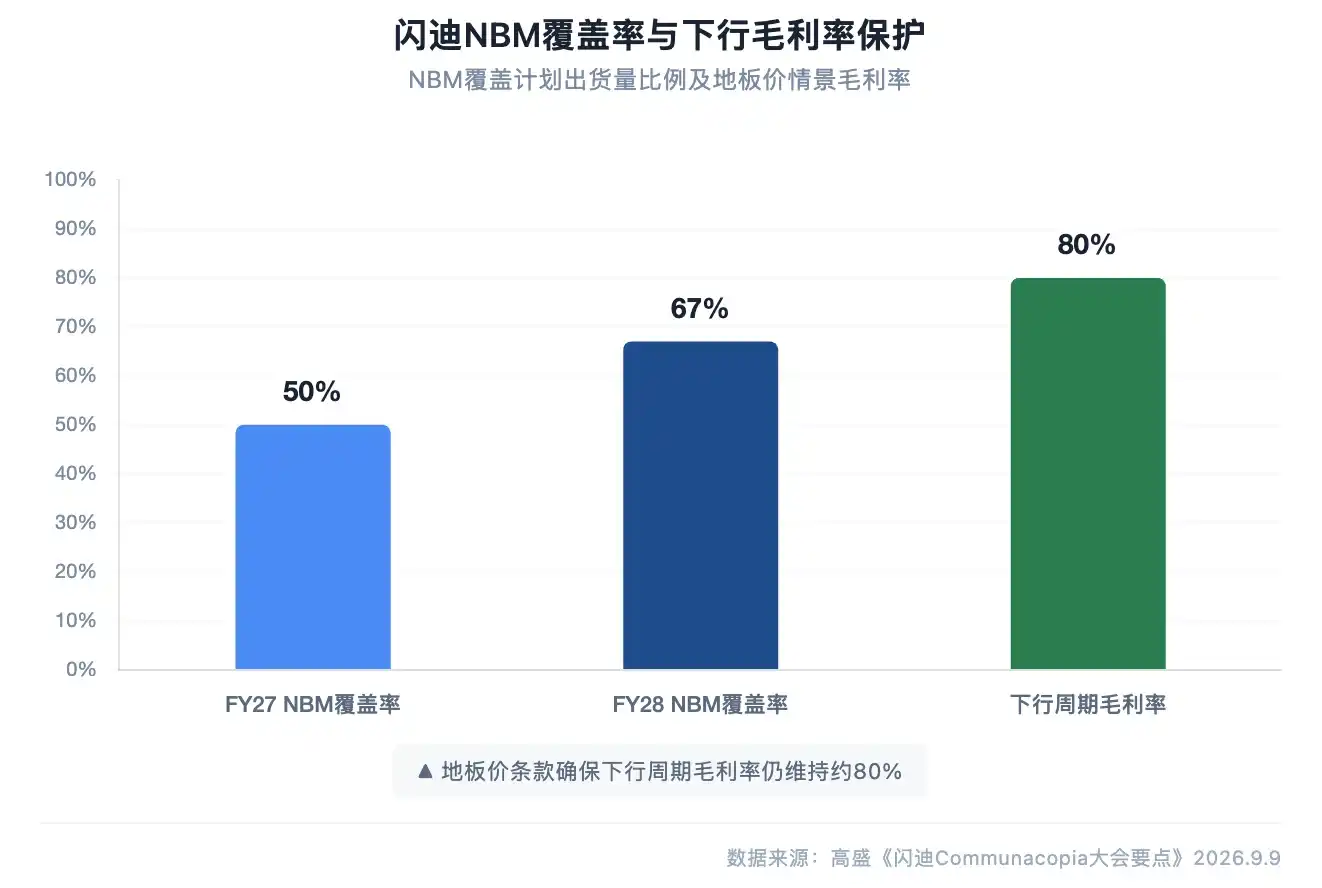
At the Communacopia conference, Sandisk revealed that its long-term agreements (NBM) now cover 50% of FY27 and 67% of FY28 planned shipment volumes. Even in a pessimistic NAND price decline scenario, the floor prices in these agreements can still support a gross margin of around 80%. In its conference summary report dated September 9, Goldman Sachs maintained its 'Buy' rating with a 12-month target price of $2,200, implying a 26.6% upside potential from the current price of $1,738.

Goldman Sachs believes Sandisk's core investment thesis is shifting from cyclical speculation to structural upgrade. The NAND market is transitioning from short-term spot pricing to long-term agreements, with data center demand becoming the primary driver. Growth on the supply side is constrained, while demand continues to expand driven by AI inference. Through its joint venture platform with Kioxia and low capital intensity, Sandisk possesses stronger earnings visibility in this cycle.

NBM Locks in 80% Gross Margin

Sandisk's management detailed the financial components of NBM at the conference. The floor price clause is central, ensuring that under extreme scenarios of significant NAND price declines, the gross margin for the majority of its business can still be maintained at around 80%. This protective mechanism alters Sandisk's profit structure, making it no longer fully exposed to the sharp fluctuations of spot prices.

In terms of coverage ratio, 50% of FY27 planned shipments and 67% of FY28 are covered by NBM. Goldman Sachs views this coverage as a significant improvement in Sandisk's revenue visibility for the next two years. Management's confidence in long-term financial targets is precisely built upon the certainty brought by these agreements.
Supply Constraints, Chinese Capacity Absorbed Domestically

Sandisk's outlook on the NAND supply side is tight. Management believes that supply growth will remain sluggish for the foreseeable future, while the proliferation of AI inference continues to drive demand growth. This supply-demand dynamic provides support for prices.

Regarding capacity expansion by Chinese competitors, Sandisk believes that their new supply is primarily absorbed by the local market, having a limited impact on the global market. Goldman Sachs also mentioned in its report that YMTC's roadmap iteration is a potential risk, but its impact is judged to be manageable at present.

HBF Opens Long-Term Space

Sandisk management expressed optimism about the long-term prospects of HBF and KV Cache. HBF is seen as a potential solution to the AI 'memory wall' problem, with its higher density able to meet the dual demands of AI computing for memory bandwidth and capacity. KV Cache is crucial for AI inference; management had previously described it as a key component of the AI data center memory TAM.

Goldman Sachs cited management's estimate that by 2032, KV Cache will account for approximately 35% of the 1.2 ZB AI data center memory TAM. This data suggests that Sandisk has far greater long-term growth space in the AI storage field than in traditional NAND.

Low Capital Intensity Supports Bit Growth

Sandisk's joint venture agreement with Kioxia has been extended to 2034. Management emphasized that this arrangement, combining IP ownership and R&D investment, gives the JV efficient manufacturing capability, allowing it to gain a disproportionate share of bit growth relative to capital expenditure. Sandisk's capital intensity is about 5%, significantly lower than the industry average.

Management also stated that through the BiCS platform, the company can already see the technology roadmap for several years ahead, supporting further bit growth under the same low capital intensity. Goldman Sachs believes this cost advantage is a key differentiating factor for Sandisk compared to its peers.

Share Buybacks Lead Capital Return

Sandisk reiterated that share repurchases are the primary method for returning excess capital to shareholders. The company has executed approximately $4.5 billion in buybacks. Management remains open to introducing dividends in the future, but buybacks remain the core tool at this stage.

Goldman Sachs's $2,200 target price is based on a 20x P/E multiple applied to a normalized EPS of $110. The current price of $1,738 implies a 26.6% upside potential. Goldman Sachs believes the earnings stability brought by NBM, the industry's constrained supply, and low capital intensity jointly support this valuation.

Downside risks include: the long-term structural shift in NAND pricing failing to materialize; YMTC continuing to iterate its technology roadmap; Sandisk failing to gain eSSD market share.
Disclaimer

This article is Tide Research's compilation and interpretation of a third-party brokerage research report (Goldman Sachs, September 9, 2026), combined with the organization of public market information. The ratings, target prices, earnings forecasts, and related judgments cited in this article are the views of that brokerage's analyst, representing only the stance of their affiliated institution, and do not represent Tide Research's views, nor do they constitute any investment advice.

The market carries risks; decisions must be made independently. This article should not serve as the basis for buying or selling any securities.

Related Questions

QWhat is the key financial protection mechanism of SanDisk's NBM (Long-term Agreements) mentioned in the report, and what level of gross margin does it support?

AThe core financial protection mechanism is the floor price clause. This clause ensures that, even in a pessimistic scenario of declining NAND prices, it can support a gross margin of approximately 80% for a majority of SanDisk's business covered by these agreements.

QWhat is the current stock price of SanDisk and Goldman Sachs' 12-month target price, as stated in the article?

AThe current stock price is $1738. Goldman Sachs' 12-month target price is $2200, implying an upside potential of 26.6%.

QAccording to Goldman Sachs, what is the main reason for SanDisk's shift in core investment logic?

AGoldman Sachs believes SanDisk's core logic is shifting from cyclical speculation to structural upgrade. This is due to the NAND market's transition from short-term spot pricing to long-term agreements, with data center demand becoming the primary driver.

QWhat does SanDisk management predict regarding the long-term TAM (Total Addressable Market) contribution of KV Cache for AI data center memory by 2032?

AManagement's calculation, cited by Goldman Sachs, indicates that by 2032, KV Cache will account for approximately 35% of the 1.2 Zettabyte AI data center memory TAM.

QWhat is SanDisk's current primary method for returning excess capital to shareholders, and what is an alternative they remain open to?

ASanDisk's primary method for returning excess capital is through stock repurchases. The company has already executed about $4.5 billion in buybacks. Management is open to introducing a dividend in the future, but share repurchases remain the core tool for now.

Related Reads

Xsolla ZK Introduces a Gas Token Designed to Let Digital Items Move Between Games and Players

Xsolla ZK, Inc. has introduced Xsolla Gas (XLA), the native token of Xsolla ZK, an Ethereum Layer 2 ZK rollup network for games. XLA is designed to pay network fees when players transfer or share eligible digital items on the network. Players who prefer not to set up a separate wallet can buy XLA-NT, a non-transferable gas credit usable only for network fees on Xsolla ZK, through Xsolla Gas Station using familiar payment methods. XLA is also available on crypto exchanges including Kraken, LBank, and Biconomy in supported markets. The initiative addresses a key limitation: most digital items today live on a single game's backend and cannot be transferred to friends or used in other games, and they become inaccessible if a game shuts down. Blockchain-backed items stay with players, but transferring them typically requires a separate wallet and the right token. Xsolla ZK aims to lower these barriers. Players use Xsolla Backpack, an inventory for owned digital items; items issued in transferable form are designed to remain available even if the issuing game shuts down, and players can give them to others. Players sign in with their usual account, without needing a seed phrase or separate wallet setup. Chris Hewish, President of Xsolla (USA), said players should be able to share and gift digital items they own anytime, anywhere, with anyone they know, and that developers gain a new way to monetize games while players gain items that are theirs to keep. Developers and partners can also use XLA to pay network fees for their item activity. More than 1,500 game teams use Xsolla's tools, and Xsolla Backpack and Xsolla Gas Station are available without additional development for teams using compatible Xsolla products, integrating with existing player and payment flows. XLA is an ERC-20 token on Ethereum mainnet with a total supply of 1 billion and becomes the base token of Xsolla ZK through the canonical bridge.

TheNewsCrypto3m ago

Xsolla ZK Introduces a Gas Token Designed to Let Digital Items Move Between Games and Players

TheNewsCrypto3m ago

Hyperliquid API Wallet Permissions Keep Expanding: Once an AI Agent Is Attacked, It Could Drain the Main Account

As personal AI agents take over everyday financial decisions, Hyperliquid is seen as an ideal decentralized trading foundation thanks to its deep liquidity and composability. However, the API wallets that underpin automated trading have quietly seen their security boundaries erode across network upgrades over the past year. Lacking fine-grained permission policies, a compromised API wallet can even trigger staking slashing, spot locking, and priority fee burning, exposing the main account to total loss. The article traces how API wallets—originally scoped to prevent direct withdrawals or external transfers—have accumulated expanded permissions through successive upgrades, with no cap on margin exposure. A maliciously altered API wallet controlling an account with over ~$40M could buy 500,000 HYPE, stake it, link it to a malicious HIP-3 market, invite slashing, and lock the main account's funds for 183 days. Because API wallets are now the default trading method across the Hyperliquid frontend and third-party apps, and agents must interact with untrusted internet environments, prompt injection or key leakage can let attackers drain funds without ever stealing a private key. Existing fine-grained control via HyperEVM smart contracts introduces too much latency for high-frequency trading, while custodial solutions outsource trust to centralized middleware. The proposed fix is a lightweight bitmap permission field set at API wallet creation, recording which operation types the wallet may trigger—mirroring the mechanism already used in HIP-3 deployer sub-lists. Validating the signer against the main account's bitmap adds negligible overhead, and critically, old API wallets would never auto-inherit new permissions from future L1 upgrades. This would safely unlock staking and transfer interfaces, remove reliance on centralized custody, and pave the way for large-scale personal AI agent adoption on HyperCore.

marsbit48m ago

Hyperliquid API Wallet Permissions Keep Expanding: Once an AI Agent Is Attacked, It Could Drain the Main Account

marsbit48m ago

Upbit and Bithumb Customer Deposits Plunge 31.86%, Falling $1.87 Billion in 2026

Customer deposits in South Korean won at Upbit and Bithumb, South Korea's two largest crypto exchanges, fell 31.86% in the first nine months of 2026, according to regulatory disclosures published November 17. The platforms held about ₩5.36 trillion ($4 billion) in customer cash at end-September, down from ₩7.87 trillion at end-2025—a reduction of roughly ₩2.51 trillion ($1.87 billion). Upbit operator Dunamu saw deposits drop 31.9% from ₩5.83 trillion to ₩3.97 trillion, while Bithumb fell 31.8% from ₩2.04 trillion to ₩1.39 trillion. The figures were disclosed via South Korea's Financial Supervisory Service electronic filing system. Customer crypto holdings also lost value: Upbit's book value fell 10.9% from ₩62.23 trillion to ₩55.46 trillion, and Bithumb declined 13.1% from ₩17.90 trillion to ₩15.56 trillion. However, quantities of several major cryptocurrencies held for customers increased despite lower valuations—Upbit added 13,259 Bitcoin, 337,609 Ether and 1.22 million Solana versus year-end levels, and Bithumb reported higher holdings of Bitcoin, Ether, XRP and Solana. The data indicate the deposit decline does not necessarily mean investors withdrew entirely from the crypto market; disclosures do not explain whether funds went to bank accounts, crypto purchases or elsewhere. The drop comes amid weaker trading activity in South Korea's digital asset market, adding pressure on major exchanges.

TheNewsCrypto1h ago

Upbit and Bithumb Customer Deposits Plunge 31.86%, Falling $1.87 Billion in 2026

TheNewsCrypto1h ago

Trading

Spot
活动图片