Author: Will Owens, Galaxy Research Analyst
Compiled by: Hu Tao, ChainCatcher
Hyperliquid's HIP-4 protocol upgrade marks the arrival of a third model for predictive markets. Among the existing category leaders, Polymarket has a native consumer-facing discovery mechanism, while Kalshi has a regulated US exchange access channel. Hyperliquid announced the launch of HIP-4 in February of this year, aiming to bring outcome prediction markets into this "house of all finance," and officially activated the proposal on the mainnet on May 2nd. For hedgers and speculators, predictive markets have proven to be one of the most practical new financial primitives in recent years. Leveraging the industry-standard execution and infrastructure Hyperliquid has already established for perpetual contracts, it is now poised to compete for a share of event-driven trading volume.
Hyperliquid's user base is fundamentally different from that of Polymarket or Kalshi. The latter two have spent years building products that appeal to non-crypto users; they both have polished consumer frontends that allow users to "browse" predictive markets like shopping on Amazon. In contrast, Hyperliquid serves active crypto-native traders through a terminal frontend. While this makes its top-of-funnel audience niche, the characteristics of this group are: they are traders themselves, the vast majority hold stablecoins, and their wallets are already connected. HIP-4 is built precisely to serve this user first.
As of May 25th, HIP-4 has expanded from cyclical BTC price binary options to "canonical markets" covering real-world off-chain events published by validators. The currently live markets include:
-
"Is the BTC price above X at time Z on day Y?" This is a daily recurring binary contract that resets at 2 AM ET, settling at expiration based on the BTC mark price on HyperCore.
-
"What is the BTC price range at time Y on day X?" This is a multi-outcome contract with three buckets (above, between, below), launched within days of the HIP-4 mainnet activation, settling to the same oracle.
-
June Fed Rate Decision (hike or cut / hold), settling around June 17.
-
May CPI YoY (exactly 4.3% / below 4.3% / above 4.3%), settling around June 10 based on official BLS data.
-
NBA Finals Game 4 (New York Knicks / San Antonio Spurs).
-
2026 NBA Champion (Knicks / Spurs).
-
2026 World Cup Champion (France / Spain / England / Portugal / Brazil / Argentina / Germany etc.).
The product range is limited for the moment. But the genuinely interesting question is: what can HIP-4 become? How does it compare to Polymarket and Kalshi on infrastructure, fees, and distribution? And what does its entry mean for a predictive market sector where major players are all racing toward a "trade everything" model from different starting points?
This report provides a deep dive into HIP-4: what it implements, how it stacks up against Polymarket and Kalshi, and the profound impact its arrival has on the overall predictive market landscape.
Summary
-
Mainnet Launch: HIP-4 went live on the Hyperliquid mainnet on May 2, 2026. The proposal was announced on February 2, landed on testnet that week, and delivered three months later. Outcome prediction contracts now sit alongside perpetual and spot trading under a single margin account within HyperCore, Hyperliquid's native trading engine.
-
Notable Timing: The launch came just days after Polymarket completed its migration to a new Central Limit Order Book (CLOB v2) and new stablecoin (pUSD). The same week, Bloomberg reported Polymarket is seeking US regulatory approval to bring its flagship exchange into the compliant onshore US market.
-
Sector Scale: In April, the historical cumulative trading volume for predictive markets surpassed $150 billion. Kalshi set a new all-time high in notional volume of $14.81 billion (up 13.3% month-over-month), and surpassed Polymarket across notional volume, taker volume, and trade count for the first time. In contrast, Polymarket's volume dropped to $9.01 billion (down 14.8% MoM).
-
Growth Trajectory: While the sector experienced its first MoM volume decline in seven months, the long-term growth trend remains strong: monthly taker volume has grown over 17x in two years. Analysts at Bernstein forecast the sector scaling from $51 billion in 2025 to $1 trillion by 2030.
-
Technical Edge: HIP-4 embeds directly into HyperCore, Hyperliquid's on-chain limit order book, sharing the same execution layer and unified margin account as perpetuals and spot trading. Sub-second finality, ~200k orders per second throughput, and cross-margin composability are structural advantages Polymarket (currently contemplating migration) and Kalshi (closed centralized infrastructure) cannot replicate without rebuilding their entire product.
-
Early Results: By day 25 post-launch, HIP-4 had captured 20.1% of the 24-hour total trading volume for BTC prediction markets ($2.38 million on HIP-4 vs. $9.46 million on Polymarket).
The Current Predictive Markets
Over the last 18 months, predictive markets have been one of the most compelling growth stories in crypto and broader fintech. We have written about them multiple times, including variants like influence markets and decision markets. The combined monthly volume of Polymarket and Kalshi was around $2 billion in September 2025. By April 2026, the combined notional volume across the two platforms reached approximately $24 billion, with cumulative historical volume surpassing $150 billion that month. Monthly taker trading volume grew more than 17x in under two years.
In April, a structural shift emerged in Kalshi's favor.
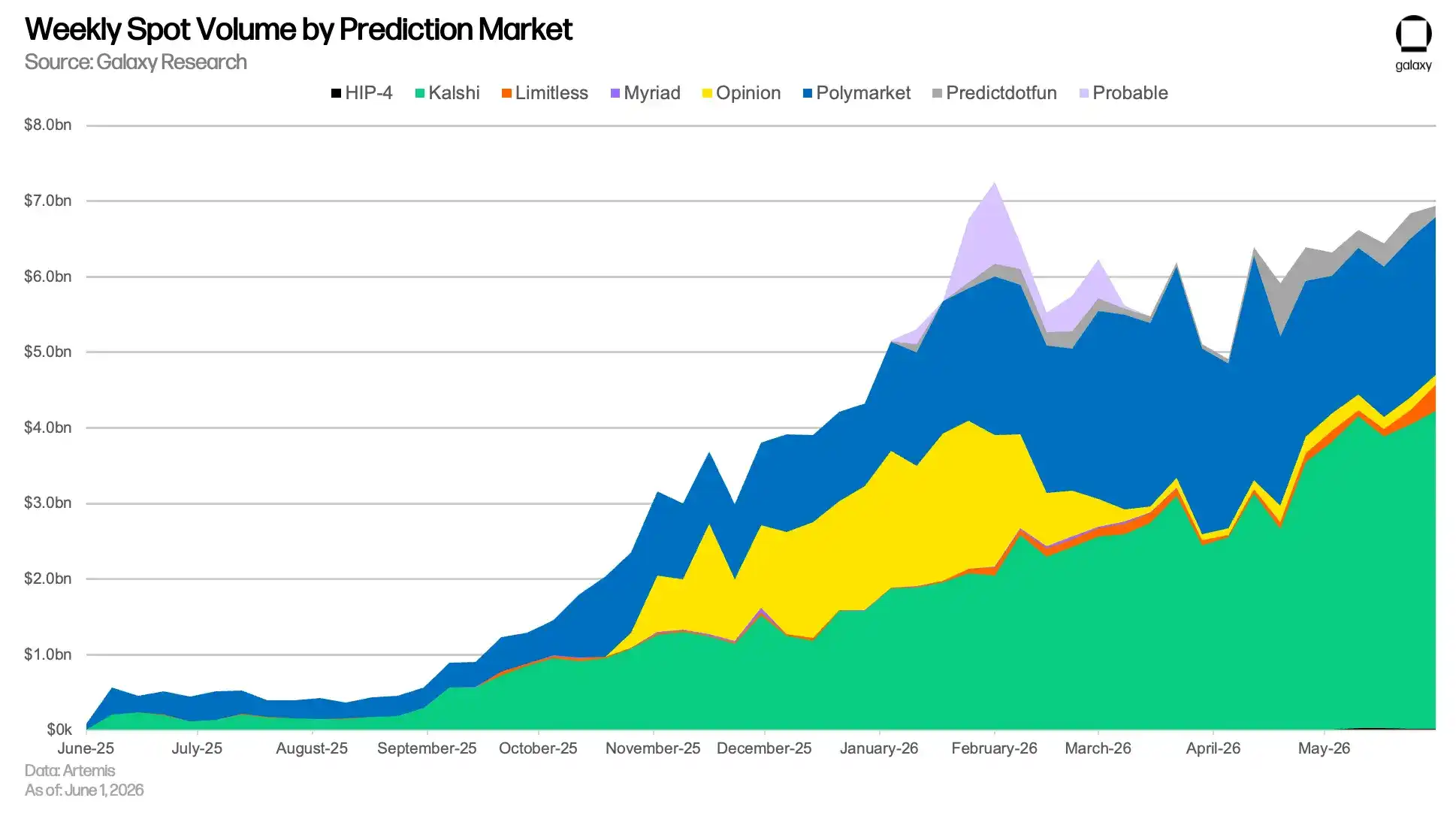
Kalshi posted $14.81 billion in notional volume for April, up 13.3% from its prior March record, setting a new all-time monthly high. Polymarket's volume fell 14.8% to $9.01 billion. Kalshi's lead widened from $2.5 billion in March to $5.8 billion in April, the largest monthly gap on record between the two platforms. Kalshi also surpassed Polymarket in taker volume ($5.42 billion vs. $1.99 billion) and trade count (94.4 million vs. 87.4 million), reversing Polymarket's long-standing lead in trade numbers.
Two structural drivers explain Kalshi's lead. First is product mix. In late April, sports contracts comprised 74.3% of Kalshi's weekly volume, and Exotics (the platform's parlay-style combo contracts) pushed that share to ~85%. The US Masters golf tournament alone generated $545 million in notional volume on Kalshi, comparable to the platform's total Super Bowl single-game volume. Kalshi is well-positioned for the NBA Finals and 2026 FIFA World Cup. That said, sports markets lean more speculative than the "information signaling" value produced by geopolitics or tech markets, even with some commercial hedging use cases. The second driver is regulatory clarity. Kalshi's status as a CFTC-regulated Designated Contract Market (DCM) grants it distribution partnerships and a faster path to the US retail market than Polymarket's.
Polymarket's category mix is more diversified (as of late April: sports 46%, politics 27%, crypto 22%), which structurally is an advantage during periods of political volatility or major crypto cycles, but a disadvantage during periods lacking political catalysts and packed with sports events. April was the latter. Polymarket's active user count also decreased from ~733k in March to 646k in April.
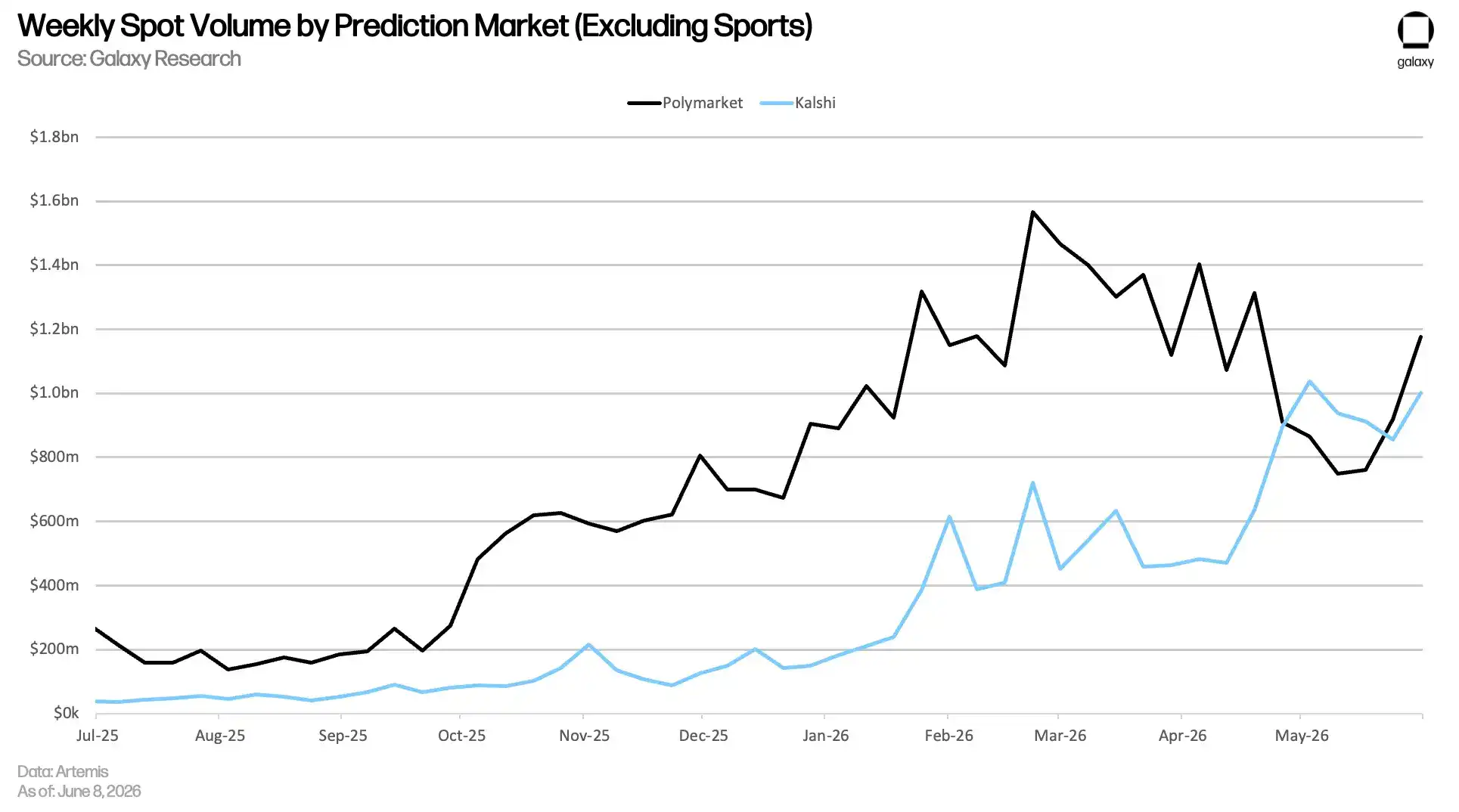
Nonetheless, Polymarket's economics remain robust. Polymarket collected $47.7 million in fees in April. Its user base also remains significantly larger than Kalshi's implied retail base. Polymarket holds the category's deepest non-sports markets, an official MLB partnership announced in March, and a $2 billion strategic investment from ICE, the parent of the New York Stock Exchange. The platform already operates a limited US-compliant product via an acquired CFTC-licensed exchange and is working to bring its flagship exchange onshore (more details below). It also just completed a major infrastructure upgrade (CLOB v2 and migration from USDC.e to its new internal collateral token pUSD) four days before HIP-4 launched, on April 28.
April also marked the sector's first MoM volume decline after seven consecutive months of record-setting. Whether this was a calendar effect (no Super Bowl, no March Madness, no NFL playoffs in April) or the first real demand ceiling will become clear as we watch May performance.
On May 1, sector open interest was $1.11 billion, with Kalshi at $630.7 million and Polymarket at $449.9 million (together ~98% share). Limitless,predict.fun, and Opinion each held less than $15 million.
Every major platform is moving from a different starting point toward the same 'trade everything from one account' model.
What is interesting here is the strategic convergence beneath the volume numbers. Both Kalshi and Polymarket are reportedly building perpetual contracts. Hyperliquid has already built outcome markets via HIP-4. Every major venue is moving from a different starting point toward the same 'trade everything from one account' model.
HIP-4 Mechanics
HIP-4 adds outcome markets to HyperCore, Hyperliquid's on-chain trading engine. These are fully collateralized binary instruments that settle to 0 or 1 at expiration based on whether a discrete real-world event occurs. The mechanics are simple and familiar to predictive market traders: buy "Yes" at price P. If the event occurs, the contract settles to 1, and you profit (1 – P). Buy "No" for the reverse. Max loss is always your entry cost. No leverage, no liquidations. USDC is becoming the consistent quote asset across Hyperliquid markets under the Coinbase/Circle AQAv2 arrangement; canonical HIP-4 outcome markets settle in USDC, and USDH issuance by Native Markets is being phased out.
To deploy a market, a builder must stake 1 million HYPE, then define the event title, resolution time, oracle source, and an optional dispute window. The 1 million HYPE stake applies per market deployed by a builder. Canonical markets are published directly by the validator set, requiring no builder stake, with their deployment and settlement managed via on-chain validator vote.
A one-off, ~15-minute single-price liquidation auction opens the market and clears at the price that maximizes matched volume. Continuous limit/market order trading follows, with prices bound between 0.001 and 0.999 until expiration. At settlement, the oracle posts 0 or 1, and USDC is paid out automatically. The PnL card looks similar to a perpetual trade, except the title is the market question rather than an asset code, your position size is expressed as a number between 0 and 1, not a leveraged notional amount. A dispute window delays final settlement if the outcome is contested.
A notable technical detail: each outcome market has two tokens ("Yes" and "No"), but their order books are merged to share liquidity. An order to buy "Yes" at price P is equivalent to selling "No" at price 1-P. Under the merged book, price-time priority generalizes to price-side-time priority. This means resting sell orders at the same merged price level fill before resting buy-side dual orders. For advanced users, balances can be manually split and merged between primary and secondary sides. These are mostly abstracted at the API level, but it's the mechanism that allows HIP-4 markets to quote tight spreads with relatively thin notional liquidity.
HIP-4 charges zero fees on opening positions. Fees are only charged upon closing, burning, or settlement. (In practice, during this initial testing phase, all outcome market fees are zero.) For traders, predicting the future on Hyperliquid is meaningfully cheaper than on Polymarket and Kalshi, which charge visibly higher fees on winning positions. This fee design also directly plugs into Hyperliquid's tiered fee structure (outcome market volume counts toward protocol-wide tier calculations), meaning active predictive market traders qualify for lower fees on their perpetual trades through the same unified account.
The first active contracts cover a recurring daily BTC price threshold event that resets at 2 AM ET. The market is essentially "Is BTC price above X at Y time on Z day? Yes or No." Within days of mainnet launch, Hyperliquid added multi-outcome markets, starting with a recurring BTC price bucket contract that settles daily to three buckets (upside, downside, in-range). Categories planned for expansion include politics, sports, macro data releases, crypto, and entertainment.
On May 25, the canonical market set expanded to include off-chain events. Hyperliquid validators now publish markets directly using automated news feed software run as part of the chain, with deployment and settlement managed by on-chain validator vote. The first off-chain markets were the June Fed rate decision (move or hold, settling ~June 17), May CPI YoY (three-bucket multi-outcome around 4.3%, settling ~June 10 based on BLS data), and the UEFA Champions League soccer champion (PSG or Arsenal). Settlement remains an internal loop on the Hyperliquid L1: no external oracles, no UMA-style optimistic dispute layer (arguably Polymarket's Achilles' heel), just validator voting based on predefined rules and automated feeds.
A natural reaction is to compare HIP-4 to HIP-3, the framework Hyperliquid provides for builders to deploy perpetual contracts. Both involve builder staking of HYPE to deploy markets on HyperCore. Both share the same matching engine and order types. But the two primitives differ structurally in ways that matter for what can be traded on each.
HIP-3 perpetuals use continuous oracles with ~1% price deviation limits per update; this design is for continuous leveraged trading on assets with continuous price discovery. This works for stocks, FX, commodities, and crypto, exactly the categories trade.xyz and other HIP-3 deployers have already built. But it doesn't work for discrete events.
A perpetual contract cannot cleanly express questions like "Does the Fed cut rates?" or "Does Trump win Oregon?" The payoff is not continuous, the oracle is not, and there is no funding rate to converge the contract to the correct answer.
HIP-4 uses fixed-range settlement, no funding rate, and no liquidation engine. These contracts are limited to their entry premium and rely on a single oracle posting rather than a streaming price feed. That's why HIP-4 had to exist as a separate proposal, not a sub-feature of HIP-3.
Perhaps the most powerful part of HIP-4 is that it allows traders to operate against the rest of their Hyperliquid account. Unified margin unlocks several concrete use cases no standalone predictive market platform can match without a full product rebuild.
First is discrete event hedging against a perpetual book. A trader holding a long ETH perpetual position ahead of a Fed meeting historically had two options: reduce size or accept binary risk exposure. HIP-4 introduces a third: buying the "Yes" or "No" contract on the event itself within the same margin account. The outcome position partially offsets directional risk in the perpetual without closing the position. For example, a $10,000 long ETH-PERP position before a Fed decision could be paired with a $1,000 "No" contract on "Fed cuts rates." If the Fed holds and ETH drops, the outcome position pays (1 – P), offsetting some of the perpetual loss. If the Fed cuts and ETH rallies, the trader loses the outcome premium but retains the perpetual upside. The hedge sits in the same margin account and settles in the same collateral.
Second is market maker hedging against discontinuous risk. A delta-neutral perpetual market maker faces tail risk from one-off events (regulatory announcements, protocol upgrades, sudden macro decisions) that streaming perpetual hedges cannot express cleanly. A market maker quoting ETH or BTC perpetuals ahead of a CPI print can use HIP-4 contracts to hedge the discontinuous part of the risk without moving capital to a separate platform or running a parallel options book. This is a real improvement in risk management for professional liquidity providers on Hyperliquid.
For a user already trading perpetuals and spot through the same account on Hyperliquid, the cost of entering predictive markets is effectively zero.
How Does HIP-4 Compare?
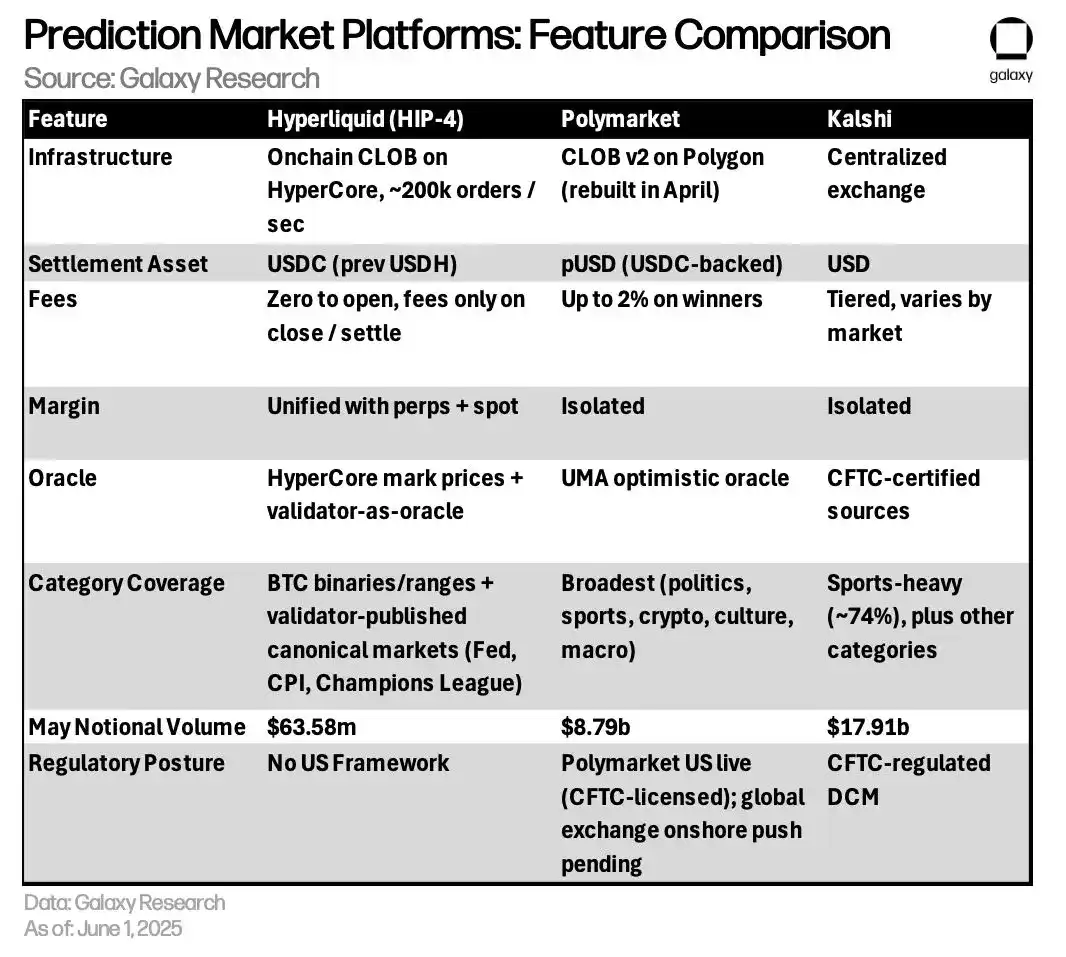
HIP-4, Polymarket, and Kalshi are now competing for the same end state: a venue where users can express a view on any event from a single account. But they start from different products, different infrastructure, and different regulatory postures. The table below outlines the structural differences. Subsequent sections detail the dimensions where the gaps matter most.
User Experience & Discovery
Polymarket and Kalshi spent years building consumer-facing frontends, and both work. They just serve different audiences and generate market depth differently. Kalshi's depth comes from programmatic, vertical-specific market generation. An NBA basketball game on Kalshi doesn't produce just one market. Instead, it produces markets covering player props, point spreads, and combo contracts.
Multiply this by every major sports league, daily weather and economic data releases, and macro data release cycles, and Kalshi's active contract count runs into the hundreds of thousands. The result is massive depth within a limited set of CFTC-permitted verticals. The app is sports-first (sports, including Exotics, now drive ~85% of weekly volume), and its funding flow is the slickest in the category. Deposit dollars, no crypto wallet needed, no cross-chain bridge, fully regulated (provided the user doesn't mind KYC). Kalshi is live on the Robinhood and Coinbase apps, putting predictive markets in front of tens of millions of retail traders who never thought to download a dedicated app. This combination of programmatic depth, regulated onramp, and embedded distribution is what powered its April volume past Polymarket's.
Polymarket is the opposite. Its depth is in breadth. Operating outside US commodity trading rules, Polymarket can list long-tail markets Kalshi legally cannot touch: hyper-specific foreign elections, foreign policy events, court rulings, Twitter dramas, crypto protocol upgrades, etc. Its category mix is the widest in the industry: politics ~27% of weekly volume, sports 46%, crypto 22%, with culture and macro filling the rest. Its frontend is built on a browsing experience, with curated categories, a "Trending" market feed, a social layer where users discuss active markets (comment sections), and an onramp flow that guides users through their first trade. The result is 646k monthly active users in April and the deepest non-sports liquidity in the category.
These are different products serving different users. If you want to day-trade minute fluctuations in NBA player props or fed funds futures, Kalshi has programmatic depth. If you want to take a position on the UK election or a celebrity court ruling, Polymarket is currently the only option. Both work. Neither will lose its respective audience to the other anytime soon. It will be interesting to watch which one can leverage institutional money flows. Predictive markets as institutional hedging tools may be the most lucrative prize for platforms, and Kalshi seems best positioned to do it.
HIP-4 has none of this. Outcome markets are tucked inside the Hyperliquid trading terminal, alongside perpetuals and spot. There is no "browse markets" view, no trending feed, no social layer, no distribution partnerships with retail brokers, no programmatic market generation across sports or macro. To be fair, HIP-4 just launched. Discovery functions run through builder frontends like Outcomexyz and Stratium, whose footprints are still small as early-stage projects.
This is a real near-term gap.
The question is whether the builder ecosystem can fill this gap quickly enough to matter. Hyperliquid's framework explicitly invites third parties to deploy markets and build frontends on top of HIP-4, exactly how perpetuals scaled on the platform via HIP-3 (trade.xyz alone now accounts for most of the HIP-3 open interest today). If a comparable builder ecosystem emerges for outcome markets on Hyperliquid, the discovery gap could shrink faster than expected. If it doesn't, HIP-4 may remain a niche feature within active trader accounts.
Infrastructure
HyperCore is the strongest part of the HIP-4 pitch and the dimension with the widest gap versus Polymarket and Kalshi. Hyperliquid's execution layer is an on-chain CLOB with sub-second finality, ~200k orders per second throughput, and a unified margin engine handling billions in daily perpetual volume. HIP-4 plugs into that infrastructure without modification. Outcome markets share the same matching engine, same order types, same wallet, and same collateral as perpetuals and spot.
Polymarket, at present, is running a newly rebuilt central limit order book on infrastructure not designed for it.
Polymarket runs on Polygon, an Ethereum L2. The CLOB v2 launch on April 28 was a complete rebuild of the matching engine and migration to pUSD as an internal collateral token, a meaningful upgrade. But Polymarket's chain dependency remains structural. The platform's VP of engineering Josh Stevens has publicly acknowledged that reaching the performance levels needed for active trading would mean migrating to a purpose-built chain. Whatever Polymarket does next on infrastructure will require multiple quarters of engineering work and likely some form of chain migration. At present, Polymarket is running a newly rebuilt CLOB on infrastructure not designed for it.
Kalshi runs on centralized exchange infrastructure. It's fast, stable, regulated, and closed. Kalshi cannot natively compose with on-chain products, cannot offer cross-margin with crypto positions, and cannot let users self-custody collateral. Its trade-off is frictionless dollar onramps and regulatory clarity. For institutions requiring a CFTC-regulated counterparty, Kalshi's infrastructure is the feature.
Ranking the three: HyperCore is the most flexible execution layer in the category, Polymarket is mid-transition, and Kalshi is designed as a closed system. But infrastructure alone doesn't win volume. It must combine with markets, users, and discovery. That's the part HIP-4 still needs to prove.
Oracle Scope
At mainnet launch on May 2, HIP-4 was limited to HyperCore's price feeds. The only markets it could resolve were variants of "What is the price of BTC at time T?" The initial two markets, the daily binary and multi-outcome bucket contracts, were both BTC price events. The May 25 expansion changed this. Hyperliquid validators now directly publish off-chain canonical markets, running automated news feed software as part of routine chain operation, with deployment and settlement via on-chain validator vote. Resolution remains a closed loop internal to the Hyperliquid L1. There's no UMA-style optimistic dispute layer and no Chainlink or Pyth integration.
This is a third path the category hasn't seen before, and worth calling out explicitly. Polymarket has UMA's optimistic oracle, which resolves arbitrary real-world events through a staking and challenge mechanism. It's permissionless and universal, which is why Polymarket can list markets on-demand on any tweet, foreign election, court ruling, or protocol upgrade. Kalshi has CFTC-certified resolution sources, with each contract going through a filing process approving the market and resolution method. The oracle layer is slower and more rigid than UMA's but is highly defensible in a regulatory sense.
Hyperliquid's validators-as-oracle model is curated, not permissionless, meaning it cannot match UMA's long-tail coverage. The validator set must actively choose, which filters for quality but limits throughput. But it's demonstrably faster and more flexible than Kalshi's filing process, and it runs without depending on a third-party resolution layer. The model works well for high-signal events with clear outcomes, less so for long-tail markets where the standard for resolution is contested or the event itself is ambiguous.
What to watch over the next 6-12 months is what Phase 2 (permissionless builder deployment, analogous to HIP-3) will look like. The canonical market question is answered (validators handle them directly), but the permissionless layer remains open.
Regulatory Posture
The three platforms occupy three different regulatory positions, and the asymmetries are more important than my table can capture.
Kalshi is a CFTC-regulated Designated Contract Market (DCM) with a frictionless on-ramp to the US retail market. That status is what unlocked the Robinhood and Coinbase distribution deals. But Kalshi's sports contracts are facing legal challenges from states claiming jurisdiction over such betting. Massachusetts has issued a ban. Wisconsin has filed suit. Venture firm a16z (also a Kalshi backer) wrote to the CFTC in April in support of federal preemption, a notable industry intervention, but the issue is unresolved. If federal preemption holds, Kalshi retains its largest growth category. If not, the sports business that drove 85% of Kalshi's April volume gets sliced up state-by-state.
Polymarket is seeking a full return to the US market. It already has a domestic foothold: after acquiring a CFTC-licensed exchange (QCEX) last year, Polymarket launched a limited US-compliant product. But that version is a popcorn stand next to the flagship store overseas, with only a tiny fraction of the markets, liquidity, and category breadth. The real prize is bringing the flagship itself onshore. In the same week HIP-4 launched, Polymarket was reported to be seeking CFTC approval to do exactly that. If approved, Polymarket would gain the US retail access it has lacked for years, presenting its deepest markets and widest category coverage to US traders for the first time, rather than the stripped-down version it currently runs inside the US.
HIP-4 inherits Hyperliquid's broader regulatory exposure, the same legal gray area the rest of crypto-native DeFi operates in. CME Group and ICE, the NYSE parent, have reportedly urged US regulators to examine Hyperliquid. According to news reports, the two exchanges told the CFTC and lawmakers that Hyperliquid's decentralized environment poses risks of manipulation and sanctions evasion, with particular focus on the 24/7 commodity and crude oil contracts running under HIP-3, categories long dominated by CME and ICE.
On-chain analyst ZachXBT noted that the NYSE reportedly objected to Hyperliquid but not to Polymarket, despite ICE's $2 billion investment in the latter. ICE's stake may give it a direct interest in slowing Hyperliquid's expansion into predictive markets via HIP-4, not just its push into commodities via HIP-3. Critics read the lobbying as an attempt to suppress a fast-growing competitor, especially as both incumbents face their own CFTC and DOJ scrutiny over well-timed oil trades. Hyperliquid called the manipulation claims "baseless concerns," arguing public blockchains expose manipulation rather than enable it. HYPE token price dropped on the day of the Bloomberg report.
The broader regulatory picture is also shifting. The Senate Banking Committee passed the CLARITY Act on a bipartisan 15-9 vote on May 14, moving the bill to the full Senate. The legislation would create a federal framework classifying most digital assets as commodities under CFTC jurisdiction, formally extending the CFTC's derivatives authority to include crypto spot markets. The bill also includes provisions protecting non-custodial software developers from money transmitter laws (see CLARITY Act Sec. 604, the "Blockchain Regulatory Certainty Act" or "BRCA"). While this safe harbor was designed for Tornado Cash and Samourai-mode developer prosecutions (programmers who write and release open-source software but have no ongoing operational control) and Hyperliquid is a different fact pattern (an actively operated trading venue that happens to settle on-chain), it could benefit Hyperliquid if its developers are determined to be "non-controlling" in the Sec. 604 context. But key is that Hyperliquid would need to navigate CLARITY Act Title III, specifically the Sec. 301 framework dealing with Securities Act and Bank Secrecy Act obligations.
This includes exemptions for decentralized financial trading ledger applications, but Sec. 301(a)(2)(A) strips those exemptions if the protocol is determined to be a non-decentralized trading protocol. If Hyperliquid fails to qualify for the exemption, and the regulator implementing the Act determines it to be a non-decentralized trading protocol, then Hyperliquid would need to take on Bank Secrecy Act obligations under Sec. 301(b)(d)(D).
During the May 14 Senate Banking Committee markup, some amendments were made to the latest text of the CLARITY Act that are not in the latest publicly available version, some reportedly related to the BRCA. Moreover, negotiations over CLARITY Act wording are ongoing, with illicit finance and BRCA-related issues among the top unresolved matters. Thus, all of this may change between the time of this writing and final passage of the bill into law.
Beyond BRCA and BSA questions, Hyperliquid is hoping the CFTC's emerging acceptance of perpetual contracts will include on-chain perpetuals. That hasn't happened, and it's unclear if it will, but Hyperliquid founder Jeff Yan met with lawmakers in Washington for a week in mid-May with the Hyperliquid Policy Center.
All of which is to say: many regulatory questions remain about whether Hyperliquid can replicate its offshore dominance in the US.
Summary of the four dimensions in this section: Polymarket leads on oracle scope and consumer UX, Kalshi leads on regulated US distribution and sports, and HIP-4 leads on infrastructure and unified margin, with a regulatory path that may be opening up. None of the three dominates all four dimensions. What happens as each platform expands into the others' domains will be the category story for the next 12-18 months.
Risks
HIP-4 launched 25 days ago into a competitive category, and the arguments for why it may not evolve into a meaningful product are real. The following risks are most likely to determine whether HIP-4 can expand beyond a niche feature in a trader terminal.
Canonical Market Breadth
The remaining limitation is breadth, not category coverage. Both HIP-4 and Polymarket curate market launches, so this isn't curation vs. open. The difference is what each resolution layer can support. UMA's optimistic oracle can resolve arbitrary real-world events, so Polymarket's curation is a product choice, not a technical ceiling; it can list virtually infinite long-tail markets on demand.
HIP-4's validators-as-oracle model can only resolve what the validator set can adjudicate cleanly, so its curation is partly forced by the resolution model. The validator set must actively choose to publish each market, which filters for quality but limits throughput as noted. Long-tail markets (specific foreign elections, court rulings, anything socially contested) require a Phase 2 permissionless deployment with broader oracle integrations, which hasn't launched yet. Until Phase 2 arrives, HIP-4's market directory will remain limited to what validators can resolve, capping the rate of market growth even as category coverage expands.
Discovery Gap
Hyperliquid is a trading terminal, not necessarily a consumer product. Outcome markets have no native browsing layer or social component. The bet is that builder frontends will fill this gap the way trade.xyz scaled HIP-3. If they don't, HIP-4 will remain a feature for active Hyperliquid traders, never reaching the audience sizes Polymarket and Kalshi have built. Discovery is also the only risk Hyperliquid cannot solve on its own. It depends on third parties choosing to build. In Hyperliquid's favor, it's one of the most attractive places in crypto to be a builder.
Validator Centralization
Hyperliquid runs on 24 (soon 27) validators, and the chain's history includes the JELLY delisting event in March 2025 where the team froze a market mid-run. This precedent is well-known to crypto-native users and is the "trust" version Hyperliquid operates under. For predictive markets that settle to binary outcomes where dispute resolution is critical, this is a real execution risk source. The May 25 expansion makes this risk more concrete in principle: canonical market resolution now relies on explicit validator voting, not an external oracle posting.
In practice, the validators-as-curation model is preempting this risk. The initial canonical markets (Fed move/hold, CPI bucketed around a fixed figure, binary Champions League final) are all designed with unambiguous resolution outcomes tied to a single authoritative source. The harder cases (post-settlement macro data revisions, contested sports outcomes, ambiguous Fed statement wording) are the types of markets the validator set has an incentive not to publish. The closed-loop design removes third-party oracle dispute risk but concentrates resolution power in the validator set, and the early market selection suggests Hyperliquid understands that trade-off.
Regulatory Exposure
Hyperliquid, like the rest of the category, operates in the same DeFi gray area. The CLARITY Act offers a plausible path to legal US operation, but it's not law yet. Until then, HIP-4 inherits Hyperliquid's current status as an offshore, unregulated venue, and the CME/ICE lobbying efforts indicate this risk is real, not theoretical. Regulatory action against Hyperliquid, or a final CLARITY Act that excludes on-chain derivatives or simply fails to resolve its legality, would meaningfully constrain HIP-4's addressable market. The outlook over 12-24 months is brighter than six months ago, but the near-term reality hasn't changed.
Convergence Pressure
This risk became non-hypothetical on May 29, when the CFTC approved Kalshi's Bitcoin perpetual contract (BTCPERP), which Kalshi moved to launch. Kalshi had telegraphed the move since April, but approval turned the plan into a real competitive threat. This is the first CFTC-regulated perpetual contract in US history, and the framing is clear: a regulated, onshore alternative to the offshore platforms dominating the perpetual market, with Hyperliquid first among them. The "trade everything" pressure is now clearly reciprocal. HIP-4 is Hyperliquid moving into predictive markets; Kalshi launching a perpetual directly attacks Hyperliquid's strongest, most defensible product.
Two things soften this threat in the near term. First, Kalshi's approval is currently limited to BTC, with the CFTC reviewing additional contracts case-by-case, so this is a single regulated perpetual, not the full multi-asset book Hyperliquid runs. Second, the CFTC currently has only one sitting commissioner, Chairman Michael Selig, a Trump appointee who has championed bringing perpetuals onshore, making the regulatory posture supportive but thin and possibly fragile. Polymarket is reportedly also seeking to launch its own perpetual product.
But the direction of travel is now clear. A CFTC-regulated competitor offering an onshore perpetual exactly targets the institutional hedging money flows, the most lucrative prize in the category, and it has something Hyperliquid cannot yet offer: US regulatory status. If Kalshi expands beyond BTC before HIP-4 launches its permissionless markets and broad category coverage, then the convergence race tilts toward the incumbent that can run the full tech stack under US regulation first. Over the next 12 months, the landscape may depend more on who can credibly run the full tech stack than on who builds the best outcome markets, and Kalshi has fired the first shot.
So What?
The predictive market category is undergoing a structural shift that most coverage misses. The key story isn't Kalshi vs. Polymarket, nor HIP-4 vs. either incumbent. The key story is convergence. Every major venue is racing toward the same end state: a single account, a single margin engine, all markets in one place. Hyperliquid built outcome markets on top of a perpetuals platform. Kalshi and Polymarket are building perpetuals on top of predictive market platforms.
The race to trade everything is now the category's defining competitive dynamic, and the prize is the most lucrative customer segment in crypto-adjacent finance: institutions that need to hedge and speculate across asset classes, events, and time horizons, all in one venue.
Each platform starts from a different moat. Polymarket has consumer distribution and the most flexible oracle layer. Kalshi has US regulatory access and the clearest sports product. Hyperliquid has the best execution infrastructure in crypto and a unified margin engine competitors can't match without rebuilding their tech stack from scratch.
The question is which moat is hardest to copy. In one sense, both Polymarket and Kalshi are trying to build what Hyperliquid already has. CLOB v2 is Polymarket trying to build HyperCore on Polygon. Polymarket reportedly seeking its own chain is Polymarket trying to build execution parity with HyperCore.
Kalshi is a different case. It already runs a high-performance regulated exchange, and its May 29 perpetual approval proves it can launch product. What Kalshi cannot easily replicate isn't the perpetual itself, but the composability around it: cross-margin between perpetuals, spot, and outcome contracts in a single self-custodied account. Kalshi's closed, centralized design is the source of its regulatory clarity but also what prevents that unified, composable account from emerging. Kalshi can match Hyperliquid product by product; what it can't easily match is the integrated tech stack.
By contrast, Hyperliquid needs to expand category coverage and attract a consumer discovery layer. HIP-3 already demonstrated the platform can attract builders to its primitives. Building markets and discovery on top of an execution layer is easier than rebuilding the execution layer itself, and the unified, composable account is what Hyperliquid has already built. This asymmetry favors Hyperliquid, though the advantage is narrower versus Kalshi than versus Polymarket.
The key story isn't Kalshi vs. Polymarket, nor HIP-4 vs. either incumbent. The key story is convergence.
We are long-term constructive on HIP-4 for two reasons:
First, the regulatory framework around HIP-4 is changing faster than most coverage suggests. The CLARITY Act passed the Senate Banking Committee on May 14. Jeff Yan and the Hyperliquid Policy Center are actively engaged in the process in Washington. Six months ago, the offshore DeFi exposure looked permanent. Now, there is a credible path to US regulatory clarity, and Hyperliquid is positioning to capture it.
Second, HIP-4 is progressing faster than expected. By day 25, the protocol had captured 20% of the combined 24-hour trading volume for BTC prediction markets, and the validator-published canonical market set already covers Fed, CPI, and sports. The validators-as-oracle model is a third credible path between UMA's universal resolution flexibility and Kalshi's CFTC-certified rigidity. Phase 2 permissionless deployment remains the long-term unlock for arbitrary builder markets, but the near-term category gaps have closed faster than implied at launch.
Hyperliquid spent two years becoming the standard for on-chain perpetuals. It did so by building infrastructure first, attracting builders second, then letting the consumer layer assemble itself on top. HIP-4 is applying the same playbook to a new product surface. The platform that wins this race will be the one whose execution layer is hardest to replicate, whose builder ecosystem delivers fastest, and whose regulatory path opens widest.
On all three counts, Hyperliquid's case is stronger than current market positioning suggests.