From 'Interest Rate Trading' to 'Dollar Debasement Trade', the Logic Behind Gold's Rise Has Changed

marsbitPublished on 2026-08-28Last updated on 2026-08-28

Abstract

From "Rate Trade" to "Debasement Trade": The Logic Behind Gold's Rally Has Shifted Gold surged by 17% in August. According to UBS, the key development was a fundamental shift in the driving narrative mid-rally—from the traditional "rate trade" to a "debasement trade" focused on fiscal and dollar concerns. The bank breaks the summer rebound into two acts. The first was a technically-driven bounce from a solid base, supported by light positioning, resilient physical demand (especially from central banks like China's), and softening US economic data. The second act, triggered by the US Treasury's announcement to double long-term bond buybacks, marked a shift in gold's pricing logic. The market began viewing higher long-term yields as a sign of fiscal sustainability risks rather than economic strength, weakening gold's traditional inverse correlation with real rates. Gold's role evolved from an "opportunity cost" asset to a hedge against "fiscal credibility" and currency debasement, further aided by a weakening US dollar. UBS maintains a bullish outlook, noting rising upside risks to its long-term forecasts. While it lowered its 2026 year-end target to $4,675/oz, its 2027+ forecasts are unchanged, with an upside scenario target as high as $6,500/oz. The primary near-term risk is a hawkish Fed pivot, which could trigger a correction. However, UBS views any such dip as a buying opportunity, not a trend reversal, unless AI-driven growth allows for significantly higher rates. The...

Original author: Dong Jing

Original source: Wall Street News

Since the beginning of August, gold has staged a robust rebound of up to 17%. However, UBS believes that more important than the magnitude of the rise is the fundamental shift in the underlying logic driving this gold rally—the market is transitioning from the traditional 'interest rate trade' to the 'dollar debasement trade.'
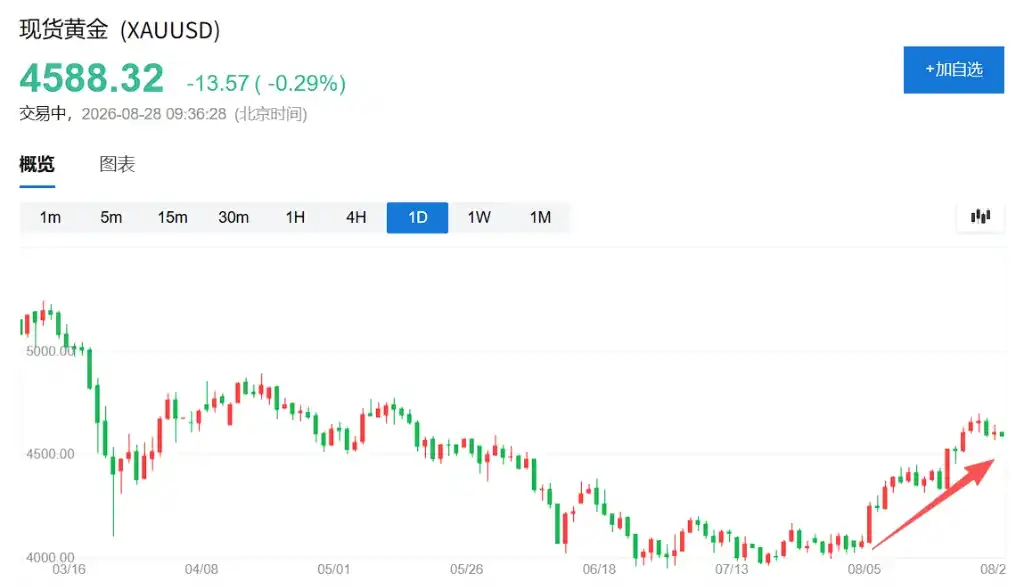
(Spot Gold Daily Chart)

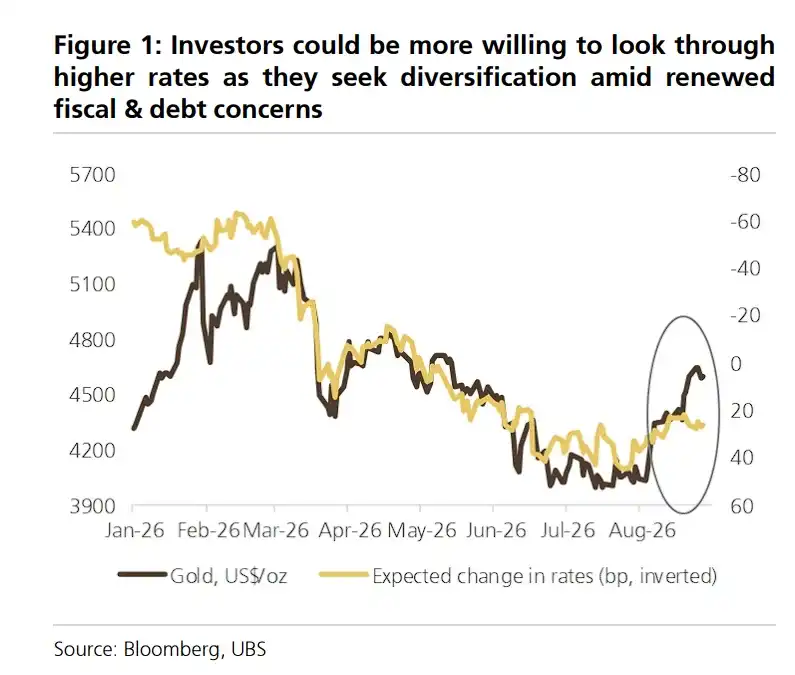
According to information from Wind Trading Desk, UBS's August 27 precious metals research report dissects this late-summer gold rebound into a "two-act play": Act One was a technically-driven rebound fueled by fundamental repair, catalyzed by extremely light positioning, resilient physical demand, central bank gold buying, and softening U.S. economic data. Act Two is a qualitatively different "currency debasement trade"—the U.S. Treasury's announcement to double its long-term bond repurchase program triggered deep-seated market concerns about fiscal sustainability, causing the traditional negative correlation between gold and interest rates to loosen.

The bank argues that gold's pricing logic has shifted from the "opportunity cost framework" (where higher real rates pressure gold) to a "fiscal credibility framework." Even if long-term real interest rates remain high, as long as the market perceives that high rates stem from fiscal risks rather than a strong economy, gold may continue to rise.
UBS maintains its bullish outlook on gold prices and explicitly states that upside risks to medium- to long-term forecasts are rising. UBS lowered its year-end 2026 gold price target from $5,000/oz to $4,675/oz (a 6.5% cut) but kept its 2027 and beyond forecasts unchanged, with an upside scenario target reaching as high as $6,500/oz. Notably, the bank identifies a hawkish Fed stance as the primary near-term downside risk. However, UBS clearly states that any pullback triggered by rising rate hike expectations should be viewed as a buying opportunity, not a trend reversal.

Act One: Fundamental Repair Forms a Bottom—Positioning, Demand, and Central Banks Provide Triple Support

The report states that before the August rally began, net positioning in the gold market was extremely light. Persistent inflation pressures fueled concerns that the Fed might restart rate hikes, leaving investors hesitant to buy aggressively but also lacking conviction to short, resulting in a wait-and-see stance. Despite a roughly 30% pullback from the year's highs, sentiment among medium- to long-term investors remained biased towards bullishness, with many waiting for better entry points.

UBS believes that gold's repeated failed attempts to breach the $4,000/oz level gradually rebuilt market confidence and established a solid bottom. This bottom formation was aided by stronger-than-expected demand resilience:

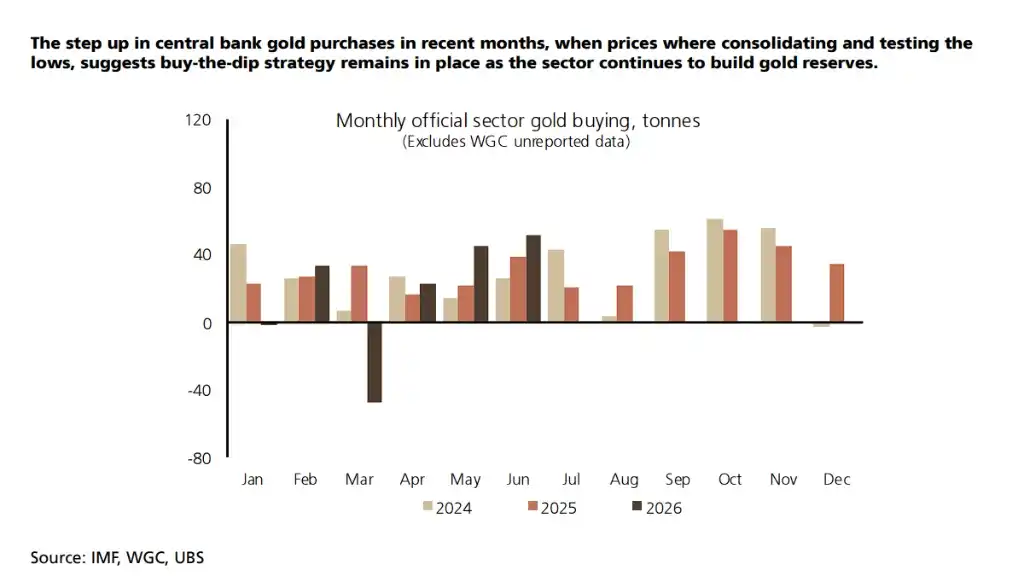
  • Official Sector Buying on Dips: More importantly, the official sector (i.e., central banks) accelerated purchases during price declines, providing substantive support for this bottom—the People's Bank of China's gold purchases increased as prices fell, showing a clear "buy the dip" strategy.
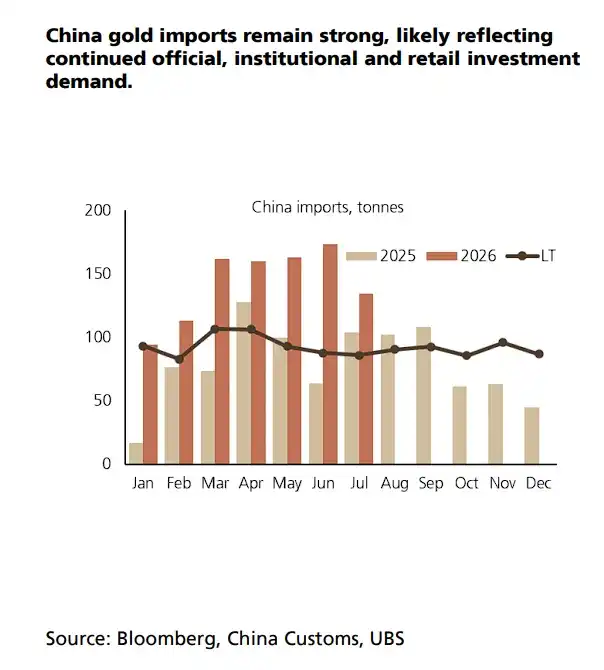
  • Robust Physical Demand: China's gold imports remained consistently above both last year's levels and historical averages, reflecting support from official, institutional, and retail investment demand. In India, imports were suppressed by regulatory hurdles, but seasonal demand patterns are emerging, with stronger fundamental support expected in the second half of the year and during festive seasons.
  • Soft U.S. Economic Data Provides Catalyst: Weak U.S. economic data released in early August prompted markets to scale back Fed rate hike expectations, becoming the direct trigger for gold's breakout. The initial move was driven by short covering, followed by new long entries. However, due to thin summer liquidity, market participants were generally cautious, and profit-taking was relatively swift.

Act Two: Narrative Shift—The "Currency Debasement Trade" Returns to Center Stage

The report points out that as gold prices stabilized and consolidated around $4,400/oz, the catalyst for the second leg higher emerged: the U.S. Treasury's announcement to double its long-term bond repurchase program.

While the scale of this measure itself is not large relative to the entire U.S. Treasury market, and its original purpose was merely liquidity management, the signal it sent far exceeded the operation itself—the market interpreted it as the Treasury's intent to actively intervene when long-end rates are under pressure, bringing discussions of fiscal sustainability and debt credibility back to the forefront.

Under the traditional framework, rising real interest rates mean a higher opportunity cost of holding gold, pressuring prices. But this time was different: the reason for rising rates changed. When the rise in long-end yields reflects fiscal risks and declining confidence in sovereign debt, rather than economic strength, investors become more willing to "look through" this opportunity cost and continue holding gold.

Concurrently, a weakening dollar provided an additional tailwind, further strengthening gold's role as a fiat currency alternative. Whether this logic is termed "de-dollarization," "de-fiatization," or "currency debasement hedging," its portfolio implication is consistent: gold can serve as a diversification tool, hard asset, and source of resilience under a broader range of macro scenarios.

Upside Risks Are Accumulating: What Scenarios Would Make UBS More Bullish?

UBS explicitly states it maintains its basic call for higher gold prices and acknowledges that upside risks to medium- to long-term forecasts have increased.

The clearest upside scenario is: Fiscal and debt issues become embedded in strategic asset allocation decisions, driving broader and more persistent increases in gold holdings, causing the rally to exceed baseline forecasts in both magnitude and duration. The following factors would reinforce this outcome:

  • Evidence of continued central bank gold buying;
  • Sustained resilience in Asian physical demand;
  • Further dollar weakness.

Other bullish scenarios include: persistently soft economic data, a surprisingly dovish pivot by the Fed, or a resurgence of market concerns about Fed independence.

Notably, current monetary and fiscal policy signals are diverging: The Fed remains focused on inflation control, while the Treasury has already acted to ease long-end pressure.

The market will closely parse Fed Chair Kevin Warsh's speech at Jackson Hole and subsequent statements from the Treasury. Due to the lack of forward guidance, every economic data release will have a greater impact on Fed policy expectations and gold price movements.

Biggest Near-Term Risk: A Hawkish Fed, But Pullbacks Are Opportunities

UBS clearly states that gold is not immune to a hawkish Fed. A rate hike this year, or signals from the Fed that significantly raise the probability of hikes, could trigger a sharp decline in gold prices by pushing real rates and the dollar higher. Thin summer liquidity and the rapid August gains could amplify the magnitude of such a correction.

However, UBS's judgment is: Such corrections should be viewed as buying opportunities, not the beginning of a sustained bear market.

A more critical downside risk lies in: If AI investments deliver far stronger-than-expected economic growth, the Fed would have ample room to hike rates significantly to suppress inflation. This scenario would have a more profound and lasting impact on gold.

In summary, the report states that when the market begins to view gold as a hedge against fiscal credibility risk and currency debasement, rather than merely an inflation hedge or interest rate trade, its strategic position in investment portfolios undergoes a qualitative change.

UBS research indicates that overall market allocation to gold remains low, and growth in assets under management creates room for further portfolio diversification. If fiscal and debt sustainability issues become a more enduring driver of strategic allocation, gold's upside potential could far exceed current baseline forecasts.


Related Questions

QAccording to the UBS report mentioned in the article, what are the two distinct phases ('acts') driving gold's strong rally in August?

AThe first phase is a technically-driven rebound based on fundamental repair, catalyzed by extremely light positioning, resilient physical demand, central bank purchases, and softening U.S. economic data. The second phase is a 'Monetary Debasement Trade' driven by market concerns over fiscal sustainability, sparked by the U.S. Treasury's announcement of doubling long-term bond buybacks.

QHow has the primary pricing logic for gold shifted according to UBS's analysis?

AThe primary pricing logic for gold has shifted from an 'opportunity cost framework' (where higher real rates pressure gold) to a 'fiscal credibility framework.' This means gold may continue to rise even if long-term real rates stay high, as long as the market views the high rates as stemming from fiscal risk rather than economic strength.

QWhat recent policy action triggered the market's shift toward a 'Monetary Debasement Trade' narrative for gold?

AThe U.S. Treasury's announcement that it would double the size of its long-term Treasury buyback operations triggered the shift. While operationally small, it signaled active intervention in the long end of the yield curve, leading markets to question fiscal sustainability and debt credibility.

QWhat does UBS identify as the key near-term downside risk for gold, and what is its recommended strategy if this risk materializes?

AA hawkish Federal Reserve stance is identified as the key near-term downside risk. If expectations for rate hikes cause a sharp gold price correction, UBS recommends viewing it as a buying opportunity to increase positions, not as the beginning of a sustained bear market.

QWhat scenario does UBS outline as the clearest 'upside scenario' that could push gold prices significantly above its base forecast?

AThe clearest upside scenario is if fiscal and debt sustainability concerns become embedded in strategic asset allocation decisions, leading to broader and more permanent increases in gold holdings. This would be reinforced by evidence of continued central bank buying, sustained Asian physical demand, and further U.S. dollar weakness.

Related Reads

4.8 Billion Dollars: Tether's Hand Has Reached Into 13 U.S. Public Companies

Tether, the world's largest stablecoin issuer, holds roughly $4.8 billion in public-market exposure across 13 U.S.-listed companies, according to a Protos review of regulatory filings. Its holdings span a controversial video platform, gold royalty companies, a satellite firm, bitcoin miners, and a bitcoin treasury project. Key positions include a 50.3% stake (including warrants) in Rumble (RUM), though voting power is capped below 9.9%; Rumble has also acquired Tether's Northern Data and counts Tether as its most important advertising client, committed to $50 million annually for two years. Tether and Bitfinex are controlling shareholders of Twenty One Capital (XXI), with rights to nominate four of seven directors, including Tether CEO Paolo Ardoino; the company trades at about 60% of its bitcoin value. In gold, Tether holds about 27% of Elemental Royalty (ELE), 12.6% of Gold.com (GOLD), 12.6% of Versamet Royalties (VMET), 14.6% of Metalla (MTA), 14.4% of Gold Royalty (GROY), 12% of Aurelion (AURE), and about 8% of Antalpha (ANTA). It also holds 19.7% of Bitdeer (BTDR) and a stake in Adecoagro (AGRO), plus shares in Satellogic (SATL), 9.9% of SDEV (down about 99%), and a stake in VCI Global (VCIG) via Oobit. Powerlaw Corp (PWRL) claims roughly $20 million in Tether equity. The exposure is concentrated in a few large holdings—Twenty One, Rumble, and Adecoagro—showing Tether's growing role as a multi-sector financial institution that also places executives in key positions.

marsbit11m ago

4.8 Billion Dollars: Tether's Hand Has Reached Into 13 U.S. Public Companies

marsbit11m ago

Tesla and SpaceX Merger Accelerates: A $3.47 Trillion Giant, Deal Could Be Announced as Early as December

Tesla and SpaceX are reportedly advancing merger talks, with a deal potentially announced as early as December, though complex corporate structure and regulatory issues could delay it to early 2027. Based on recent market values—SpaceX at about $1.90 trillion and Tesla at about $1.57 trillion—the combined entity would be worth roughly $3.47 trillion, making it one of the largest corporate integrations in history and bringing rocket launch, satellite internet, EVs, energy storage, AI, and robotics under one roof. In October, Musk called a merger "a good idea" and confirmed both companies had formed independent director special committees. The strategic logic centers on AI infrastructure—chips, compute, and energy—with the Terafab chip manufacturing joint venture as a concrete example, expected to produce first test chips in mid-2027 and reach mass production in Q3 2028. Shareholder impact is significant: Musk holds about 40-45% economic interest in SpaceX with over 80% voting power via dual-class shares, versus nearly 20% of Tesla with equal voting rights, raising questions about control and whether Tesla shareholders would accept a new structure. Regulatory hurdles may be the hardest obstacle, given SpaceX's sensitive U.S. defense contracts and Tesla's major China operations, implicating CFIUS and Chinese regulators. The merger reflects Musk's ambition to unify his business empire around a shared technology base spanning Earth and space.

marsbit46m ago

Tesla and SpaceX Merger Accelerates: A $3.47 Trillion Giant, Deal Could Be Announced as Early as December

marsbit46m ago

10-Second 4K Image Generation: MiniMax Once Again Delivers Open-Source SOTA

MiniMax has released MiniMax H3 Image, an open-source image generation model that has quickly claimed state-of-the-art status among open-weight models. It natively outputs 4K images (around 16 million pixels) in roughly 10 seconds with the fast version, supports up to 16 reference images, and ranks first among open-weight models on Artificial Analysis for both text-to-image and image editing. The model is available via web, API, and local deployment on GitHub and HuggingFace. In hands-on tests, H3 Image produced highly realistic WeChat chat screenshots with accurate iPhone status bar details, rendered complex graffiti-style text ("MiniMax H3 Image") with 3D lettering and spray-paint effects, and generated convincing Victoria's Secret backstage photos, cinematic street portraits, and Y2K-style retro portraits. It also handled image-to-image tasks well: turning a photo into a hand-drawn sticker, adding CCTV-style face bounding boxes and zoom-ins, and converting realistic images into anime collage styles. The model further demonstrated understanding of physical structure by generating a labeled exploded-view diagram of a 35mm camera, producing accurate outfit try-on images, e-commerce product posters, and typography-heavy Eastern botanical posters, and following complex multi-reference editing instructions. Architecturally, H3 Image derives from MiniMax's full-modal video model H3, retaining its backbone and text encoder (a 32-billion-parameter multimodal language model) while dropping the audio branch. Its core is a 33.1-billion-parameter diffusion Transformer using 3D multimodal rotary position encoding, with text and reference-image tokens processed in a single stream and decoded by a VAE. Native generation avoids external super-resolution. The video-first lineage is credited with giving the model strong visual world knowledge, including viewpoint, material, lighting, and motion understanding. The release has energized the global AI community: derivatives such as Pruna's P-H3-Image, Nvidia's Sol-H3, and Pika H3 Flex have appeared, with roughly 220 H3-based entries on Hugging Face. Chinese open-source technology is increasingly the foundation for overseas teams, and MiniMax is building a commercial loop around free weights plus paid hosted APIs and subscriptions. The article argues competition is shifting from raw model capability to ecosystem strength.

marsbit1h ago

10-Second 4K Image Generation: MiniMax Once Again Delivers Open-Source SOTA

marsbit1h ago

Jensen Huang Resigns, CFO Becomes NVIDIA Interim CEO, Who Is Kress?

NVIDIA announced on November 12 that co-founder Jensen Huang has resigned as president, CEO, and board member, effective immediately, after scandals involving extramarital affairs. The board accepted his resignation on November 11, and Huang, who led the company for 33 years and holds about 3.6% of shares, also left the board entirely. CFO Colette Kress has been appointed interim CEO while continuing as EVP and CFO; she becomes the first female leader in NVIDIA's history. Former Synopsys CEO Harvey C. Jones, a director since 1993, becomes the company's first independent board chair. The board will search for a permanent CEO internally and externally. Kress, 59, holds a finance degree from the University of Arizona and an MBA from SMU Cox, and previously worked at Texas Instruments, Microsoft, and Cisco before joining NVIDIA in 2013 at Huang's invitation. During her 13 years as CFO, NVIDIA's revenue grew from $4.13 billion in FY2014 to $215.9 billion in FY2026, roughly 52-fold, and she became a billionaire in July 2025 with a net worth of about $1–1.2 billion. The resignation followed reports of Huang's infidelity, including a New York Times report of a romantic relationship with NVIDIA healthcare VP Kimberly Powell. NVIDIA shares fell sharply, hitting a five-month low below $150 before recovering to about $160. The board expressed confidence that operations, customer commitments, and product roadmaps will not be disrupted.

marsbit1h ago

Jensen Huang Resigns, CFO Becomes NVIDIA Interim CEO, Who Is Kress?

marsbit1h ago

Trading

Spot
活动图片