Washington's efforts to establish national rules for cryptocurrency trading, custody, and market oversight are currently focused on the CLARITY Act. The bill, which passed the House of Representatives, allocates federal authority between the Securities and Exchange Commission (SEC) and the Commodity Futures Trading Commission (CFTC), and establishes requirements for exchanges, brokers, dealers, disclosure, and customer asset protection.
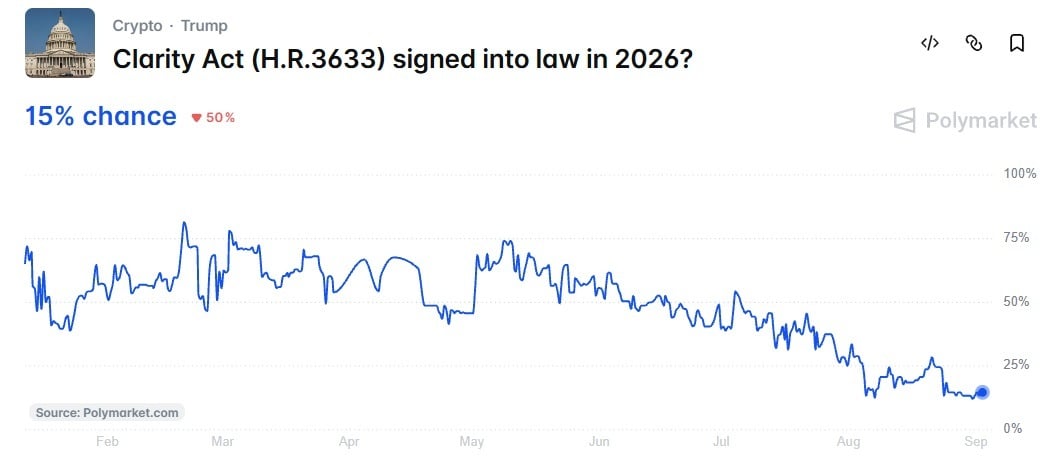
Traders on prediction markets remain skeptical that the Crypto Asset Market Structure Act will complete the legislative process this year. A Polymarket contract on the law taking effect in 2026 showed on September 2 that the probability of the CLARITY Act (H.R. 3633) being passed by both chambers and signed by the president by December 31 is 15%. Trading volume reached approximately $11.62 million.
This low probability contrasted with House Financial Services Committee Chairman French Hill's renewed mention of the bill during September 2 hearings on growth, affordability, innovation, and capital access. In his prepared remarks, the Arkansas Republican listed the CLARITY Act's House passage among the committee's accomplishments and called for permanent, predictable financial rules.
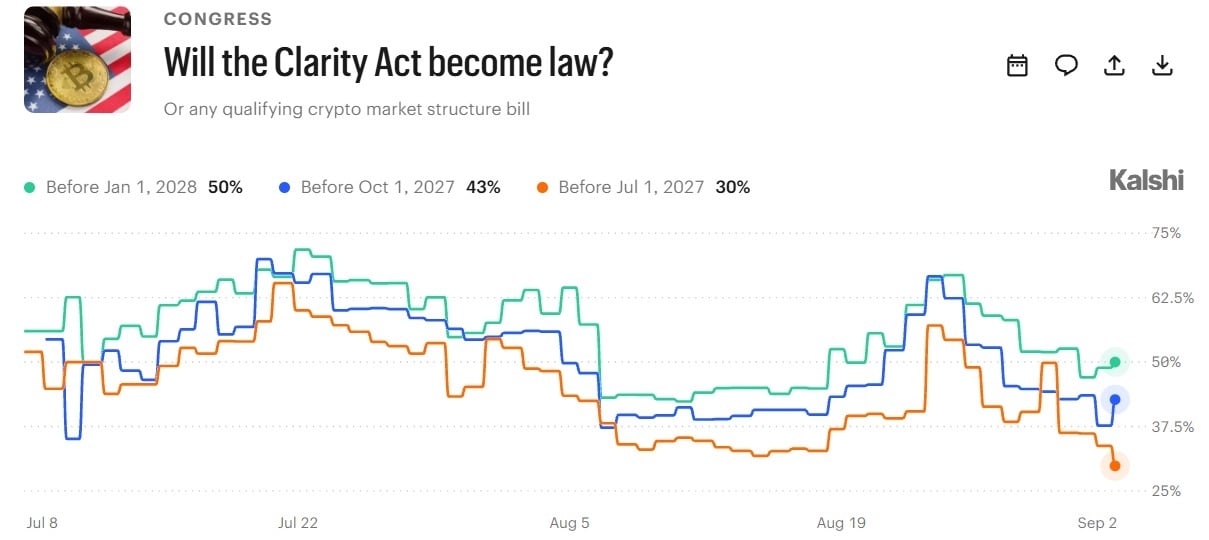
Long-term Kalshi contracts showed higher probabilities, although they assess a broader range of possible outcomes and cannot be directly compared to the 2026 Polymarket contract. Kalshi estimated the probability that the CLARITY Act or another relevant crypto market structure bill becomes law by July 1, 2027 at 30%, and by January 1, 2028 at 50%. Trading volume was approximately $6.85 million.
The latest data shows traders are distinguishing between an upcoming Senate vote and final enactment. By August 31, the market had already separated procedural progress from final passage: traders assessed the probability of a Senate vote as high, but the probability of the bill becoming law during 2026 as much lower. The latest Polymarket figure of 15% rose from 13%, but still largely signalled against passage.
September 15 cloture motion will be the next test
The next significant step will be a procedural vote on the bill, which senators could hold as early as September 15. According to the official Senate schedule, a motion to invoke cloture on H.R. 3633 will be voted on at 2:15 PM. Passing a cloture motion typically requires 60 votes, so the bill's future depends on its ability to maintain bipartisan support.
In earlier stages, the bill already received bipartisan support. On May 14, the Senate Banking Committee approved H.R. 3633 by a vote of 15 to 9, sending it to the full floor. Democratic Senators Ruben Gallego and Angela Alsobrooks joined Republicans in supporting the bill's advancement, though the committee's approval did not guarantee sufficient support for cloture or final passage.
Subsequently, Senate negotiators unveiled a revised bill merging the work of the Banking and Agriculture Committees. The updated CLARITY Act framework addresses SEC and CFTC jurisdiction, consumer protection, illicit financing, decentralized finance (DeFi), intermediary oversight, disclosure requirements, and certain network tokens.
The revised language creates another factor affecting the timeline, reflected in the low odds for 2026 passage. Senate approval of provisions differing from the House-passed bill may require additional action before the bill reaches the president's desk. The Polymarket contract will pay out only if H.R. 3633 clears all remaining steps by the end of 2026.
Hill's regulatory initiative faces legislative calendar constraints
Hill included the CLARITY Act within a broader economic agenda covering capital markets, housing, community financial institutions, and regulatory modernization. He stated, "Republicans on the committee are working diligently to codify these reforms into law to make them permanent and predictable." Prediction market probabilities indicate traders view the remaining congressional schedule as a significant obstacle to this goal.
In his September 2 statement, the lawmaker did not provide extensive arguments for digital assets, but had previously explained why he considers CLARITY critical. During July field hearings marking the one-year anniversary of the bill's House passage, Hill compared passing stablecoin legislation without a crypto market framework to an unfinished communication system, with the CLARITY bill remaining stalled in the Senate.
Hill stated:
"We need to get CLARITY done because of one key point I always emphasize: if you have the GENIUS Act and a dollar-backed stablecoin that President Trump signed in July of last year, but you don't have a market structure bill, it's like getting permission to own a cell phone but not having a cellular network."
The bill could impact centralized exchanges, decentralized platforms, brokers, dealers, token issuers, and customers. Centralized and decentralized crypto exchange structures raise different issues related to asset custody, regulatory compliance, and consumer protection, which the proposed framework aims to address.
If senators agree to take up the cloture motion on September 15, the vote will become the next direct test for market skepticism. Overcoming this procedural hurdle could improve forecasts for Senate consideration, while failure would reinforce the current 85% probability assessed for H.R. 3633 not becoming law during 2026.
end-content