Fitch Ratings flags risk for US banks with high crypto exposure

cointelegraphPublished on 2025-12-09Last updated on 2025-12-09

Abstract

Fitch Ratings warns that US banks with significant cryptocurrency exposure may face negative reassessments of their business models and risk profiles. While crypto integration can offer benefits like improved efficiency and new revenue streams, it also introduces reputational, liquidity, operational, and compliance risks. The agency notes that banks must adequately manage challenges such as crypto volatility, pseudonymity of owners, and security of digital assets. A downgrade from Fitch could lead to lower investor confidence and higher borrowing costs for these banks. The report also highlights systemic risks from the growing stablecoin market, which could impact the broader system and even the Treasury market if adoption expands sufficiently. Major banks like JPMorgan and Bank of America are mentioned as being involved in the sector.

International credit rating agency Fitch Ratings has warned that it may reassess US banks with “significant” cryptocurrency exposure negatively.

In a report posted on Sunday, Fitch Ratings argued that while crypto integrations can boost fees, yields and efficiency, they also pose “reputational, liquidity, operational and compliance” risks for banks.

“Stablecoin issuance, deposit tokenization and blockchain technology use give banks opportunities to improve customer service. They also let banks leverage blockchain speed and efficiency in areas such as payments and smart contracts,” Fitch said, adding:

“However, we may negatively re-assess the business models or risk profiles of U.S. banks with concentrated digital asset exposures.”

Fitch stated that while regulatory advancements in the US are paving the way for a safer cryptocurrency industry, banks still face several challenges when dealing with cryptocurrencies.

“However, banks would need to adequately address challenges around the volatility of cryptocurrency values, the pseudonymity of digital asset owners, and the protection of digital assets from loss or theft to adequately realize the earnings and franchise benefits,” said Fitch.
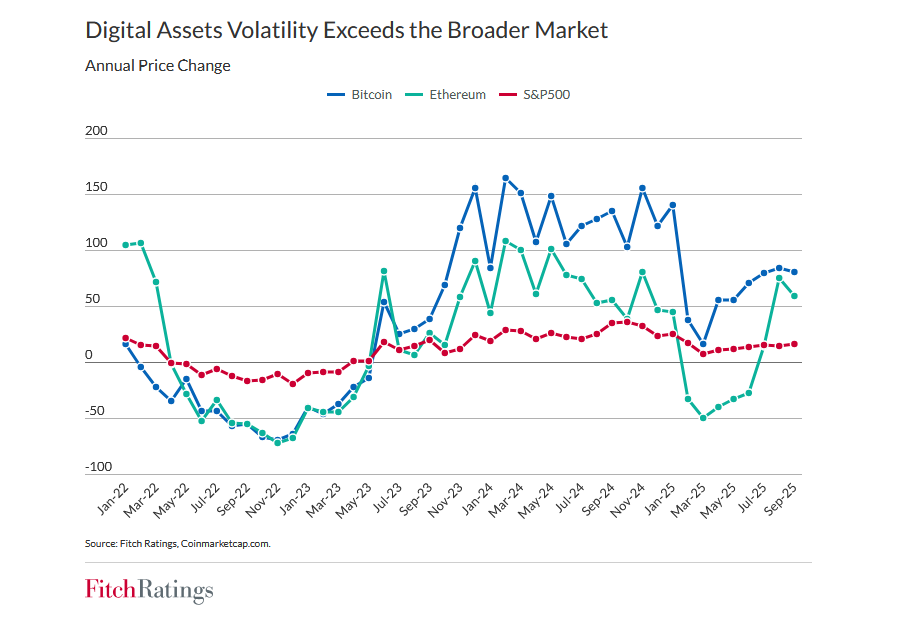
Bitcoin and Ether volatility vs S&P 500. Source: Fitch Ratings

Fitch Ratings is one of the “Big Three” credit rating agencies in the US alongside Moody’s and S&P Global Ratings.

The ratings from these firms — which can be controversial — carry significant weight in the financial world and impact how businesses are perceived or invested in from an economic viability perspective.

As such, Fitch’s downgrading the ratings of a bank with significant crypto exposure could result in lower investor confidence, higher borrowing costs and challenges to growth.

The report highlighted that several major banks, including JPMorgan Chase, Bank of America, Citigroup, and Wells Fargo, are involved in the crypto sector.

Fitch highlights systemic stablecoin risks

Fitch argued that another risk could come from the explosive growth of the stablecoin market, especially if it becomes large enough to influence other areas and institutions.

“Financial system risks could also increase if adoption of stablecoins expands, particularly if it reaches a level sufficient to influence the Treasury market.”

Related: Crypto, TradFi sentiment improves: Will Bitcoin traders clear shorts above $93K?

Moody’s also recently highlighted potential systemic risks of stablecoins in a report from late September, arguing that widespread adoption of stablecoins in the US could ultimately threaten the legitimacy of US dollar.

“High penetration of USD-linked stablecoins in particular can weaken monetary transmission, especially where pricing and settlement increasingly occur outside the domestic currency,” Moody’s said.

“This creates cryptoization pressures analogous to unofficial dollarization, but with greater opacity and less regulatory visibility,” it added.

Magazine: When privacy and AML laws conflict: Crypto projects’ impossible choice

Related Reads

Why Is It Difficult for Retail Investors to Break Free from the Loss Cycle of High-Frequency Trading?

Why Retail Traders Struggle to Escape the High-Frequency Trading Loss Cycle Retail investors often fall into a trap of continuous losses in cryptocurrency markets due to high-frequency day trading, which is structurally skewed against them. The author, sharing from personal experience, explains that frequent trading without informational advantages—such as access to real order flow, liquidity maps, or market maker positions—inevitably leads to financial ruin over time. The key insight is that winning isn’t just about making profits but about preserving them. Most successful retail traders actually succeed by trading less: catching major market moves, then stepping back to avoid giving back gains. In contrast, constant trading—often driven by overconfidence and the false belief that discipline and risk management alone can beat the market—results in consistent losses. The article compares modern day trading to a "casino disguised as a café," where inexperienced traders, especially young ones, mistake gambling for a learnable skill. They rely on superficial tools like TradingView charts without understanding that institutional traders use advanced systems like Bloomberg terminals with exclusive data. Ultimately, the author advises retail traders to reduce trading frequency, avoid day trading, and focus on long-term strategies instead of chasing quick wins. The real tragedy is not losing money but believing that high-frequency trading is a sustainable strategy rather than a form of gambling.

比推18m ago

Why Is It Difficult for Retail Investors to Break Free from the Loss Cycle of High-Frequency Trading?

比推18m ago

Bull vs. Bear Debate: Is Stablecoin Leader CRCL Worth Buying? Why Can't High-Growth Earnings Drive the Stock Price?

"Circle (NYSE: CRCL), the issuer of USDC, has sparked intense debate in the crypto community following its Q3 2025 earnings report. Despite reporting strong growth—revenue up 66% YoY to $740 million and net income of $214 million, driven by a 108% increase in USDC circulation—its stock price fell significantly post-earnings and remains near its IPO price of $64. The core disagreement revolves around Circle’s business model and sustainability. Critics, including Jiang Zhuorer, argue that Circle operates like a bank, earning primarily through interest on reserve assets (mainly U.S. Treasuries), but is highly vulnerable to interest rate cuts. They highlight that ~60% of revenue is paid to distributors like Coinbase, leaving thin margins that could turn negative in a low-rate environment. They also warn of competition from traditional financial giants like JPMorgan and potential policy changes. Proponents, such as BTCdayu and qinbafrank, counter that Circle is building a long-term, network-driven infrastructure play. They compare it to Amazon or JD.com, arguing that current profit-sharing is a strategic cost to achieve scale, compliance advantage, and eventual market dominance in a winner-take-all industry. They believe USDC’s合规 (compliance) edge and institutional trust will drive adoption to multi-trillion dollars, outweighing interest rate risks. Short-term concerns include significant post-IPO lockup expirations adding selling pressure, and structural barriers like U.S. tax treatment of USDC as a property (not cash), hindering retail payment adoption. The debate encapsulates a clash between cyclical concerns (rates, costs, competition) and structural optimism (scale, compliance, network effects)."

Odaily星球日报1h ago

Bull vs. Bear Debate: Is Stablecoin Leader CRCL Worth Buying? Why Can't High-Growth Earnings Drive the Stock Price?

Odaily星球日报1h ago

Trading

Spot
Futures
活动图片