Ethereum Faces Liquidation Zones: Large Holders Cluster Risk Levels Between $1,700 And $1,000

bitcoinistPublished on 2026-02-07Last updated on 2026-02-07

Abstract

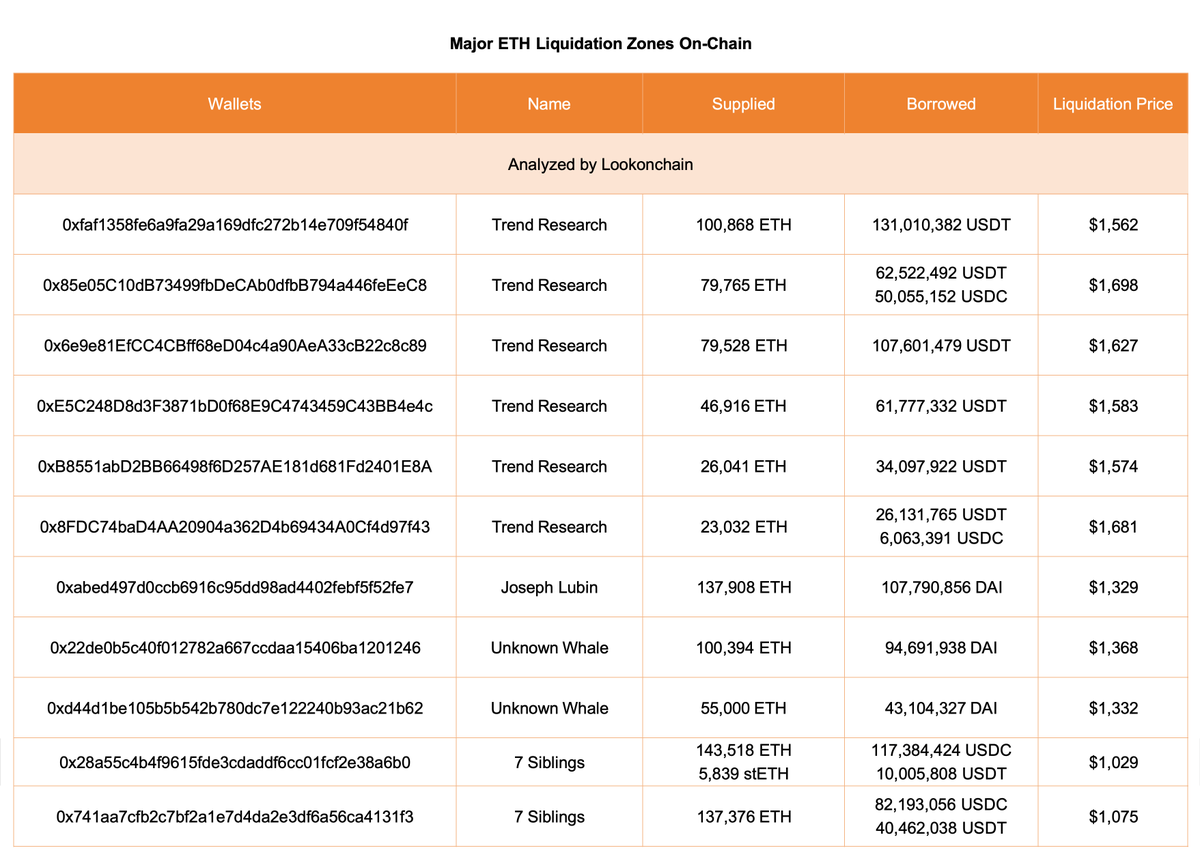
Ethereum has fallen below the critical $2,000 mark amid a broader bearish market structure, weakening macro sentiment, and persistent outflows from risk assets. According to Lookonchain data, three major on-chain liquidation clusters could significantly impact ETH's short-term price action if selling pressure continues. These include Trend Research (356,150 ETH, liquidation between $1,562–$1,698), a group including Joseph Lubin (293,302 ETH, liquidation at $1,329–$1,368), and the entity 7 Siblings (286,733 ETH, liquidation near $1,075–$1,029). These zones may act as volatility accelerators if prices decline further, potentially triggering cascading liquidations. Market sentiment has also been affected by reports of Vitalik Buterin moving ETH, though these are often for operational or charitable purposes.

Ethereum has slipped below the critical $2,000 level, reinforcing a broader bearish market structure as selling pressure intensifies across the crypto sector. The breakdown comes amid weakening macro sentiment, persistent outflows from risk assets, and declining confidence in short-term crypto demand. Together, these factors have pushed ETH into a defensive phase, with traders increasingly focused on downside liquidity zones rather than recovery signals.

Recent data highlighted by Lookonchain points to three major on-chain liquidation clusters that could shape Ethereum’s next moves. These zones represent areas where leveraged positions may be forced to close if price declines continue, potentially accelerating volatility. Historically, such liquidation pockets tend to act as magnets during corrective phases, amplifying both panic selling and short-term price swings.

Market sentiment has also been affected by reports of Ethereum co-founder Vitalik Buterin moving and selling ETH. While these transactions are often linked to funding ecosystem development, charitable initiatives, or operational needs rather than outright bearish positioning, they can still influence trader psychology. In fragile markets, even neutral fundamental events can trigger disproportionate reactions.

Lookonchain data highlights three major on-chain liquidation clusters that could significantly influence Ethereum’s short-term price dynamics if bearish pressure persists. According to the analysis, Trend Research reportedly holds about 356,150 ETH, valued near $671 million, with estimated liquidation levels between $1,562 and $1,698. If price approaches this band, forced position closures could amplify volatility and accelerate downside momentum.
Ethereum Transactions | Source: Lookonchain

Another key concentration involves Ethereum co-founder Joseph Lubin alongside two unidentified large wallets. Combined holdings are estimated at around 293,302 ETH, roughly $553 million, with potential liquidation thresholds between $1,329 and $1,368. This zone sits deeper in the corrective structure and could act as a secondary stress level if broader market weakness continues.

A third cluster attributed to the entity known as 7 Siblings holds approximately 286,733 ETH, valued at around $541 million. Their liquidation prices are significantly lower, near $1,075 and $1,029, representing a deeper capitulation scenario should selling pressure intensify further.

It is important to note that liquidation estimates depend heavily on leverage assumptions, collateral adjustments, and evolving market conditions. Still, these zones provide a useful framework for understanding where volatility could increase, as leveraged positions historically tend to magnify both downward cascades and eventual stabilization phases in crypto markets.


Related Questions

QWhat are the three major on-chain liquidation clusters for Ethereum mentioned in the article, and what are their approximate liquidation price ranges?

AThe three major liquidation clusters are: 1) Trend Research, with liquidation levels between $1,562 and $1,698; 2) Joseph Lubin and two unidentified wallets, with thresholds between $1,329 and $1,368; 3) The entity 7 Siblings, with liquidation prices near $1,075 and $1,029.

QAccording to the article, what factors have contributed to pushing Ethereum into a defensive phase below $2,000?

AThe factors include weakening macro sentiment, persistent outflows from risk assets, declining confidence in short-term crypto demand, and intensifying selling pressure across the crypto sector.

QHow can transactions by Ethereum co-founders, like Vitalik Buterin, impact the market even if they are not bearish in nature?

AEven when these transactions are for funding development, charity, or operational needs rather than bearish positioning, they can still influence trader psychology and trigger disproportionate reactions in fragile markets.

QWhat is the estimated value of the ETH holdings for the Trend Research cluster, and how many ETH does it represent?

AThe Trend Research cluster holds about 356,150 ETH, which is valued at approximately $671 million.

QWhy is it important to note that liquidation estimates depend on certain factors, according to the article?

ALiquidation estimates depend heavily on leverage assumptions, collateral adjustments, and evolving market conditions, meaning they are not absolute but provide a useful framework for anticipating potential volatility.

Related Reads

Institutional Adoption of Prediction Markets Stuck at the Third Stage

Prediction markets are transitioning from niche platforms focused on elections and sports to mainstream financial tools, as highlighted at Kalshi Research's inaugural conference. While sports still dominate trading volume (around 80%), non-sports categories like macroeconomics, politics, and entertainment are growing faster, signaling a shift from entertainment-based trading to information and risk management tools. Institutions, including Wall Street firms, are increasingly using prediction markets for data reference (Stage 1 adoption), with some progressing to system integration (Stage 2). However, full-scale trading (Stage 3) is limited due to the lack of margin trading, requiring full collateral for positions—a barrier for leverage-dependent entities. Kalshi is working with regulators to introduce margin mechanisms. Key insights from participants like Goldman Sachs and CNBC emphasize the value of real-time pricing for events (e.g., Fed decisions, tariffs), providing benchmarks previously unavailable. The path to maturity mirrors historical financial instruments like options, with expectations that prediction markets will become institutional staples within five years. Political leaders, including Trump and Schumer, now cite Kalshi odds, underscoring its growing influence. The platform rewards domain expertise over traditional finance backgrounds, attracting diverse participants from fields like music and poker. Ultimately, prediction markets are evolving into critical infrastructure for pricing uncertainty.

marsbit21m ago

Institutional Adoption of Prediction Markets Stuck at the Third Stage

marsbit21m ago

The First Year of Computing Power Inflation: The Cheaper DeepSeek Gets, the Harder It Is to Stop This Round of Price Hikes

The year 2026 marks the beginning of "computing power inflation." While AI inference costs have dropped by over 80% in 18 months globally, China's three major cloud providers—Alibaba Cloud, Baidu AI Cloud, and Tencent Cloud—simultaneously announced price hikes of 20–30%. This reflects a deeper structural shift driven by Jevons Paradox: as unit costs fall (e.g., via models like DeepSeek-R1), demand explodes, especially with the rise of reasoning models and AI agents that consume 10–50x more tokens per task. Although DeepSeek open-sourced its model weights, it did not release its inference optimization stack, leaving a significant engineering efficiency gap between cloud providers and smaller players. The big three are leveraging this advantage to reposition: Alibaba focuses on high-margin premium clients, Baidu filters out low-value users, and Tencent capitalizes on ecosystem lock-in. Meanwhile, ByteDance’s Volcano Engine adopts a more moderate pricing strategy to capture displaced customers. Unexpectedly, the price surge is pushing large enterprises toward self-built computing solutions once their cloud bills exceed a certain threshold. While cloud providers aim to boost profitability, they risk driving away innovative startups and accelerating competition from GPU leasing and domestic hardware providers like Huawei. The涨价 trend is expected to persist for 2–3 years, fueled by rising token consumption from reasoning models, AI agent adoption, and NVIDIA export restrictions. The inflection point depends on whether domestic chips can match NVIDIA’s efficiency, likely around 2027–2028. Until then, cloud providers will maintain pricing power, and the key for AI companies is to optimize token usage—the real moat in this era.

marsbit1h ago

The First Year of Computing Power Inflation: The Cheaper DeepSeek Gets, the Harder It Is to Stop This Round of Price Hikes

marsbit1h ago

Trading

Spot
Futures

Hot Articles

Discussions

Welcome to the HTX Community. Here, you can stay informed about the latest platform developments and gain access to professional market insights. Users' opinions on the price of ETH (ETH) are presented below.

活动图片