ESMA gives crypto firms 3 months to exit non-compliant stablecoins

cointelegraphPublished on 2026-10-08Last updated on 2026-10-08

Abstract

The European Securities and Markets Authority (ESMA) has instructed EU-based crypto firms to stop offering services involving stablecoins that do not comply with the Markets in Crypto-Assets Regulation (MiCA). Firms have until January 8, 2027, to address existing exposures to non-compliant stablecoins. This directive applies to all MiCA-regulated services, including trading, custody, and investment advice. Companies must implement controls to prevent EU clients from acquiring or increasing holdings in unauthorized stablecoins. Regulators may allow limited temporary services, such as liquidation or withdrawal, to help clients exit positions, but these must be closely supervised. This guidance expands on ESMA's earlier call for restrictions on trading non-compliant stablecoins.

The European Securities and Markets Authority (ESMA) has urged EU crypto firms to stop providing services involving stablecoins that aren’t compliant with the Markets in Crypto-Assets Regulation (MiCA) framework, setting a three-month deadline to address existing exposures.

On Thursday, ESMA said national regulators should require companies to address remaining exposures to non-compliant stablecoins as soon as possible and no later than Jan. 8, 2027.

“Crypto-asset service providers (CASPs) authorised under MiCA should cease providing services related to non-MiCA-compliant stablecoins to clients in the European Union,” ESMA wrote.

The guidance covers MiCA-regulated crypto services, including trading platforms, exchange services, order execution, custody, transfers, investment advice and portfolio management.

ESMA said crypto firms should implement technical, contractual and organisational controls to prevent EU clients from acquiring or increasing their exposure to unauthorised stablecoins.

Regulators may permit limited services to help clients exit existing positions, including liquidation, conversion, withdrawal, transfers and safekeeping. However, ESMA said such activities must be temporary and closely supervised.

The update expands on ESMA’s January 2025 guidance, which called for restrictions on trading and exchange services that involved non-compliant stablecoins.

Related: EU banking watchdog calls for crypto lending rules under MiCA

Related Questions

QWhat is the deadline set by ESMA for EU crypto firms to stop providing services involving non-MiCA compliant stablecoins?

AThe deadline is January 8, 2027.

QWhat types of crypto-asset services are covered by ESMA's guidance regarding non-compliant stablecoins?

AThe guidance covers MiCA-regulated services including trading platforms, exchange services, order execution, custody, transfers, investment advice, and portfolio management.

QAccording to ESMA, what measures should crypto firms implement regarding EU clients and unauthorized stablecoins?

ACrypto firms should implement technical, contractual, and organizational controls to prevent EU clients from acquiring or increasing their exposure to unauthorized stablecoins.

QWhat limited services might regulators permit regarding non-compliant stablecoin exposures?

ARegulators may permit limited services to help clients exit existing positions, including liquidation, conversion, withdrawal, transfers, and safekeeping, provided these activities are temporary and closely supervised.

QHow does ESMA's latest guidance on stablecoins relate to its previous guidance from January 2025?

AThe latest update expands on the January 2025 guidance, which initially called for restrictions on trading and exchange services involving non-compliant stablecoins.

Related Reads

Bitbase Points' First Phase "Origin" Launches Trading Personality Cards, Seven Types Generated Weekly

Bitbase has launched trading personality cards in the first phase of its Bitbase Points program, "ORIGIN." The cards are automatically generated by the system based on each user's trading characteristics over the past week and update every Monday at 00:00 UTC. The first batch was generated on November 9 and can be viewed on the Points page. The personality cards are designed to align with ORIGIN's 26-week focus on sustained user participation rather than short-term concentrated trading. While Points record user participation and contribution, personality cards record how users trade, allowing users to track changes in their trading habits week by week throughout the ORIGIN period. There are seven types of personality cards: the "Diamond Hands" representing long-term holding, the "Guerrilla Captain" for short-term trading, the "Human Alarm Clock" for those who trade at fixed times, the "Risk Control Expert" for those focused on risk management, the "Ambush Master" for those primarily using limit orders, the "Full Attendance King" for continuous participation, and the "Hexagon Warrior" for balanced trading styles. Each card features a personality name, a description, and a corresponding image, all derived from Bitbase's brand IP character BENIE. Personality cards are regenerated weekly, so the same user may receive different card types in different weeks. When a card has not yet been generated, the page displays "Generating." Users who continue trading and accumulate more data may receive personality cards in subsequent weekly updates. Users can share their cards on the Points page. Bitbase plans to introduce more personality types during the ORIGIN period. Bitbase is a global digital asset trading platform offering spot, contracts, TradFi, and wealth management services to individual and institutional users, with the brand proposition of "focusing on value amid change."

marsbit8m ago

Bitbase Points' First Phase "Origin" Launches Trading Personality Cards, Seven Types Generated Weekly

marsbit8m ago

Crypto RUG History: A Bold New Chapter Just Added

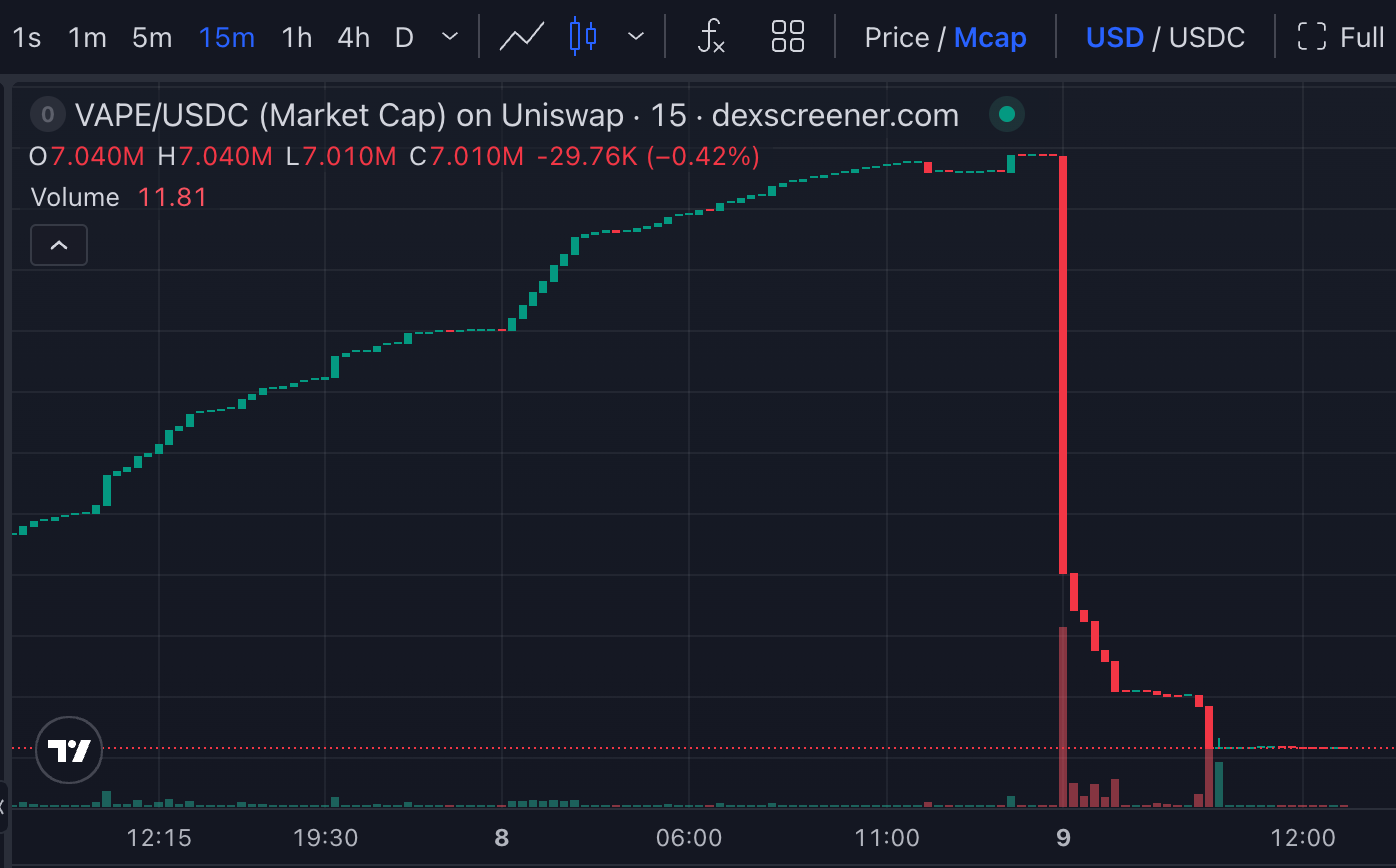
The DePIN project Puffpaw, which raised $6 million in a 2024 seed round led by Lemniscap with participation from Folius Ventures and Spartan Group, recently resurfaced after half a year of silence to launch its VAPE token and airdrop — but the move appears designed to exploit prediction markets rather than reward the community. Despite the funding, VAPE launched with no CEX support and only a few tens of thousands of dollars in DEX liquidity. Early supporters who spent hundreds of dollars on genesis NFTs or devices received airdrops worth only tens of dollars, locked under a 156-week vesting schedule, while team-linked addresses controlled 97%–99.88% of circulating supply. The real motive lay on Polymarket, where markets asked whether Puffpaw's FDV one day after launch would exceed $50M/$100M/$200M/$300M/$400M. Since the project had been dormant, YES probabilities were low, letting the team cheaply accumulate YES positions across tiers and then use its fully controlled token to paint the price. VAPE's first-day chart showed a suspicious "staircase" climb with no wicks, with FDV precisely held just below $400 million long enough to trigger the market conditions, after which the token was dumped and FDV collapsed from nearly $400 million to about $7 million. On-chain analyst Atlantis Liquidity found that of 1,285 wallets holding positions in the Polymarket market, 1,259 (nearly 98%) had never traded any other Polymarket market — likely purpose-built accounts. Polymarket results have since been disputed twice; all five sub-markets are now under final review by UMA token holders, with voting expected to end November 11. The community is split between those arguing that honoring the payout would reward fraud and those insisting that contractual certainty requires settling YES if the literal FDV conditions were met.

Odaily星球日报28m ago

Crypto RUG History: A Bold New Chapter Just Added

Odaily星球日报28m ago

Trading

Spot
活动图片