Data Reveals: Is Solana's Slower Transfer Speed Actually Caused by Validators 'Playing Games'?

比推Published on 2026-01-08Last updated on 2026-01-08

Abstract

Jito Labs launched the IBRL Explorer tool to analyze Solana validator behavior in block construction, revealing widespread "timing games" that slow down the network. The tool evaluates validators based on slot time (35%), even distribution of non-vote transactions (40%), and early vote processing (25%). Many validators engage in "late packing," where non-vote transactions are delayed until the final ticks of a slot, prioritizing profit maximization through MEV extraction (e.g., backrunning or sandwich attacks) at the expense of network latency and user experience. This disrupts Solana’s intended streaming design, increases execution variance, and exacerbates negative market structure effects like wider bid-ask spreads. A debate exists between Jito and Temporal (developer of Harmonic client) over what constitutes optimal block construction. Temporal argues IBRL scores favor Jito’s approach and misclassify Harmonic’s auction-based method, which batches transactions but claims continuous execution. Harmonic outperforms in per-block revenue but faces scrutiny over potential user trade-offs. Protocol-level solutions like Multi-Concurrent Proposers (MCP) aim to eliminate single-leader monopolies by enabling parallel block building, but depend on Alpenglow’s mainnet launch (est. 2026). Meanwhile, Jito’s BAM client, now adopted by ~12% of stake, offers auditable ordering logic to mitigate MEV externalities. The competition highlights tensions between validator profitability and net...

Author: Carlos, Luke Leasure

Original Title: Solana’s block-building wars

Compiled and Edited by: BitpushNews


2026年1月5日, JITO launched a public tool called IBRL Explorer, designed to measure the block packaging behavior of validators on Solana and expose the previously invisible "timing games" in block construction.

First, we need to understand some background about Solana's market structure. Solana is designed as a streaming system: ideally, while a block is being built, the leader continuously disseminates data fragments (i.e., small data packets). This behavior aims to minimize transaction landing latency (the interval between a validator receiving a transaction and that transaction being processed). However, whether Solana's transaction pipeline is truly continuous actually depends on how validators assemble their blocks.

Jito defines the optimal block packaging behavior from the validator's perspective: fast construction, continuous streaming transmission, and early state propagation. Jito's IBRL score is a weighted mix of these three variables:

  • Slot Time (35%): Validators score higher if their block is built within the following thresholds: a handover slot taken over from another validator is less than 550 milliseconds, or as a continuous slot (i.e., any remaining slot in the leader's rotation) is less than 380 milliseconds.

  • Non-Vote Transaction Packaging (40%): Validators are rewarded with points when transactions are evenly distributed across the 64 ticks of a slot (rather than cramming most non-vote transactions into the last few ticks of the slot, i.e., "delayed packaging"). This is the most controversial variable in the IBRL score, which will be explained in detail later.

  • Early Voting (25%): Validators get a full score when at least 90% of the vote transactions are processed within the first 32 ticks. The score decreases if votes are pushed to later parts of the block.

IBRL Explorer shows that many validators exhibit delayed packaging of non-vote transactions, and in some cases, even extend the slot time. Delayed packaging postpones state propagation, increases the variance of execution results, undermines Solana's streaming design, and thus reduces network latency. What you get is not a continuous data stream, but a bursty data eruption.

In an optimal block, as in the example below from a Helius validator, most vote transactions are processed in the first half of the block ("early state propagation"), while non-vote transactions are relatively evenly distributed across the 64 ticks of the slot ("continuous streaming transmission").
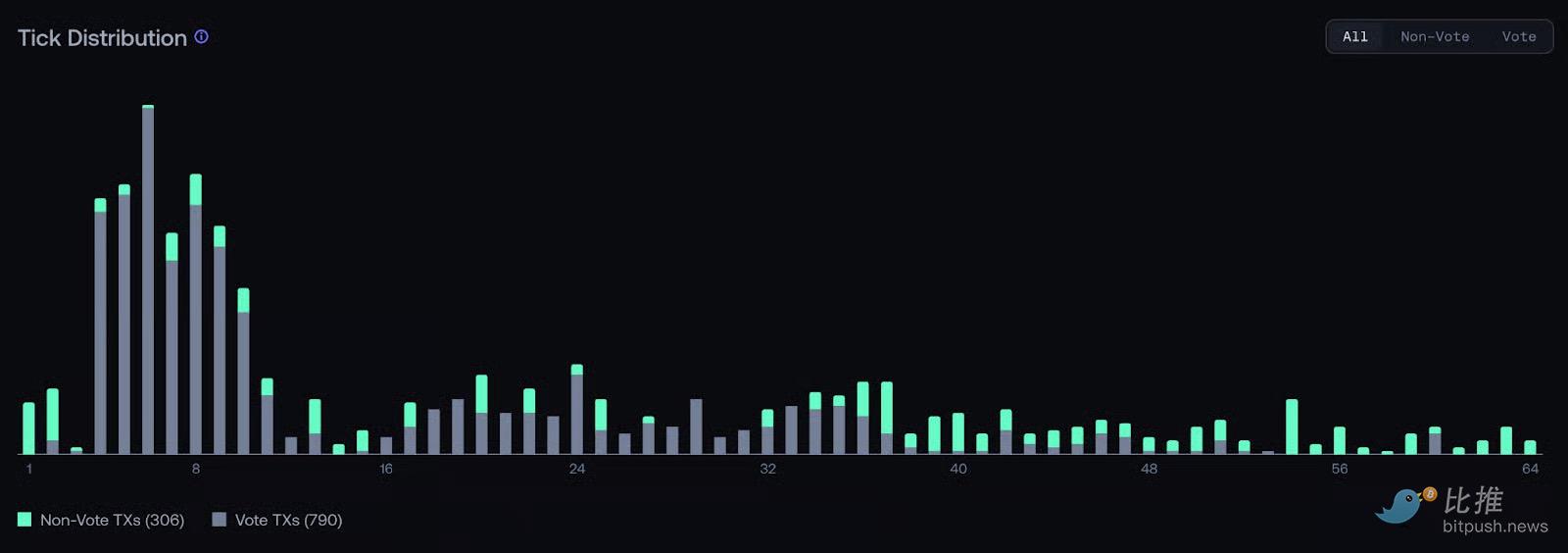
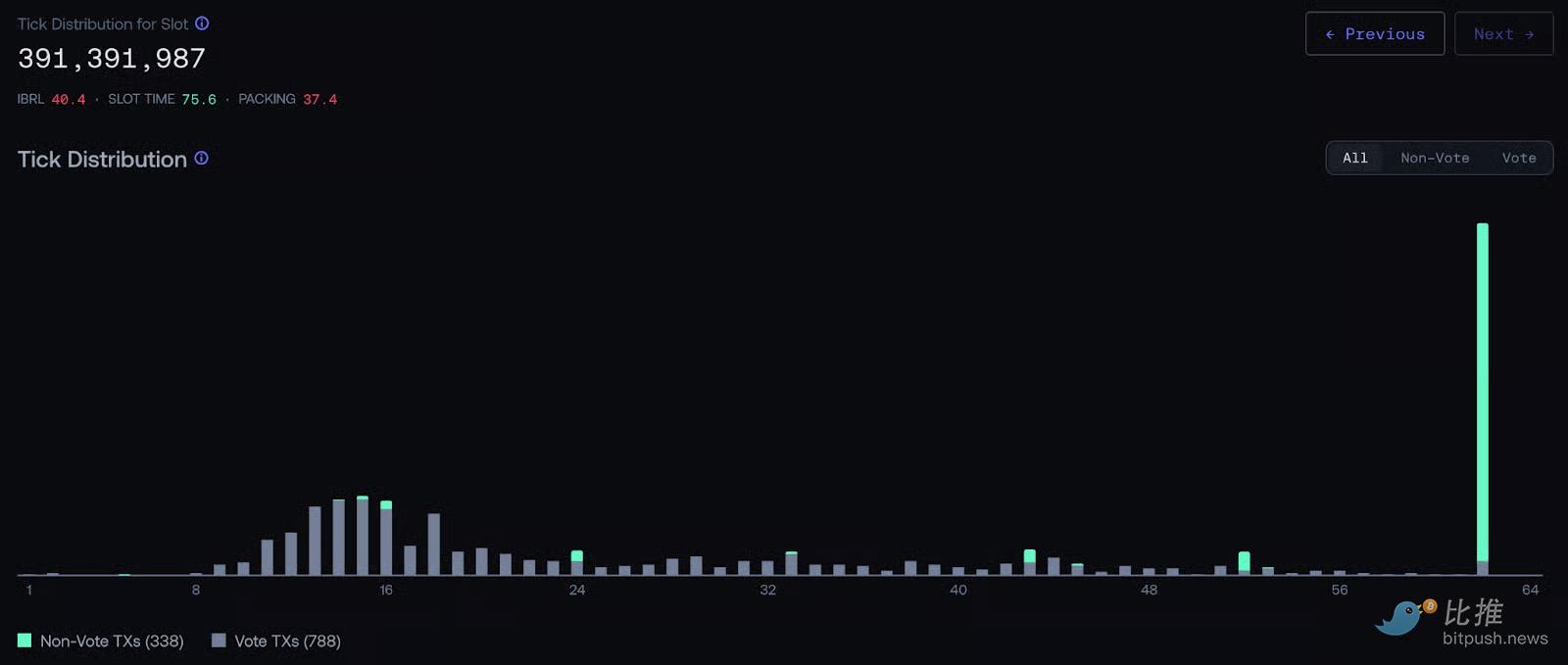
In contrast, intentional delayed packaging is evident in the example block from Galaxy below, where most non-vote transactions are crammed into the last few ticks of the slot. By doing this, validators prioritize extractive value over network health by delaying state transitions until the last moment.

According to Lucas Bruder, co-founder and CEO of Jito Labs, validators are incentivized to wait until the last moment of the slot to observe more incoming transactions, selecting those with the highest fees to maximize rewards.

But why should users care? While maximizing profit is rational behavior for an individual validator, this behavior introduces hidden censorship, delays state propagation, and forces the next leader to "catch up," thereby slowing down the entire network.

More importantly, delayed packaging is also directly related to Solana's emerging "Payment for Order Flow" (PFOF) dynamics, as outlined by Benedict Brady in this article. Because wallets and applications often generate pre-routed signed transactions (i.e., market orders with slippage limits), valuable "back-running" options are embedded in the orders. The user-beneficial practice is to sell this back-running right to trading firms, while the extractive practice is to conduct "sandwich attacks." Either way, there is an incentive to increase the value of back-running by slowing down transaction landing speed, which is exactly what delayed packaging achieves.

This incentive pushes Solana towards a more adversarial market structure for applications and users. It also weakens the key guarantees that market makers rely on, particularly regarding in-block cancellations and deterministic execution, leading to wider bid-ask spreads. Without streaming, no matter how excellent the application logic, a truly real-time market remains out of reach for Solana.

Temporal vs. Jito Debate

Before delving into how Solana addresses this issue, it must be acknowledged that there is an active debate even about what constitutes "good" block construction. Temporal, a core contributor to Harmonic, has raised objections to Jito's framework and IBRL scoring method. Their criticism is that the score embeds a specific set of design preferences that favor Jito's block construction method and by default make Harmonic appear worse, reflected in the consistently lower scores of validators running Harmonic.

According to the Harmonic co-founder, Harmonic's blocks are executed continuously without delay, but data fragments are only released after an auction process lasting about 300 milliseconds is completed. This method gives block builders enough time to compete and gives the rest of the network enough time to replay Harmonic's block. The visualization below shows the same slot (391,822,619) from Temporal Emerald, a validator running Harmonic.
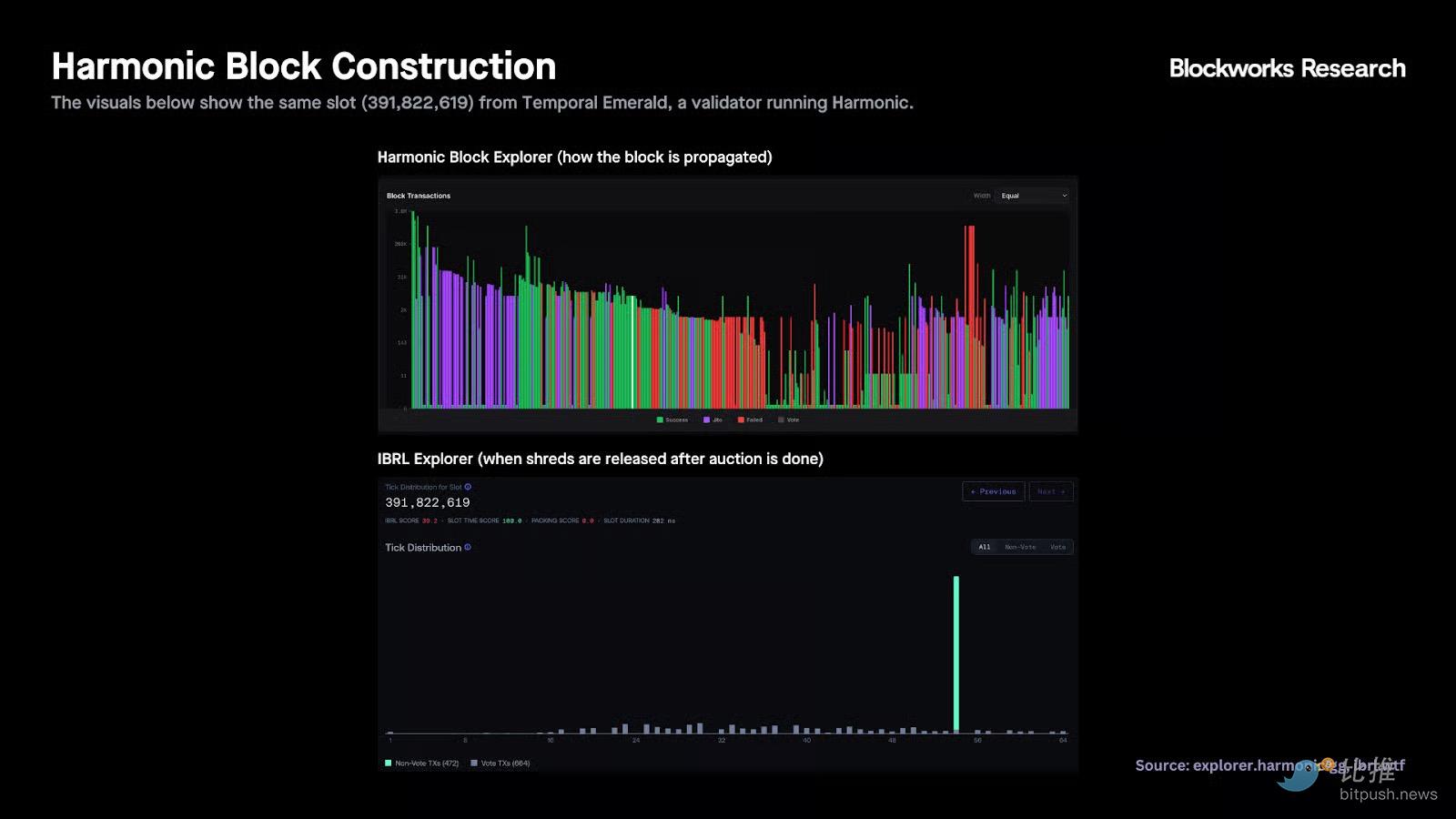
From the context of how the block is propagated (above figure), Harmonic's execution appears to be evenly spaced. In other words, the block builder continuously constructs the block through parallel block construction, and the reason transactions are only concentrated in the final ticks (below figure) is because that is the moment the auction resolves.

Over the past 30 days, Harmonic has outperformed both Jito and Firedancer in terms of average and median total revenue per block (priority fees + tips), thereby delivering higher rewards to validators and stakers. The open question is whether this superior performance is achieved at the expense of users through the timing games described above.
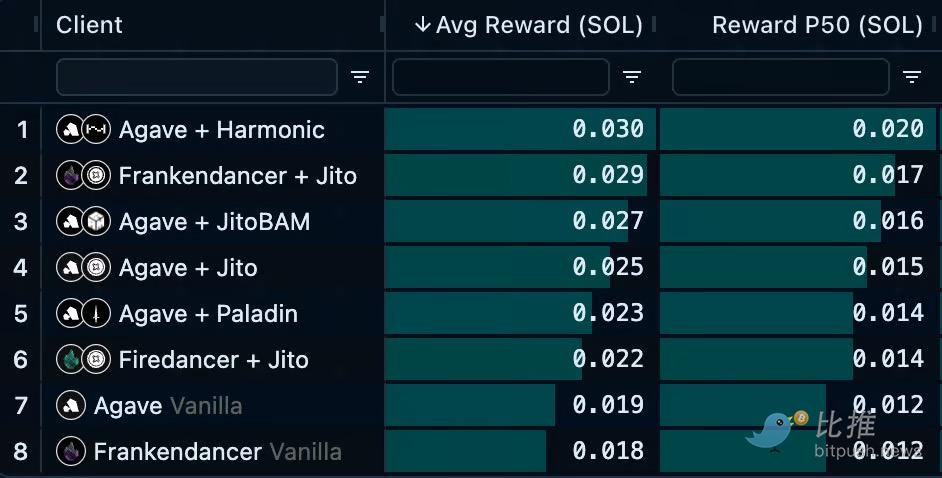
Source: https://reports.firedancer.io/

Multiple Concurrent Proposers (MCP) & BAM

After presenting both sides, one point still holds true: continuous streaming is crucial.

Harmonic's claim is not that streaming is unimportant, but that IBRL fails to capture how Harmonic achieves it and may misclassify its auction mechanism as "timing games." At this stage, I do not yet have sufficient technical background or data to form a definitive opinion, but Solana is already developing a protocol-level solution aimed at addressing the underlying incentive problem.

This solution is Multiple Concurrent Proposers (MCP), an architecture developed by Anatoly Yakovenko and Max Resnick. The motivation is simple: under the current single-leader model, one proposer controls ordering and can effectively act later than others, enabling delayed packaging and reinforcing the PFOF-like dynamics described above. MCP eliminates the single leader's monopoly by having multiple proposers build candidate blocks in parallel and independently. This architecture prevents a single leader from unilaterally suppressing transactions or delaying execution to extract profits.

That said, a prerequisite for MCP is the launch of Alpenglow on the mainnet. Alpenglow is expected to launch in 2026, but the timeline remains uncertain. In the meantime, Jito's BAM might drive change by making ordering logic auditable. BAM aims to expand Solana's micro-structural design space, enabling applications that require finer control over ordering (e.g., prioritizing cancellation orders for perpetual contract trading venues), while also helping to mitigate negative MEV externalities like front-running. The figure below outlines BAM's transaction pipeline.
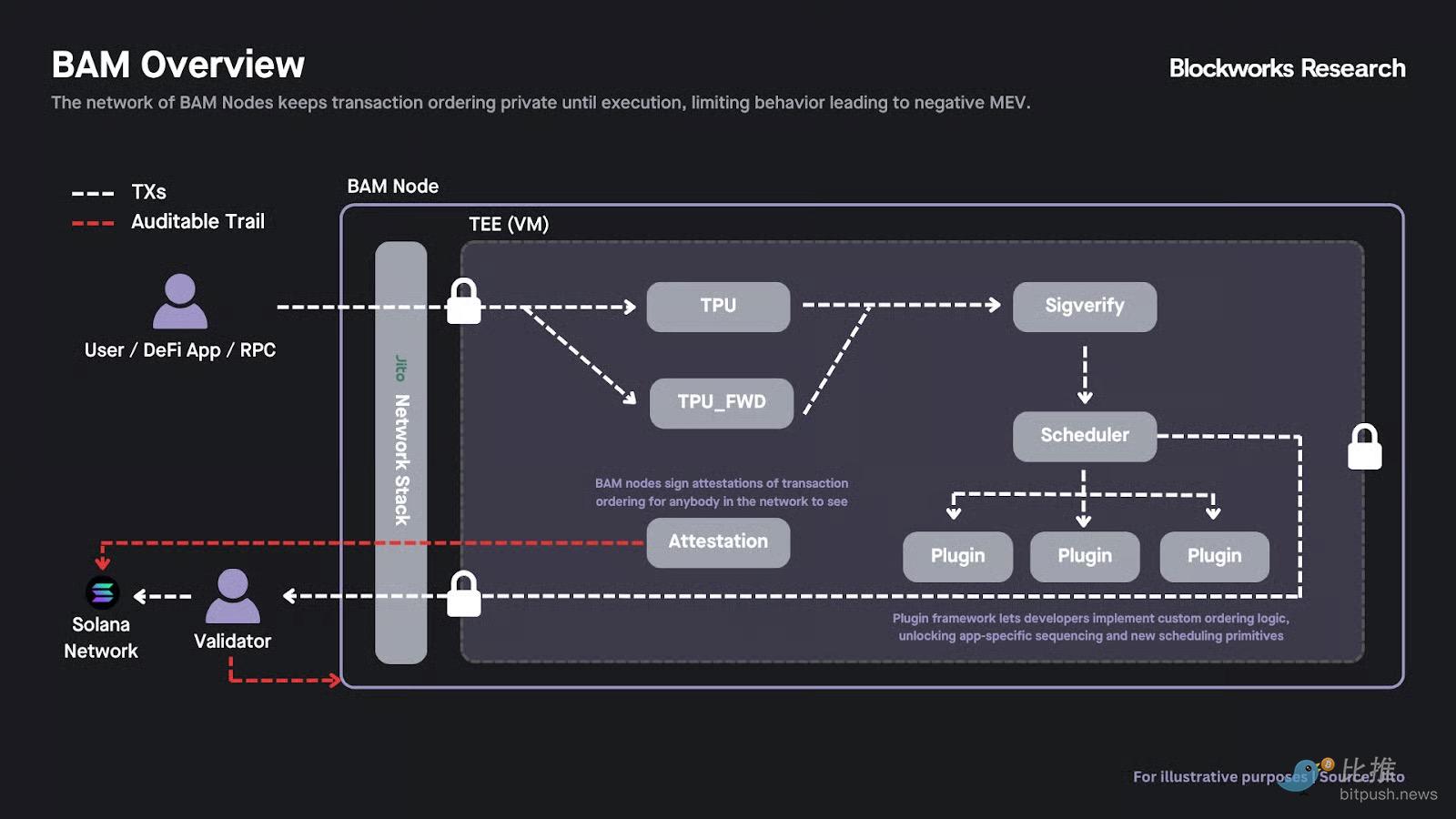
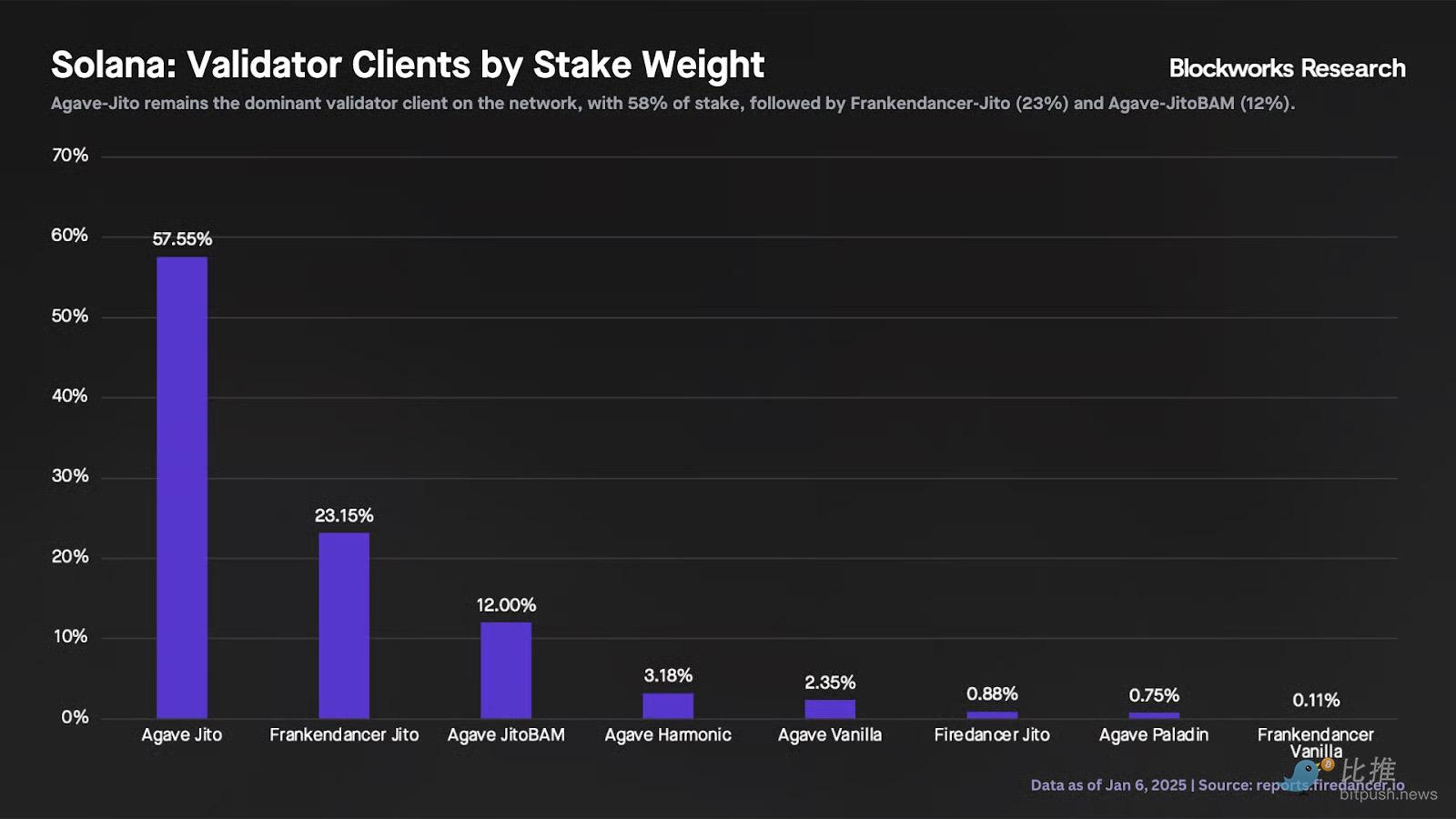
BAM (Agave-BAM) is currently the third-largest client on Solana by stake share (approx. 12%), behind Agave-Jito and Frankendancer-Jito. Approximately 205 validators are already running BAM, highlighting its rapid adoption among the Solana validator set. In contrast, Harmonic remains relatively small, holding just over 3% of the stake share and about 20 validators.

It will be worth watching how the competitive dynamics of block construction evolve in the coming months and what this means for Solana's market structure.


Original article link: https://www.bitpush.news/articles/7601133

Related Questions

QWhat is the purpose of Jito's IBRL Explorer tool, and what problem does it aim to address on the Solana network?

AJito's IBRL Explorer is a public tool designed to measure validator block packing behavior on Solana and expose the previously invisible 'timing games' in block construction. It aims to address issues where validators delay packing non-vote transactions to the end of a slot, which postpones state propagation, increases variance in execution results, and undermines Solana's streaming design, ultimately degrading network latency.

QAccording to the Jito framework, what are the three key variables that make up the IBRL score, and what is the weight of each?

AThe three key variables in the IBRL score are: 1. Slot Time (35% weight): Validators score higher if their block is built within a threshold time. 2. Non-Vote Transaction Packing (40% weight): Validators are rewarded when transactions are evenly distributed across the slot's 64 ticks, rather than being packed late. 3. Early Voting (25% weight): Validators get a full score if at least 90% of vote transactions are processed within the first 32 ticks.

QWhat is 'delayed packing' by validators, and why are they incentivized to do it according to Lucas Bruder?

A'Delayed packing' is when validators intentionally hold non-vote transactions and pack most of them into the final few ticks of a slot. According to Lucas Bruder, co-founder and CEO of Jito Labs, validators are incentivized to wait until the last moment of a slot to observe more incoming transactions and select those paying the highest fees, thereby maximizing their rewards and extractable value.

QWhat is the core criticism from Harmonic (Temporal) regarding Jito's IBRL scoring method?

AHarmonic's core criticism is that Jito's IBRL score embeds a specific set of design preferences that favor Jito's own block-building method. They argue that the score incorrectly classifies Harmonic's auction mechanism as a 'timing game,' making validators running Harmonic appear worse, even though Harmonic claims its blocks are executed continuously and data shards are only released after an auction resolves.

QWhat are the two proposed solutions mentioned in the article to address the underlying incentive problems in Solana's block building?

AThe two proposed solutions are: 1. Multi-Concurrent Proposers (MCP): A protocol-level solution that allows multiple proposers to build candidate blocks in parallel, eliminating the single leader's monopoly and its ability to delay packing. 2. Jito's BAM (Block-Engine & Auction Manager): A solution that aims to make ordering logic auditable, extend Solana's micro-structure design space, and help mitigate negative MEV externalities like front-running.

Related Reads

Claude Code Introduces Dynamic Workflows: Enabling AI to Form Teams and Collaborate

Claude Code introduces dynamic workflows, enabling AI to coordinate teams of specialized agents for complex tasks. This transforms Claude from a code assistant into a programmable workbench. Workflows address key limitations of single-agent systems: agentic laziness (premature task completion), self-preferential bias (favoring own outputs), and goal drift (losing sight of original objectives). The system allows Claude to dynamically create execution frameworks using JavaScript. It can split tasks, dispatch parallel agents for isolated work (e.g., in separate worktrees), implement adversarial validation, run tournaments, and synthesize results. This multi-agent approach is valuable for tasks requiring deep research, factual verification, code migration, root cause analysis, large-scale triage, and qualitative sorting. Key patterns include: classify-and-route, fan-out-and-synthesize, adversarial verification, generate-and-filter, tournaments, and loop-until-done. While token usage is higher, workflows excel where tasks resemble programming—needing problem decomposition, isolated context, hypothesis testing, and handling many details. They extend Claude Code's utility beyond technical work to areas like business plan review, resume screening, and naming brainstorm. The feature is not a universal solution but points to a future where AI tool competitiveness depends on organizing reliable, reusable, and auditable execution flows for complex goals.

marsbit4m ago

Claude Code Introduces Dynamic Workflows: Enabling AI to Form Teams and Collaborate

marsbit4m ago

Hyperliquid, Wall Street's 24/7 Trading Convenience Store

Hyperliquid: The 24/7 Trading "Convenience Store" for Wall Street Hyperliquid, a decentralized cryptocurrency exchange, has become a go-to platform for Wall Street traders seeking to trade around the clock, especially during traditional market closures. Founded by Jeff Yan, a former quantitative trader, after the FTX collapse, the platform emphasizes user self-custody of assets. It offers a wide range of perpetual contracts—leveraged derivatives with no expiry—on assets from Bitcoin and crude oil to the S&P 500 and even pre-IPO companies like SpaceX. A notable example involves a hedge fund trader who capitalized on geopolitical news over a weekend, securing a 243% return on oil derivatives before markets reopened. The platform, run by just 11 employees, generated approximately $800 million in revenue last year, and its native token HYPE has seen significant growth. Its rise highlights the merging of traditional finance and crypto. While U.S. users are currently restricted, recent CFTC rule changes could open access. The platform is known for its transparency, having processed $10 billion in liquidations during a market crash while competitors faltered. Regulators warn of the high risks and complexity of perpetual contracts for retail investors. Key to its appeal is a strong community culture, direct engagement with founders, and a simple interface. Despite rules against VPN use, it attracts global users with its permissionless approach. Hyperliquid plans to expand into prediction markets and options, aiming to eventually host all financial activity.

marsbit4m ago

Hyperliquid, Wall Street's 24/7 Trading Convenience Store

marsbit4m ago

Who Funds the Agents?

**Summary: Who Funds AI Agents?** OpenAI recently shut down a feature allowing AI agents to shop for users, highlighting the challenge of creating a secure and regulated environment for agent-driven transactions. While payment infrastructure exists, a crucial governance layer—defining spending limits, fraud detection, tax handling, and return policies—is largely missing. The potential is enormous: AI agents already processed $73M across 176M transactions last year, with McKinsey forecasting this could grow to $3-5T in global consumer commerce by 2030. The core competition isn't just about processing payments, which can be very cheap (especially with crypto-based settlement), but about controlling the rules that govern agent spending. Key players like Stripe and Coinbase are racing to dominate this governance layer. Stripe's acquisition of wallet provider Privy allows it to set spending policies, identity checks, and human-in-the-loop approvals directly at the wallet level. Similarly, Coinbase's stack, including its x402 protocol and AgentKit, embeds governance rules. This vertical integration across settlement, wallet, and governance layers is becoming the dominant strategy. Control over the governance layer is where significant future value lies. If agents handle trillions in transactions, even a small fee for managing compliance, fraud prevention, and policy enforcement could generate billions in annual revenue. The companies that successfully integrate across the payment stack will capture value from idle agent balances, transaction fees, and governance services, positioning themselves as the foundational banks of the AI agent economy.

marsbit32m ago

Who Funds the Agents?

marsbit32m ago

Trading

Spot
Futures

Hot Articles

Discussions

Welcome to the HTX Community. Here, you can stay informed about the latest platform developments and gain access to professional market insights. Users' opinions on the price of S (S) are presented below.

活动图片













