Crypto Investigator Exposes North Korea’s Secret $1 Million A Month Scheme

bitcoinistPublished on 2026-04-09Last updated on 2026-04-09

Abstract

Cryptocurrency investigator ZachXBT exposed a North Korean state-sponsored IT worker scheme generating over $1 million per month. An infostealer malware breach revealed an internal payment server (luckyguys[.]site) used by DPRK operatives to manage crypto payments and fake identities. The data included chat logs, transaction histories, and organizational details, showing over $3.5 million flowed through linked wallets since late 2025. Workers posed as freelancers, used fabricated identities, and targeted DeFi projects. The operation, though less sophisticated than other DPRK hacking groups, highlights the regime's use of crypto for revenue generation and sanctions evasion. The site was taken down after the report.

Crypto detective ZachXBT uncovered an internal North Korean payment server tied to 390+ accounts, chat logs, and transaction histories.

The DPRK Crypto-Infiltration Saga, Part III (From This Week Only)

The North Korean secret crypto-agents saga continues. The hidden network of North Korea–aligned crypto hackers have been slowly exposed on the social network X these past days, following the attribution of the April 1st $285 million attack on Drift Protocol to UNC4736, a North Korea–aligned, state‐sponsored hacking group.

On Sunday, security researcher Taylor Monahan claimed that North Korean IT workers have quietly worked inside more than 40 DeFi projects over roughly seven years. Also on Sunday and Monday, multiple crypto industry actors shared videos and stories of North Korean IT workers failing the “Kim Jong-Un Test”.

Now, it was ZachXBT turn to publish his findings, which he did yesterday on a thread on the social network X. The exfiltrated data, that hadn’t been publicly released before, was shared with him by an anonymous source.

The extraction of the data was possible because one of this IT workers workers from the Democratic People’s Republic of Korea (DPRK) had his device infected with an infostealer (malware designed specifically to steal sensitive information). The malware exposed IPMsg chat logs, fabricated identities, and detailed browser activity.

The thread walks through how DPRK IT agents, often posing as freelancers abroad, are allegedly getting paid in crypto and funneled back into regime‐linked channels.

A Breakdown Of The Findings

The website that surfaced from the data extraction was called luckyguys.site. According to the crypto detective, it appeared to function as an internal payment remittance hub: a Discord‐like messaging platform where DPRK IT operatives reported and reconciled their crypto payments with superiors.

Believe it or not, the site’s default login password was set to “123456”. At the moment of the data extraction, ten accounts were still using it unchanged.
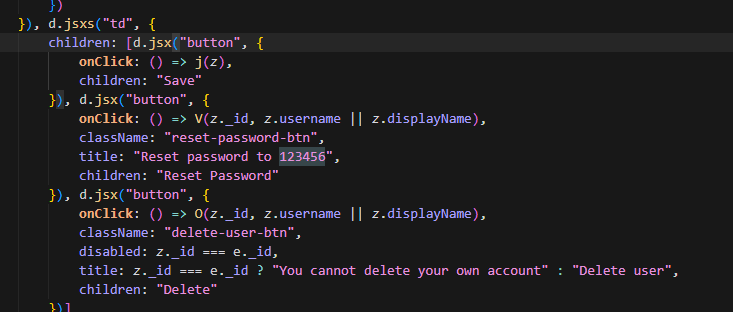
The 123456 password. Source. ZachXBT on X.

The account roster showed roles, Korean names, locations, and internal group codes that align with known North Korean IT worker structures. ZachXBT highlighted that three of the companies referenced in the data, Sobaeksu, Saenal, and Songkwang, are already subject to OFAC sanctions.

The crypto investigator shared a video showing direct messages from one WebMsg account, “Rascal”, with PC‐1234 (the server admin account) that spell out payment transfers and the use of fake identities from December 2025 to April 2026. Every payment in these chats is routed and finalized via PC‐1234. The logs also reference Hong Kong addresses for billing and delivery of goods, although whether those details are genuine still needs to be confirmed.

The findings only grow more interesting as the thread advances. Since late November 2025, more than $3.5 million has flowed into the payment wallets. The same remittance pattern shows up again and again: users either send crypto in directly from an exchange or service, or off‐ramp into fiat via Chinese bank accounts using platforms such as Payoneer.

After that, PC‐1234 acknowledges the incoming funds and hands over login credentials, which can be for different crypto exchanges or fintech payment apps, depending on the specific user.

A Reconstruction Of The Network’s Hierarchy

The crypto detective reconstructed the network’s entire organizational hierarchy using the full dataset and made an interactive version of this org chart.
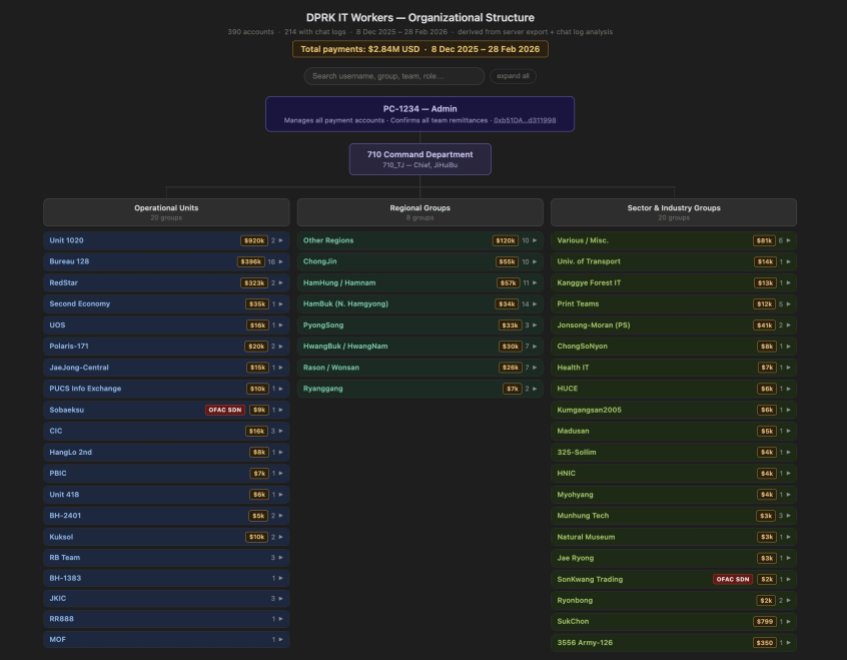
DPRK IT Workers - Organizational Structure. Source: ZachXBT on X.

When the investigator followed the internal payment wallets on‐chain, he found connections to several already‐attributed DPRK IT worker clusters. The Tron‐based wallet was frozen by Tether in December 2025.

Other interesting findings show that the compromised device, which belonged to someone called “Jerry”, still had Astrill VPN in use, along with multiple fabricated identities being used to apply for jobs. Inside an internal Slack workspace, a user named “Nami” shared a blog post about a deepfake job applicant linked to DPRK IT workers. One colleague asked if the story was about them, while another reminded the group they weren’t allowed to post external links.

Jerry exchanged messages with another North Korean IT worker about plans to steal from a project, using a Nigerian proxy to target Arcano, a GalaChain game. If that attack was ever carried out or not is unclear.

The admin also distributed 43 Hex-Rays/IDA Pro training materials to the group between November 2025 and February 2026. These sessions focused on disassembly, decompilation, both local and remote debugging, and a range of cybersecurity techniques. One link shared on November 20 was explicitly titled: “using-ida-debugger-to-unpack-an-hostile-pe-executable”.

Final Thoughts

ZachXBT closing image for the thread. Source: ZachXBT on X.

ZachXBT concluded that this DPRK IT worker cluster appears relatively unsophisticated compared with outfits like AppleJeus and TraderTraitor, which run much tighter operations and pose a far greater systemic threat to the crypto industry. His earlier estimated that North Korean IT workers collectively pull in several million dollars a month is reinforced by this dataset.

Today, the investigator posted an update explaining that the internal DPRK payment portal has been pulled offline following the publication of his findings. All of the data was fully captured and archived beforehand.

Crypto is now deeply embedded in geopolitical shadow economies. On‐chain transparency cuts both ways for users and adversaries.

It wouldn’t be surprising if markets start to price higher compliance costs for CEXs and OTC desks, or if there is more friction for stablecoin flows in sanctioned regions. The North Korean saga surely raises the odds of more aggressive enforcement against cross‐border flows, privacy tools, and high‐risk venues.
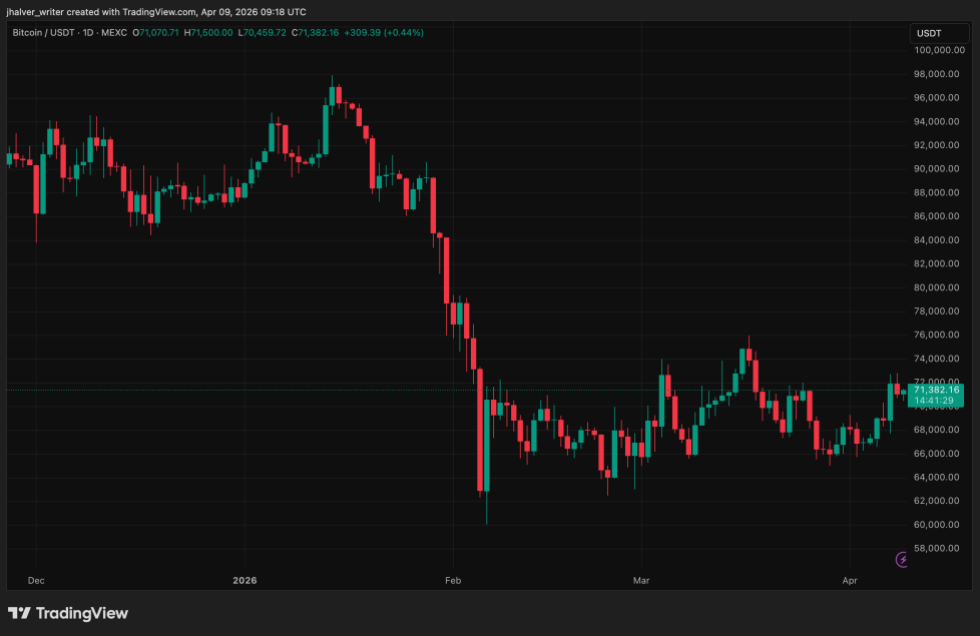
Yesterday, Bitcoin bounced back and reclaimed $72k. At the moment of writing, BTC trades for around $71k on the daily chart. Source: BTCUSDT on Tradingview.

Cover image from Perplexity. BTCUSDT chart from Tradingview.

Trending Cryptos

Related Questions

QWhat did crypto detective ZachXBT uncover about North Korea's crypto operations?

AZachXBT uncovered an internal North Korean payment server tied to over 390 accounts, chat logs, and transaction histories, revealing a scheme where DPRK IT workers pose as freelancers to earn and funnel crypto back to regime-linked channels.

QHow was the data about the DPRK IT worker network obtained?

AThe data was obtained because a DPRK IT worker's device was infected with an infostealer malware, which exposed IPMsg chat logs, fabricated identities, and detailed browser activity.

QWhat was the purpose of the website 'luckyguys.site' discovered in the investigation?

AThe website 'luckyguys.site' functioned as an internal payment remittance hub where DPRK IT operatives reported and reconciled their crypto payments with superiors, using a Discord-like messaging platform.

QHow much money was received by the payment wallets linked to the DPRK network since late November 2025?

ASince late November 2025, over $3.5 million was received across the payment wallet addresses linked to the DPRK IT worker network.

QWhat happened to the internal DPRK payment portal after ZachXBT published his findings?

AThe internal DPRK payment portal was taken offline following the publication of ZachXBT's findings, though all data had been fully captured and archived beforehand.

Related Reads

A Critical Review of Base Co-founder's "Letter of Self-Criticism"

Yesterday, Base co-founder Jesse Pollak published a self-critical post on X, reflecting on Base's successes and failures over the past two years. While his candor is commendable, the author argues his analysis still misses key points. Jesse admitted his primary mistake was heavily betting that onchain social platforms (like Farcaster) and creator tokens would drive mainstream crypto adoption. The author harshly criticizes this strategy, giving it a "0/100" score. They argue onchain social offers no superior user experience, and creator tokens, like Jesse's own $JESSE, fail to solve fundamental issues about value and creator adoption, unlike successful memecoins on other chains. The author is more forgiving regarding Base lagging in areas like perpetual DEXs and prediction markets, giving this an "80/100". They note strong competitors like Hyperliquid had unique advantages, and Base has found significant success in other narratives like AI and RWA. The author gives Jesse's overall reflection a "60/100" or passing grade. While Jesse now correctly sees multiple paths to adoption (stablecoins, payments, AI Agents) beyond just social, he, along with other industry leaders like Toly and Vitalik, still underestimates the powerful role of memecoins in driving mainstream awareness and adoption. The critique concludes that leaders often leverage memes for user acquisition but fail to genuinely embrace or thoughtfully develop the space, revealing a retreat from idealism and a disconnect from grassroots, viral growth mechanisms.

marsbit14m ago

A Critical Review of Base Co-founder's "Letter of Self-Criticism"

marsbit14m ago

When Traditional Finance Fails People in Crisis, Bitcoin Succeeds

When traditional finance fails to reach people in crisis, Bitcoin succeeds. This article highlights how fundraising platforms like GoFundMe face severe limitations in delivering aid to conflict zones like Gaza due to banking regulations, sanctions, and compliance rules. For instance, Sami Jamal Al-Shannat raised over £55,000 for his family but couldn't receive the funds directly; instead, money had to be routed through a beneficiary in another country, leading to disputes and loss of access. The piece explores how compliance requirements often force reliance on intermediaries, shifting risk and responsibility away from platforms and onto individuals. In contrast, Bitcoin and blockchain-based platforms like Geyser and Agora enable direct, peer-to-peer transactions, bypassing traditional financial bottlenecks. These platforms shift trust from centralized institutions to verifiers—local partners or trusted organizations—who validate projects, allowing donors to send funds directly to recipients' wallets. While not a panacea, Bitcoin offers a way to circumvent "transnational financial repression," where sanctions and AML rules inadvertently harm legitimate aid recipients, activists, and dissidents. The conclusion emphasizes that open payment networks and decentralized trust models represent a systemic shift, empowering beneficiaries and providing more resilient humanitarian fundraising in crisis situations. However, challenges around verification, accountability, and fraud prevention remain.

marsbit41m ago

When Traditional Finance Fails People in Crisis, Bitcoin Succeeds

marsbit41m ago

Bitcoin Shifts Towards Consolidation, Long-Term Holder Selling Pressure Significantly Eases

Bitcoin's Bottoming Process Shows Signs of Shifting Dynamics Bitcoin's bottom formation is ongoing, but key characteristics are changing. The capitulation selling by long-term holders (LTHs), a primary source of selling pressure this cycle, has begun to cool from its recent peak. Buyers successfully absorbed the selling at the June lows, and price is now recovering to challenge overhead resistance. The market is testing higher resistance levels. Bitcoin reacted more strongly to soft inflation data than major equity indices, signaling sellers may be exhausted and buyers are waiting for a catalyst. Its correlation with stocks is weakening while its inverse relationship with the USD is deepening, suggesting liquidity dynamics are now more influential than risk sentiment. On-chain, price sits between the network's Realized Price (a historical bear market floor) and the Short-Term Holder (STH) cost basis near $69k, a key resistance level where recent buyers break even. LTH profit-taking has largely dried up, and losses now dominate realized on-chain volume—a typical late bear market signal. Crucially, the pace of LTH capitulation has started to decline. Derivatives markets show bearish positions are being unwound, with put/call ratios falling and crash protection costs moderating. However, this derisking hasn't been accompanied by significant spot buying, a missing link for sustained recovery. US spot ETF outflows have slowed but not reversed. In conclusion, foundational elements for a bottom are forming: LTH selling is easing, low-point selling was absorbed, and the market is responding to positive macro cues. The next critical test is whether spot-driven buying can push price through and hold above the STH cost basis near $69k. The follow-through is not yet confirmed.

marsbit59m ago

Bitcoin Shifts Towards Consolidation, Long-Term Holder Selling Pressure Significantly Eases

marsbit59m ago

Defending Champions or New Kings? World Cup Final Sees All AIs Backing the Same Side

Will the 2026 World Cup final see Argentina successfully defend their title or a new champion crowned? AI models from various platforms have made their prediction. The final in Buenos Aires pits defending champions Argentina against a resilient Spanish side that has reached this stage with a record of exceptional defensive solidity, conceding only one goal in seven matches. Argentina's path was dramatically different, filled with late comebacks and narrow victories, including a semi-final win over England secured by late goals assisted by the 39-year-old Lionel Messi. A poignant subplot adds narrative weight: a nearly 20-year-old photo shows a young Messi bathing an infant Lamine Yamal, who is now a 19-year-old key player for Spain, symbolizing a potential passing of the torch. In the semi-finals, most AI models incorrectly predicted a French victory over Spain, with only Google's Gemini correctly picking Spain's advancement and also accurately forecasting Argentina's win over England. For the final, however, all six surveyed AIs—ChatGPT, Claude, Gemini, Grok, DeepSeek, and Qwen—unanimously predict a Spanish victory. Their reasoning centers on Spain's superior defense, midfield control, and better physical preparedness after a less strenuous knockout stage journey. While consensus favors Spain as champions, five of the six AIs believe the match will be tightly contested, predicting a draw (1-1 or 0-0) within regular time, with Spain's advantage potentially telling in extra time or even a penalty shootout. Only DeepSeek forecasts a clear Spanish victory within 90 minutes. The stage is set for a clash between Argentina's legendary fighting spirit and Spain's machine-like consistency, with artificial intelligence firmly backing the latter to lift the trophy.

Odaily星球日报1h ago

Defending Champions or New Kings? World Cup Final Sees All AIs Backing the Same Side

Odaily星球日报1h ago

Trading

Spot

Hot Articles

Discussions

Welcome to the HTX Community. Here, you can stay informed about the latest platform developments and gain access to professional market insights. Users' opinions on the price of S (S) are presented below.

活动图片















