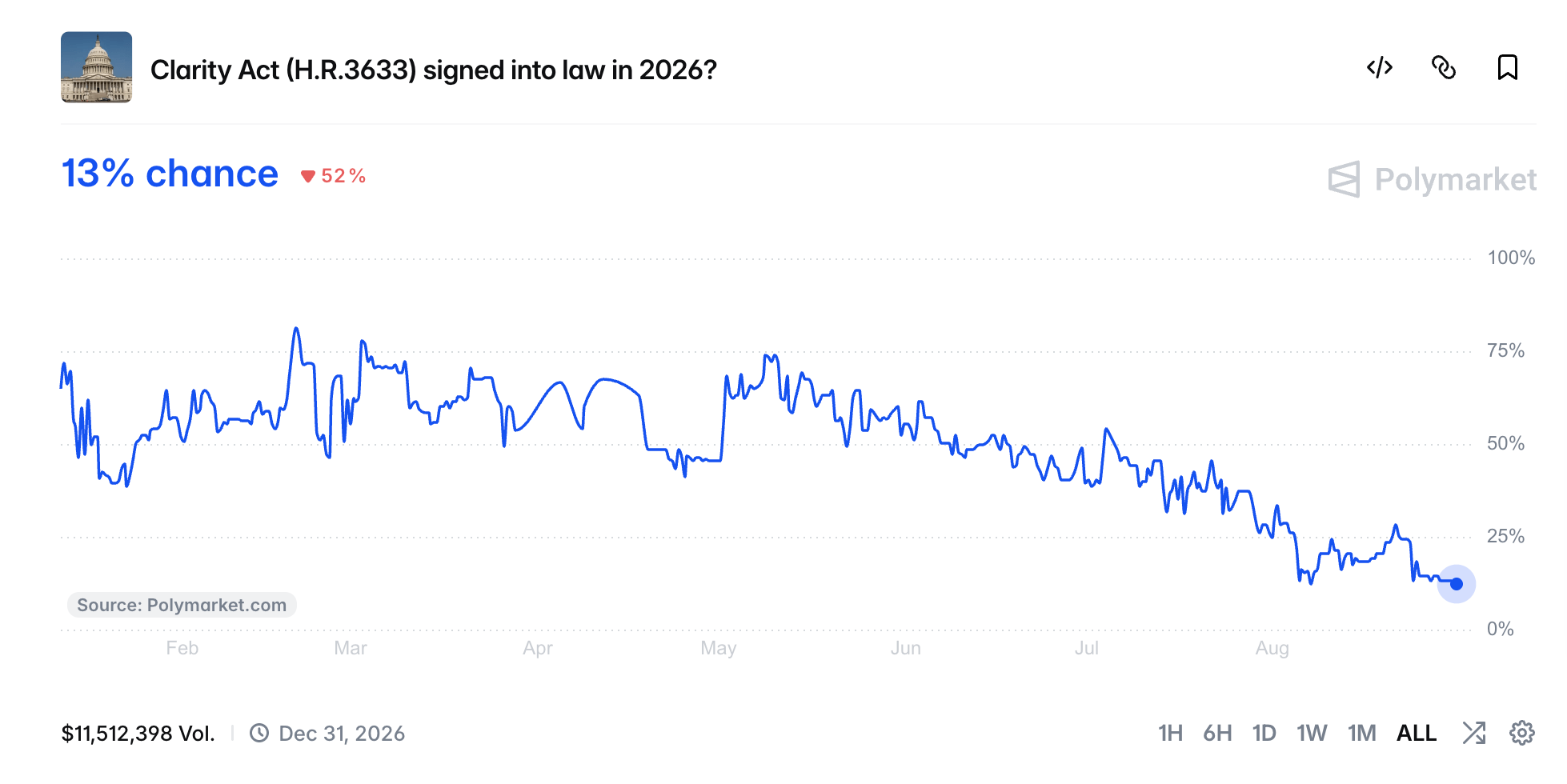
The disagreements are hard to ignore. At the time of writing, traders on Kalshi price the likelihood of a Senate vote by October 1st at 91%, while Polymarket assesses the chances of the CLARITY Act becoming law this year as extremely low.
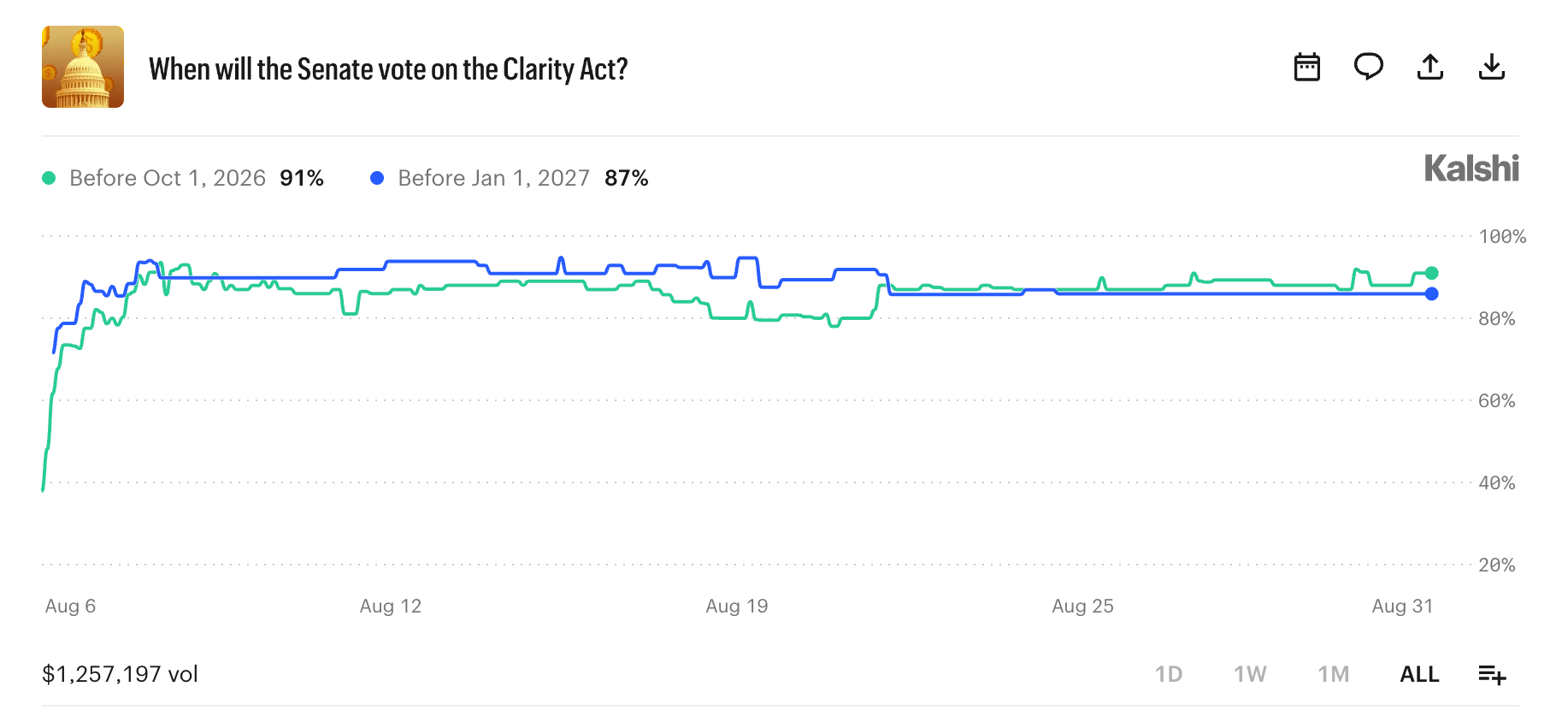
Traders expect senators to show up and vote, but money on the prediction markets suggests Congress likely won't finish the job.
Senate Vote on September 15th Kickstarts the Countdown to CLARITY
The Senate left Washington on August 8th after Majority Leader John Thune filed a cloture petition, scheduling a procedural vote for September 15th. Passing such a petition typically requires 60 votes and would allow the Senate to move to debate and potentially pass the bill.
Meeting this goal only solves the first hurdle. As reported by American Banker, Ian Katz of Capital Alpha Partners sharply lowered his odds of the bill passing from roughly 40% to 25%, possibly lower, warning that approving the cloture petition still doesn't guarantee passage. Galaxy Digital went further, lowering its odds to 10% in August, as Congress burned through precious calendar days.
Prediction Markets Bet That Congress Will Vote but Won't Close the Deal
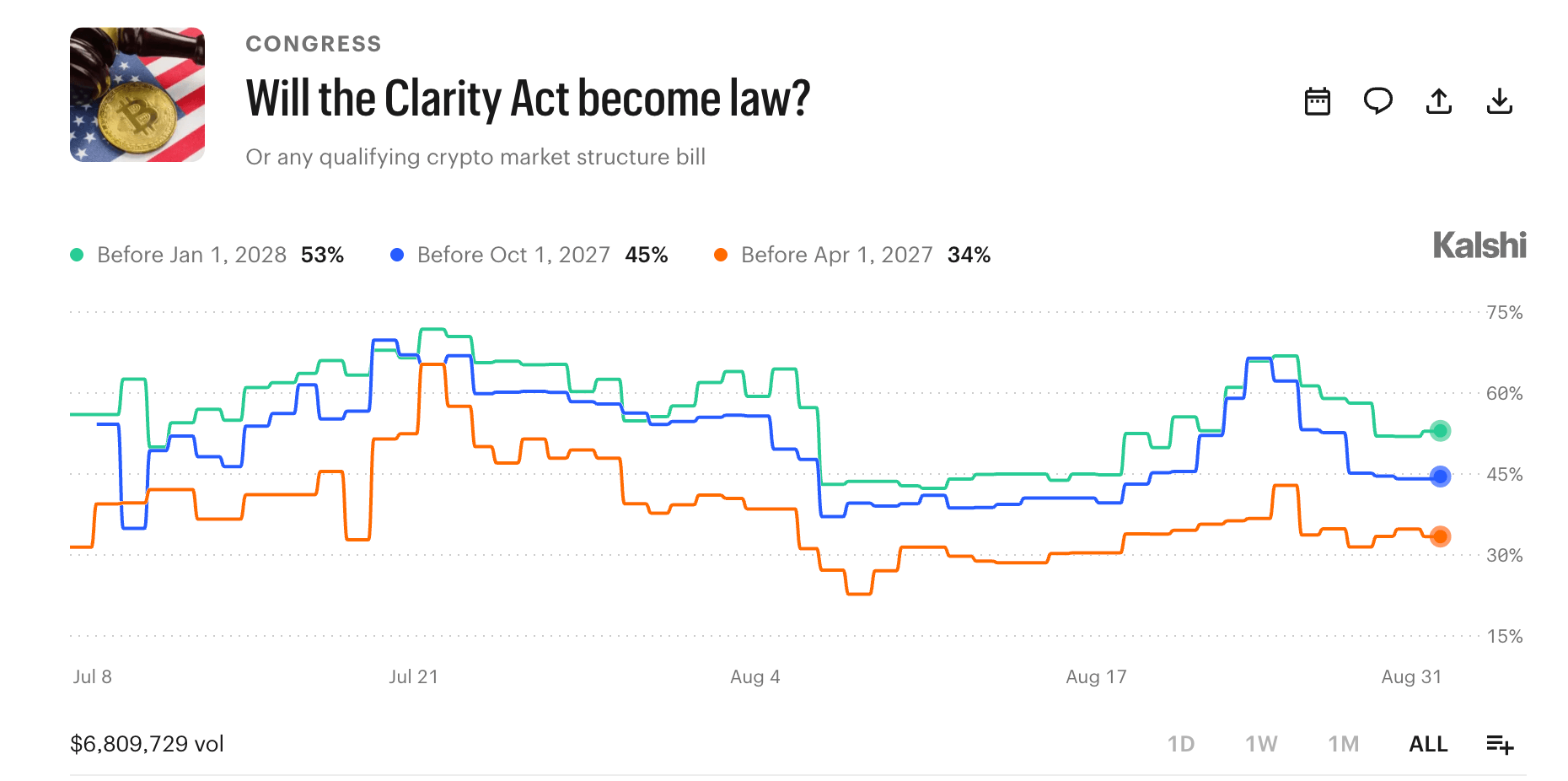
The money flowing to prediction markets says largely the same thing. Kalshi's Senate vote betting market has drawn over $1.25 million in volume, while its broader crypto market framework passage contract has drawn over $6.8 million.
Polymarket's more direct bet on whether H.R. 3633 will become law in 2026 has drawn roughly $11.5 million. The implied probability is just 13%—a staggering drop from the 82% traders priced in February.
Three Battles That Could Derail Congress's Crypto Rules
This fight extends far beyond another round of Washington theater. The CLARITY Act would create a federal regulatory framework for crypto markets, granting the Commodity Futures Trading Commission (CFTC) exclusive authority over spot digital commodity markets and the Securities and Exchange Commission (SEC) oversight over certain securities offerings and exchange activity.
Currently, three conflicts are undermining the coalition needed to muster 60 votes in the Senate: ethics restrictions concerning government officials and crypto; stablecoin yield offerings that banks view as competition for deposits; and safeguards covering decentralized finance (DeFi) and non-custodial software developers.
Several Democrats who previously seemed open to negotiations have criticized the latest text revisions, while banking groups continue to take shots at stablecoin yield. Republicans, including Senators Cynthia Lummis, Tim Scott, John Boozman, John Thune, and Thom Tillis, remain among the bill's most active supporters.
SEC and CFTC Move Ahead as Congress Loses Time
Regulators aren't planning to wait for lawmakers. The SEC's crypto rulemaking and the CFTC's work on exchanges, leveraged trading, and decentralized finance (DeFi) could lay down core elements of a regulatory framework without Congress, though future administrations can generally overturn agency rules more easily than federal statutes.
That's why September 15th becomes a decisive moment. Even if senators clear the 60-vote procedural hurdle, Congress will face a packed schedule filled with government funding, defense legislation, and looming midterm elections. Another stumble could push the market structure fight entirely into a lame-duck session or until 2027.
For crypto companies, banks, and investors, the question now isn't whether Washington will keep debating the CLARITY bill, but whether senators can muster enough votes on September 15th to keep it alive.