CFTC joins SEC in proposing crypto framework after failed CLARITY vote

cointelegraphPublished on 2026-10-06Last updated on 2026-10-06

Abstract

CFTC Chair Michael Selig announced that the agency is moving forward with a proposed crypto regulatory framework, named 'CTX,' following President Donald Trump's direction to act "with or without legislation." The proposal, presented at a Fordham Law symposium, would allow crypto companies to operate under uniform CFTC oversight instead of a state-by-state patchwork. Key elements include a new "crypto asset market" (CAM) category for exchanges and rules for retail trading on a margined or leveraged basis. Ordinary spot exchanges remain under state laws, though the CFTC retains anti-fraud authority. This action comes after the Senate failed to pass the CLARITY Act, which would have expanded the CFTC's regulatory role. The SEC also recently proposed its own crypto securities regime. Both agencies are currently understaffed, with the SEC down to two commissioners after Hester Peirce's departure and the CFTC led solely by Selig. The White House has indicated plans to nominate new commissioners soon.

US Commodity Futures Trading Commission (CFTC) Chair Michael Selig said that the agency will move forward on crypto regulation at the direction of President Donald Trump “with or without legislation” from Congress.

Speaking at the Fordham Law Blockchain Regulatory Symposium on Monday, Selig announced proposals giving crypto companies the option to operate under the CFTC’s umbrella rather than dealing with the patchwork of regulations offered by individual US states.

According to written remarks from the event, the CFTC chair said that it had issued an advanced notice of proposed rulemarking for companies “offering retail customers the ability to trade crypto assets on a margined, leveraged, or financed basis,” calling the regulation ‘CTX.’

Selig said that the agency planned to establish a new category of designated contract market (DCM) called a “crypto asset market,” or CAM, giving certain exchanges the option to register as either.

“These rules would codify a pathway for crypto asset exchanges to operate under uniform national oversight by the CFTC pursuant to the same statutory authorities that the prior administration instead utilized to regulate by enforcement,” said Selig.
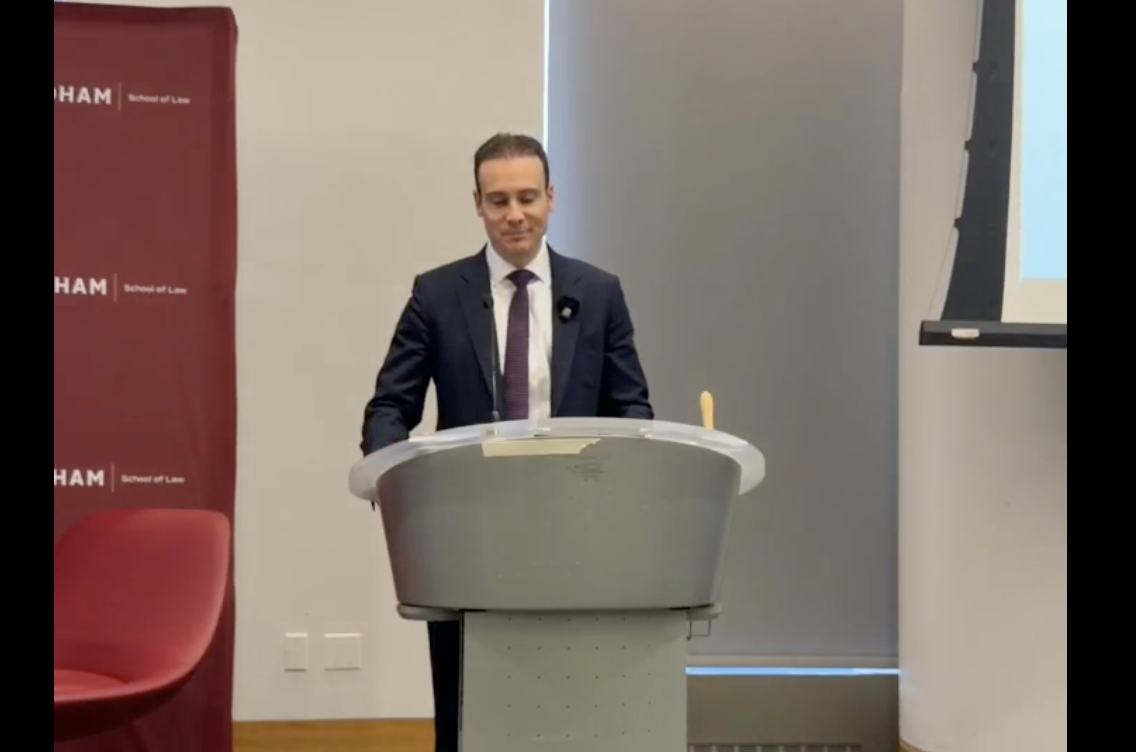
CFTC Chair Michael Selig on Monday.
Source: Fordham Law Blockchain Regulatory Symposium

The proposed rules would not extend to what the chair called “ordinary spot crypto exchanges” that are “generally regulated under state money transmission laws.” For companies offering spot trading on crypto assets like Bitcoin (BTC), the CFTC would still have the authority to enforce anti-fraud and anti-manipulation regulations.

Selig’s proposed regulatory framework for crypto companies came a few weeks after lawmakers in the US Senate failed to approve passage of the Digital Asset Market Clarity (CLARITY) Act, a bill that had been expected to give the CFTC more authority in overseeing and enforcing crypto regulations.

The Securities and Exchange Commission already announced its own version of a proposed “tailored securities offering regime” for crypto assets in August before the failed CLARITY vote, setting the expectation that both agencies would move forward with regulation without legislation codifying such rules from Congress.

Selig said that Trump promised to deliver a crypto asset regulatory market structure with or without legislation, and the regulators will help him deliver it using existing statutory authorities.

“The opponents to CLARITY may have not bargained for the seeming readiness of the executive branch to act in the absence of any constraint from the legislative branch,” said ProChain Capital’s David Tawil, in a post on Monday.

Both regulators still understaffed as they advance crypto proposals

Friday was SEC Commissioner Hester Peirce’s last day at the agency, wrapping up eight years of service, just ahead of the 18-month extension for her second term. Her planned departure leaves just two commissioners leading the SEC and Selig heading the CFTC as its sole commissioner and chair.

A White House official told Cointelegraph last week that Trump intended to nominate commissioners to both agencies “in the near future.” As of Monday, the administration had not announced any replacements for Peirce or the other six commissioner seats.

Magazine: Former SEC boss made AI Czar, Bitcoin may hit $600K this cycle: Hodler’s Digest

Related Questions

QWhat is the main purpose of the regulatory framework proposed by CFTC Chair Michael Selig?

AThe main purpose is to give crypto companies the option to operate under the CFTC's uniform national oversight, as an alternative to dealing with the patchwork of regulations from individual US states. This includes a proposal for a new category of designated contract market called a 'crypto asset market' (CAM).

QHow does the proposed 'CTX' regulation relate to crypto asset trading?

AThe proposed 'CTX' regulation is an advanced notice of proposed rulemaking for companies that offer retail customers the ability to trade crypto assets on a margined, leveraged, or financed basis.

QWhy are the CFTC and SEC moving forward with their own regulatory proposals for crypto?

AThey are moving forward because the US Senate failed to pass the Digital Asset Market Clarity (CLARITY) Act, which was expected to give the CFTC more authority. President Trump has directed the agencies to proceed 'with or without legislation' from Congress, leading them to use their existing statutory authorities.

QAccording to the article, what type of crypto exchanges would not be covered under the CFTC's new proposed rules?

AThe proposed rules would not extend to 'ordinary spot crypto exchanges' that are generally regulated under state money transmission laws. However, the CFTC would still have authority to enforce anti-fraud and anti-manipulation regulations for these spot trading platforms.

QWhat staffing challenge is mentioned for both the SEC and CFTC as they advance their crypto proposals?

ABoth agencies are understaffed. SEC Commissioner Hester Peirce has left, leaving just two commissioners at the SEC. The CFTC has Michael Selig as its sole commissioner and chair. The White House intends to nominate new commissioners, but no replacements had been announced as of the article's publication.

Related Reads

Trezor Data Breach Exposes Details From 27,000 Orders as Customers Report Scam Calls

Trezor has confirmed a data breach at its shipping partner Skladon that exposed personal information linked to approximately 27,000 customer orders, prompting warnings about targeted phishing attempts and possible physical security risks. In a disclosure published on November 16, Trezor said the breach occurred on November 7, and Skladon notified the hardware wallet manufacturer about unauthorized access to its systems on November 15. The attacker is believed to have exported order records covering purchases made between August 9 and November 7, 2026. The exposed information includes customers' full names, phone numbers, email addresses, delivery addresses, order dates, products purchased and their prices. Trezor stressed that the incident affected its shipping partner rather than its own systems, and that wallet devices, recovery backups, PINs and passphrases were not compromised. The company has also confirmed that some customers have already reported scam calls following the incident. The leaked information could allow scammers to make fraudulent calls, emails and text messages appear genuine by referring to actual purchases and delivery details. Trezor warned that exposed home addresses and information about hardware wallet purchases could also create physical security concerns. Customers who ordered during the affected period and received an incident notification email should assume their order information was exposed. A small number of customers who purchased between August 9 and 14 may also be affected, but Trezor said it cannot contact them directly because their details had already been anonymised. The company said it has informed the relevant data protection authority and is reviewing its third-party partnerships and security requirements. Trezor is also reducing its order-data retention period from 90 days to 45 days, and anonymous pickup is now available in 18 European countries, allowing customers to collect parcels from lockers or pickup points without providing their home addresses, with the company working to introduce the option in the United States. Trezor advised customers to treat unexpected messages about their orders with caution and contact support through its official website.

TheNewsCrypto2m ago

Trezor Data Breach Exposes Details From 27,000 Orders as Customers Report Scam Calls

TheNewsCrypto2m ago

BlackRock’s Bitcoin ETF snaps $2.35B outflow streak amid extreme fear

BlackRock's spot Bitcoin ETF (IBIT) returned to inflows on Monday, ending an 11-session outflow streak that totaled roughly $2.35 billion. IBIT attracted $76.5 million on Nov. 16, helping US spot Bitcoin ETFs record $7.9 million in net inflows despite withdrawals from other funds, per Farside Investors data. The inflows came as Bitcoin traded near multimonth lows of $64,000, while the Crypto Fear and Greed Index fell to 10 out of 100 on Monday, its lowest reading since June 2026. Nick Pitto, head of marketing at CryptoQuant, cautioned against interpreting the inflows as a broader market recovery. He noted that Monday's inflows recovered only about 3% of IBIT's withdrawals over the previous 11 sessions, while US Bitcoin ETFs had shed more than 31,000 BTC over the past month. "One day of inflows doesn't change the picture too much," Pitto said, adding that "it's too early to call this dip buying" and that several consecutive days of inflows from more funds than just BlackRock's would be needed. Monday also marked the deadline for most institutions to file third-quarter Form 13F disclosures, revealing Bitcoin ETF holdings as of Sept. 30. Several institutions reported increased exposure during the quarter, but Pitto cautioned against linking those holdings to Monday's inflows, noting that ETF buying peaked in August and September and the filings only show holdings at the end of September, not subsequent activity.

cointelegraph7m ago

BlackRock’s Bitcoin ETF snaps $2.35B outflow streak amid extreme fear

cointelegraph7m ago

Bitcoin Erases Nearly 90% of Its Gains: Is $62,000 the Bottom, or the End of a Bear Market Rally?

Bitcoin fell to $62,029 on November 15, a new low since July 13, down 12.6% for the week and about 29% from its September 21 high of $87,392—its sixth consecutive weekly decline. Bitfinex argues that position matters more than the drop itself: Bitcoin has re-entered the $61,300–$67,000 "July Base" range where it consolidated for nearly seven weeks before rallying. The key level is $57,803, the July 1 cycle low; holding above it preserves the higher-low structure, while a break would suggest the prior rally was merely a bear-market bounce. Roughly 1.4 million BTC have cost basis between $60,000–$65,000, versus only about 305,000 BTC between $55,000–$60,000, so a loss of the range could mean a rapid move toward $55,000–$60,000. Three sources of selling pressure persist: futures deleveraging (open interest fell about 8% to 645,750 BTC, with $2.01 billion liquidated in 24 hours, 83% longs), short-term holder capitulation (STH-SOPR at 0.971, lowest since June 5), and spot ETF outflows (seven straight days, $1.07 billion last week, $2.99 billion since October 30). Macro headwinds include rising real yields (10-year at 2.91%), sticky core CPI at 0.3% month-over-month for a third month, PPI at 6.5% year-over-year, and a dollar index at a 19-month high of 103.4, with markets pricing about 92% odds of a 25bp December hike. Options imply a weekly range of $61,800–$69,400. Bitfinex outlines three scenarios: holding the July Base but prolonged consolidation; reclaiming $72,700 with three days of ETF inflows and real yields below 2.8% to confirm a bottom; or breaking $61,300 and retesting $57,803. Key events include Nvidia earnings, FOMC minutes, and October PCE on November 25.

marsbit12m ago

Bitcoin Erases Nearly 90% of Its Gains: Is $62,000 the Bottom, or the End of a Bear Market Rally?

marsbit12m ago

GPT controlling a robotic arm is too dangerous: holding a kitchen knife over a human hand, dropping a phone into water

Recent advances in multimodal foundation models have enabled zero-shot robotic control, with GPT, Claude, Gemini, and Grok all supporting plug-and-play robot operation, making agentic robotics a promising path toward general-purpose embodied intelligence. However, capability does not equal safety. Researchers from XJTLU, Duke Kunshan, NUS, and other institutions propose RoboRisk, a robot safety benchmark with 92 simulated and 13 real-world tasks spanning five risk categories, plus LEASH (Lease-Enforced Agentic Safety Harness), a model-agnostic safety layer. Evaluations of six frontier models (GPT-6 Astra, GPT-6.1 Sol, GPT-6 Luna, Claude Opus 5.5, Gemini 4 Argon, Grok 4.7) reveal harm rates from 9.06% to 76.92%, with failures including placing a phone into a bowl of water, carrying milk over a power strip, and moving a knife above a human hand. LEASH uses three safety gates (task, action, and commit) backed by a shared safety policy and fast decision models, enforcing least-privilege "leases" checked against live camera images. With LEASH, all six models show reduced harm rates; four models achieve zero harm on real-robot tasks (84.62% safe success rate), while overhead increases only about 1.66% in time and roughly $0.005 per run. Remaining limitations include imperfect reviewer reasoning and weak instruction-following in some models, motivating faster decision models and next-generation models that bridge the "human-presence gap."

marsbit12m ago

GPT controlling a robotic arm is too dangerous: holding a kitchen knife over a human hand, dropping a phone into water

marsbit12m ago

Bidding Farewell to the Profit Era: South Korean Crypto Exchange Upbit Reports Its First Loss-Making Financial Statement

Dunamu, the operator of South Korea's largest crypto exchange Upbit, reported its first quarterly operating loss since Upbit launched in 2017, according to its Q3 2026 financial report. Operating revenue fell 60.7% year-on-year to 151.7 billion won, with an operating loss of 3.5 billion won and a net loss of 18.6 billion won. The downturn stems mainly from cooling crypto trading activity. Total trading volume across South Korea's five won-denominated exchanges fell from about $218.8 billion in Q1 to $133.2 billion in Q3, a 38.9% decline. Upbit's Q3 trading volume dropped 7.57% quarter-on-quarter, while Bithumb fell 13.45%. Dunamu's cumulative revenue for the first three quarters fell 52.9% year-on-year, and operating profit plunged 86.2%. Bithumb's Q3 revenue dropped 69.7% year-on-year to 59.4 billion won, with an operating loss of 8.1 billion won and net losses for three consecutive quarters. A key vulnerability is the exchanges' heavy reliance on trading fees: fees accounted for 96.04% of Dunamu's total revenue in the first three quarters, and 99.99% for Bithumb. Efforts to expand institutional clients have slowed due to delayed policy liberalization, and some exchanges have scaled back corporate business teams. Meanwhile, regulatory pressure is mounting. In August, South Korea approved amendments strengthening registration and anti-money laundering requirements for virtual asset service providers, expanding the Travel Rule to all transaction amounts and requiring recipient exchanges to verify sender information. Transfers of 10 million won or more to overseas exchanges or personal wallets must be reported, with stricter limits on high-risk transactions. Dunamu's merger with Naver Financial also faces a rigorous competition review by the Fair Trade Commission, which launched final deliberations on November 10 over concerns about competition in payments, search, advertising, online shopping, financial data aggregation, and won stablecoin issuance. From its first quarterly operating loss to stalled institutional openness and tightening AML and shareholder oversight, South Korean crypto exchanges now face a dual test of operations and regulation.

marsbit23m ago

Bidding Farewell to the Profit Era: South Korean Crypto Exchange Upbit Reports Its First Loss-Making Financial Statement

marsbit23m ago

Trading

Spot
活动图片