Author: Oluwapelumi Adejumo
Compiled by: Saoirse, Foresight News
On September 9th, U.S. exchange-traded funds tracking Ethereum, XRP, and Solana attracted nearly $59 million in inflows, while Bitcoin-related products experienced $120.24 million in outflows. This phenomenon once again highlights the rotation of capital among compliant crypto assets.
However, the broader market has shown little sign of this rotation effect. The Altcoin Season Index tracked by BlockchainCenter registered a reading of 37, well below the threshold of 75. Reaching this threshold would indicate that three-quarters of the top 50 eligible tokens by market cap have outperformed Bitcoin over the past 90 days.
This divergence is becoming a typical characteristic of the expanding crypto ETF market. While investors now have more channels to allocate to assets beyond Bitcoin, capital remains concentrated in a handful of leading assets and has not spread to the wider token market.
Wall Street's Capital Rotation is Confined to a Narrow Inner Circle of ETFs
The market performance on September 9th illustrates that institutional-level altcoin trading can reach a significant scale, but it does not necessarily translate into a broad market rally.
Ethereum ETFs saw net inflows of $34.75 million, XRP products saw inflows of $12.29 million, and Solana attracted $11.73 million. At the same time, Bitcoin ETFs experienced outflows for the second consecutive trading day.
This data does not definitively prove that investors immediately bought the other three cryptocurrencies after redeeming their Bitcoin ETFs. However, it clearly indicates a divergence in market demand for leading compliant crypto assets.
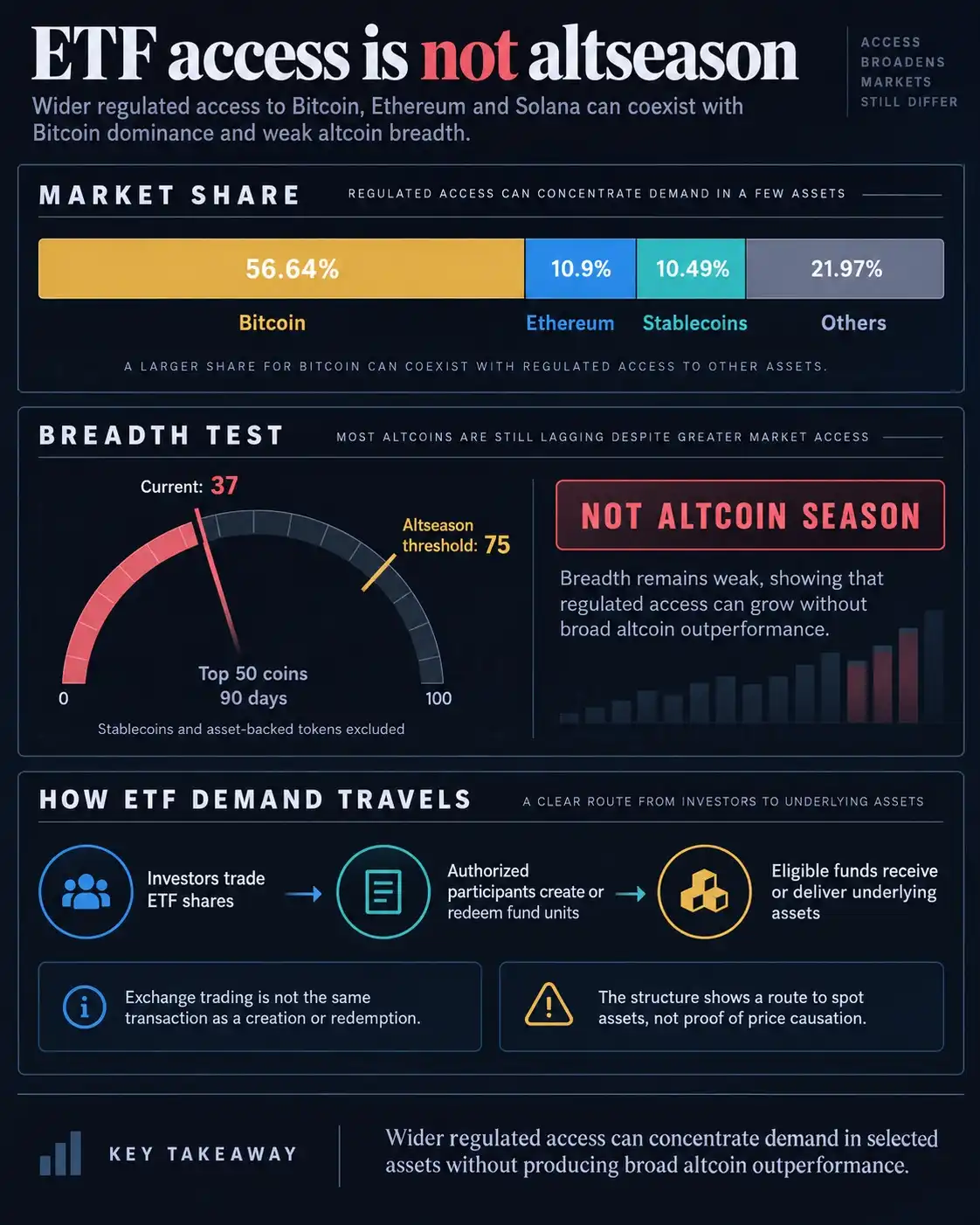
ETF Availability ≠ Altcoin Season. Even with compliant ETF channels for Bitcoin, Ethereum, and Solana, a scenario where Bitcoin dominates and most altcoins remain weak can still co-exist.
This pattern is not a one-day exception.
Over the past 30 days leading up to September 9th, Bitcoin ETFs continued to lead the pack with net inflows of $3.42 billion; Ethereum attracted $1.76 billion; while Solana and XRP recorded net inflows of $200.88 million and $185.32 million, respectively.
According to SoSoValue's data on listed spot crypto ETFs, total net inflows over 30 days amounted to $5.64 billion. Among these, the four categories of Bitcoin, Ethereum, XRP, and Solana accounted for a combined $5.57 billion.
The other products ranked behind them received only a minuscule portion of the capital.
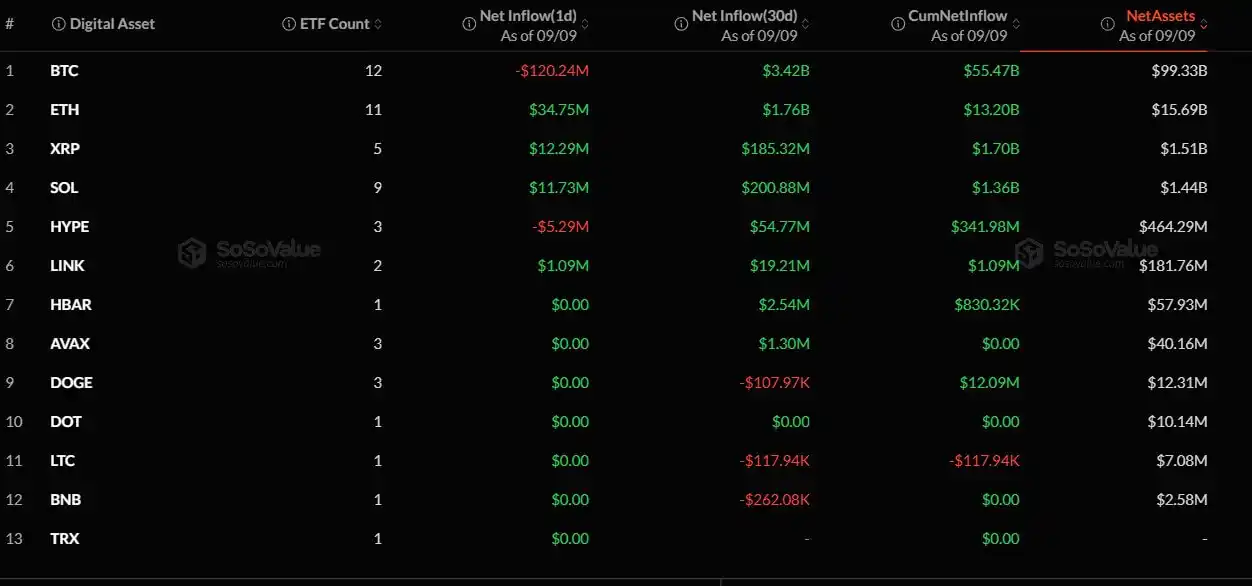
U.S. Cryptocurrency ETF Landscape (Source: SoSoValue)
During the same period, the Hyperliquid fund saw inflows of $54.77 million, and Chainlink attracted $19.21 million. Hedera saw inflows of $2.54 million, and Avalanche $1.30 million. Dogecoin, Litecoin, and BNB experienced minor net outflows, while Polkadot (DOT) had zero net inflows.
The gap is even more pronounced in terms of Assets Under Management (AUM). Bitcoin ETF AUM stands at $99.33 billion, and Ethereum ETF at $15.69 billion. XRP and Solana each hold around $1.5 billion.
Following them, Hyperliquid's AUM is approximately $464 million, and Chainlink's is less than $182 million. The AUM of all other listed products falls below $60 million.
This hierarchical structure allows investors to rotate from Bitcoin into other compliant assets without the need to venture further into the broader crypto token market.
In past market cycles, traders generally expected the Bitcoin rally's benefits to trickle down first to Ethereum, then to large-cap altcoins, and finally to various small-cap speculative tokens. However, ETFs have created a new path: institutional portfolios simply adjust positions among Bitcoin, Ethereum, XRP, and Solana, leaving the vast majority of the token market unaffected.
For a True Altcoin Season, Capital Needs to Diffuse Further Outward
Broad market data shows that this outward transmission of market momentum has yet to materialize.
BlockchainCenter defines an Altcoin Season as a 90-day period where 75% of the top 50 eligible cryptocurrencies by market cap outperform Bitcoin. The index reading of 37 on September 9th means fewer than half of the required tokens have met this criterion.
CoinGecko data shows Bitcoin's current dominance at 56.64% of the total crypto market capitalization. Compared to 56.02% three months ago and 56.54% a year ago, this figure has remained largely unchanged. Despite the launch of more compliant ETF products for altcoins, Bitcoin's market share has held steady.
Therefore, distinguishing between "Altcoin Rotation within ETFs" and a "Genuine Altcoin Season" becomes crucial.
Ethereum, XRP, and Solana can attract hundreds of millions in inflows, but this does little to spur momentum for tokens like Dogecoin, Avalanche, or Polkadot, which are less tied to institutional allocation logic.
Even as more ETF products gain approval, it does not guarantee a natural diffusion of capital outward. On September 9th, despite Bitcoin outflows and inflows into the three leading altcoins, the ETFs for Hedera, Avalanche, Dogecoin, Polkadot, Litecoin, and BNB all recorded zero net inflows.
For fund issuers, the core challenge is no longer just packaging new tokens into ETFs, but convincing institutions to look beyond their few preferred assets and allocate to a wider range.
Sustained redemptions from Bitcoin ETFs will serve as the ultimate stress test. If ETH, XRP, and Solana continue to absorb the outflowing capital while ETFs for mid- and small-cap tokens remain deserted, Wall Street will frequently witness localized altcoin rotations, but traders may continue to wait in vain for the comprehensive altcoin season they are eagerly anticipating.