Capital B bought 376 bitcoins for $29 million, increasing reserves to 3,521 BTC

cryptonews.ruPublished on 2026-09-08Last updated on 2026-09-08

Abstract

French company Capital B has purchased an additional 376 bitcoins for €25.3 million ($29.5 million), increasing its total Bitcoin treasury holdings to 3,521 BTC. The acquisition, funded by a €30.1 million capital raise, was executed at an average price of €67,182 per coin. With total spending of €309.4 million and an average cost of €87,878 per BTC, Capital B now ranks 25th among public companies holding Bitcoin, surpassing Sweden's H100 Group. This purchase marks its largest since September 2025. The trend of corporate accumulation continues, with Japan's Metaplanet acquiring 2,823 BTC and Michael Saylor's Strategy resuming buys with a 4,603 BTC purchase in August. While some firms like K Wave Media have reduced holdings, others are increasing their Bitcoin reserves, with Capital B now being Europe's second-largest public corporate holder behind Germany's Bitcoin Group SE.

French company Capital B, which is building a bitcoin reserve, has purchased 376 bitcoins ($BTC) for 25.3 million euros ($29.5 million), bringing its total holdings to 3,521 $BTC.

The purchase was financed after Capital B raised approximately 30.1 million euros ($35 million), including a private placement backed by investors Adam Back and TOBAM, according to a statement released on Monday.

The company acquired the bitcoins at an average price of 67,182 euros per coin; Swissquote Bank Europe facilitated the transaction, and Taurus provided custody.

In total, Capital B has spent 309.4 million euros to build its bitcoin reserve at an average cost of 87,878 euros per $BTC. According to BitcoinTreasuries.net, following this purchase, the company now ranks 25th among public companies in terms of bitcoin holdings.

This latest acquisition is the largest for Capital B since September 2025, when the company bought 551 $BTC for 54.7 million euros. Additionally, the company holds 61 $BTC for operational purposes; these assets are held separately from the treasury reserves and are not included in performance metrics related to bitcoin.

Related: Satoshi-era bitcoins awaken after 16 years of dormancy: 600 $BTC moved

Leading companies with $BTC reserves continue to accumulate

While companies such as K Wave Media and Sequans Communications have begun reducing their bitcoin reserves, others continue to accumulate the asset.

Japanese Metaplanet acquired 2,823 $BTC in the second quarter for approximately $222 million, bringing its holdings to 43,000 $BTC. During the quarter, the company paid an average of about $78,850 per bitcoin and now ranks third among public corporate bitcoin holders—after Michael Saylor's Strategy and Twenty One Capital, according to BitcoinTreasuries.net.

In August, Sweden-based H100 Group more than tripled its bitcoin holdings after acquiring Norwegian companies that owned 2,455 $BTC. The all-stock transaction increased H100's reserve to 3,506 $BTC, which at the time made it the second-largest public corporate bitcoin holder in Europe. Capital B's latest purchase puts it 15 $BTC ahead of H100, although both companies still trail Germany's Bitcoin Group SE, which holds 3,605 $BTC.

Strategy, the world's largest corporate bitcoin holder, also resumed purchases in August after a two-month pause, acquiring 4,603 $BTC for $370 million. This brought its holdings to 845,050 $BTC, acquired for a total of $63.3 billion.
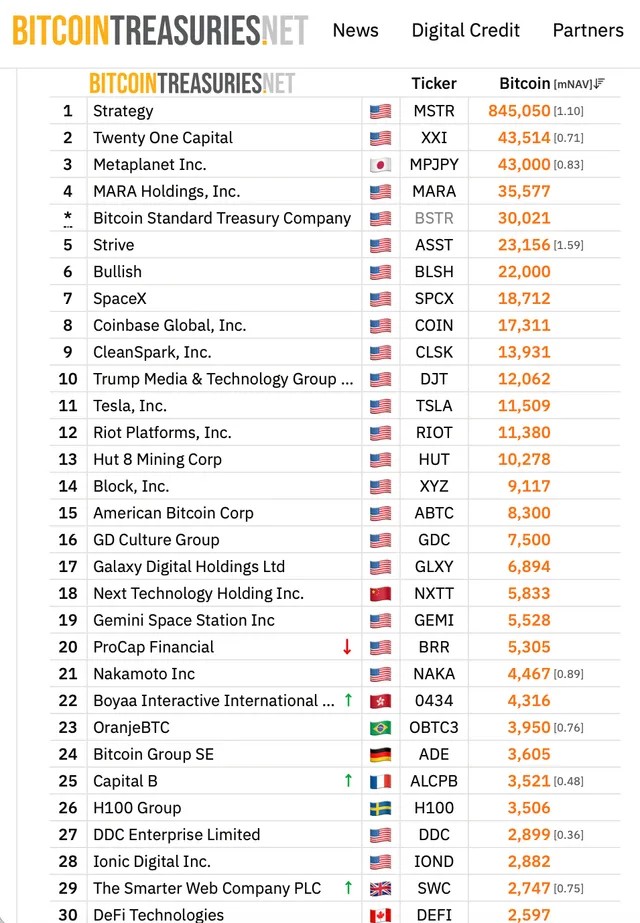
Top 30 companies with bitcoin reserves. Source: BitcoinTreasuries.NET

Magazine: 'White hats' seized 4,000 $BTC from Liquid, ETFs saw the best inflows of 2026: Hodler’s Digest

end-content

Trending Cryptos

Related Questions

QWhat is the total amount of Bitcoin (BTC) that French company Capital B now holds after its latest purchase, and what is its ranking among public corporate holders?

AAfter purchasing an additional 376 BTC, Capital B now holds a total of 3,521 BTC in its treasury reserve. This purchase moved the company to the 25th position among public companies by Bitcoin holdings.

QHow did Capital B finance its recent purchase of 376 Bitcoin, and what was the average purchase price per coin?

AThe purchase was financed after Capital B raised approximately €30.1 million ($35 million), including a private placement backed by investors Adam Back and TOBAM. The company acquired the Bitcoins at an average price of €67,182 per coin.

QWhich company is identified as the world's largest corporate holder of Bitcoin, and how many BTC does it hold after resuming purchases in August?

AStrategy (Michael Saylor's company) is identified as the world's largest corporate holder of Bitcoin. After resuming purchases in August by acquiring 4,603 BTC for $370 million, its total holdings reached 845,050 BTC.

QWhat significant action did the Japanese company Metaplanet take regarding Bitcoin in the second quarter, and what is its new ranking?

AIn the second quarter, Japanese company Metaplanet acquired 2,823 BTC for approximately $222 million, bringing its total holdings to 43,000 BTC. This move positioned it as the third-largest public corporate holder of Bitcoin, according to BitcoinTreasuries.net.

QHow did the Swedish company H100 Group significantly increase its Bitcoin holdings in August, and how does it compare to Capital B after Capital B's latest purchase?

AIn August, H100 Group more than tripled its Bitcoin holdings by acquiring Norwegian companies that owned 2,455 BTC in an all-stock deal. This increased its reserve to 3,506 BTC. While Capital B's latest purchase (3,521 BTC) puts it 15 BTC ahead of H100 Group, both companies are still behind the German Bitcoin Group SE, which holds 3,605 BTC.

Related Reads

Overseas viral tracking robot now available for immediate purchase in China

Beni, a compact follow-cam robot from Shenzhen startup Mondo Tech, has officially launched in China at 4,999 yuan. Founded in early 2025 by former DJI executives—CEO Gao Jianrong (ex-head of DJI RoboMaster) and CTO Yang Shuo (former DJI technical director and Tesla Optimus control/algorithms engineer)—the company blends DJI-style hardware polish with consumer-friendly design. Roughly the size of a lunchbox and weighing 1.75 kg, Beni can run, jump, flip upright after falling, and hit speeds up to 28.8 km/h, all while shooting stabilized 4K video. Its core selling point is autonomous tracking: press a button and Beni follows you during runs, skateboarding, cycling, or family outings, adjusting its angle as you move, functioning like a "DJI Pocket 3 with legs." A bundled smartwatch-like controller enables blind operation and motion-based mini-games such as "find the coins" and tug-of-war. Visual processing runs on-device with 32GB storage plus microSD support, and footage is not uploaded to servers unless cloud templates are used. An app called MondoCut auto-edits highlights. Battery life is about 1.5 hours, with an 800-yuan "Explorer Edition" adding two spare batteries. Reviewers note minor flaws: obstacle avoidance isn't foolproof (glass doors), it can lose track in crowded places, and there's a learning curve. The article frames Beni as a pragmatic entry into embodied AI for consumers—positioned at the intersection of utility, emotional value, and cost—and suggests emotional connection, not just labor, may be embodied AI's fastest path into ordinary life.

marsbit15m ago

Overseas viral tracking robot now available for immediate purchase in China

marsbit15m ago

Where 95% of Pump.fun's Revenue Comes From: Making Money Off Tokens That Go to Zero, Turning the Meme Ecosystem Into a Zero-Sum Game

Pump.fun dominates meme coin issuance, capturing 92% of tokens and 84% of trading volume, but its revenue model depends on failure. About 95% of protocol income comes from tokens still on the bonding curve or below $250K market cap, and 87% comes from tokens less than a day old. A 1.25% fee applies to each trade, with 0.95% going to the platform. Fifteen top tokens with combined peak valuations of $1.4B generated only about $1.5M in fees, while small tokens below $250K produced $506M—meaning 1,000 tokens that die at $20K earn more than one token reaching $100M. This incentive structure encourages bundling, mass token issuance, paid KOL promotions, and PvP trading—all of which generate fees. The top 25 issuer addresses launched 761,000 tokens with under 1% graduating, earning $128M. Pump.fun has paid $29.6M in promotion rewards to 51,115 wallets, with the top 10 taking 16%; most promoted tokens have market caps under $100K, and followers of 14 tracked promoters lost $926K in a single day. Promoted tokens typically fall 48% within an hour and 74% within a day. The result is infinite supply against shrinking demand. Of 24.4 million tokens ever launched, only 312 still hold a market cap above $100K—a 0.0013% survival rate. Quarterly launches match 2024 levels, but tokens reaching $10M fell from 207 to 24. The author urges traders to hold quality tokens longer, judge KOLs by follower profitability, and shift volume to platforms rewarding longevity. Proposed reforms include higher initial market caps, deeper liquidity, fees shared with holders and LPs, creator fees vesting over time, and promotion rewards tied to sustained follower holdings rather than volume. A more radical model would abandon bonding curves for uniform-price fundraising with refunds on failure and wallet caps, charging fees only on successful raises.

marsbit25m ago

Where 95% of Pump.fun's Revenue Comes From: Making Money Off Tokens That Go to Zero, Turning the Meme Ecosystem Into a Zero-Sum Game

marsbit25m ago

BiyaPay Research Institute Observation | U.S. Stocks Rebound, Hong Kong Tech Pulls Back: Can Nvidia and Platform Earnings Stabilize Expectations?

U.S. stocks rebounded last week, with the S&P 500 up 2.51% and the semis ETF SOXX up 9.35%, though Nvidia fell 12.75% after its board accepted Jensen Huang's resignation, with CFO Colette Kress serving as interim CEO. AMD, Broadcom and Micron rallied, showing that sector recovery does not mean every leader is endorsed. CoreWeave rose 14.50% on strong revenue and financing clarity, but cash returns remain unproven. Cisco beat on revenue yet fell 6.24% as gross margin slipped, highlighting that profit quality and expectations matter. Hong Kong tech pulled back, with the Hang Seng Tech Index down 6.50%; Alibaba, Meituan and Tencent all fell despite southbound net buying of HK$11.87 billion, showing that one source of demand cannot set the overall price. SMIC rose 6.45% on better quarterly results but faces margin pressure ahead. U.S. October CPI rose 0.4% month-on-month, with core CPI up 0.3%, while PPI reached 6.5% year-on-year and long-term Treasury yields exceeded 5%, so rate constraints persist. Investors should distinguish gains backed by operating improvement from mere rebound after sharp declines. Key catalysts in the coming two weeks include Nvidia's earnings on Nov 17, results from JD.com, Tencent and Alibaba, U.S. retail sales data, and the FOMC minutes, followed by PCE data and Thanksgiving trading arrangements.

marsbit26m ago

BiyaPay Research Institute Observation | U.S. Stocks Rebound, Hong Kong Tech Pulls Back: Can Nvidia and Platform Earnings Stabilize Expectations?

marsbit26m ago

Open power struggle! Jensen Huang discusses return as CEO with allies, while Bessent urges Nvidia to pick an 'outsider'

Nvidia is embroiled in a public battle over its CEO position following Jensen Huang's resignation. Huang has discussed returning with confidants, and allies are forming a Silicon Valley "war room" to lobby the board and seek White House support. A petition demanding his reinstatement has gathered over 100,000 signatures, including from Elon Musk, Tim Sweeney, and other tech leaders. Musk argued that many Nvidia supply chain deals are handshake agreements with Huang that could be lost without him. Major shareholders Altimeter Capital and Atreides Management also urged the board to consider Huang's return. Meanwhile, Treasury Secretary Bessent publicly pressured the board on Fox News to seek an outside successor and pursue "drastic leadership change." He also questioned whether Nvidia knowingly violated high-end chip export controls, citing the company's decision to stop separately disclosing Singapore revenue after direct sales fell and Singapore billings surged, with only 1% of chips reportedly remaining there. He demanded answers from the board and outside counsel within 10 days. Huang's return faces obstacles: his affair with a subordinate is a fireable offense, he holds no controlling stake, and he faces congressional scrutiny, having agreed to closed-door interviews with three House committees. Arm CEO Rene Haas has been approached as a potential successor, though no formal process has begun. Interim CEO Colette Kress is leading the company ahead of Tuesday's quarterly earnings.

marsbit46m ago

Open power struggle! Jensen Huang discusses return as CEO with allies, while Bessent urges Nvidia to pick an 'outsider'

marsbit46m ago

Panoramic Market Weekly: Circle Native Payment Network, Real AI Calls, and Prediction Market Shifts

This week's earnings season highlights stablecoin payments moving from concept to real commercial deployment, with Circle's Payment Network at the forefront. Circle CEO Jeremy Allaire argues that on-chain settlement will dramatically lower marginal costs for value transfer, with transaction fees needing to fall below 10 basis points to fulfill the network's promise. Artemis estimates that by 2032, Circle's Payment Network could process around $1 trillion in stablecoin volume—about 1.5% of global non-commodity cross-border flows—generating roughly $755 million in annual revenue at a 7 bps fee and valuing the business at about $3.5 billion, or 20% of Circle's market cap. However, competition is intensifying as Mastercard acquires BVNK and Visa reportedly considers integrating Fireblocks. Using AI to analyze 1,343 earnings calls and 17,721 analyst questions, Artemis ranked the sharpest exchanges, including tough questions on mining capex returns and a Barclays call where management deflected a buyout question by citing a dropped signal. Prediction markets are structurally disrupting traditional sports betting. Card-spend data shows triple-digit growth in deposits to Polymarket and Kalshi from Q1 to Q3 2026, while legacy sportsbooks decline. Notably, nearly 90% of Kalshi depositors and 72% of Polymarket users never used cards on traditional betting platforms, indicating new incremental audiences. States without legal sports betting account for 55% of Kalshi's volume despite holding only a third of the U.S. adult population. DraftKings has cut profit guidance and is boosting marketing and R&D spending to defend its turf. Finally, AI infrastructure remains severely supply-constrained. CoreWeave says confirmed demand through 2027 exceeds its available capacity by more than 10x, with 2028 reservations oversubscribed before opening. TSMC confirms insatiable demand for advanced chips, and Ramp data shows enterprise token consumption still growing steeply.

marsbit51m ago

Panoramic Market Weekly: Circle Native Payment Network, Real AI Calls, and Prediction Market Shifts

marsbit51m ago

Trading

Spot

Hot Articles

What is $BITCOIN

DIGITAL GOLD ($BITCOIN): A Comprehensive Analysis Introduction to DIGITAL GOLD ($BITCOIN) DIGITAL GOLD ($BITCOIN) is a blockchain-based project operating on the Solana network, which aims to combine the characteristics of traditional precious metals with the innovation of decentralized technologies. While it shares a name with Bitcoin, often referred to as “digital gold” due to its perception as a store of value, DIGITAL GOLD is a separate token designed to create a unique ecosystem within the Web3 landscape. Its goal is to position itself as a viable alternative digital asset, although specifics regarding its applications and functionalities are still developing. What is DIGITAL GOLD ($BITCOIN)? DIGITAL GOLD ($BITCOIN) is a cryptocurrency token explicitly designed for use on the Solana blockchain. In contrast to Bitcoin, which provides a widely recognized value storage role, this token appears to focus on broader applications and characteristics. Notable aspects include: Blockchain Infrastructure: The token is built on the Solana blockchain, known for its capacity to handle high-speed and low-cost transactions. Supply Dynamics: DIGITAL GOLD has a maximum supply capped at 100 quadrillion tokens (100P $BITCOIN), although details regarding its circulating supply are currently undisclosed. Utility: While precise functionalities are not explicitly outlined, there are indications that the token could be utilized for various applications, potentially involving decentralized applications (dApps) or asset tokenization strategies. Who is the Creator of DIGITAL GOLD ($BITCOIN)? At present, the identity of the creators and development team behind DIGITAL GOLD ($BITCOIN) remains unknown. This situation is typical among many innovative projects within the blockchain space, particularly those aligning with decentralized finance and meme coin phenomena. While such anonymity may foster a community-driven culture, it intensifies concerns about governance and accountability. Who are the Investors of DIGITAL GOLD ($BITCOIN)? The available information indicates that DIGITAL GOLD ($BITCOIN) does not have any known institutional backers or prominent venture capital investments. The project seems to operate on a peer-to-peer model focused on community support and adoption rather than traditional funding routes. Its activity and liquidity are primarily situated on decentralized exchanges (DEXs), such as PumpSwap, rather than established centralized trading platforms, further highlighting its grassroots approach. How DIGITAL GOLD ($BITCOIN) Works The operational mechanics of DIGITAL GOLD ($BITCOIN) can be elaborated on based on its blockchain design and network attributes: Consensus Mechanism: By leveraging Solana’s unique proof-of-history (PoH) combined with a proof-of-stake (PoS) model, the project ensures efficient transaction validation contributing to the network's high performance. Tokenomics: While specific deflationary mechanisms have not been extensively detailed, the vast maximum token supply implies that it may cater to microtransactions or niche use cases that are still to be defined. Interoperability: There exists the potential for integration with Solana’s broader ecosystem, including various decentralized finance (DeFi) platforms. However, the details regarding specific integrations remain unspecified. Timeline of Key Events Here is a timeline that highlights significant milestones concerning DIGITAL GOLD ($BITCOIN): 2023: The initial deployment of the token occurs on the Solana blockchain, marked by its contract address. 2024: DIGITAL GOLD gains visibility as it becomes available for trading on decentralized exchanges like PumpSwap, allowing users to trade it against SOL. 2025: The project witnesses sporadic trading activity and potential interest in community-led engagements, although no noteworthy partnerships or technical advancements have been documented as of yet. Critical Analysis Strengths Scalability: The underlying Solana infrastructure supports high transaction volumes, which could enhance the utility of $BITCOIN in various transaction scenarios. Accessibility: The potential low trading price per token could attract retail investors, facilitating wider participation due to fractional ownership opportunities. Risks Lack of Transparency: The absence of publicly known backers, developers, or an audit process may yield skepticism regarding the project's sustainability and trustworthiness. Market Volatility: The trading activity is heavily reliant on speculative behavior, which can result in significant price volatility and uncertainty for investors. Conclusion DIGITAL GOLD ($BITCOIN) emerges as an intriguing yet ambiguous project within the rapidly evolving Solana ecosystem. While it attempts to leverage the “digital gold” narrative, its departure from Bitcoin's established role as a store of value underscores the need for a clearer differentiation of its intended utility and governance structure. Future acceptance and adoption will likely depend on addressing the current opacity and defining its operational and economic strategies more explicitly. Note: This report encompasses synthesised information available as of October 2023, and developments may have transpired beyond the research period.

5.4k Total ViewsPublished 2025.05.14Updated 2025.05.14

What is $BITCOIN

Discussions

Welcome to the HTX Community. Here, you can stay informed about the latest platform developments and gain access to professional market insights. Users' opinions on the price of BTC (BTC) are presented below.

活动图片