Bitcoin Soars Toward $70,000 Amid $1.3 Billion Short Squeeze

cryptonews.ruPublished on 2026-08-19Last updated on 2026-08-19

Abstract

Bitcoin surged sharply towards $70,000 amid a significant short squeeze. The price, previously stuck in a $61.5k-$65k range, broke out after the US Treasury announced plans to double its maximum purchase amount for long-term bonds to support liquidity. This news pushed down bond yields, making riskier assets like Bitcoin more attractive, and coincided with renewed inflows into US spot Bitcoin ETFs. The rapid price move above $66,000 triggered massive liquidations in the derivatives market, predominantly of leveraged short positions. Approximately $1.48 billion worth of positions were liquidated in an hour, with around $1.3 billion coming from shorts. These forced closures created a self-reinforcing buying cycle, accelerating the rally to levels not seen since early summer. The key question is whether the momentum can be sustained after the forced buying subsides. Maintaining the breakout likely requires continued spot market demand, indicated by ETF flows. The next major test is the $69,000-$70,000 resistance zone. As of Wednesday late morning ET, Bitcoin was trading around $68,468.

The move unfolded swiftly towards the end of the morning trading session in the US. Bitcoin had been largely stuck in a range between $61,500 and $65,000 for several weeks, leading to unusually low volatility and prompting traders to increasingly open positions betting on the continuation of this range.

Treasury Action Lit the Fuse

One catalyst was a statement from the US Treasury Department that it would at least double the maximum size of its long-term Treasury securities buyback operations to support liquidity, increasing it from $2 billion to at least $4 billion per operation. The changes are scheduled to take effect on September 9th.

This announcement was significant because the cost of long-term government borrowing had been rising sharply. The yield on 30-year Treasury bonds had reached approximately 5.33–5.34%, nearing a peak not seen in nearly two decades, before falling to around 5.2% on this news.
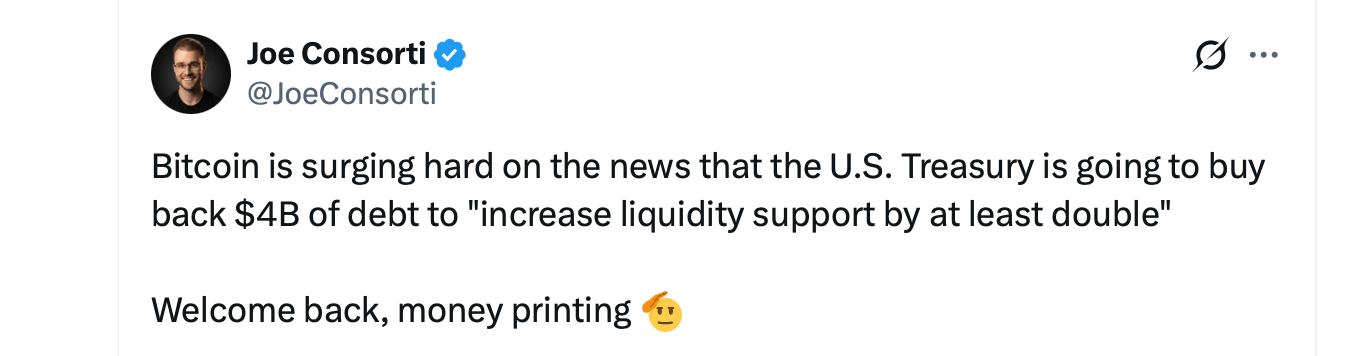
Image Source: X

Lower yields can make riskier investments more attractive by reducing the returns from government bonds. Stocks, gold, and bitcoin benefited from this, as traders interpreted the Fed's step as easing the pressure that had been building in bond markets.

Bitcoin's price also found another source of support. Earlier in the week, US spot bitcoin exchange-traded funds recorded an inflow of $297.6 million, with market data pointing to additional positive flows around August 19th.

Short Sellers Get Caught in a Liquidation Trap

The real acceleration occurred in the derivatives markets. As Bitcoin's price surpassed the $66,000 mark, leveraged traders betting on lower prices began to see their positions liquidated—exchanges automatically closed positions where there was insufficient collateral to cover the losses.

According to statistics from Coinglass.com, over a 60-minute period, liquidations of crypto short and long positions (predominantly shorts) amounted to roughly $1.48 billion. These forced closures compel short sellers to buy back their positions, creating additional demand just as prices are already rising.
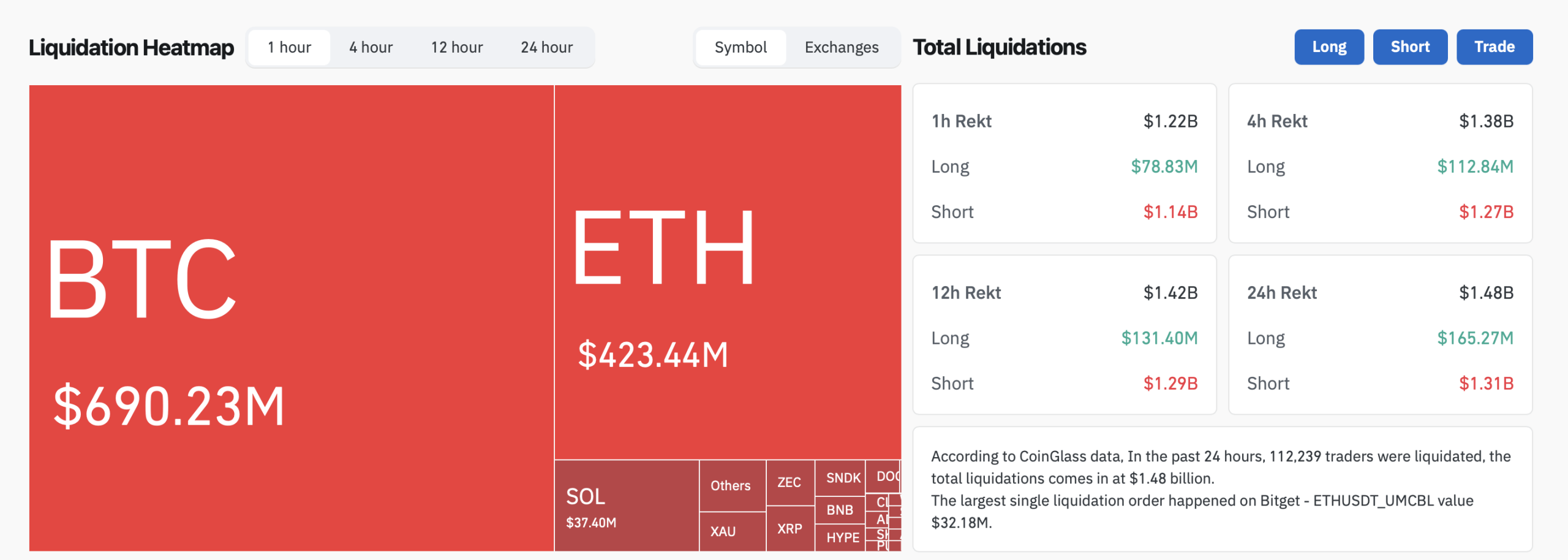
Crypto liquidations on Wednesday, according to coinglass.com statistics. Approximately $1.3 billion in liquidations came from short positions.

Leverage amplified this chain reaction. A trader using 20:1 or 40:1 leverage can lose their entire capital due to a relatively small price move against their position. Each liquidation can push prices higher, triggering the liquidation of the next set of short positions and creating a self-reinforcing squeeze. Over the past day, around 114,538 traders suffered complete losses.

The sharp surge in Bitcoin brought it to levels not seen since early summer. The speed of the move was particularly impressive: the most intense phase unfolded in roughly 15–60 minutes amid a surge in trading volume.

$70,000 – Bitcoin's Next Test

The question now is whether buyers can hold onto the gains after the forced buying subsides. Derivatives can create impressive candles, but sustaining a breakout typically requires steady demand in the spot market, where investors buy bitcoin directly, not through leveraged contracts.

ETF fund flows serve as one indicator of this demand. Continued inflows, stable or declining Treasury yields, and a pickup in spot trading could help bitcoin turn the former resistance area around $66,900 into support and achieve a more confident breakout from the multi-week range.

The danger lies in a trend reversal if leveraged traders start opening new long positions faster than underlying demand develops. The immediate test for bitcoin will be the $69,000 to $70,000 area, where traders will be watching to see if the August 19th spike becomes a sustained breakout or just another 'whipsaw' event fueled by leverage.

As of Wednesday at 11:50 AM Eastern Daylight Time (EDT), Bitcoin is trading at $68,468 per unit.

Related Questions

QWhat were the main factors that triggered Bitcoin's rapid rise towards $70,000?

AThe main factors were: 1) An announcement from the US Treasury Department to at least double the maximum size of its long-term Treasury buyback operations, which reduced bond yields and made riskier assets like Bitcoin more attractive. 2) A significant short squeeze in the derivatives market, where overleveraged short positions were forcibly liquidated as Bitcoin broke above $66,000, creating a self-reinforcing buying pressure. 3) Positive inflows into US spot Bitcoin ETFs prior to the move.

QWhat is the role of the 'short squeeze' described in the title and article?

AThe 'short squeeze' refers to the forced liquidation of approximately $1.3 billion in leveraged short positions. When Bitcoin's price rose above $66,000, traders who had bet on a price decline using leverage saw their positions automatically closed by exchanges due to insufficient collateral. These forced closures required the short sellers to buy back Bitcoin to cover their positions, creating a surge of additional demand that further accelerated the price increase.

QAccording to the article, what is the next key test for Bitcoin's price?

AThe next key test for Bitcoin is the resistance area between $69,000 and $70,000. The article states that traders will be watching to see if the surge on August 19th represents a sustainable breakout from the multi-week trading range or just another leverage-fueled spike that could reverse.

QWhy did the US Treasury's announcement about bond buybacks positively impact Bitcoin's price?

AThe Treasury's announcement to increase long-term Treasury bond buybacks helped push down bond yields (e.g., the 30-year yield fell from ~5.34% to ~5.2%). Lower yields on these safe-haven government bonds make riskier investments like stocks, gold, and Bitcoin relatively more attractive by comparison, as traders seek higher returns.

QWhat does the article suggest is needed for Bitcoin to maintain its breakout above the previous trading range?

AThe article suggests that to maintain the breakout, Bitcoin needs sustained demand in the spot market (where investors buy Bitcoin directly), not just leveraged derivatives trading. Continued inflows into spot Bitcoin ETFs, stable or declining Treasury yields, and active spot trading are cited as factors that could help turn the former resistance near $66,900 into support and solidify the breakout.

Related Reads

CFTC Finally Recognizes 'Private Keys as Ownership', How Will the 108-Page New Rule Reshape the Crypto Derivatives Landscape?

The CFTC has unveiled a 108-page Advance Notice of Proposed Rulemaking (ANPR) introducing Regulation CTX and Reg CAM, marking a significant regulatory shift for the crypto derivatives landscape. This move, led by Commissioner Michael Selig, provides the industry's first clear compliance framework following years of enforcement based on Dodd-Frank rules. A key breakthrough is the formal recognition of the "Not your keys, not your coins" principle. The rules clarify that "actual delivery" for crypto assets requires transferring possession of access credentials (like private keys), effectively exempting pure self-custodial, peer-to-peer transactions (e.g., on DEXs like Uniswap) from CFTC exchange registration requirements for day-to-day oversight. Furthermore, Reg CAM allows for a "Fully Integrated Crypto Asset Market" structure. This permits qualified platforms to combine exchange, broker (FCM), and clearinghouse (DCO) functions under one entity, aligning with the integrated model of major crypto exchanges like Coinbase. The CFTC defended this approach by contrasting the safety of customer funds in its registered entities during the FTX collapse with the losses in offshore affiliates. The ANPR also explores critical forward-looking areas: the regulatory treatment of front-end interfaces integrating DeFi yield vaults; potential mandates for smart contract audits and formal verification; the use of on-chain transparency for proof of reserves; and the possibility of compliant, fully on-chain order book exchanges. This regulatory "help" aims to provide certainty for on-chain finance to flourish under a new U.S. framework.

marsbit17m ago

CFTC Finally Recognizes 'Private Keys as Ownership', How Will the 108-Page New Rule Reshape the Crypto Derivatives Landscape?

marsbit17m ago

Exclusive Interview with Chicago Fed President Goolsbee: The Clash Between Hard Data and Sentiment, Consumer Disconnect, and Concerns Over AI Infrastructure Overheating

Chicago Fed President Austan Goolsbee discusses the growing divergence between strong macroeconomic data ("hard data") and widespread public pessimism ("vibes"). He explains that the Federal Reserve prioritizes hard data, like labor market ratios and retail sales, for policy decisions, as the traditional link between consumer sentiment and actual spending has nearly broken down. Goolsbee attributes the public's negative economic feelings to the "salience" of high absolute price levels for items like gas and groceries, political polarization influencing surveys, and the memory of past real wage declines. The labor market remains in an unusual "low-hire, low-fire" stalemate with high stability but low mobility. A key concern is the potential for a $1.5 trillion AI infrastructure spending boom to cause localized economic overheating. Goolsbee warns this could complicate inflation control if it spills over into broader demand and costs, risking a scenario reminiscent of past investment bubbles. Core insights include: sentiment is no longer a reliable spending indicator; cumulative price increases drive public pain more than inflation rates; strong spending by high-income groups masks stagnation at lower levels; and the Fed remains committed to returning inflation to 2% as the fundamental solution to cost-of-living anxieties.

marsbit28m ago

Exclusive Interview with Chicago Fed President Goolsbee: The Clash Between Hard Data and Sentiment, Consumer Disconnect, and Concerns Over AI Infrastructure Overheating

marsbit28m ago

U.S. Becomes Net Importer of Bitcoin in 2026, Institutions Accumulate as Retail Exits

In 2026, the U.S. became a net importer of Bitcoin for the first time since the 2022 market correction, according to a Chainalysis report. A deep divergence emerged between institutional and retail investors. Large institutions and professional capital, utilizing compliant channels like spot ETFs approved in 2024, have maintained a strong pace of accumulation, moving BTC into cold storage and trusts. In contrast, retail investors have largely been net sellers, reducing small transactions and active addresses, leading to a one-way transfer of coins from散户 to institutional vaults. Following the SEC's approval of spot Bitcoin ETFs in January 2024, the U.S. has seen its share of global Bitcoin activity increase consecutively. Despite market pullbacks, the U.S. crypto economy remained stable at $2.78 trillion in 2026, retaining 97.8% of its capital from the previous year's expansion. The report also highlights a broader global settlement pattern: the U.S. is exporting digital dollar stablecoins—accelerated by regulations like the 2025 GENIUS Act mandating full U.S. Treasury backing—to global trade networks, while simultaneously using its capital advantage to absorb the finite supply of Bitcoin as a strategic store-of-value asset for institutional balance sheets. This dual flow positions the U.S. to both provide dollar liquidity abroad and accumulate scarce digital assets domestically as the macro rate-cut cycle deepens.

marsbit32m ago

U.S. Becomes Net Importer of Bitcoin in 2026, Institutions Accumulate as Retail Exits

marsbit32m ago

Strategy Spent $16 Billion in Rescue Funds, Preferred Stock STRC Buyback Loop Faces Liquidity Test?

MicroStrategy (now Strategy) launched a high-yield preferred stock, STRC, with a 12% annual dividend, designed to raise funds by issuing shares at or above their $100 face value to finance continuous Bitcoin purchases. However, since mid-May, STRC's price fell below par, dropping as low as $74.57 in late June, halting new issuances. To restore the $100 benchmark and restart this funding channel, Strategy initiated an aggressive weekly buyback program in late July, spending a cumulative $1.6 billion to repurchase STRC. Last week's buyback hit a record $192.4 million—approximately nine times its Bitcoin purchases for the same period. This massive effort has pushed STRC's price back to $99.90. The funding for these repurchases primarily comes from selling MSTR common stock in the open market. At the current spending rate, the authorized buyback budget could be exhausted in about two weeks, though the board may increase it again. The company's available liquidity could also be depleted in just over three weeks at this pace. This situation represents a significant shift in Strategy's capital strategy. Instead of using raised funds to leverage Bitcoin acquisitions, a substantial portion is now being diverted to support STRC's price. The company even sold some Bitcoin this summer to fund the repurchases. While financially accretive if MSTR trades above ~$131, this activity effectively reduces MSTR's leverage to Bitcoin's price. Market data shows Strategy's buybacks accounted for 20-25% of STRC's trading volume in September, raising concerns about a lack of independent buy-side demand. The critical question remains: if Strategy stops its buyback support after reaching the $100 target, whether sufficient external demand exists to sustain the price, or if the costly cycle will need to restart.

marsbit33m ago

Strategy Spent $16 Billion in Rescue Funds, Preferred Stock STRC Buyback Loop Faces Liquidity Test?

marsbit33m ago

Trading

Spot
活动图片