Bitcoin Red Team reports 5K findings in sweeping security audit

cointelegraphPublished on 2026-08-06Last updated on 2026-08-06

Abstract

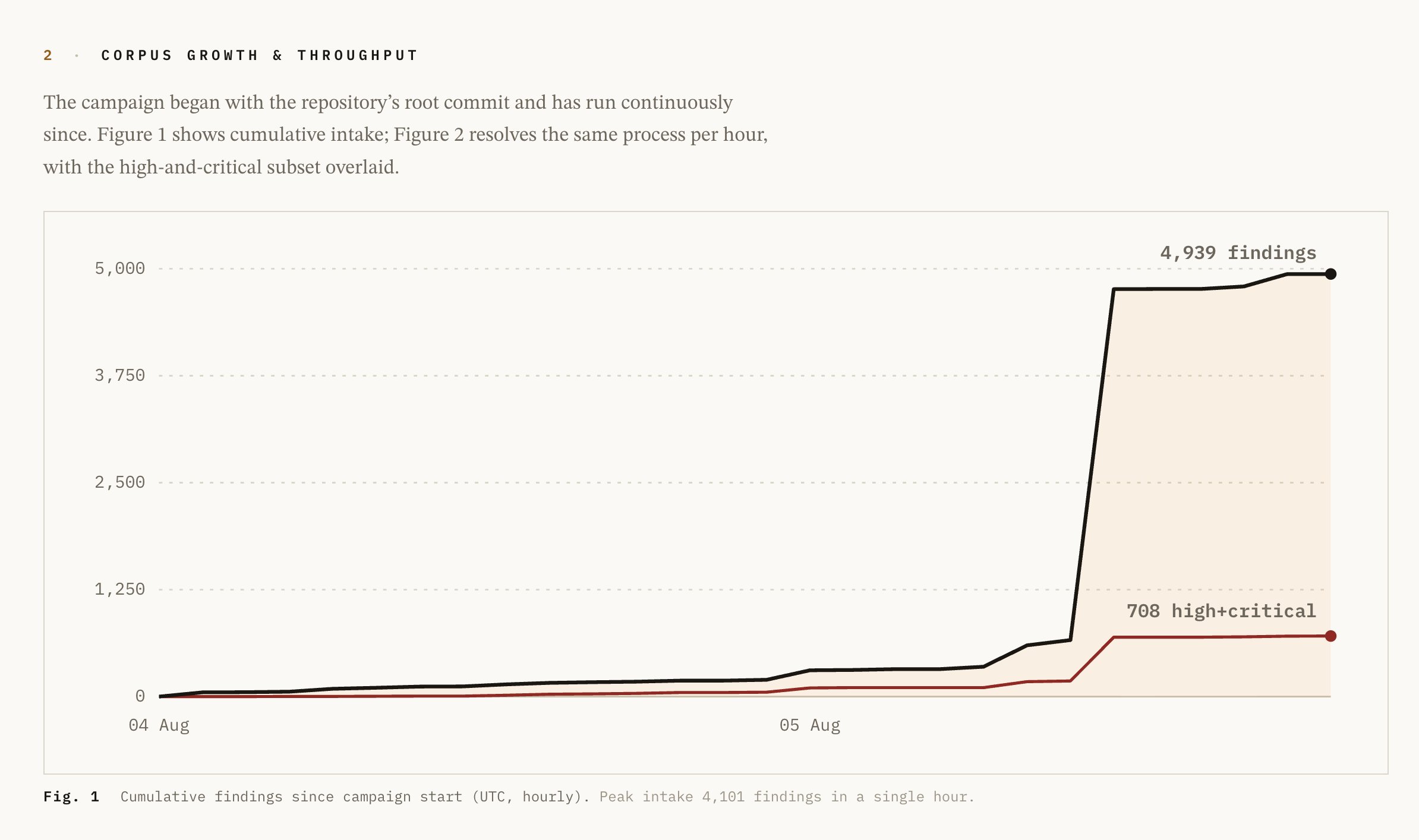
A volunteer Bitcoin security group called Bitcoin Red Team, comprised of 16 members, has reported finding nearly 5,000 potential issues during a rapid, AI-assisted audit of Bitcoin ecosystem projects. According to developer Calle, the team averaged about one critical exploit discovery per hour per person. In the first 29.8 hours of operation, they identified 4,962 potential vulnerabilities across 390 projects, with 720 classified as high- or critical-level issues. The campaign follows a recent hack of the Coldcard hardware wallet that resulted in over $100 million in Bitcoin being stolen.

A Bitcoin security group made up of just 16 volunteers said they have found nearly 5,000 potential issues during a rapid AI-assisted review of projects in the Bitcoin ecosystem.

Bitcoin Red Team is a volunteer security effort that includes Rob Hamilton, CEO of AnchorWatch and Bitcoin developer Calle, among others, which has been using AI tools and human review to scan open-source Bitcoin-related repositories for vulnerabilities.

“We’re averaging on the order of 1 critical exploit per hour per person,” said Calle in a post to X on Wednesday.

Source: Calle

The launch of the Bitcoin security review campaign comes just days after the Coldcard hardware wallet hack, which has seen over $100 million in Bitcoin stolen.

According to Calle, in the first 29.8 hours of its operation, its team has found 4,962 potential issues across 390 projects. As many as 720 of them are considered high- or critical-level issues. So far, 21.4% of findings have been able to be reproduced.

Related: At least 15 attackers exploited Coldcard vulnerability: Galaxy

Trending Cryptos

Related Questions

QWhat is the name of the volunteer security group that found nearly 5,000 potential issues in the Bitcoin ecosystem?

AThe volunteer security group is called Bitcoin Red Team.

QHow many volunteers are part of the Bitcoin Red Team security effort mentioned in the article?

AThe Bitcoin Red Team is made up of 16 volunteers.

QAccording to developer Calle, what is the approximate rate of finding critical exploits per person per hour?

AAccording to Calle, they are averaging on the order of 1 critical exploit per hour per person.

QHow many of the 4,962 potential issues found were considered high- or critical-level?

A720 of the 4,962 potential issues found were considered high- or critical-level.

QWhat recent event is mentioned as the context for the launch of this security review campaign?

AThe launch of the Bitcoin security review campaign comes just days after the Coldcard hardware wallet hack, which saw over $100 million in Bitcoin stolen.

Related Reads

DATA Network joins Sui and Walrus to scale the supply chain for AI training data

The DATA Network, which operates the Trace onchain registry for rights-cleared AI training data with over 250 million verifiable receipts, is joining the Sui blockchain ecosystem and adopting Walrus as its default storage layer. This integration addresses a critical need for the next generation of AI models, which require real-world, consented data with clear provenance due to regulatory requirements and legal challenges. The open internet has been largely exhausted as a data source. Trace registers the origin and usage rights of data from contributors—such as personal dashcam footage or medical notes—and handles payments to them, processing over 3 million receipts daily. Sui's object-centric model allows datasets and their licenses to be managed onchain, with fast, parallel transaction processing. Walrus provides efficient, secure storage for large files, ensuring data is only accessible to licensed buyers. By integrating with Walrus, Trace will be able to store an immutable, encrypted copy of the original data file itself, strengthening provenance guarantees. As part of the migration, the DATA Network will be upgraded to run natively as a protocol on Sui, and its independent chain will be retired. The $DATA token will transition to the Sui protocol on a one-to-one basis. Sui Foundation is making a $30 million strategic investment in the DATA Network, becoming its largest institutional stakeholder. Leaders from Mysten Labs (original contributor to Sui), PIP Labs, and DATA Foundation highlighted that the combination provides a comprehensive solution for storing, licensing, and paying for the high-quality, consented data essential for advancing AI, with the scale and integrity proofs the industry demands.

TheNewsCrypto8m ago

DATA Network joins Sui and Walrus to scale the supply chain for AI training data

TheNewsCrypto8m ago

ICP Cloud Engine Heats Up: "20% of Revenue Used for Burn", How Far is it From Token Revaluation?

The ICP community is discussing Cloud Engines, a product enabling enterprises to run private subnets on the Internet Computer. It is linked to the "Mission 70" deflationary plan, where node providers allocate 20% of Cloud Engines revenue to buy and burn ICP tokens, aiming to reduce ICP's inflation rate from 9.72% to 2.92%. This narrative connects enterprise adoption to token scarcity and potential price appreciation for ICP, which is down 99.6% from its peak. Cloud Engines functions as a "custom data center," offering businesses dedicated, sovereign infrastructure without vendor lock-in, using the same underlying protocol as the public ICP network. Key selling points include data sovereignty and hardware choice. However, critical features like SEV-encrypted nodes (for enhanced security) and operator-controlled upgrades are still on the roadmap, not yet live. Early adopters include Pakistan's national cloud engine and a UNDP pilot. The "Mission 70" goal relies on two pillars: supply-side reductions (like cutting node rewards) and demand-side increases in token burns from Cloud Engines revenue. While supply-side changes can be enacted via governance, the demand-side depends entirely on market adoption. Current daily burn rates are far below the levels needed to achieve the 26% deflation target attributed to increased burns. Analysts remain cautious, viewing the 20% burn mechanism as a forward-looking narrative. The product is in early access, and significant, scalable enterprise adoption is unproven. Near-term price catalysts are more likely to come from implementable supply-side governance proposals. The Cloud Engines story represents a longer-term bet on ICP capturing a segment of the enterprise cloud market, with token revaluation contingent on the product generating substantial, quantifiable burn data.

marsbit27m ago

ICP Cloud Engine Heats Up: "20% of Revenue Used for Burn", How Far is it From Token Revaluation?

marsbit27m ago

Bank of America's Hartnett: Interest Rate Hikes Become the Biggest Positive, Bond-Ending Bubble Logic Is Spreading

In a recent note, Bank of America strategist Michael Hartnett argues that aggressive central bank tightening, including a potential Fed hike in October, could paradoxically be the most bullish near-term catalyst for risk assets. His core thesis is "the bond bubble is bursting." While stocks remain resilient due to strong US data, solid earnings expectations, and robust AI-related capital expenditure plans, bonds are already showing severe stress, with government bonds down 4.4% year-to-date. The logic is that a proactive Fed hike could help anchor runaway long-end yields (the 10-year recently touched 5.36%), preventing a disorderly surge toward 6%. Without such action, the pressure from rising term premiums could continue unabated. The damage from higher rates is already visible in the most rate-sensitive areas: South Korean retail brokers, French government bonds (with the France-Germany spread hitting 140 bps, reminiscent of the 2012 crisis), and CCC-rated credit. Hartnett highlights that the $8 trillion in money market funds is unlikely to flow into equities without a clear shift to monetary easing. Furthermore, the upcoming US midterm elections pose a key risk; a Democratic sweep (currently a 64% probability) could trigger a >10% equity sell-off due to fears of higher taxes and regulation. Near-term strategy involves positioning for a peak in yields (e.g., long 30-year Treasuries) and risk contraction ahead of the elections, while maintaining exposure to commodities and EM assets. Key levels to watch include 10-year yields at 6%, the France-Germany spread at 150 bps, and a Bull & Bear Indicator below 8 for a potential risk rebound.

marsbit31m ago

Bank of America's Hartnett: Interest Rate Hikes Become the Biggest Positive, Bond-Ending Bubble Logic Is Spreading

marsbit31m ago

Silicon Valley AI Status: Whoever Has the Compute is the Boss

The Silicon Valley AI Power Crunch: Compute is King Silicon Valley's race for AI dominance has devolved into a desperate scramble for computing power. The situation has become so extreme that even top executives are resorting to unusual measures. Anthropic's CEO Dario Amodei was reportedly turned down by Meta's Mark Zuckerberg when seeking additional GPU resources, leading to a deal where SpaceX acts as a broker, reselling Nvidia GPUs to Anthropic. This venture reportedly generated $2.561 billion in quarterly AI revenue for SpaceX. The shortage is reshaping the industry's dynamics, creating a new "compute economy" where GPU access is the ultimate currency. This scarcity is causing internal strife at major firms and altering competitive landscapes. A high-profile example is Noam Shazeer, a key AI scientist whom Google re-hired for $2.7 billion, only for him to leave for OpenAI reportedly due to insufficient compute resources for his team. Similar frustrations over resource allocation have been cited within Google and DeepMind. For AI startups, the challenge is existential. Cloud providers are now demanding multi-year contracts with large upfront payments, making flexible, on-demand access nearly impossible. This has spurred innovative workarounds, including a new market for "global compute prospecting"—companies scavenging for underutilized server capacity worldwide—and venture capital firms like Y Combinator and Radical Ventures directly acquiring and allocating GPU clusters for their portfolio companies. The root causes are complex: explosive growth in AI model complexity and the shift from simple chatbots to persistent "Agent" systems dramatically increase compute demands. While tech giants are building new data centers, supply cannot keep pace with immediate needs. Rental prices for critical chips like the Nvidia H100 have surged nearly 40% in months. The consequence is a consolidation of power. Compute access is becoming the definitive barrier to entry, significantly strengthening large companies with their own infrastructure and creating a lucrative "picks and shovels" market for those who control the hardware supply. In today's Silicon Valley, compute isn't just a resource—it's the foundation of survival and competitive advantage.

marsbit57m ago

Silicon Valley AI Status: Whoever Has the Compute is the Boss

marsbit57m ago

Trading

Spot

Hot Articles

What is $BITCOIN

DIGITAL GOLD ($BITCOIN): A Comprehensive Analysis Introduction to DIGITAL GOLD ($BITCOIN) DIGITAL GOLD ($BITCOIN) is a blockchain-based project operating on the Solana network, which aims to combine the characteristics of traditional precious metals with the innovation of decentralized technologies. While it shares a name with Bitcoin, often referred to as “digital gold” due to its perception as a store of value, DIGITAL GOLD is a separate token designed to create a unique ecosystem within the Web3 landscape. Its goal is to position itself as a viable alternative digital asset, although specifics regarding its applications and functionalities are still developing. What is DIGITAL GOLD ($BITCOIN)? DIGITAL GOLD ($BITCOIN) is a cryptocurrency token explicitly designed for use on the Solana blockchain. In contrast to Bitcoin, which provides a widely recognized value storage role, this token appears to focus on broader applications and characteristics. Notable aspects include: Blockchain Infrastructure: The token is built on the Solana blockchain, known for its capacity to handle high-speed and low-cost transactions. Supply Dynamics: DIGITAL GOLD has a maximum supply capped at 100 quadrillion tokens (100P $BITCOIN), although details regarding its circulating supply are currently undisclosed. Utility: While precise functionalities are not explicitly outlined, there are indications that the token could be utilized for various applications, potentially involving decentralized applications (dApps) or asset tokenization strategies. Who is the Creator of DIGITAL GOLD ($BITCOIN)? At present, the identity of the creators and development team behind DIGITAL GOLD ($BITCOIN) remains unknown. This situation is typical among many innovative projects within the blockchain space, particularly those aligning with decentralized finance and meme coin phenomena. While such anonymity may foster a community-driven culture, it intensifies concerns about governance and accountability. Who are the Investors of DIGITAL GOLD ($BITCOIN)? The available information indicates that DIGITAL GOLD ($BITCOIN) does not have any known institutional backers or prominent venture capital investments. The project seems to operate on a peer-to-peer model focused on community support and adoption rather than traditional funding routes. Its activity and liquidity are primarily situated on decentralized exchanges (DEXs), such as PumpSwap, rather than established centralized trading platforms, further highlighting its grassroots approach. How DIGITAL GOLD ($BITCOIN) Works The operational mechanics of DIGITAL GOLD ($BITCOIN) can be elaborated on based on its blockchain design and network attributes: Consensus Mechanism: By leveraging Solana’s unique proof-of-history (PoH) combined with a proof-of-stake (PoS) model, the project ensures efficient transaction validation contributing to the network's high performance. Tokenomics: While specific deflationary mechanisms have not been extensively detailed, the vast maximum token supply implies that it may cater to microtransactions or niche use cases that are still to be defined. Interoperability: There exists the potential for integration with Solana’s broader ecosystem, including various decentralized finance (DeFi) platforms. However, the details regarding specific integrations remain unspecified. Timeline of Key Events Here is a timeline that highlights significant milestones concerning DIGITAL GOLD ($BITCOIN): 2023: The initial deployment of the token occurs on the Solana blockchain, marked by its contract address. 2024: DIGITAL GOLD gains visibility as it becomes available for trading on decentralized exchanges like PumpSwap, allowing users to trade it against SOL. 2025: The project witnesses sporadic trading activity and potential interest in community-led engagements, although no noteworthy partnerships or technical advancements have been documented as of yet. Critical Analysis Strengths Scalability: The underlying Solana infrastructure supports high transaction volumes, which could enhance the utility of $BITCOIN in various transaction scenarios. Accessibility: The potential low trading price per token could attract retail investors, facilitating wider participation due to fractional ownership opportunities. Risks Lack of Transparency: The absence of publicly known backers, developers, or an audit process may yield skepticism regarding the project's sustainability and trustworthiness. Market Volatility: The trading activity is heavily reliant on speculative behavior, which can result in significant price volatility and uncertainty for investors. Conclusion DIGITAL GOLD ($BITCOIN) emerges as an intriguing yet ambiguous project within the rapidly evolving Solana ecosystem. While it attempts to leverage the “digital gold” narrative, its departure from Bitcoin's established role as a store of value underscores the need for a clearer differentiation of its intended utility and governance structure. Future acceptance and adoption will likely depend on addressing the current opacity and defining its operational and economic strategies more explicitly. Note: This report encompasses synthesised information available as of October 2023, and developments may have transpired beyond the research period.

3.5k Total ViewsPublished 2025.05.13Updated 2025.05.13
What is $BITCOIN

Discussions

Welcome to the HTX Community. Here, you can stay informed about the latest platform developments and gain access to professional market insights. Users' opinions on the price of BTC (BTC) are presented below.

活动图片